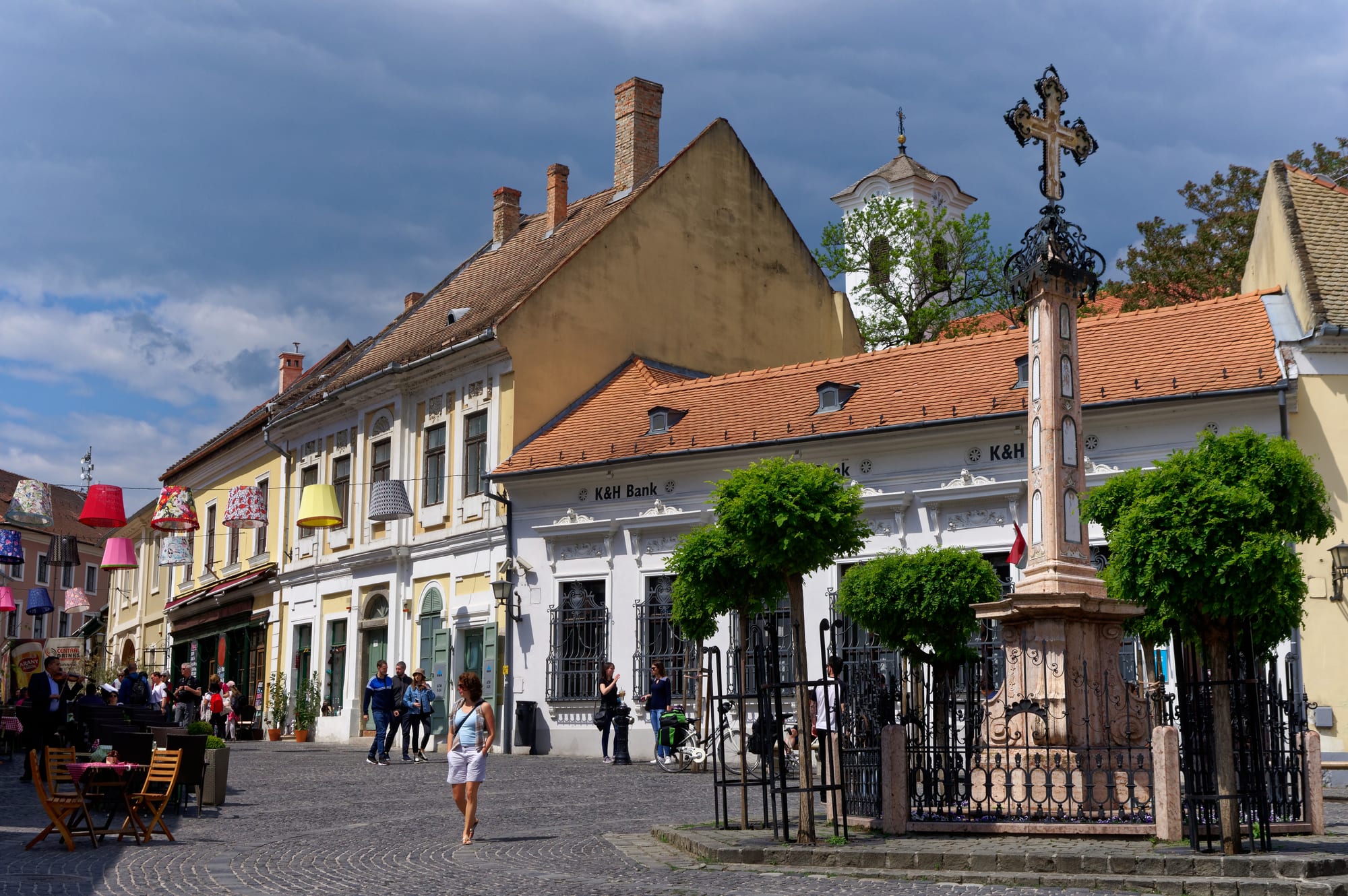
A cobbled square lined with pastel baroque houses with tiled roofs, a tall ornate stone cross in a railed enclosure and a church tower behind

Hungary

Budapest & Central Hungary

Fő tér, the main square of the Danube town of Szentendre in Pest County. (Jakub Hałun / Wikimedia Commons · CC BY-SA 4.0)

The heart of Hungary around the capital, taking in Budapest, the counties of Pest, Fejér and Komárom-Esztergom, and the Danube as it swings south through the Visegrád Hills — the old royal centres of Esztergom and Székesfehérvár, the Serbian-founded town of Szentendre and the Habsburg palace at Gödöllő.

Explore Budapest & Central Hungary

History

The Romans made the Danube their frontier here, and Aquincum, in today's Óbuda, became the capital of the province of Pannonia Inferior, with an amphitheatre and baths whose ruins survive. After the Magyar conquest the kingdom's centre lay not in Budapest but in two towns to the west and north: Esztergom, where Stephen I was born and where Hungary's first archbishopric was founded, and Székesfehérvár, the coronation and burial city of the medieval kings. After the Mongol invasion of 1241–42 Béla IV built a castle on Buda hill, and in the 14th century the Angevin kings ruled from Visegrád, where the kings of Hungary, Poland and Bohemia met in 1335. Matthias Corvinus later made Buda a Renaissance court.

The Ottomans took Buda in 1541 and held it for almost a century and a half; Székesfehérvár's royal basilica was ruined in this period. After the Habsburg-led siege of 1686, Serbian refugees fleeing the Ottomans settled in Szentendre, and the Grassalkovich family built the baroque palace at Gödöllő, later the favourite retreat of Franz Joseph and Empress Elisabeth.

Buda, Pest and Óbuda were joined in 1873, and the new capital boomed into a great Central European city, celebrated at the millennium of 1896. It suffered the siege of 1944–45, the deportation and murder of much of its Jewish community, and the fighting of the 1956 uprising, which began in its streets. In 1991 the leaders of Hungary, Poland and Czechoslovakia met again at Visegrád, giving its name to the Visegrád Group.

Culture & Customs

Budapest has long set itself apart from the rest of the country: more liberal in its politics, more cosmopolitan, and dismissive of the provinces in a way the provinces return. Its identity was built in the coffee houses of the early 20th century, where the Nyugat literary journal was conceived, and in the thermal baths, which remain part of everyday life. The city is split in character as well as by the river: hilly, residential Buda and flat, busy Pest.

Jewish Budapest remains one of Central Europe's largest communities, centred on the old Seventh District around the Dohány Street Synagogue, where the courtyards now host the city's ruin bars. Outside the capital, older minority traditions survive. Szentendre's Serbian Orthodox churches recall the refugees of the 1690s; German-speaking Swabian villages lie in the hills west of Budapest; and Ráckeve on Csepel Island keeps a Serbian church too.

Szentendre has been an artists' town since the early 20th century, known for its galleries and the ceramics of Margit Kovács. The year is marked by the national holiday of 20 August, when fireworks are fired over the Danube in Budapest, the Sziget music festival on Óbuda Island in August, and the Budapest Spring Festival of classical music. Székesfehérvár stages royal-themed historical festivals, reflecting its pride as the "city of kings".

Daily Life

Budapest has about 1.7 million people, and Pest county, which surrounds it, more than a million more, many of them commuters in a ring of fast-growing suburbs such as Budaörs, Érd and Gödöllő. Székesfehérvár is the main city of Fejér; Tatabánya, a former coal-mining town, is the seat of Komárom-Esztergom; smaller centres include Dunaújváros, a steel town built in the 1950s, and the historic towns of Esztergom, Szentendre and Tata.

The capital dominates the national economy: government, finance, universities, media, pharmaceuticals and tourism are concentrated here. The towns to the west along the M1 motorway and around Székesfehérvár host electronics and car-component factories, and Esztergom has a large Suzuki car plant. Housing costs in Budapest have risen sharply, and short-term lets in the centre are a live political issue.

The working day begins early, lunch is often a set menu in a canteen or restaurant, and evenings in the capital run late in the Seventh District's bars. At weekends Budapest families head for the Buda hills, the Danube Bend villages or a spa, and in summer many leave for Lake Balaton.

Food

Budapest's food culture grew from its cafés and pastry shops. The Dobos torta, sponge layered with chocolate buttercream under a hard caramel top, was created here by the confectioner József C. Dobos in the 1880s, and the Esterházy torta, walnut meringue layers with cream, is a café staple. Gundel palacsinta, a pancake filled with walnuts and rum and covered in chocolate sauce, is named after the city's famous restaurateur Károly Gundel. Jewish baking survives in flódni, a layered cake of apple, walnut, poppy seed and plum jam.

Everyday eating means lángos, deep-fried dough with sour cream and cheese, from market stalls; pogácsa, small savoury scones; and főzelék, a thick vegetable stew served in cheap canteens with a fried egg or meatballs. The Great Market Hall and the local market halls sell paprika, salami, goose liver and pickles, and the chilled curd bar Túró Rudi is sold in every shop.

The region's drinks are Unicum, the bitter herbal liqueur made by the Zwack family in Budapest; sparkling wine from the cellars of Budafok in the city's south; and whites from the Etyek-Buda wine region west of the capital. Wines from the small Neszmély district near the Danube in Komárom-Esztergom and from the Mór area in Fejér, known for its Ezerjó white grape, appear on local lists. Szentendre has a marzipan museum.

Attractions & Natural Wonders

Budapest's riverfront is the region's great sight. On the Buda side are Buda Castle and the Hungarian National Gallery, the Matthias Church and the Fishermen's Bastion, and Gellért Hill with its Citadel and Liberty Statue; on the Pest side are the Parliament, the Chain Bridge, St Stephen's Basilica, the State Opera on Andrássy Avenue, Heroes' Square and City Park. The Dohány Street Synagogue, the Great Market Hall, Margaret Island, the Roman ruins of Aquincum, the House of Terror and the thermal baths of Széchenyi, Gellért and Rudas round out the city.

North of Budapest the river enters the Danube Bend. Szentendre has cobbled lanes, Orthodox churches and the Hungarian Open Air Museum, a large village museum of rebuilt rural buildings. At Visegrád the river turns sharply below the hilltop citadel and the excavated royal palace of the Angevin and Corvinus kings. Esztergom's neoclassical basilica, Hungary's largest church, stands on Castle Hill above the Mária Valéria Bridge to Štúrovo in Slovakia. The wooded Pilis and Visegrád hills behind offer walking trails.

East of the capital, Gödöllő's royal palace keeps rooms devoted to Empress Elisabeth. To the south-west, Székesfehérvár has the ruins of its medieval royal basilica in the Garden of Ruins and a baroque old town, with Lake Velence nearby for birdwatching and swimming, and the Brunszvik mansion at Martonvásár, linked to Beethoven. In Komárom-Esztergom the lakeside town of Tata and the 19th-century fortresses of Komárom are worth a detour.

Cities in Budapest & Central Hungary

Planning basics

Budget

Budapest is the most expensive place in Hungary, especially for hotels in the inner districts and restaurants around Váci utca and the Castle District, yet it remains cheaper than Vienna or Prague. The towns of the Danube Bend, Székesfehérvár and Gödöllő are noticeably cheaper and are easy day trips, so many travellers base themselves in the capital and spend less on day outings than on the city itself.

Daily Budget Midrange
USD 110–220 (central hotel, restaurant meals, a bath visit, a Danube Bend day trip)
Daily Budget Shoestring
USD 50–85 (hostel dorm, market-hall and bakery food, a public-transport pass)

A multi-day public-transport pass covers Budapest's metro, trams, buses and the suburban HÉV within the city; eat the main meal at lunch, when many restaurants offer a set menu.

Safety

The region is safe. Risks are concentrated in Budapest: pickpockets on busy trams and around the main sights, inflated bills in some bars and restaurants aimed at tourists, and unlicensed taxis. The hill country of the Danube Bend is walking terrain with steep paths and ticks in summer.

Use licensed taxis or an app, check prices before ordering in bars, and keep bags closed on public transport. Check current official travel advice before travelling.

Climate

Continental like the rest of the country, but Budapest's built-up centre holds heat in summer and is often a few degrees warmer than the surrounding countryside. The wooded Visegrád and Pilis hills north of the city are cooler and catch more rain and snow, while the plain around Székesfehérvár is dry and open.

Summer
warm to hot, typically 25–32°C in Budapest, with heat waves above 35°C and thunderstorms
Winter
cold and often grey, around -3 to 4°C, with fog along the Danube and occasional snow

Transportation

Budapest has a dense network of metro lines, trams, buses and the HÉV suburban railway, which runs to Szentendre and Gödöllő in well under an hour. Trains reach Esztergom in roughly one to one and a half hours and Székesfehérvár in about an hour, and buses and seasonal Danube boats link Visegrád and the Bend villages. The airport is about 30–45 minutes from the centre by bus or taxi.

Visit the Danube Bend by train or bus one way and river boat the other when the boats are running in the warmer months.

Best Time to Visit

April to June and September to October suit both the city and the Danube Bend, with mild weather and the river boats running. July and August are hot and busy, and the Sziget festival fills the city in August. Winter has short days but is the best season for the outdoor thermal pools and Budapest's Christmas markets.