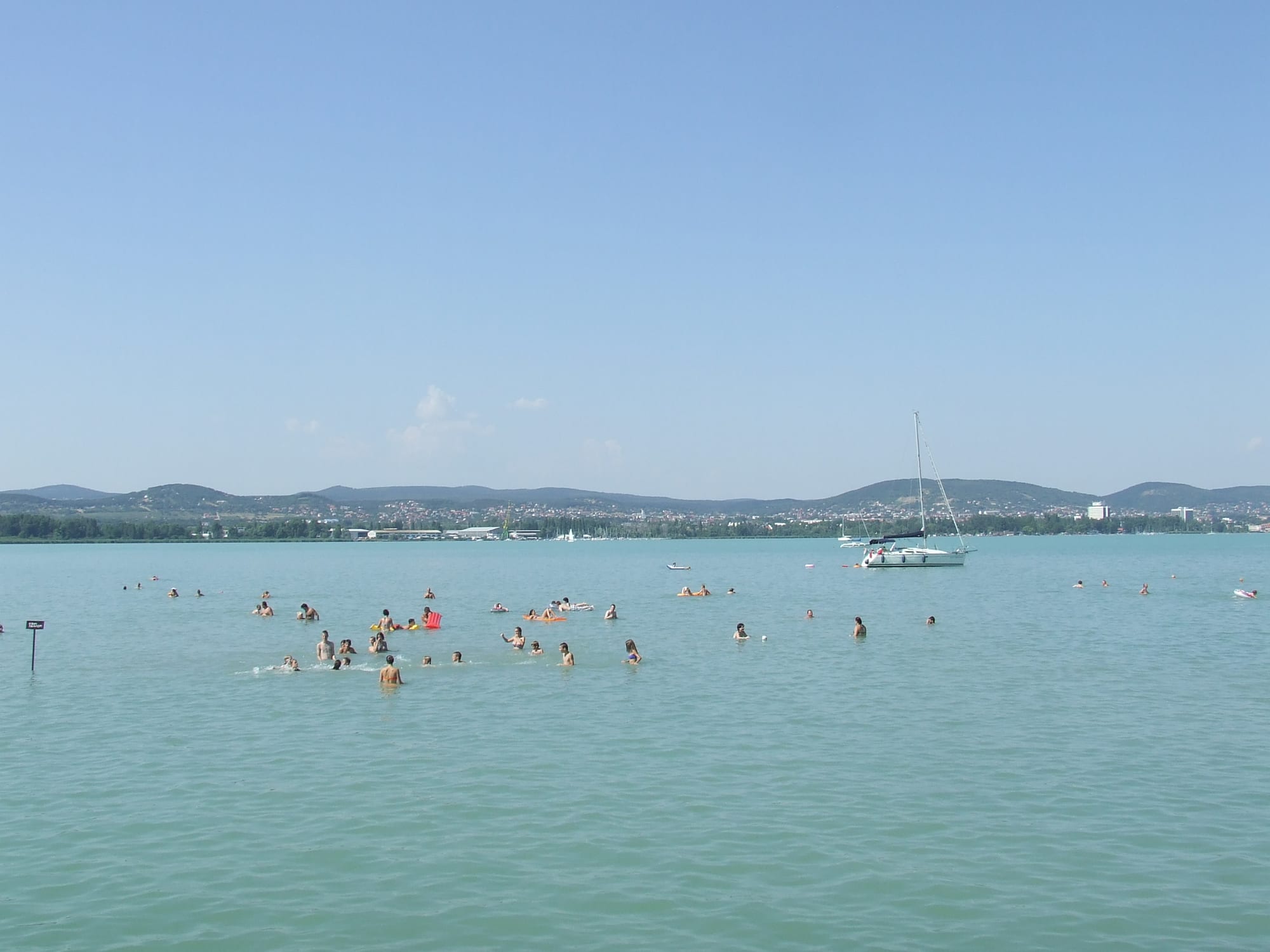
Swimmers and a moored sailing boat in pale green lake water, with low wooded hills and a town on the far shore

Hungary

Lake Balaton & Transdanubia

Summer bathers in the shallow water of Lake Balaton off the Tihany peninsula. (Christo / Wikimedia Commons · CC BY-SA 4.0)

Western Hungary between the Danube and the Austrian, Slovenian and Croatian borders — seven counties of rolling hills, vineyards and old towns centred on Lake Balaton, from Győr and Sopron in the north-west to Pécs and the Villány wine country in the south. Roman, Ottoman and Habsburg history overlap here more closely than anywhere else in the country.

Explore Lake Balaton & Transdanubia

History

Transdanubia was the core of Roman Pannonia, and its towns sit on Roman foundations: Savaria, today's Szombathely, Scarbantia at Sopron, Arrabona at Győr and Sopianae at Pécs, whose early Christian burial chambers are a UNESCO World Heritage Site. Charlemagne's Franks and then the Magyars followed, and the new kingdom's Christian institutions took root here early: the Benedictine archabbey of Pannonhalma was founded in 996, Veszprém became the seat of the queens' bishopric, and Andrew I founded the abbey at Tihany in 1055. In 1367 a university was founded at Pécs, the first in Hungary.

The Ottoman wars shaped the south. The Hungarian army was destroyed at Mohács in 1526, Szigetvár fell after Miklós Zrínyi's last stand in 1566, and Pécs spent about 140 years as an Ottoman town. The north-west stayed largely in Habsburg hands, and aristocratic families such as the Esterházy at Fertőd and the Festetics at Keszthely built great estates. German settlers repopulated villages in Baranya and Tolna in the 18th century.

After 1918 the western border was redrawn, and a plebiscite in 1921 kept Sopron in Hungary, earning it the title "the most loyal town". Under communism Balaton became the country's holiday coast, and in the 1980s a meeting place for families from East and West Germany. Since 1990 the proximity of Austria has pulled the north-west into the car industry.

Culture & Customs

Transdanubia's identity is layered. Pécs, close to the Croatian border, has Croat, German and Roma minorities, and the villages of Baranya and Tolna still have Swabian German communities, their churches and wine cellars marked by the settlers of the 1700s. Sopron and the western border towns have long been bilingual in character, oriented towards Vienna. The Őrség in the far south-west keeps scattered wooden farmsteads and a strong pottery tradition.

The best-known festival is the Busójárás at Mohács, a late-winter carnival in which men in horned wooden masks and sheepskins drive out winter; it is listed as UNESCO intangible heritage and is linked to the town's Šokac Croat community. Pécs's Zsolnay factory made the glazed ceramic tiles that roof many Hungarian buildings, and Herend, near Veszprém, has made hand-painted porcelain since the 1820s. Veszprém calls itself the "city of queens", and was European Capital of Culture in 2023, following Pécs in 2010.

Balaton has its own summer culture of wine terraces, music festivals and holiday homes, with a lasting sense of difference between the livelier southern shore around Siófok and the quieter, hillier and more expensive northern shore. Wine-harvest festivals fill the autumn in Badacsony, Villány and Szekszárd.

Daily Life

Pécs and Győr are the largest cities. Szombathely, Sopron, Kaposvár, Veszprém and Zalaegerszeg are smaller county towns, and Keszthely, Balatonfüred and Siófok are the main lake towns. Much of the south is a landscape of small villages, several of them shrinking as younger people move away.

The north-west is one of Hungary's most prosperous areas: Audi's large engine and car plant at Győr, factories around Szombathely and Zalaegerszeg, and thousands of commuters who cross daily to work in Austria. Paks in Tolna runs Hungary's only nuclear power station. The south lives more on farming, wine, universities and public services, and wages there are lower.

Around Balaton life follows the season. The resorts fill from June to August with Hungarian families, students and German visitors, and many of the buffets and beaches then shut down; in winter the lake towns are quiet, and the population of holiday homes is far greater than that of year-round residents.

Food

Lake Balaton's signature fish is the fogas, a large pikeperch, served grilled or fried, and bream (keszeg) are among the lake's common fish. Dödölle, potato and flour dumplings fried in fat and served with onion and sour cream, is a country staple, known in Baranya and Somogy as gánica, and the Őrség and Vas produce pumpkin-seed oil, dark green and nutty, poured over salads and potatoes.

The south shares Balkan influences, with grilled meats and the paprika-rich cooking of the Danube towns, and the Swabian villages of Baranya keep German sausages and pastries. The region's wines are its pride. The volcanic hills of the northern shore, Badacsony and nearby Somló, give mineral whites from grapes such as Olaszrizling and Kéknyelű. Villány makes Hungary's best-known reds, notably Cabernet Franc and blends, and Szekszárd is known for Kadarka and its own Bikavér red blend. Sopron is a Kékfrankos town, and Pannonhalma's monks still make wine as well.

Attractions & Natural Wonders

Lake Balaton is the centre. On its northern shore the Tihany peninsula has its Benedictine abbey church and lavender fields, with the inner lakes and the volcanic cones of the Balaton Uplands National Park behind. Balatonfüred is a 19th-century spa town; Badacsony and the castle hill of Szigliget rise from vineyards; and Keszthely, at the western end, has the Festetics Palace. Just beyond, the thermal lake at Hévíz can be swum in all year, and the Kis-Balaton wetlands shelter birdlife. The southern shore, with Siófok, is flat, shallow and made for beach holidays.

North of the lake, Veszprém has a castle hill of baroque buildings above a gorge, with Herend's porcelain workshops and the Bakony hills nearby. Győr is a baroque river town at the meeting of three rivers, and Pannonhalma's abbey stands on a hill to the south. Sopron's walled old town and Firewatch Tower sit close to Lake Fertő, shared with Austria, and the Esterházy Palace at Fertőd. Kőszeg's small old town and the Őrség National Park lie further south along the border.

In the south, Pécs has its early Christian burial chambers, the cathedral, the former Mosque of Pasha Qasim on Széchenyi Square and the Zsolnay Cultural Quarter, with the Mecsek hills above. Villány's cellars, the castle at Siklós, Mohács's battlefield memorial and the fortress at Szigetvár complete the region.

Cities in Lake Balaton & Transdanubia

Planning basics

Budget

Prices are close to the national average except at Lake Balaton in July and August, when rooms and restaurants on the northern shore, in Tihany and in Hévíz cost noticeably more and fill up early. Out of season the lake is cheap. Pécs, Győr, Sopron and the smaller county towns are good-value bases, and wine tasting in Villány or Badacsony is inexpensive compared with Western Europe.

Daily Budget Midrange
USD 100–200 (hotel or spa hotel, restaurant meals, wine tastings, a hire car or bike)
Daily Budget Shoestring
USD 45–75 (guesthouse or campsite, lake-side buffets, trains and buses)

Visit Balaton in June or September for lower prices; many lake-side restaurants and beaches close from October to April.

Safety

The region is very safe. The main hazards are natural: fast-moving summer storms on Lake Balaton that can capsize small boats, heat and sunburn, and busy roads along the lake in peak season. Petty theft from cars and beaches occurs in the resorts.

Respect the storm-warning lights, leave nothing on show in parked cars, and swim at supervised beaches. Check current official travel advice before travelling.

Climate

Transdanubia is milder and wetter than the Great Plain. The far west around Szombathely and the Őrség is the wettest and coolest part of Hungary, with an Alpine influence, while the south around Pécs and Villány, sheltered by the Mecsek hills, is the sunniest and warmest, with a slight Mediterranean touch. Lake Balaton moderates the air near its shores and its shallow water warms quickly in summer.

Summer
warm to hot, 25–31°C, with lake water often above 22°C in July and August and occasional sudden storms on Balaton
Winter
cold and damp, around -2 to 5°C; the lake sometimes freezes over, and Hévíz stays warm enough for bathing

Transportation

Trains run from Budapest along both shores of Balaton, reaching Siófok in about one and a half hours, Győr in about the same time, and Pécs and Sopron in roughly three hours. Car ferries cross the narrow strait between Tihany and Szántód in the warmer months, and passenger boats link the lake's main resorts in summer. A cycle route circles the whole lake. For Győr and Sopron, Vienna's airport is often closer than Budapest's; a car helps in the wine hills and the Őrség.

Signal lights around Balaton's shore warn of approaching storms; boats and swimmers should head for shore when they flash rapidly.

Best Time to Visit

June to early September for swimming and the Balaton resort season, with July and August the busiest and liveliest. May and September to October suit Pécs, Sopron, the wine regions and cycling around the lake, and the grape harvest runs from September. Mohács's Busó carnival falls in late winter, and Hévíz is worth visiting in any season.