💰 Budget
Győr is a good-value city by Western European standards and cheaper than Budapest or Vienna. The old town is compact, so a central base saves on transport, and many sights, from the cathedral to the riverside, cost nothing to visit.
- Daily Budget Midrange
- USD 100–200 (city hotel, restaurant meals, museum and bath tickets, a trip to Pannonhalma)
- Daily Budget Shoestring
- USD 45–75 (guesthouse or hostel, market buffets and bakeries, local buses)
A free city bus serves the downtown area, and walking the old town, the riverbanks and the cathedral costs nothing.
📅 Best Time to Visit
May to September for café terraces, the riverside and the thermal pools outdoors, with July the warmest and wettest month. Spring and autumn are mild and good for walking the old town and visiting Pannonhalma. Winter is cold and grey, brightened by the Christmas markets and the handball season.
⏳ Suggested Number of Days
Most visitors need one or two days for the city itself. Allow about three to take in the surrounding countryside as well; the number grows for anyone combining Győr with Vienna, Bratislava or Sopron.
- First Visit
- 1–2 days
- With Surroundings
- 3 days
🚆 Transportation
The old town is small and mostly pedestrianised, and a free city bus runs around the downtown area. Local buses cover the outer districts, the zoo and the arenas. Bridges link the centre with Révfalu, Sziget and Újváros, and the flat city suits cycling. Several motorways and main roads meet here, and the M1 motorway can be reached from several parts of the city.
Parking garages around the old town take the pressure off the centre's narrow, partly car-free streets.
🛬 Airport & Station Connections
Győr is a national rail hub on the Vienna–Budapest main line, served by Railjet trains in both directions; trains from Budapest take about one and a half hours, and other lines run to Sopron, Veszprém and Celldömölk. The nearest passenger airports are Bratislava, about 90 km away, Vienna, about 117 km, and Budapest, about 159 km; the local Győr-Pér airport has no passenger flights.
🚶 Walkability
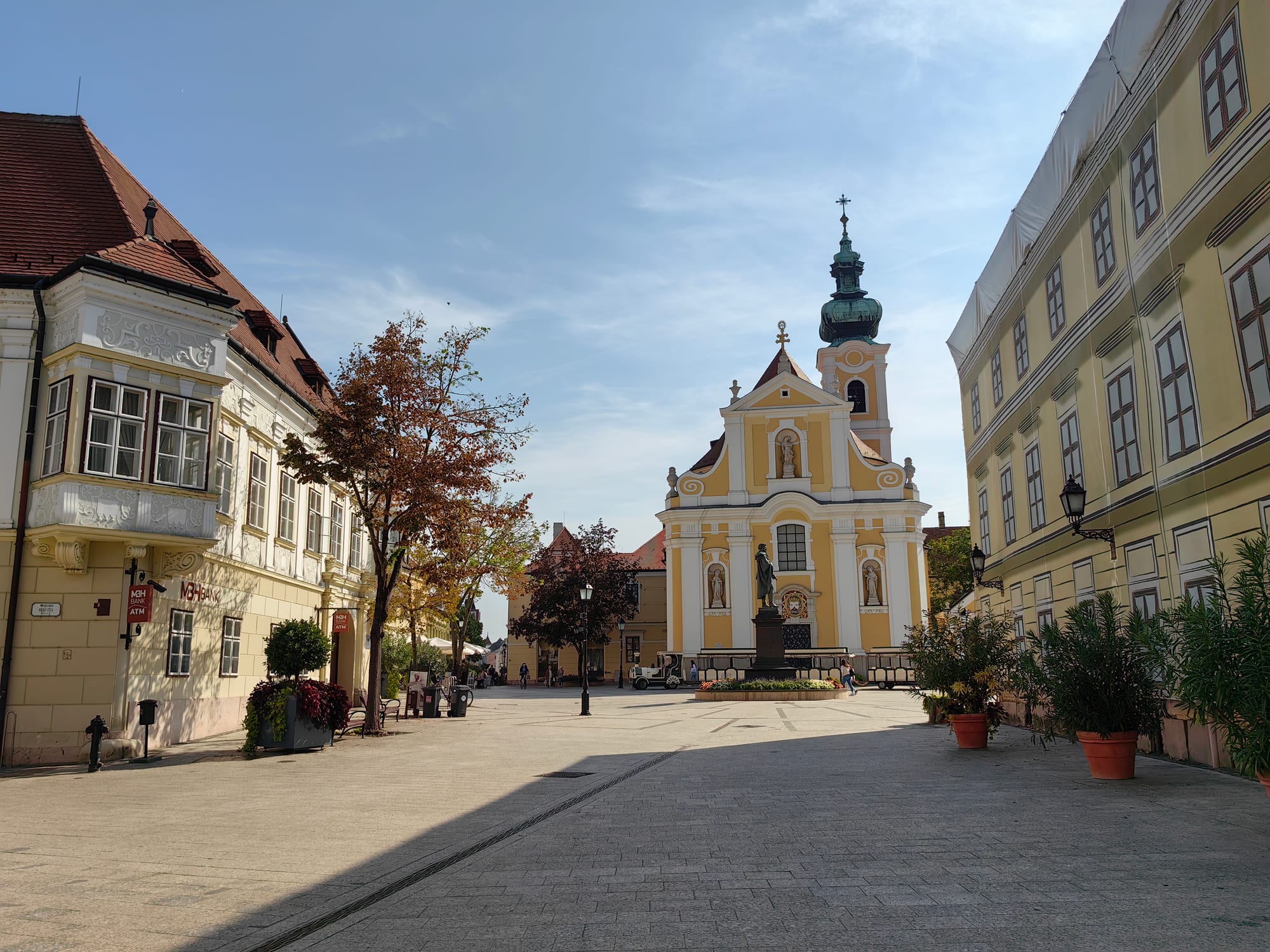
Very walkable. The old town is a roughly rectangular area of less than half a square kilometre, mostly pedestrian streets, with the cathedral, squares and riverbanks a few minutes apart. Bridges lead on foot to Révfalu and Sziget; the station is at the southern edge of the centre.
🛡️ Safety
Hungary is a safe country with low levels of violent crime. Győr is a calm and prosperous city; visitors mainly need to watch bags in crowds and avoid leaving valuables in cars.
Keep belongings close at markets and big matches, and stay off flooded riverbanks when the Danube and its arms run high. Check current official travel advice before travelling.
🌦️ Climate
An oceanic climate bordering on humid subtropical, with an annual average of 11.1°C and modest rainfall, July being the wettest month and February the driest.
- Summer
- warm — July averages 21.6°C, and the record high is 40.6°C
- Winter
- cold — January averages 0.3°C, and the record low is −22.1°C
🤝 Local Customs
Győr is proud of its baroque heritage — it is known as the baroque city and the city of rivers — and of its sport: handball is the most popular game in town, and the women's team draws passionate crowds. German is widely understood alongside Hungarian.
Churches are working places of worship; dress modestly, keep quiet during services and ask before photographing inside.
💳 Common Payment Methods
The currency is the Hungarian forint (HUF). Cards are widely accepted in shops, restaurants and hotels; cash is useful at the market hall and small buffets. ATMs are easy to find in the centre and at the station.