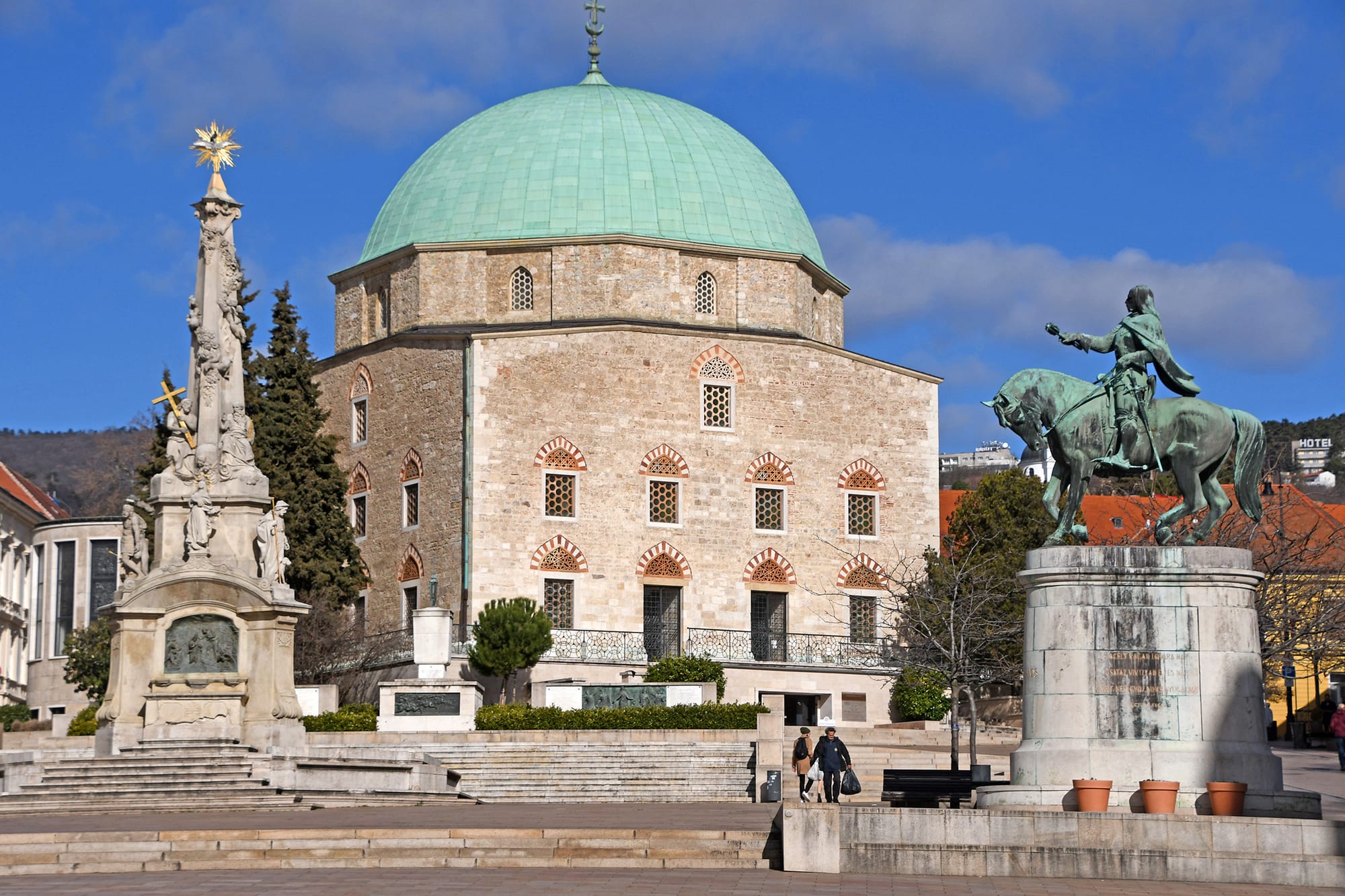
A square stone former mosque with a green copper dome, beside a baroque plague column and an equestrian statue

Lake Balaton & Transdanubia, Hungary

Pécs

The former Mosque of Pasha Qasim on Széchenyi tér, the main square of Pécs. (Pasztilla aka Attila Terbócs / Wikimedia Commons · CC BY-SA 4.0)

Hungary's fifth-largest city, on the southern slopes of the Mecsek hills near the Croatian border — Roman Sopianae, seat of a bishop since 1009, home of the country's first university and for 150 years an Ottoman town. Today it is a university city known for its early Christian tombs, a former mosque on the main square, Zsolnay ceramics and a busy gallery scene.

Neighbourhoods

  • Belváros (Old Town)
    • First-time visitors
    • Historic district
    • Museums

    The old walled centre around Széchenyi tér, with the former mosque of Pasha Qasim, the cathedral and the early Christian tombs on Szent István tér, and Káptalan utca's row of museums. Pedestrian streets run west from the main square towards the Yakovalı Hasan mosque.

    Open in Maps
  • Zsolnay Quarter
    • Arts and culture
    • Families
    • Concerts

    East of the centre, the former Zsolnay ceramics factory was turned into a cultural quarter for 2010, with exhibitions of Zsolnay ceramics, the family mausoleum, a planetarium, a puppet theatre, concert spaces and a university theatre.

    Open in Maps
  • Mecsek slopes
    • Viewpoints
    • Nature
    • Quiet and residential

    The northern parts of the city climb the slopes of the Mecsek hills, with residential streets and woods above. Buses run up to Misina, where the TV tower looks out over the city and the plain to the south.

    Open in Maps
  • Around the railway station
    • Close to public transport
    • Budget

    The southern, flatter side of the centre around the railway station, with the long-distance bus station nearby to the north-east — a short walk or bus ride from the old town and a practical base for arrivals.

    Open in Maps

Things to do

Landmarks of many faiths

  • Mosque of Pasha Qasimlandmark

    The domed mosque built on the main square in 1543–46 and consecrated as a Catholic church after the Ottomans left, with the crescent still visible beneath the cross on its cupola.

    Open in Maps
  • Pécs Cathedrallandmark

    The four-towered cathedral of Saints Peter and Paul, built on Roman-era foundations, dating from the 11th century and renovated in the 19th; it was made a minor basilica during the papal visit of 1990.

    Open in Maps
  • Yakovalı Hasan Pasha Mosquelandmark

    A mosque of the 17th century with its minaret, at the western end of the main pedestrian street, still used for worship by the city's Muslim community.

    Open in Maps
  • Pécs Synagoguelandmark

    The synagogue of 1869, one of the main sights of the old town.

    Open in Maps
  • Barbakánlandmark

    The single surviving bastion of the medieval wall that encircled the old town.

    Open in Maps

Roman and early Christian Pécs

  • Early Christian Necropolismuseum

    Decorated tombs, mausoleums and burial chapels of the 4th century, with burial chambers below and memorial chapels above, a UNESCO World Heritage Site since 2000.

    Open in Maps

Museums and the Zsolnay legacy

  • Csontváry Museummuseum

    The largest collection of the visionary painter Tivadar Kosztka Csontváry, a pharmacist who became a self-taught painter.

    Open in Maps
  • Vasarely Museummuseum

    A museum on Káptalan utca devoted to Victor Vasarely, founder of the op-art movement, one of three collections of his work.

    Open in Maps
  • Zsolnay Museummuseum

    The life and work of Vilmos Zsolnay and his ceramics factory, with the lustrous Zsolnay pieces shown in chronological order.

    Open in Maps
  • Mining Museummuseum

    Relics of the region's coal and uranium mining, shown in a former wine-cellar system beneath Káptalan utca.

    Open in Maps
  • Zsolnay Cultural Quarterattraction

    The former ceramics factory turned cultural centre, with exhibitions, the Zsolnay Mausoleum, a planetarium, a puppet theatre and concert halls.

    Open in Maps

Hills and viewpoints

  • Pécs TV Towerviewpoint

    A 197-metre television tower on Misina peak, the tallest building in Hungary, with a public observation deck looking over the city, the Mecsek and the hills to the south.

    Open in Maps
  • University of Pécslandmark

    Heir to the first Hungarian university, founded here in 1367, and today among the most international universities in the country.

    Open in Maps

Short trips from the city

  • Villányattraction

    The small wine town south of Pécs at the foot of the Villány hills, known for full-bodied reds and rows of cellars.

    Open in Maps
  • Siklós Castlelandmark

    A medieval castle in the small town of Siklós, south of Pécs.

    Open in Maps

Seasonal events

  • University DaysApril

    A week of events for the students of the University of Pécs and the city, including a music festival.

  • Fishing on OrfűJune

    A three-day festival of Hungarian bands at a campsite in Orfű, a village in the Mecsek hills.

  • Sétatér festivalSeptember

    An almost month-long festival in the city centre with music, wine-cellar stands and artisans' stalls along the streets.

  • Busójáráslate winter, before Lent

    The carnival in nearby Mohács at the end of the carnival season, with parades of masked busós who, in one old story, scare away winter.

Eat and drink

Long-standing places and food districts in Pécs. Hours, ratings and directions come from your maps app, always current.

Pécs classics

  • Restaurants of the old townneighborhood

    The pedestrian streets around Széchenyi tér and between the main square and the cathedral hold most of the city's restaurants, cafés and wine bars.

    Open in Maps
  • Pécsi Sörfőzderestaurant

    The city's brewery, founded in 1848 as the Pannónia brewery and one of the four best-known Hungarian breweries, which also brews an unfiltered beer.

    Open in Maps

Wine

  • Villány wine cellarsneighborhood

    Rows of cellars at the foot of the Villány hills south of the city, known for full-bodied red wines.

    Open in Maps

Experience Pécs

History

The Romans founded Sopianae at the beginning of the 2nd century in a land of Celtic and Pannonian tribes, a group of wine-producing colonies whose centre lay where the Bishop's Palace now stands. By the 4th century it was the capital of the province of Valeria and a significant early Christian centre, and its decorated burial chambers, with chapels above and tombs below, are now a UNESCO World Heritage Site. The medieval town appears in 871 as Quinque Basilicae, later Quinque Ecclesiae — five churches — the meaning behind its German name, Fünfkirchen.

Stephen I founded the diocese of Pécs in 1009, and Peter Orseolo, the second king of Hungary, was buried in the cathedral in 1046. In 1367 Louis I founded a university here, the first in Hungary, on the advice of the bishop William of Koppenbach. After the defeat at Mohács in 1526 Suleiman's armies plundered the town, and in June 1543 the bishop handed its keys to the Ottomans. For almost 150 years Pécs was an Ottoman town: churches became mosques, baths and Qur'an schools were built, and a bazaar replaced the market. The mosque of Pasha Qasim on the main square and the Yakovalı Hasan Pasha Mosque survive from this time.

The Austrian army retook the city in the siege of 1686. German settlers arrived from 1688, and for a long time only about a quarter of the population was Hungarian. Coal mining, the Zsolnay ceramics works, Angster organs and Littke sparkling wine drove 19th-century growth, and the railway reached Budapest in 1882. After 1920 the university of Pressburg moved here. Part of the German community was expelled in 1945–48; coal and uranium mining continued until the mines eventually closed. In 2010 Pécs was a European Capital of Culture.

Culture & Customs

Pécs has been a meeting place of cultures for two thousand years, and it shows it openly. Christian churches stand beside Ottoman mosques, minarets and baths, and the city has the largest number of Ottoman buildings in Central Europe. The Croat, German and Roma minorities keep their own institutions, among them a Croatian theatre, and the Yakovalı Hasan Pasha Mosque is still used by local Muslims.

Art is the other strand. The Zsolnay factory's glazed ceramics, known for their lustrous eosin glaze, were used to decorate numerous buildings, and a Zsolnay fountain stands in the city. Káptalan utca is lined with museums, including those devoted to the visionary painter Csontváry and to Victor Vasarely, the founder of op art. The European Capital of Culture year of 2010 brought the Kodály Centre concert hall, a regional library and knowledge centre, the Museum Street and the Zsolnay Cultural Quarter in the old factory grounds.

The university gives the city a young population and a busy calendar. University Days in April bring a student rector election and a music festival, the Sétatér festival fills the centre with music and wine stalls in September, and the city's theatres include the National Theatre, a puppet theatre and a summer theatre. Padlocks are fastened to the fences on the street from the main square to the cathedral.

Daily Life

Pécs had about 156,000 inhabitants at the 2011 census, about two-fifths of the population of Baranya County, down from some 180,000 in the 1980s. It is the largest city in Transdanubia and the fifth-largest in Hungary, the administrative and economic centre of Baranya County and the seat of a Catholic diocese.

The University of Pécs is the city's defining institution, with around 20,000 students, about a quarter of them from abroad; its medical school has a large programme in English and a newer one in German. The coal and uranium mines have closed, leaving only a sand mine, and the university, county institutions, the Pécsi Sörfőzde brewery and tourism are prominent in the city's economy today. Attila Péterffy has been mayor since 2019 and was re-elected in 2024.

Life is lived on two levels. The flat south of the city holds the railway station and the plain beyond, while the north climbs the Mecsek slopes, with woods above. In summer cool air flows down from the hills at night. International students add many languages to the streets of the centre, and the Mecsek woods are close at hand above the city.

Food

Pécs eats in the style of southern Hungary. Halászlé, the hot paprika fish soup of carp or mixed river fish, is native to the Danube and Tisza regions and is also cooked across the border in Croatian Baranya, where it is called fiš paprikaš. It is among the spiciest dishes native to Europe.

Wine has been made here since the Romans founded Sopianae as a group of wine-producing colonies. The Villány hills to the south make full-bodied reds, and the Sétatér festival each September brings wine-cellar stands into the streets of the old town. In the 19th century Littke sparkling wine, made in the city, became known well beyond Hungary.

Beer has its place too. The Pécsi Sörfőzde, founded in 1848 as the Pannónia brewery, is one of the four best-known Hungarian breweries, and it also brews an unfiltered beer. The Mecsek's dolomitic spring water is prized for its high, steady mineral content. Restaurants, cafés and wine bars line the pedestrian streets around Széchenyi tér.

Planning tools

Budget

Pécs is a good-value base, well below Budapest prices for rooms and meals. Most museums cost little, and the old town's sights are close together, so transport costs stay low. Wine tasting in nearby Villány is inexpensive by Western European standards.

Daily Budget Midrange
USD 100–180 (central hotel, restaurant meals, museum entries, a wine-tasting trip)
Daily Budget Shoestring
USD 45–75 (hostel or guesthouse, bakery and canteen food, city buses)

The old town's museums are close together, so a day of sightseeing needs no transport; a wine-tasting trip to Villány is the main extra cost.

Best Time to Visit

May and September to October are the most pleasant, with mild weather for the hills and the grape harvest in the surrounding wine country from September. Summer is warm and sunny, with festivals; winter is quieter, and the Busójárás carnival in nearby Mohács falls in late winter.

Suggested Number of Days

Two days are enough for the old town, its museums and the Zsolnay Quarter. Three or four allow time for the Mecsek hills and the wine country and castles to the south.

First Visit
2 days
With Surroundings
3–4 days

Transportation

Buses are the main public transport; the city's tram line closed in 1960. The long-distance bus station lies a short walk north-east of the railway station, and buses climb to Misina for the TV tower and to the Zsolnay Quarter. The old town itself is best covered on foot.

Taxis can be ordered by phone or through the Bolt app.

Airport & Station Connections

The M6/M60 motorway links Pécs with Budapest in about two hours by car. Trains from Budapest run via Pusztaszabolcs and take roughly three hours, and there are direct trains to Mohács and Nagykanizsa. Pécs-Pogány International Airport opened in 2006, but most international travellers fly into Budapest.

Walkability

The old town is compact and largely pedestrianised, and the main sights are a few minutes apart. The city rises northwards up the Mecsek slopes, so streets above the cathedral are steep; the Zsolnay Quarter is a longer walk or short bus ride east of the centre.

Safety

Hungary is a safe country with low levels of violent crime. Pécs is a relaxed university city; the usual care with bags in busy places and with belongings left in cars is enough.

Use licensed taxis, keep bags closed in crowds and take care on steep paths in the Mecsek hills. Check current official travel advice before travelling.

Climate

Pécs lies where continental, Mediterranean and oceanic influences meet, and has around 2,080 hours of sunshine a year. On hot summer nights cool air flows down from the hills into the city.

Summer
warm to hot — July and August are the hottest months, reaching about 30°C, with cool air flowing down from the hills on sultry evenings
Winter
cold — January is the coldest month, at about 0.4°C

Local Customs

Tips (borravaló) are customary in restaurants, bars and taxis. Pécs is proud of its mixed heritage — Croat, German and Roma minorities, a small Muslim community and a Catholic diocese — and its places of worship are active: modest dress and quiet behaviour are expected in the cathedral, the mosques and the synagogue.

Check the bill for a service charge of about 10 per cent; if none is included, about 10 per cent is usual.

Common Payment Methods

The currency is the Hungarian forint (HUF). Cards are widely accepted in shops, restaurants and museums; small bakeries, market stalls and some wine cellars prefer cash, and ATMs are common in the centre.