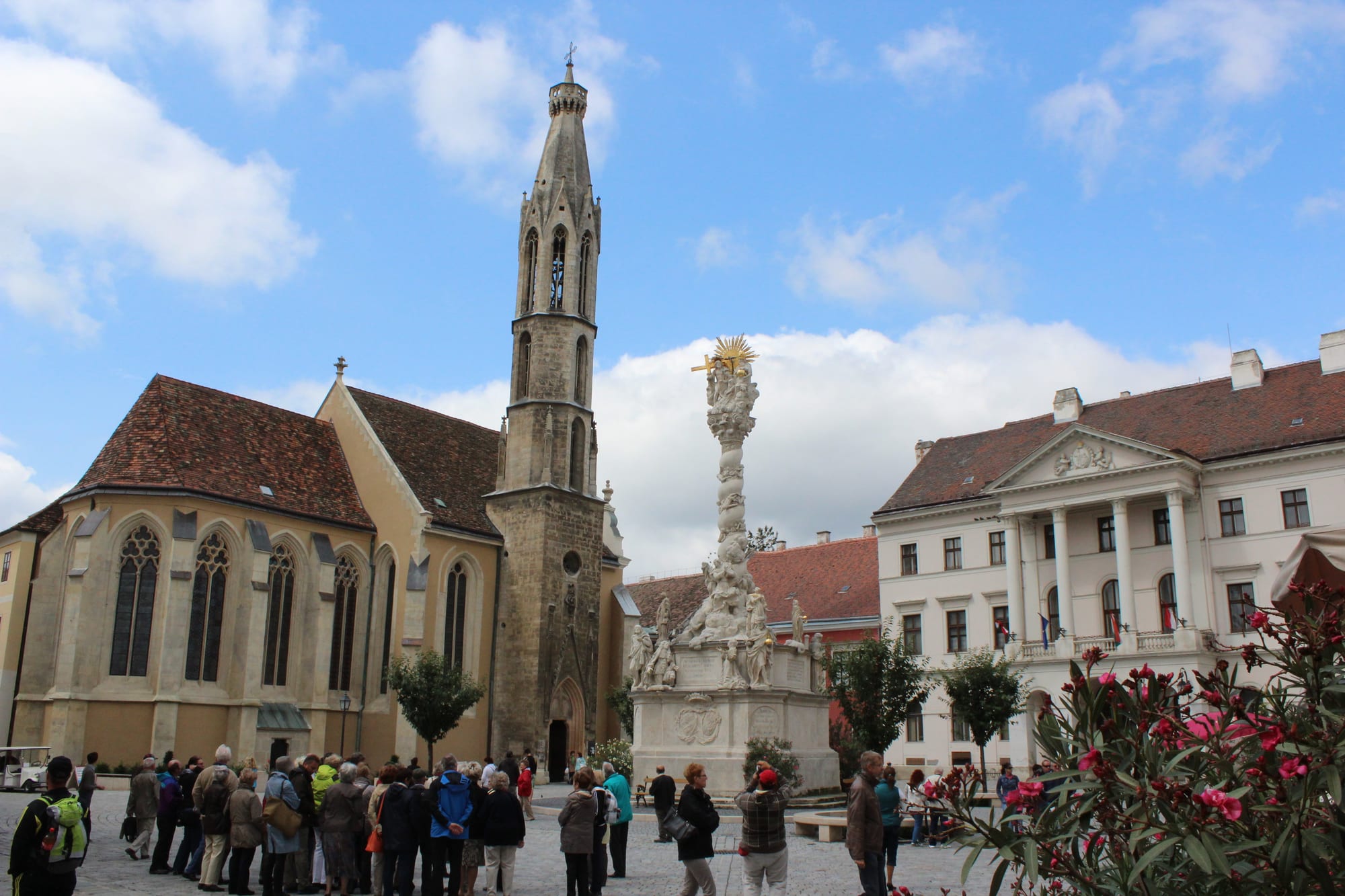
A cobbled square with a white baroque column, a Gothic church with a tall spire and a columned civic building under blue sky

Lake Balaton & Transdanubia, Hungary

Sopron

The Holy Trinity Column on Fő tér, Sopron's main square, with the Goat Church and the former County Hall behind. (Zátonyi Sándor (ifj.), Fizped / Wikimedia Commons · CC BY-SA 3.0)

A bilingual Hungarian city of about 60,000 people on the Austrian border near Lake Fertő, built over the Roman town of Scarbantia. Its old centre keeps a wealth of medieval, Renaissance and baroque houses; a 1921 plebiscite kept it in Hungary, and today it lives on wine, a university, cross-border trade and visitors from Vienna.

Neighbourhoods

  • The inner town (Belváros)
    • First-time visitors
    • Historic district
    • Museums

    The car-free medieval core inside the line of the old walls, laid out over the Roman town. Fő tér, the main square on the site of the Roman forum, is ringed by the Firewatch Tower, the Goat Church and old merchants' houses, and Új utca and Templom utca hold synagogues, churches and museums.

    Open in Maps
  • Várkerület and Széchenyi tér
    • Best for food
    • Shopping
    • Close to public transport

    The ring street that curves around the inner town, lined with shops, cafés and old houses, leading south to Széchenyi tér with its Art Nouveau post office, the Liszt cultural centre and the Széchenyi statue.

    Open in Maps
  • Lővérek
    • Quiet and residential
    • Walks and nature

    The leafy resort quarter on the wooded slopes south-west of the centre, about 2 km out, with 19th-century summer villas, a swimming pool, a sanatorium and marked paths leading up to lookout towers in the Sopron Hills.

    Open in Maps

Things to do

The old town

  • Firewatch Towerviewpoint

    The 61-metre symbol of the city, whose round lower part stands on the Roman town wall and served as the north gate tower from the 13th century; a museum of city history and a wide view from the top.

    Open in Maps
  • Gate of Loyaltylandmark

    The gateway at the foot of the Firewatch Tower made in memory of the 1921 referendum, in which Sopron and eight villages chose to stay in Hungary.

    Open in Maps
  • Holy Trinity Columnlandmark

    A baroque column of 1701 in the middle of Fő tér, one of the best-known sights of the square.

    Open in Maps
  • Goat Churchlandmark

    The Gothic Benedictine church on Fő tér, the city's main Catholic church, which has hosted coronations and sessions of parliament; known for its frescoes, lancet windows and Capistran pulpit.

    Open in Maps
  • Old Synagoguemuseum

    A Gothic synagogue on Új utca from around 1300, among the rarest survivals of medieval Jewish architecture in Eastern Europe, now a museum of Jewish religion and customs.

    Open in Maps

Museums

  • Fabricius Housemuseum

    A merchant's house on Fő tér with a Gothic hall and loggia, whose medieval cellars hold a Roman lapidary and an archaeological display on the Amber Road.

    Open in Maps
  • Pharmacy Museummuseum

    A 15th–16th-century house on the main square, once the Angel Pharmacy, which King Louis II declared Hungary's first national monument in 1525.

    Open in Maps
  • Central Mining Museummuseum

    The largest and most comprehensive mining collection in Hungary, housed in the baroque Esterházy Palace on Templom utca.

    Open in Maps
  • Storno Housemuseum

    A Renaissance house on Fő tér, one of the protected historic houses that line the main square.

    Open in Maps

Walks and the hills

  • Sopron Mountainspark

    The low wooded range on the edge of the city, an eastern outlier of the Alps, with marked trails, springs, brooks, small lakes and several lookout towers.

    Open in Maps

Short trips from the city

  • Pan-European Picnic memorial sitelandmark

    The place on the border near Sopron where, on 19 August 1989, hundreds of East Germans crossed into Austria during a peace demonstration, an early breach in the Iron Curtain.

    Open in Maps
  • Fertőrákosattraction

    A village about 10 km away by Lake Fertő, with an old limestone quarry that holds an open-air museum, a cave theatre used for concerts and a Mithras sanctuary.

    Open in Maps
  • Lake Neusiedl (Lake Fertő)park

    The large, shallow steppe lake shared with Austria, whose reed beds and shores form a joint national park and World Heritage Site.

    Open in Maps
  • Eszterházalandmark

    The rococo palace of the Esterházy princes at Fertőd, sometimes called the Hungarian Versailles, where Joseph Haydn lived and worked with his orchestra from 1766 to 1790.

    Open in Maps
  • Kőszegneighborhood

    A small town to the south, known for its historical character.

    Open in Maps

Seasonal events

  • Spring Festival of Sopronspring

    A season of concerts and cultural events.

  • VOLT FestivalJune

    A large music festival held in the city each June.

  • Pan-European Picnic anniversaryAugust

    Commemorations of the 1989 border opening at the memorial site on the frontier.

  • Plebiscite anniversaryDecember

    The anniversary of the 1921 plebiscite, a city holiday.

  • Christmas marketDecember

    Stalls and lights on Fő tér beneath the Firewatch Tower.

Eat and drink

Long-standing places and food districts in Sopron. Hours, ratings and directions come from your maps app, always current.

Sopron classics

  • Wine bars of the old townneighborhood

    Bars and cellars in the old houses of the inner town — one occupies the baroque Kossow House on Fő tér — pouring Kékfrankos, Traminer and other Sopron wines.

    Open in Maps
  • Cafés on Széchenyi tércafe

    Cafés on the city's second great square, facing the former casino that is now the Liszt cultural centre.

    Open in Maps

Markets and streets

  • Sopron market hallmarket

    The city's covered market on Csarnok utca, for fruit, vegetables and local produce.

    Open in Maps
  • Várkerületneighborhood

    The ring street around the old town, with cafés, confectioners and restaurants in its old houses.

    Open in Maps

Experience Sopron

History

Sopron stands on the Roman town of Scarbantia, in the province of Pannonia; its forum lay where the main square is now, and Roman walls and foundations still turn up across the old town. Deserted during the Migration Period, the ruins were refortified by the Hungarians between the 9th and 11th centuries, and the town took its Hungarian name from a castle steward called Suprun. It became the seat of one of the first counties of the kingdom, and after the townspeople opened their gates to King Ladislaus IV in 1273 he made Sopron a free royal town. Its Jewish community was expelled in 1526.

The Ottomans ravaged the area in 1529 but never took the town. Plague killed half the population in 1655, and a fire in 1676 destroyed much of the medieval town, which was rebuilt in baroque style over the following decades. In 1753 Hungary's first coal mine opened in the forest at Brennbergbánya, and in 1919 the mining and forestry academy moved here from Selmecbánya, the origin of today's University of Sopron.

After the First World War the German-speaking parts of the region were awarded to Austria, but a disputed plebiscite on 14 December 1921 kept Sopron and eight villages in Hungary, with 65 per cent voting to stay, earning the title Civitas Fidelissima, "the most loyal town". In 1944 almost all of its Jewish population was deported; few returned. The city was bombed several times and taken by the Red Army on 1 April 1945. On the Iron Curtain for four decades, it saw the Pan-European Picnic of 19 August 1989, when hundreds of East Germans crossed to Austria, a step towards the fall of the Berlin Wall.

Culture & Customs

Two languages and two countries shape Sopron. In 1910 just over half the population was German-speaking; that heritage was suppressed during the Cold War and is now recognised again, with bilingual signs across the town and a steady flow of visitors from Vienna, 70 km away. The ethnic German wine growers of the area in the Habsburg era were known as Ponzichter.

The town's identity rests on its old centre: a dense knot of medieval, Renaissance and baroque houses over Roman foundations, with churches of several denominations, including one of Hungary's largest Lutheran churches, and two medieval synagogues. The loyalty of 1921 is commemorated each December, and the Pan-European Picnic each August. Franz Liszt, born in the old Sopron County, gives his name to the cultural centre, a choir and the town's symphony orchestra.

Cultural life includes spring and summer festivals, concerts in the quarry cave theatre at Fertőrákos, a cellar theatre and the VOLT music festival in June. In sport, the women's basketball club Sopron Basket is one of the most successful in Hungary, with 15 national titles and the EuroLeague won in 2022. The old town's streets have also served as a film set, including for the second season of The Crown.

Daily Life

A little over 60,000 people live in Sopron, which recorded 60,548 at the 2011 census, and locals believe the real figure is higher. It is a county-rank city in Győr-Moson-Sopron county and the centre of the Sopron wine region. Neighbouring Sopronbánfalva merged with the city in 1950 and Balf in 1985; housing stretches from the old centre to the Lővérek villas and outlying estates.

The socialist state tried to make Sopron an industrial city, and the mine at Brennbergbánya closed in 1951 after flooding. Since 1990, and above all since EU membership, the economy has turned towards Austria: full trade links have been restored, and many visitors come from Vienna. The University of Sopron and the vineyards also shape the town.

The town's rhythm is set by its border position. Visitors from Vienna fill the old town, while residents head for the hills, the pool in Lővérek, which opened in 2021, or the lake. The M85 expressway, finished in 2024 with a tunnel north of the city, has shortened journeys to the rest of Hungary.

Food

Wine is what Sopron is known for at the table. It is one of the few regions of Hungary making both red and white wines, and its climate resembles that of neighbouring Burgenland in Austria; several winemakers work on both sides of the border. Kékfrankos — the grape known in Austria as Blaufränkisch — is so closely tied to the city that Sopron is nicknamed "the capital of Kékfrankos". Kékfrankos, Traminer and Grüner Veltliner (Zöld Veltelini) are its best-known wines.

The wine bars and cellars of the old town, some in houses with Gothic and baroque vaulted cellars, are the natural place to taste them. Everyday produce comes from the covered market hall on Csarnok utca, and the cafés and confectioners of Várkerület and Széchenyi tér are where the town stops for coffee and cake.

Restaurants serve the national repertoire: gulyás, properly a brothy soup of beef, potato and paprika; pörkölt, the thicker stew; chicken paprikás with nokedli dumplings and sour cream; and savoury and sweet palacsinta pancakes. In December a Christmas market fills Fő tér beneath the Firewatch Tower.

Planning tools

Budget

Sopron is a good-value base by Western European standards, though prices are somewhat higher than in eastern Hungary because of the many visitors from Austria. Wine tasting is inexpensive, and the old town's squares, walls and churches cost nothing to see.

Daily Budget Midrange
USD 100–200 (hotel, restaurant meals, museum tickets, wine tastings, a hire car or bike for the lake)
Daily Budget Shoestring
USD 45–75 (guesthouse room, market food and bakeries, local buses)

The squares, walls and lookout towers in the hills are free; parking around the centre is paid by zone.

Best Time to Visit

May to October suits the old town, the hills and cycling around Lake Fertő, with the music festivals in early summer and the grape harvest in autumn. Summers are warm rather than hot. December brings the Christmas market on the main square; the rest of the winter is cold and quiet.

Suggested Number of Days

The compact old town can be seen in a day, but two allow time for its museums and the hills. Three or four days leave room for the lake, the palace at Fertőd and the border villages, especially with a car or bike.

First Visit
1–2 days
With Surroundings
3–4 days

Transportation

The inner town is closed to cars except with a permit and is easily walked. Local buses serve the rest of the city, including Lővérek, and there is paid parking in three zones around the centre. Bikes suit the flat country around Lake Fertő; a car helps for Fertőd and the hills.

Sopron belongs to the Vienna regional fare zone, so Vienna network tickets covering the whole zone are valid on the train to Sopron.

Airport & Station Connections

Vienna is about 70 km away, and Vienna Airport, 74 km north of the city, is the nearest international airport. Suburban trains run hourly from Wien Meidling, taking about 70 minutes; trains from Budapest take from about two and a half hours, and only a few run direct. The M85 expressway, completed in 2024 with a tunnel north of the city, links Sopron with the border and the rest of Hungary, and buses run to Győr, Kőszeg and Szombathely.

Walkability

Excellent in the centre. The inner town is small, car-free and full of cobbled lanes, and the ring street and Széchenyi tér are a few minutes away. Lővérek is about 2 km out and uphill, a walk or a short bus ride, with forest paths beyond.

Safety

Hungary is a safe country with low levels of violent crime. Sopron is a calm, prosperous town where visitors meet few problems beyond the occasional theft from cars and bags in busy spots.

Keep valuables out of sight in parked cars and watch belongings in crowds at festivals and the Christmas market. Check current official travel advice before travelling.

Climate

Relatively mild and balanced for Hungary, and slightly cooler than the national average, with an annual mean of about 10.9°C. Extreme heat is rare, and dry spells have become more frequent in recent years.

Summer
warm — July days reach about 25–26°C and nights fall to 16–17°C; only a few days a year pass 30°C
Winter
cold — January days reach about 2–4°C and nights often drop below freezing, to around -3°C

Local Customs

Sopron is officially bilingual: many street and traffic signs are in Hungarian and German, and German is widely understood. The town is proud of its title "the most loyal town", earned in the 1921 plebiscite, and of its wine; Kékfrankos is a point of local pride.

Churches are working places of worship, so dress modestly and keep quiet during services; some of them open only for services or by appointment.

Common Payment Methods

The currency is the Hungarian forint (HUF). Cards are widely accepted; some places near the border quote euros, usually at a poor rate, so paying in forints is generally better. Cash helps at the market and in small cellars, and ATMs are easy to find in the centre.