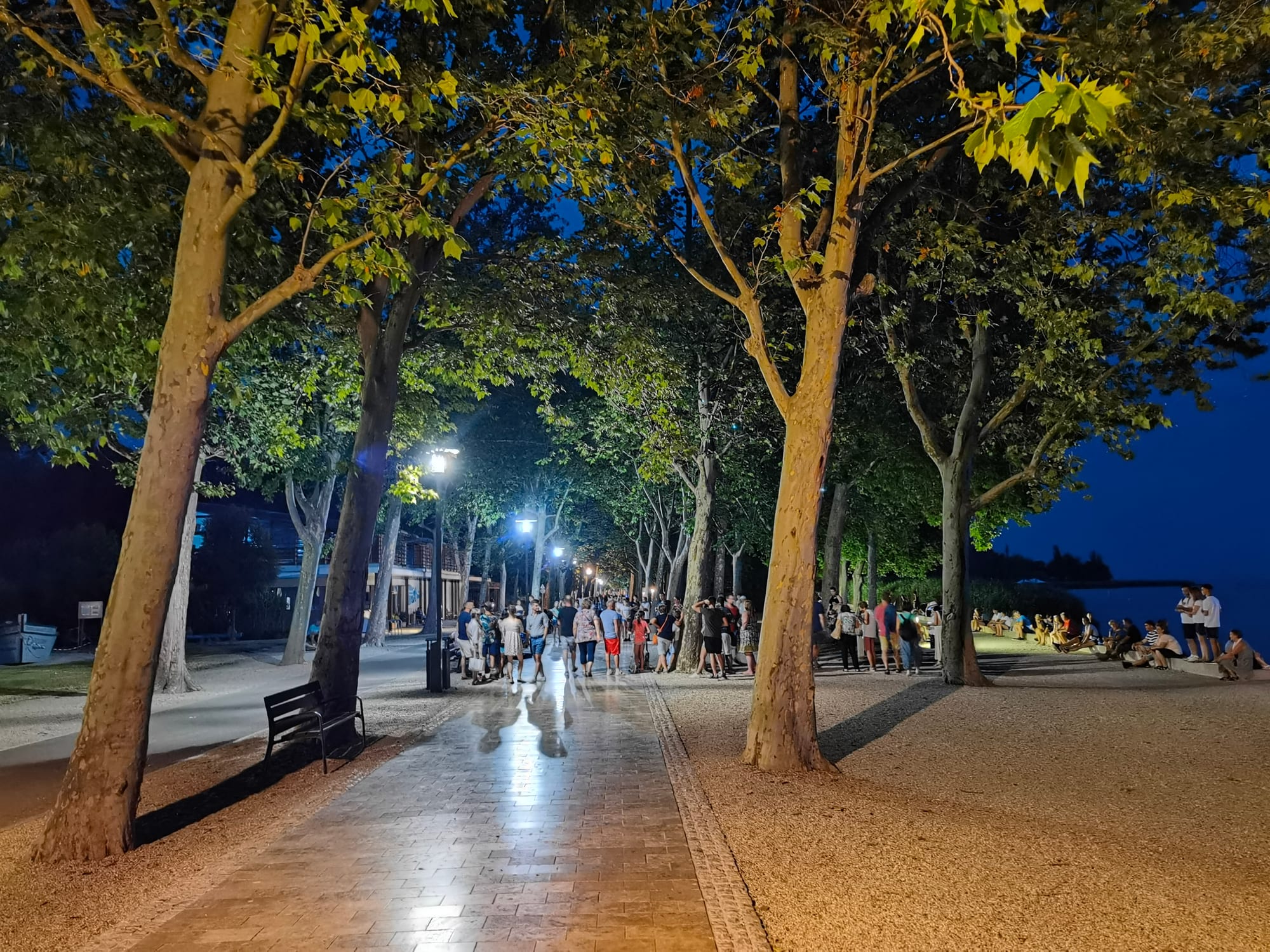
Strollers on a lamp-lit paved promenade under plane trees at dusk, with people sitting by the dark lake on the right

Lake Balaton & Transdanubia, Hungary

Balatonfüred

An evening crowd on the Tagore promenade along the lakeshore in Balatonfüred. (Christo / Wikimedia Commons · CC BY-SA 4.0)

A spa and sailing town of about 13,000 people on the northern shore of Lake Balaton, facing the Tihany peninsula. Carbonated mineral springs made it the lake's oldest resort, a meeting place for 19th-century nobles, writers and politicians; today a heart hospital, marinas, a tree-lined promenade and vineyards on the hills behind give it a quieter, more genteel feel than the southern shore.

Neighbourhoods

  • The spa quarter and lakeshore (Fürdőtelep)
    • First-time visitors
    • Historic district
    • Lake views

    The old resort that grew up around the healing springs, centred on Gyógy tér with the heart hospital, the Kossuth spring pump room and the Horváth House. The pier, the yacht harbour and the plane-shaded Tagore promenade run along the water, with villas and the round church just behind.

    Open in Maps
  • The upper old town
    • Historic district
    • Quiet and residential
    • Best for food

    The original village on higher ground away from the lake, along Jókai Mór utca and around Szent István tér, with the red sandstone Catholic church, the white Reformed church, shops and the town hall. Restaurants here are generally more traditional than those on the shore.

    Open in Maps
  • Balatonarács
    • Quiet and residential
    • Beaches

    A former village on the eastern side, joined to the town in 1954, with its own 18th-century Catholic and Calvinist churches and a small railway stop. The Kisfaludy beach is nearby, and the geographer Lajos Lóczy is buried in its cemetery.

    Open in Maps

Things to do

The spa quarter and promenade

  • Tagore promenadetrail

    The lakeside walk beside the heart hospital, named after the Indian poet Rabindranath Tagore, who was treated here in 1926; a bust and memorial tree recall him, and famous visitors have planted trees in the park beside it.

    Open in Maps
  • Kossuth Lajos spring pump roomlandmark

    A classical well-house on Gyógy tér, built in 1800 and rebuilt in 1853, where visitors can taste the town's carbonated, mineral-rich spring water.

    Open in Maps
  • Horváth Houselandmark

    A large late-baroque house on Gyógy tér built in the 1790s, where the first Anna Ball was held in 1825.

    Open in Maps
  • Round Churchlandmark

    A neoclassical Catholic church built between 1841 and 1846 and modelled on the Pantheon in Rome, with an altarpiece by János Vaszary.

    Open in Maps

Museums and villas

  • Jókai memorial housemuseum

    The summer villa of the novelist Mór Jókai, built in 1870, where he wrote much of The Man with the Golden Touch; it is now a literary memorial museum on his life here.

    Open in Maps
  • Vaszary Villamuseum

    The former summer home of Archbishop Kolos Vaszary, now used for exhibitions, concerts and literary events.

    Open in Maps
  • Lóczy Caveattraction

    A cave in the town named after the geologist Lajos Lóczy.

    Open in Maps

The lake and the hills

  • Balatonfüredi Yacht Club and the harbourattraction

    Hungary's oldest established yacht club, founded in 1867, at the heart of the town's sailing harbours; boats and paddle boats can be hired along the beaches in summer.

    Open in Maps
  • Koloska Valleytrail

    A wooded valley in the hills above town with a spring and a picnic area.

    Open in Maps
  • Balaton Uplands National Parkpark

    The protected volcanic hills, wetlands and woods of the northern shore, established in 1997, which surround the town on its landward side.

    Open in Maps

Short trips from the town

  • Tihany Abbeylandmark

    The Benedictine abbey on the Tihany peninsula, founded in 1055 by King Andrew I, who is buried in its crypt; its founding charter is known for containing the oldest written words in Hungarian.

    Open in Maps
  • Veszprémneighborhood

    The county town in the hills north of the lake, one of the oldest urban areas in Hungary, built by local legend on seven hills, among them Castle Hill.

    Open in Maps
  • Herendattraction

    A small town near Veszprém, home of the porcelain manufactory founded in 1826 that supplied the Habsburg court and specialises in hand-painted and gilded porcelain.

    Open in Maps
  • Nagyvázsonylandmark

    A village in the uplands with the 14th-century Kinizsi Castle, given by King Matthias to his general Pál Kinizsi, whose sarcophagus lies in the castle chapel.

    Open in Maps

Seasonal events

  • Sail-setting ceremonyMay

    The opening of the sailing season on the lake, followed through the summer by international regattas.

  • Anna Ballthe Saturday nearest 26 July

    A ball first held in 1825 in honour of Anna Szentgyörgyi Horváth, at which a belle is chosen from among the guests; it was the only beauty pageant held under communism.

  • Wine-tasting festivalAugust

    The town's summer wine festival, showing the wines of the vineyards on the hills behind it.

Eat and drink

Long-standing places and food districts in Balatonfüred. Hours, ratings and directions come from your maps app, always current.

Balatonfüred classics

  • Old-town restaurantsneighborhood

    Restaurants in the upper town, away from the lake, which serve more traditional Hungarian cooking than the shore.

    Open in Maps
  • Lakeside buffets and fish restaurantsneighborhood

    Snack bars and restaurants along the promenade and beaches, mostly serving fish and lángos, the deep-fried flatbread.

    Open in Maps

Wine

  • Hillside wine cellarsneighborhood

    Cellars selling white wine from the vineyards on the slopes above the town, mostly Olaszrizling from the Balatonfüred-Csopak wine region.

    Open in Maps

Experience Balatonfüred

History

People lived around Füred in prehistoric times, and the Romans left building ruins and graves here. The name first appears in writing in 1211, in a list of the properties of Tihany Abbey; in the Árpád era seven small settlements, including Füred and Arács, occupied today's town. The name is thought to come from an old word for quail, but the town's springs gave it a new meaning, and "füred" came to suggest a spa — hence later resorts named Lillafüred and Mátrafüred.

The sour, carbonated water was recorded in the early 18th century, a wooden and then a stone bath house went up, and the town was officially declared a spa in 1772. In the Reform Era of the early 19th century it became the meeting place of Transdanubia's great families. Sándor Kisfaludy founded the first Hungarian-language stone theatre in Transdanubia here in 1831; in 1825 János Szentgyörgyi Horváth held the first Anna Ball for his daughter; and in 1846, on István Széchenyi's initiative, the first steamship on Lake Balaton, the Kisfaludy, set out from Füred, which also gained a shipyard. After 1867 politicians and artists followed: the shore was built up, the promenade laid out and villas built, and Mór Jókai wrote much of his novel The Man with the Golden Touch in his villa here. Phylloxera later destroyed most of the vineyards.

A new phase began in the 1960s, with large lakeside hotels and a 4,000-place campsite built for an international caravanning rally in 1966. In 1971 Balatonfüred became Hungary's first town designated a spa and resort town, and the neighbouring village of Balatonarács had already been absorbed in 1954. In 2017 it hosted the open-water events of the World Aquatics Championships.

Culture & Customs

The town's identity rests on its 19th-century heyday as a spa and a gathering place for the nation's writers, actors and statesmen. Plaques at the colonnade known as the Füred Pantheon on Gyógy tér commemorate artists, writers and scientists linked with the town, the actress Lujza Blaha's summer house stands near Gyógy tér, and statues of Ferenc Deák, István Széchenyi and other national figures line the promenade. The Anna Ball, first held in 1825 and held each July, is its best-known social event, and it chooses a belle of the ball from among its guests.

Sailing is the other pillar. The Balatonfüredi Yacht Club, founded by members of the Hungarian gentry in 1867, is the country's oldest established club and has trained Olympic sailors and winners of the Blue Ribbon race around the lake, and the season opens each May with a sail-setting ceremony. The town also has a top-division handball club, and the 2008 Central Europe Rally, organised in place of the cancelled Dakar, finished here.

The town is considered the capital of the northern shore and has a lively civic life for its size, with a music school named after the conductor János Ferencsik, a local television studio and summer festivals of music, wine and the arts. German is the second language of many people around the lake.

Daily Life

About 13,000 people live in Balatonfüred, which is the seat of its own district in Veszprém county. The town has two cores: the lower spa quarter on the shore, with the pier at its centre, and the upper old town around the red and white churches, with shops and offices; housing estates, among them one completed in 1980 north of the station, and holiday homes spread across the slopes.

The State Hospital for Cardiology, opened in 1913 and the largest cardiac-rehabilitation centre in Hungary, has replaced the former shipyard as the main employer, alongside the hotels. Wine-growing adds to the economy, and a large shopping centre opened in 2010. The town has a swimming pool opened in 2017 and several schools, including a secondary school for viticulture.

Life follows the season. In summer the population swells with visitors, boats leave for Tihany and Siófok all day, and the promenade stays busy late; in winter the town is quiet, and in hard frosts skaters and ice boats take over the frozen shallows. In autumn 2023 the town council decided to demolish a failed lakeside leisure complex and replace it with a park and housing.

Food

The lake and the vineyards shape what is eaten and drunk here. Carp is the most common catch in the lake, and fish dishes dominate the menus along the shore, among them halászlé, the hot fisherman's soup of paprika and river fish traditionally cooked over an open fire in a cauldron called a bogrács. Lángos — deep-fried flatbread, whose name comes from láng, the Hungarian word for flame — is the classic beach snack.

Away from the water, the restaurants of the upper town keep to traditional Hungarian cooking: stews, soups, stuffed pancakes (palacsinta) and cakes. Small cube-shaped cakes are a national habit, and one of them is named after the lake itself.

Wine is the town's pride. Balatonfüred belongs to the Balatonfüred-Csopak wine region, part of the larger Balaton wine region, and its cellars sell white wine from the slopes above the town, above all Olaszrizling (Welschriesling), the most widespread grape in Hungary. Since 1987 the town has carried the title of International City of Vine and Wine, and its summer wine festival fills the promenade in August.

Planning tools

Budget

Balatonfüred costs about the national average for most of the year but rises sharply in July and August, when rooms on the northern shore fill early and restaurants on the promenade charge resort prices. Out of season it is good value, though some lakeside places close.

Daily Budget Midrange
USD 100–200 (hotel or spa hotel, restaurant meals, wine tastings, a hired bike or boat)
Daily Budget Shoestring
USD 45–75 (guesthouse room or campsite, lakeside buffets and bakeries, trains and buses)

June and September bring lower prices and quieter beaches; the promenade, the spa square and the hill paths cost nothing.

Best Time to Visit

May to September for sailing, swimming and the summer events, with July and August the busiest months and the time of the Anna Ball. Late spring and early autumn suit walking in the hills and wine tasting. Winter is quiet, and in cold spells the lake can freeze for weeks, bringing out skaters and ice boats.

Suggested Number of Days

The town itself needs a day or two. Allow three or four days to add boat trips on the lake, the peninsula next door and the hill villages, and more for a beach or sailing holiday.

First Visit
1–2 days
With Surroundings
3–4 days

Transportation

The town is small and flat along the shore, and walking or cycling covers most of it; cycle paths are plentiful. Local buses serve the town, and in summer passenger boats link the pier with Tihany, Siófok and other resorts. A car or bus helps for the hill villages.

Watch the storm-warning lights around the shore before taking a boat out; motorboats with combustion engines and jet skis are not allowed on Lake Balaton.

Airport & Station Connections

Trains from Budapest-Déli station run along the northern shore to Balatonfüred station, hourly out of season and directly in summer, and a smaller stop serves Balatonarács. Long-distance buses leave from beside the station for Veszprém, Győr and Hévíz. Budapest's Ferenc Liszt Airport is the main international gateway; the smaller Hévíz–Balaton Airport lies at the western end of the lake.

Walkability

Very walkable. The promenade, pier, spa square and villas sit close together, and the upper old town is a short uphill walk from the shore. Footpaths lead from town into the wooded hills and vineyards.

Safety

Hungary is a safe country with low levels of violent crime. In Balatonfüred the main hazards are natural: fast-moving summer storms on the lake that can capsize small boats, heat and sunburn, and busy roads along the shore in peak season. Petty theft from cars and beaches occurs in summer.

Head for shore when the storm-warning lights flash rapidly, swim at supervised beaches and leave nothing on show in parked cars. Check current official travel advice before travelling.

Climate

A mild climate with four seasons, tempered by the lake. Summers are warm and sunny with occasional sudden storms; winters are cold and often grey, and the lake sometimes freezes over.

Summer
warm — in Keszthely, at the lake's western end, July averages 21.3°C
Winter
cold — January in Keszthely averages 0.1°C, and ice can cover the lake for weeks

Local Customs

Hungarian is the main language, German is widely understood at the lake, and English is patchier, especially among older people; menus are often in English. The old spa square is still a working hospital campus, and the town keeps something of its 19th-century gentility, with a formal ball as the high point of its summer.

Many beaches charge a small entry fee, and a few words of Hungarian help at the station and with older residents.

Common Payment Methods

The currency is the Hungarian forint (HUF). Cards are widely accepted in hotels, restaurants and shops, but cash is useful for beach entry, market stalls, small buffets and wine cellars. ATMs are easy to find in the centre and near the station.