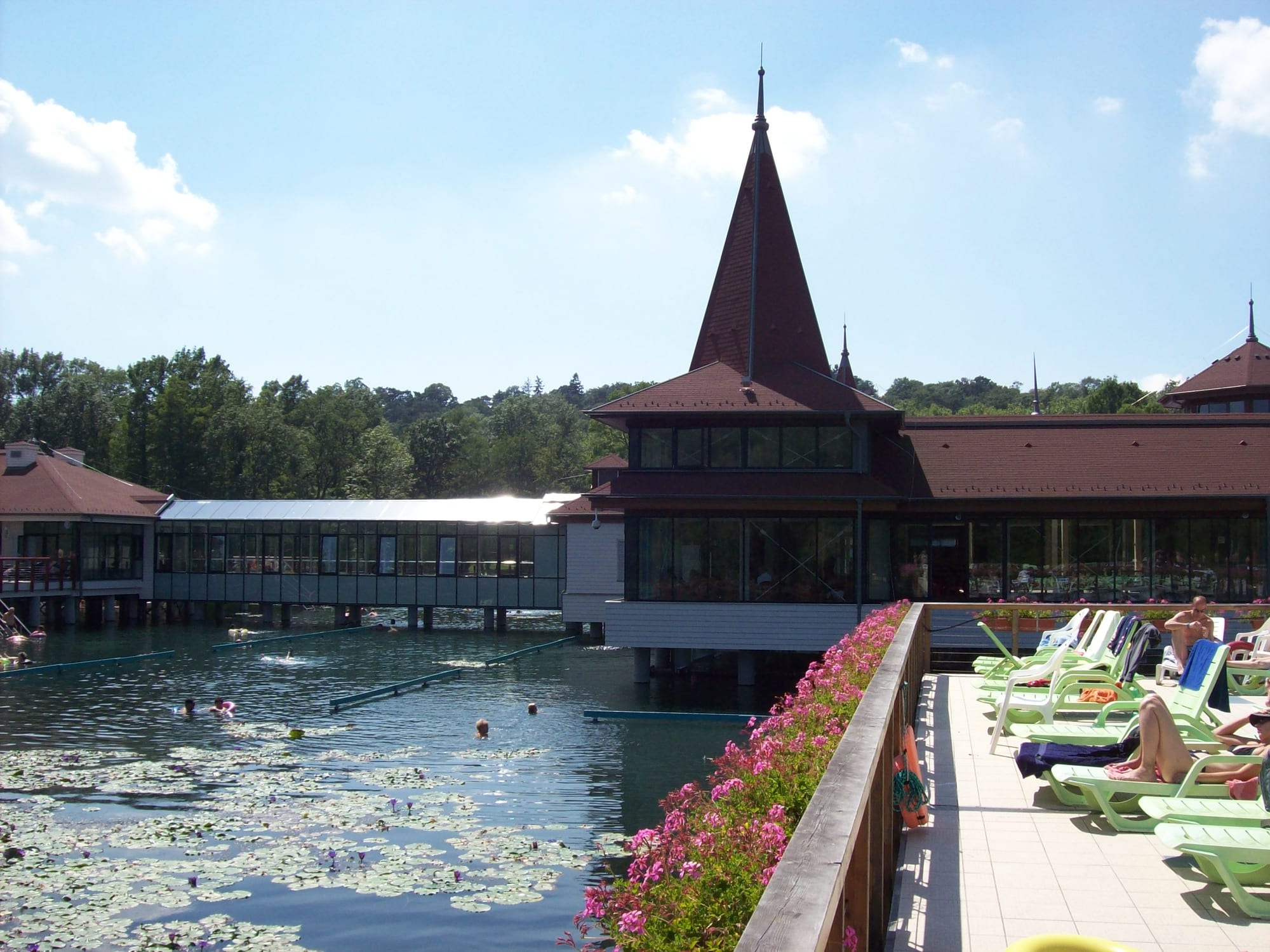
Bathers swimming among water lilies beside a pavilion bath house on stilts with steep brown spires, and a sun terrace in front

Lake Balaton & Transdanubia, Hungary

Hévíz

Swimmers among the water lilies beside the bath house on Lake Hévíz. (Jarba / Wikimedia Commons · CC BY 3.0)

A small spa town in Zala county, a few kilometres from Keszthely and the western end of Lake Balaton, built around Lake Hévíz, the largest swimmable thermal lake in Europe. Developed by the Festetics family from the 18th century, it is now one of Hungary's busiest resorts, with a pavilion bath over the water, a rheumatology hospital and the wine cellars of old Egregy.

Neighbourhoods

  • The lake and the spa quarter
    • First-time visitors
    • Spa and wellness

    The thermal lake, ringed by a protective park forest, with the pavilion bath house standing over the water and the St Andrew's rheumatology hospital on the shore. Most of the town's spa hotels and treatment centres are close by.

    Open in Maps
  • The town centre
    • Best for food
    • Close to public transport
    • Shopping

    The pedestrian zone and the Dr Schulhof Vilmos promenade, lined with cafés and shops, with the town hall, the seven-towered Holy Spirit church, the farmers' market and the bus station, which was rebuilt in 2021.

    Open in Maps
  • Egregy
    • Quiet and residential
    • Wine
    • Historic district

    A former village on the hillside joined to Hévíz in 1946, with the feel of a village still. Its 13th-century church stands among vineyards, and the lanes behind it are lined with wine bars and homely restaurants.

    Open in Maps

Things to do

The thermal lake

  • Lake Hévíz bathattraction

    The largest swimmable thermal lake in Europe, fed from a spring cave 38 metres down and warm enough for bathing all year; its water is completely renewed every three and a half days, and mist forms over it in winter.

    Open in Maps
  • St Andrew's Hospitallandmark

    The state hospital for rheumatology and rehabilitation on the lakeshore, where the lake's water and peat mud are used in treatment.

    Open in Maps
  • Water lily nature trail and treetop walkwaytrail

    A path along the lake's outflow and wetlands, where the red and other water lilies introduced in 1898 grow in the warm water.

    Open in Maps
  • Berki trailtrail

    A walking path around the lake and the surrounding moor, introducing its plants and animals.

    Open in Maps

Churches and Roman remains

  • Árpád-era church of Egregylandmark

    A 13th-century Romanesque church among the Egregy vineyards, first recorded in 1314 and one of only three intact Árpád-era churches in the Balaton Uplands.

    Open in Maps
  • Holy Spirit Churchlandmark

    A large modern Catholic church with seven towers, completed at the end of the 1990s and holding about a thousand people.

    Open in Maps
  • Roman ruin gardenattraction

    The excavated remains of an early imperial Roman country villa on Attila utca, free to visit.

    Open in Maps
  • Egregy Museummuseum

    A local museum in Egregy, opened in 2016.

    Open in Maps

Short trips from the town

  • Festetics Palacemuseum

    The baroque palace of the Festetics family in Keszthely, begun in 1745 and one of the three largest country houses in Hungary, now the Helikon Palace Museum.

    Open in Maps
  • Szigligetattraction

    A village on the northern shore of Lake Balaton, with the ruins of a medieval fortress on Várhegy hill.

    Open in Maps
  • Sümegattraction

    A small town best known for Sümeg Castle.

    Open in Maps

Seasonal events

  • Carnival Faircarnival season

    The town's Farsangi Forgatag, a carnival fair.

  • Happy Peace Times in Hévízevery year

    A festival in the town, the Boldog Békeidők Hévíze.

  • Egregy feast dayevery year

    The traditional church feast of the Egregy district, the Egregyi Búcsú.

  • Hévíz Wine Festivalevery year

    The town's wine celebration, the Hévízi Borünnep.

  • Egregy grape harvestautumn

    A harvest celebration of eating and drinking in the vineyard district.

Eat and drink

Long-standing places and food districts in Hévíz. Hours, ratings and directions come from your maps app, always current.

Hévíz classics

  • Egregy wine barsneighborhood

    Small wine bars and restaurants among the vineyards behind the Egregy church, serving local wine and home-style Hungarian cooking.

    Open in Maps
  • Promenade caféscafe

    Cafés and pastry shops along the pedestrian promenade in the centre.

    Open in Maps

Markets

  • Hévíz farmers' marketmarket

    The town's market for local produce, wine and preserves.

    Open in Maps

Experience Hévíz

History

People were drawn to the warm water long before the town existed. The first archaeological evidence goes back about 7,500 years; the Romans built villas here, left an altar stone to Jupiter and cemeteries, and used the lake to make leather, and Germanic and Slav peoples of the Migration Period used it too. The name Hévíz, meaning "hot water", first appears in a document of 1328. During the Ottoman period the water level rose and the area became swampy and hard to reach.

In 1731 the scholar Matthias Bel first mentioned cures at the lake, and in 1769 the county physician Ferenc Szláby described its water for Queen Maria Theresa. The Festetics family acquired the lake in the mid-18th century, and between 1795 and 1797 Count György Festetics built a wooden bath house on a float over the outflow. Development stalled after his death in 1819 and resumed in 1868 under György Festetics II. From 1905 the Keszthely brewery owner Vencel Reischl leased the bath for 35 years, rebuilt the hotels and restaurants and completed a new entrance in 1911, and doctors and therapies multiplied.

The modern town was formed in 1946 by joining Hévízszentandrás and Egregy, and became a town on 1 May 1992. Large hotels arrived from 1975. In the 1980s bauxite mining lowered the region's karst water and the spring's flow fell sharply, but it recovered after the mines closed.

Culture & Customs

Life in Hévíz revolves around the lake. Bathers float in the warm water through all four seasons, and in winter a mist forms over the surface. The water lilies, introduced by Sándor Lovassy in 1898, are as much a symbol of the town as the pavilion bath, and bacteria are the lake's dominant life form, alongside blue-green and green algae.

Medicine is part of the culture too. The lake's water and the mud of its peat bed, up to 8 metres thick, are used to treat rheumatic and locomotor disorders at the St Andrew's hospital and in the hotels, and Hévíz belongs to Hungary's national association of spa towns. A legend tells of a nurse whose prayer made the Virgin release a healing spring for a sick child.

The town is unusually international for its size. In 2012 Germany, Russia and Austria supplied the most guests, and many visitors come for treatment. Egregy keeps a village identity, with its Árpád-era church, wine bars and grape-harvest celebration, and the calendar includes a carnival fair and a wine festival.

Daily Life

Hévíz is small: its 830 hectares make it the smallest town by area in Zala county and in Transdanubia. It lies about 7 km north-west of the centre of Keszthely and 35 km east of the county town, Zalaegerszeg. Residents live in the streets around the centre and in the hillside district of Egregy, and tourism is the mainstay of the town's economy.

The figures are striking for a town of its size. In 2012 it recorded one million guest nights in commercial accommodation, second in Hungary only to Budapest, and hundreds of thousands of visitors come every year to a resort with more than 200 years of bathing tradition. Hotels, the hospital, treatment centres, restaurants and shops provide most of the work.

Because the lake never closes, the town has less of the summer-only rhythm of the Balaton resorts. Regional plans have long discussed a tram link with Keszthely, and a new bus station opened in 2021.

Food

Hévíz eats from the Hungarian table, with menus shaped by its many foreign guests. Restaurants serve the national classics: gulyás, properly a brothy soup of beef, potato and paprika; pörkölt, the thicker stew; halászlé, the hot fisherman's soup with rival regional versions; palacsinta, pancakes both sweet and savoury; and lángos, the deep-fried flatbread whose name comes from láng, the Hungarian word for flame.

The district of Egregy is the place to eat and drink like a local. Behind its 13th-century church, vineyards climb the slope and small wine bars pour local wines, and its restaurants offer home-style cooking. Olaszrizling, the most widespread variety in Hungary, is grown around Lake Balaton, and a wine festival and the grape harvest are the high points of the year.

In the centre, cafés and pastry shops line the promenade and pedestrian zone, and the farmers' market sells local produce. Nearby Keszthely, the lake's second-largest town, adds more restaurants and lakeside buffets.

Planning tools

Budget

Hévíz is one of the pricier towns in western Hungary because so much of it is built around spa hotels and treatments, and rooms cost more in summer. Guesthouses and private rooms are cheaper, and nearby Keszthely offers a less expensive base. Out of season the lake stays open and prices fall.

Daily Budget Midrange
USD 100–200 (spa hotel, restaurant meals, lake and treatment tickets, a hire car or bike)
Daily Budget Shoestring
USD 45–75 (private room or guesthouse, market food and bakeries, lake ticket, buses)

Lake tickets are sold for a few hours or a whole day, with reduced prices for seniors, students and children.

Best Time to Visit

Any time of year: the lake is warm enough for bathing even in winter, when steam rises from the surface, and the town is busy in every season. The quieter winter months suit a spa stay.

Suggested Number of Days

A day or two is enough to bathe in the lake and see the town. Many visitors stay much longer for courses of treatment, and extra days allow for the Balaton shore and the hills around it.

First Visit
1–2 days
With Surroundings
4–7 days

Transportation

Hévíz is small and best covered on foot or by bike, with a public bike-hire scheme. Regional Volánbusz buses link it with Keszthely in about a quarter of an hour, and a car helps for the castles, wine villages and the lakeshore.

Public bikes and the regional Volánbusz services cover most journeys.

Airport & Station Connections

Hévíz has no railway. The nearest station is in Keszthely, about 7–8 km away, reached by train from Budapest-Déli and then by bus or taxi; the whole journey takes around three hours. Direct buses from Budapest Népliget take about two and a half hours. Hévíz–Balaton Airport at nearby Sármellék receives regular charter flights.

Walkability

Very walkable. The lake, the promenade, the pedestrian zone and most hotels sit within a short walk of each other, and paths circle the lake. Egregy is a gentle uphill walk from the centre through residential streets.

Safety

Hungary is a safe country with low levels of violent crime. Hévíz is a quiet resort, and problems are rare beyond occasional petty theft in busy places.

Lock valuables away at the bath and in parked cars, and take any medical advice on spa treatment from a doctor. Check current official travel advice before travelling.

Climate

A mild climate with four seasons, moderated by the nearby Balaton. Summers are warm and winters cold and often grey, though the thermal lake makes the town a year-round destination.

Summer
warm — in neighbouring Keszthely, July averages 21.3°C
Winter
cold — January in Keszthely averages 0.1°C, and mist forms over the warm lake

Local Customs

Germany, Russia and Austria were the largest sources of guests in 2012, and the town is used to foreign visitors. The town is a place of rest and medical treatment, and its pace is calm.

Keep voices low in treatment areas and dress modestly in the churches.

Common Payment Methods

The currency is the Hungarian forint (HUF). Cards are widely accepted at hotels, the bath and most restaurants, and some places quote euros, usually at a poor rate. Cash helps at the market and the wine bars of Egregy.