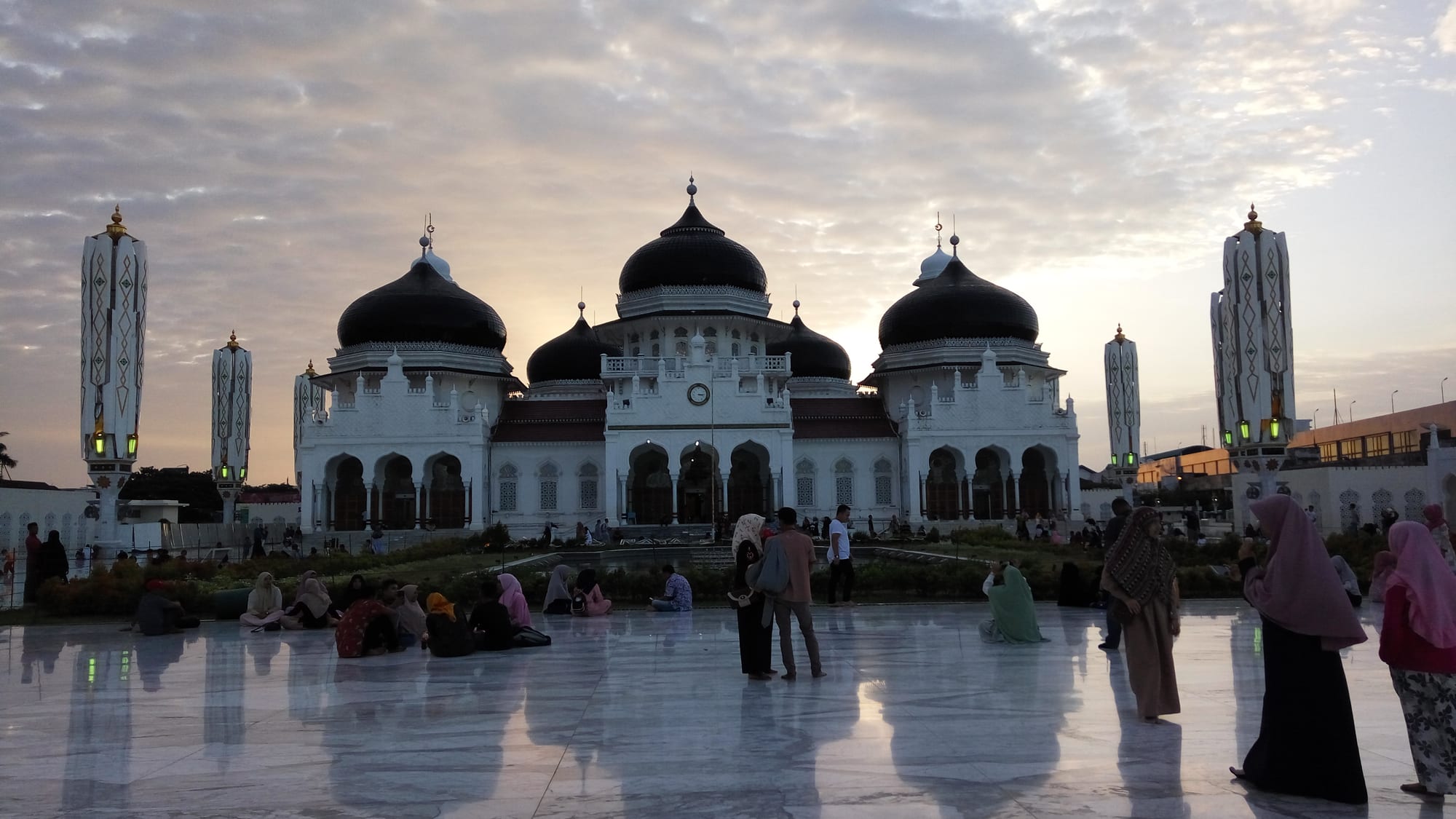
A white mosque with black onion domes and arched arcades behind a wide wet marble courtyard reflecting the evening sky

Sumatra, Indonesia

Banda Aceh

The Baiturrahman Grand Mosque and its courtyard in the centre of Banda Aceh. (Si_Gam / Wikimedia Commons · CC BY-SA 3.0)

The capital of Aceh province, at the northern tip of Sumatra where the Aceh River meets the Malacca Strait. Once the seat of a powerful sultanate and later the focus of a long war with the Dutch, it was devastated by the Indian Ocean tsunami of December 2004 and rebuilt around the surviving Baiturrahman Grand Mosque. It is now a devout provincial city of about 270,000.

Neighbourhoods

  • Baiturrahman and the centre
    • First-time visitors
    • Historic district

    The heart of the city around the grand mosque and its marble plaza, with government offices, hotels, the Aceh Tsunami Museum and the Blang Padang field within a short walk. Evenings fill the square with families after prayers.

    Open in Maps
  • Peunayong
    • Best for food
    • Markets
    • Local life

    The old Chinese trading quarter across the Aceh River from the mosque, with shophouses, a produce market and the densest concentration of restaurants and coffee shops in the city. Most of the night-time eating happens here.

    Open in Maps
  • Kuta Alam
    • Quiet and residential
    • Close to transport

    A large residential and commercial district north-east of the centre, holding shops, hospitals and much of the city's everyday business, and the road out towards the fishing harbour at Lampulo.

    Open in Maps
  • Ulee Lheue
    • Waterfront
    • Ferries
    • Sunsets

    The coastal quarter at the western edge of the city, almost entirely destroyed in 2004 and rebuilt around its ferry terminal, which serves Weh island. A seafront road, stalls and a surviving mosque draw people at the end of the day.

    Open in Maps
  • Darussalam
    • Students
    • Quiet and residential

    The university district several kilometres east of the centre, built around Syiah Kuala University and the Ar-Raniry Islamic university, with cheap eating places, bookshops and student lodgings.

    Open in Maps
  • Lampulo
    • Local life
    • Seafood

    The fishing harbour on the northern edge of the city, where boats land their catch in the early morning and an auction hall and grill stalls follow it. One of the tsunami memorials, a fishing boat left on a house roof, stands in the streets behind.

    Open in Maps

Things to do

Landmarks

  • Baiturrahman Grand Mosquelandmark

    The white mosque with black domes, rebuilt by the Dutch between 1879 and 1881 after the earlier mosque burned during their attack, and left standing by the tsunami when the district around it was destroyed.

    Open in Maps
  • Gunongan Historical Parklandmark

    The remains of the Acehnese royal grounds, with a white circular structure of the 17th century associated with Sultan Iskandar Muda and a garden around it.

    Open in Maps
  • Aceh Museummuseum

    The provincial museum, whose grounds hold a traditional Acehnese timber house and the large Cakra Donya bell, said to have come from China in the 15th century.

    Open in Maps

Tsunami memorials

  • Aceh Tsunami Museummuseum

    A curved, wave-shaped building of 2009 designed by Ridwan Kamil, entered through a dark corridor of running water and rising to a chamber inscribed with the names of the dead.

    Open in Maps
  • PLTD Apung 1landmark

    A steel power-generating barge, weighing some 2,600 tonnes, carried two to three kilometres inland by the wave and left in a residential district, now kept as a memorial with a viewing platform.

    Open in Maps
  • Ulee Lheueneighborhood

    The seafront and ferry district that took the full force of the wave, with a mosque that survived it and a mass grave nearby.

    Open in Maps

Getting around

  • Sultan Iskandar Muda International Airporttransit hub

    The city's airport, about 13 kilometres south-east in Aceh Besar Regency, with domestic flights and pilgrimage charters.

    Open in Maps

Short trips

  • Weh Islandattraction

    A small volcanic island about 15 kilometres off the northern tip of Sumatra, reached by ferry from Ulee Lheue in about 45 minutes on the fast boat, with coral reefs and diving off Iboih and Rubiah.

    Open in Maps
  • Sabangattraction

    The town on Weh island, a coaling station and free port under the Dutch and a free-trade zone since 2000; it is the northernmost and westernmost city in Indonesia.

    Open in Maps
  • Lhokngabeach

    A coastal district south-west of the city with a long surf beach backed by hills, rebuilt after the tsunami destroyed almost all of it.

    Open in Maps

Seasonal events

  • Tsunami remembrance26 December

    Prayers, mass-grave visits and public ceremonies mark the anniversary of the 2004 earthquake and tsunami across the city.

  • Ramadan and Eid al-Fitrvaries with the Islamic calendar

    Eating places close in daylight through the fasting month, night markets appear after sunset, and the city empties as families travel for the Eid holiday.

Eat and drink

Long-standing places and food districts in Banda Aceh. Hours, ratings and directions come from your maps app, always current.

Banda Aceh classics

  • Mie Acehrestaurant

    Thick yellow noodles fried or served in a spiced curry broth with beef, prawns or crab — the dish the city is known for, sold in specialist shops all over town.

    Open in Maps
  • Ayam tangkaprestaurant

    Chicken pieces fried with handfuls of curry leaves, pandan and green chillies until the leaves crisp, then served buried under them.

    Open in Maps
  • Kuah beulangongrestaurant

    A rich goat or beef curry with jackfruit, cooked in huge pots for religious feasts and communal meals and sold in Acehnese restaurants at other times.

    Open in Maps

Markets and food districts

  • Peunayongneighborhood

    The old Chinese quarter and the city's main eating district, with a morning market, seafood restaurants, noodle shops and rows of coffee houses.

    Open in Maps
  • Lampulo fish marketmarket

    The harbour auction where tuna and reef fish are landed at dawn, with grill stalls nearby cooking the catch.

    Open in Maps

Coffee houses

  • Aceh coffee shopscafe

    Gayo arabica and robusta poured through cloth filters in warung kopi that run from before dawn until late; sanger, a sweetened milky coffee, is the local order.

    Open in Maps

Experience Banda Aceh

History

Banda Aceh grew as the capital of the Sultanate of Aceh, established in the early 16th century at the mouth of the Aceh River, where ships entering the Strait of Malacca made their first landfall in the archipelago. Pepper and the pilgrim trade made it rich, and it became a centre of Islamic scholarship known as the doorway to Mecca. Under Iskandar Muda in the early 17th century the sultanate reached its height, fighting the Portuguese at Malacca and sending embassies as far as the Ottoman court; the Gunongan and the royal garden survive from that period. A series of women ruled as sultana later in the same century.

The Dutch declared war in 1873, and their expedition commander, General Johan Köhler, was killed in the fighting around the city, wrecking the first expedition. The war that followed lasted about three decades, was among the most costly the Netherlands fought in the Indies, and left a deep distrust of outside rule. The Dutch rebuilt the mosque that had burned in their attack, and the town was known as Kutaraja until the old name was restored in 1963. After independence Aceh's relations with Jakarta stayed difficult, and the Free Aceh Movement fought an insurgency from 1976.

On the morning of 26 December 2004 an earthquake off the west coast of Sumatra sent a tsunami into the city. Waves reached several kilometres inland, and the disaster killed around 170,000 people in Indonesia, with Banda Aceh among the worst-hit places. Reconstruction brought international aid on a vast scale, new housing, roads and escape buildings. The disaster also helped bring the sides to the Helsinki agreement of August 2005, which ended the insurgency and gave the province special autonomy, including the right to apply Islamic law.

Culture & Customs

Acehnese identity rests on Islam and on a long memory of resistance. The province is often called the veranda of Mecca, and religious observance runs deeper in daily life here than almost anywhere else in Indonesia: prayer times empty the shops, Friday mornings shut the city, and religious by-laws set the rules for dress and conduct. The Acehnese language, related to Cham languages of mainland Southeast Asia rather than to Malay, is widely spoken alongside Indonesian.

The best-known art form is the Saman, a seated dance of synchronised clapping, chest-slapping and chanting performed in a tight line, which is on UNESCO's list of intangible cultural heritage in need of urgent safeguarding. Other Acehnese dances such as the Ratoh Duek and Seudati use the same close-packed rows and rising tempo, and are performed at weddings and provincial festivals. Embroidered Acehnese cloth with gold thread, songket weaving and rencong daggers are the traditional crafts.

Coffee houses are the other great institution. Men and, increasingly, women gather in warung kopi from before dawn to argue politics, do business and read the papers, and the city has hundreds of them. Hospitality is warm but formal: visitors are welcomed, offered coffee at once, and asked direct questions about family and religion. The 2004 tsunami is part of everyday conversation, and most families lost members; people generally speak about it plainly rather than avoiding it.

Daily Life

About 270,000 people live inside the city of Banda Aceh, a compact place on both banks of the Aceh River, with the larger district of Aceh Besar spreading around it. The population is overwhelmingly Acehnese and Muslim, with a small Chinese community long established in Peunayong. Its age profile is young, and the two universities in Darussalam — Syiah Kuala and the Ar-Raniry Islamic university — bring tens of thousands of students from across the province.

Government is the largest employer: Banda Aceh is the provincial capital, and the special autonomy settlement channels substantial funds through it. Trade, transport, hospitals, education and fishing fill out the rest, and the harbours at Lampulo and Ulee Lheue support a fleet that supplies the markets. Much of the built environment dates from after 2004, with aid-funded housing estates, wide roads and marked evacuation routes laid across the flattened western districts.

The day starts very early, with coffee houses busy before the dawn prayer and markets trading by first light, and slows sharply in the afternoon heat. Evenings belong to the mosque plaza and to the food streets of Peunayong. Ongoing issues include a provincial economy that remains among the poorer ones in Indonesia despite autonomy funds, debate about the reach of the religious by-laws, and preparedness for the next earthquake, which is treated as a matter of when rather than whether.

Food

Acehnese cooking is the spiciest and the most Indian-influenced in Sumatra, built on curry leaves, cardamom, star anise, cumin and dried chilli. Mie Aceh is the city's signature: thick yellow noodles stir-fried or served soupy in a dark spiced gravy with beef, prawns or whole crab, topped with fried shallots, pickles and a wedge of lime. Kuah beulangong, a curry of goat or beef with young jackfruit, is cooked in enormous pots for religious feasts and communal meals. Ayam tangkap buries fried chicken under crisp curry and pandan leaves with green chillies.

Rice is eaten with gulai curries, and the Acehnese use asam sunti — sun-dried and salted belimbing wuluh, a sour fruit — where other regions use tamarind. Seafood is central, with grilled fish and squid from the Lampulo boats. Roti canai and martabak show the Indian and Malay side of the kitchen, and sate matang, an Acehnese satay, is served with peanut sauce and a bowl of broth.

Sweets include timphan, a soft dumpling of glutinous rice flour, banana and coconut milk steamed in banana leaf, made especially for Eid. Coffee is the drink that defines the place: arabica from the Gayo highlands inland and robusta from elsewhere in Aceh, brewed strong and strained through a long cloth sock. Sanger, coffee with condensed milk beaten to a froth, is the everyday order, and kopi sanger and a plate of noodles is the standard breakfast. No alcohol is sold anywhere in the province.

Planning tools

Budget

Banda Aceh is inexpensive even by Indonesian standards. Rooms, noodle meals and coffee cost little, and the main memorials charge nothing or very little. The costs that add up are the flight in, a car with driver for the coast, and the ferry and accommodation on Weh island. Alcohol is not sold, which removes a line from most budgets.

Daily Budget Midrange
USD 45–100 (hotel, restaurant meals, a car with driver, the ferry to Weh)
Daily Budget Shoestring
USD 15–30 (guesthouse, warung meals, shared minibuses or ride-hailing)

Carry cash for small shops and ferries, and agree the price of a car and driver for the day before setting off.

Best Time to Visit

Northern Aceh is driest from about February to August, which is also the best window for the ferry crossing and diving off Weh island. November to January brings the heaviest rain and rougher seas. Ramadan changes the city completely, with daytime eating places shut, and travel is difficult around the Eid holiday.

Suggested Number of Days

The city's memorials and central landmarks fit comfortably into a day or two. Adding the island offshore, the west coast or the highlands inland turns it into a longer trip, and ferry timings and weather are what usually decide the length.

First Visit
1–2 days
With Surroundings
3–5 days

Transportation

The city is small and flat, and most people move by motorbike. There is little in the way of public transport beyond labi-labi minibuses on fixed routes; app-based motorbike and car taxis work in the built-up area, and hotels arrange cars with drivers for trips along the coast. Ferries and fast boats to Weh island leave from Ulee Lheue, west of the centre.

Traffic is lighter than in most Indonesian cities but helmets are compulsory, and women riding pillion are expected to dress modestly.

Airport & Station Connections

Sultan Iskandar Muda International Airport is about 13 kilometres south-east of the centre, roughly half an hour by road, with flights to Medan, Jakarta and other Indonesian cities. Overland, Medan is a long bus or car journey down the coast, usually most of a day or more. Ferries link Ulee Lheue with Weh island in under an hour on the fast boat.

Walkability

The centre around the grand mosque, the tsunami museum and the Blang Padang field is easy on foot, and Peunayong is a short walk across the river. Beyond that the city spreads out and the heat is heavy, so most journeys of more than a kilometre are made by motorbike. Pavements are uneven and often occupied by parked bikes.

Safety

Banda Aceh is a calm city with little crime against visitors. The coast lies on a major fault, so earthquakes are felt regularly and tsunami evacuation routes are signposted and worth learning. Aceh applies Islamic by-laws covering dress, alcohol, gambling and contact between unmarried men and women, enforced by a religious police force, with public caning among the punishments; some provisions can apply to non-Muslims.

Dress modestly, avoid alcohol, and note the tsunami evacuation signs near the coast. Wear a helmet and only ride a scooter if experienced, avoid cheap cocktails and home-brewed spirits, dress modestly outside Bali and beach resorts, and heed volcano exclusion zones and tsunami warnings. Check current official travel advice before travelling.

Climate

Equatorial, hot and humid all year, with temperatures changing little between months. The wettest period runs from about September to January; February to August is drier, though showers occur in any month. Sea breezes make the coast more bearable than the inland heat suggests.

Summer
hot and humid in the drier months, typically 24–33°C with long sunny spells
Winter
the wet season, roughly October–January: much the same, about 23–31°C, with heavy rain and rough seas

Local Customs

Aceh is the most conservative province in Indonesia and the only one applying Islamic law. Women are expected to cover their hair, arms and legs in public, including non-Muslim visitors at government offices and mosques, and men should avoid shorts away from the beach. Alcohol is not sold. Unmarried couples should not share a room or show affection in public. Prayer times pause business, and Friday midday prayers close much of the city.

Ask before photographing people, remove shoes and cover up at mosques, and use the right hand for giving and receiving. Tipping is not expected.

Common Payment Methods

The currency is the Indonesian rupiah. Cash is used for almost everything outside hotels and larger shops, and bank machines are clustered in the centre; withdraw enough before heading to Weh island.