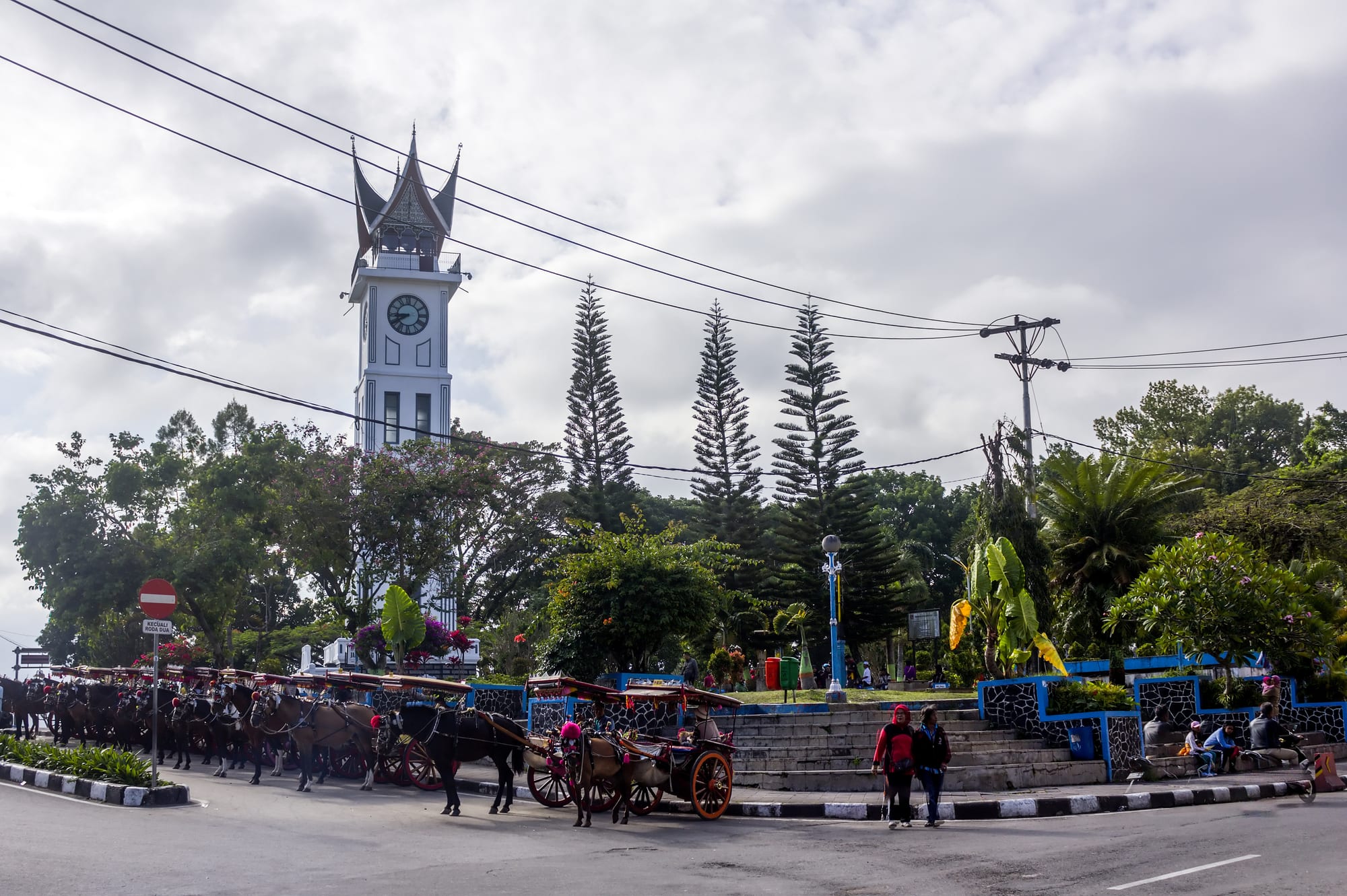
A white clock tower with a pointed Minangkabau roof above trees, with horse-drawn carts lined up on the road in front

Sumatra, Indonesia

Bukittinggi

The Jam Gadang clock tower and its plaza in the centre of Bukittinggi, with horse carts waiting alongside. (Crisco 1492 / Wikimedia Commons · CC BY-SA 4.0)

A hill city of about 125,000 people in the Minangkabau highlands of West Sumatra, built on ridges above the Sianok canyon between the volcanoes Singgalang and Marapi. Founded around a market and fortified by the Dutch as Fort de Kock, it is cool, walkable and known for its clock tower, its markets and its food.

Neighbourhoods

  • The Jam Gadang plaza and Pasar Atas
    • First-time visitors
    • Markets
    • Close to public transport

    The centre of town, where the clock tower stands over a plaza busy from early morning until late. The upper market, hotels, minibus stops and rows of food stalls are all within a few minutes' walk, and the ground falls away steeply on every side.

    Open in Maps
  • Kampung Cina and the lower market
    • Best for food
    • Shopping
    • Street life

    The streets dropping north-west from the plaza towards the lower market, historically the Chinese trading quarter. Small shops, cloth sellers and eating houses line the slope, and the town's busiest food lanes are here.

    Open in Maps
  • Benteng and Kinantan hill
    • Historic district
    • Families
    • Views

    The hill above the centre holding the remains of the Dutch fort, the town's zoo and cultural park, and a footbridge across the main road. It is green, quiet and the easiest place to look out over the roofs to the volcanoes.

    Open in Maps
  • Panorama and the canyon rim
    • Views
    • Walks
    • Quiet and residential

    The southern edge of town, where a park on the cliff top overlooks the Sianok canyon and the wartime Japanese tunnels run beneath it. Guesthouses and homes sit along quiet streets set back from the drop.

    Open in Maps
  • The surrounding villages
    • Local life
    • Crafts
    • Countryside

    Nagari villages spread over the plateau beyond the town, with rice terraces, horn-roofed rumah gadang houses, silver workshops and weaving sheds. Many people who work in Bukittinggi live out here.

    Open in Maps

Things to do

In the town

  • Jam Gadanglandmark

    The clock tower of 1926, 26 metres high, a gift from Queen Wilhelmina to the town's Dutch controleur and crowned with a Minangkabau roof after independence.

    Open in Maps
  • Fort de Kocklandmark

    The remains of the Dutch hilltop fort of 1825, built during the Padri War and now standing in a park linked to the zoo by a footbridge.

    Open in Maps
  • Lobang Jepangattraction

    A network of tunnels dug into the canyon wall by forced labour during the Japanese occupation, entered from the park on the rim.

    Open in Maps

Short trips

  • Lake Maninjauattraction

    A caldera lake about 36 kilometres west of town, reached by a road of many hairpin bends, with fish farms and villages along its shore.

    Open in Maps
  • Pagaruyung Palacelandmark

    A full reconstruction of the Minangkabau royal house near Batusangkar, with tiers of horn-shaped roofs and carved and painted walls.

    Open in Maps
  • Payakumbuhattraction

    A market town east of here on the road towards Riau, the gateway to the cliff-walled Harau valley and the waterfalls of the Limapuluh Kota district.

    Open in Maps
  • Padang Panjangattraction

    A small, rainy town on the road south, known for its arts institute, its Minangkabau music and dance schooling and its satay.

    Open in Maps
  • Mount Marapiviewpoint

    The active volcano east of the town, a constant presence on the skyline and subject to exclusion zones when it is restless.

    Open in Maps
  • Mount Singgalangviewpoint

    The volcano about 10 kilometres south-west of the town, with no recorded eruptions of its own, forested to the summit, with two small lakes at the top and paths up from the villages on its lower slopes.

    Open in Maps

Seasonal events

  • Ramadan and Eid al-Fitrshifts through the year with the Islamic calendar

    The fasting month is strictly kept in West Sumatra, with many restaurants closed by day, and Eid brings home thousands of Minangkabau who live elsewhere.

  • Pacu Jawi cow racesafter the rice harvest

    Races in the muddy rice fields of Tanah Datar Regency south-east of town, in which a rider stands on a wooden plough behind a pair of bulls and holds them by their tails; no winner is formally declared.

  • Tabuikthe month of Muharram in the Islamic calendar

    The Ashura procession at Pariaman on the coast, ending with tall biers carried to the sea, drawing visitors from across the highlands.

  • Independence Day17 August

    Parades, school competitions and traditional performances around the clock tower, in a town closely tied to the story of the republic.

Eat and drink

Long-standing places and food districts in Bukittinggi. Hours, ratings and directions come from your maps app, always current.

Markets and food streets

  • Pasar Atas and Pasar Aur Kuningmarket

    The town's traditional markets — the upper market sprawling over the slope beside the clock tower, and the larger Aur Kuning towards the edge of town — selling vegetables, chillies, cloth, cassava crackers and cooked food, with the busiest trading on market days.

    Open in Maps
  • Nasi Kapau stallsneighborhood

    A lane of stalls where women serve rice with a tiered display of curries — offal, jackfruit, fish and the beef stew gulai — ladled out with long-handled spoons.

    Open in Maps
  • Evening stalls around Jam Gadangneighborhood

    Carts and folding tables that appear near the clock tower after dark selling grilled corn, martabak, satay, sweet drinks and coffee.

    Open in Maps

Highland specialities

  • Coffee houses on the canyon sidecafe

    Simple places serving kopi kawa daun, an infusion of dried coffee leaves drunk from a coconut shell, along with teh talua, tea whisked with egg yolk.

    Open in Maps
  • Sanjai cracker shopsneighborhood

    Shops on the road out of town selling karupuak sanjai, thin cassava crisps coated in red chilli paste, boxed up as the standard gift from Bukittinggi.

    Open in Maps

Experience Bukittinggi

History

Bukittinggi began as a market on a ridge in the Minangkabau highlands, at the meeting point of roads through the volcanic plateau. Its modern shape was imposed by war. During the Padri conflict, which set Islamic reformers against the traditional adat leadership from 1803, the Dutch intervened on the side of the adat chiefs and in 1825 built a fort on the hill above the market, naming it after the commander Hendrik Merkus de Kock. The town that grew around it became known as Fort de Kock, and the Dutch used it as a hill station and a centre of administration and schooling for the highlands.

That schooling mattered. The teacher-training and religious schools of the highlands produced a generation of nationalists, among them Mohammad Hatta, born in the town in 1902, who became the republic's first vice-president. The Japanese occupied the area in 1942, made Bukittinggi a regional headquarters and had tunnels dug into the canyon wall by forced labour.

After the Dutch occupied Yogyakarta, the emergency government of the republic was established at Bukittinggi on 22 December 1948 under Sjafruddin Prawiranegara, and its leaders moved about the highlands to avoid capture, keeping Indonesian sovereignty alive until it was dissolved in July 1949. The town was officially renamed Bukittinggi in 1949, its name meaning high hill. It was later caught up in the regional PRRI rebellion of 1958 and suffered damage in the earthquakes that periodically strike West Sumatra, but it has kept its role as the market, education and tourism centre of the highlands.

Culture & Customs

Bukittinggi is the natural capital of Minangkabau culture, and that culture is unusual: the largest matrilineal society in the world, and a devoutly Muslim one. Ancestral houses and rice land belong to the women of a clan and pass from mother to daughter, while men hold ceremonial authority as maternal uncles and are expected to make their own way. The saying that custom rests on religion and religion on the Book sums up how the two systems are held together.

Out of this comes merantau, the tradition of young men leaving home to seek experience and money elsewhere, which has scattered Minangkabau traders, restaurateurs and intellectuals across Indonesia and Malaysia and given the Padang restaurant its national reach. Those who leave are expected to send money back and to return for ceremonies; the plateau's villages are full of large houses built with outside earnings.

The town's visible culture is in its buildings and crafts: the horn-shaped roofs of the rumah gadang, songket weaving at Pandai Sikek and Koto Gadang, talempong gong-chime music, the martial art silek and the randai theatre that combines it with song. Weddings are large, matrilineal and organised by the wife's family. Manners are formal, speech is indirect and proverb-laden, and debate — for which Minangkabau people are known across the country — is enjoyed.

Daily Life

About 125,000 people live inside the city boundary, which makes Bukittinggi small by Indonesian standards but the busiest place in the highlands, serving a much wider population that comes in to trade, study and see doctors. The economy is built on the markets, on tourism from within Indonesia and Malaysia, on schools, universities and hospitals, and on the farms around the town, which grow rice, vegetables, chillies and coffee in volcanic soil.

Life is organised around the market days that bring villagers in from the plateau, around prayer times, and around the cool weather, which makes the town more active in the middle of the day than the lowlands. Horse carts still trot around the plaza alongside minibuses and scooters. Evenings centre on the clock tower, where families gather, and on coffee houses where men talk late.

Households are shaped by migration. A great many families have members working in Jakarta, Java or Malaysia, and the money and the returning holidaymakers are part of the local economy; the week after Eid al-Fitr fills every hotel and clogs every road. The pressing worries are the volcano, whose eruptions close farmland and disrupt the air, earthquakes, the price of vegetables, and the fire risk in the crowded markets.

Food

West Sumatran food is among the most widely eaten cooking in Indonesia and its neighbours, and in Bukittinggi it is eaten at its source. The local version of the Padang meal is nasi Kapau, named after a village just outside town: rice served with dishes heaped on a stepped display and ladled out with a long-handled spoon, among them gulai tambusu, a stuffed intestine curry, jackfruit gulai, and beef stewed in coconut milk. Rendang, dark and nearly dry, and dendeng balado, thin crisp beef under red chilli, are everywhere, and sate Padang comes in a thick, spicy yellow sauce.

The highlands add their own dishes. Itiak lado mudo is duck stewed with green chilli, a speciality of the villages around the canyon. Dadiah, buffalo milk soured in a bamboo tube, is eaten for breakfast with sticky rice and palm sugar. Lamang tapai pairs glutinous rice cooked in bamboo with fermented black rice.

Drinks are as distinctive as the food. Kopi kawa daun is brewed from dried coffee leaves rather than beans, and is served in a coconut shell. Teh talua is tea whisked with egg yolk, sugar and lime until it foams. The town's best-known edible souvenir is karupuak sanjai, thin cassava crisps in a fierce red chilli coating, sold in boxes along the road out towards Payakumbuh.

Planning tools

Budget

Bukittinggi is cheap even by Indonesian standards. Guesthouses and small hotels near the centre cost little, market food less, and the markets themselves are free to walk around. The main expenses are a car with a driver for trips to the lake, the valleys or the palace, and guides for walks on the volcanoes.

Daily Budget Midrange
USD 45–95 (hotel room, restaurant meals, a car and driver for a day out, entry fees)
Daily Budget Shoestring
USD 15–28 (guesthouse room, market and warung meals, minibuses)

Draw cash in town before heading into the villages, where card payment is rare and machines are few.

Best Time to Visit

The highlands are pleasant all year. The drier months from about May to September give the clearest views of Singgalang and Marapi and firmer paths in the valleys. Rain is heaviest from October to March but usually falls in the afternoon. Ramadan closes many eating places by day, and the week after Eid al-Fitr is the busiest of the year.

Suggested Number of Days

Two days is enough for the town itself, which is small and easily walked. Four or five allows for the lake, the valleys and the villages of the plateau, which are the main reason most people stay longer.

First Visit
2 days
With Surroundings
4–5 days

Transportation

The town centre is covered on foot. Beyond it, small minibuses called angkot run on fixed routes to the surrounding villages and towns, and horse carts, bendi, still work as local transport around the plaza. Cars with drivers are easily arranged for day trips, and long-distance buses and shared minibuses leave for Padang, Medan and Pekanbaru.

Roads on the plateau are winding and slow, so allow much longer than the map distance for any trip to the lake or the valleys.

Airport & Station Connections

There is no airport at Bukittinggi. Most visitors fly into Minangkabau International Airport, about 23 kilometres north-west of Padang, and travel on by car or minibus: Bukittinggi lies 90 kilometres by road from Padang, a climb of a few hours depending on traffic through the gorge. Long-distance buses connect with Medan, a journey of the better part of a day, and with towns across Sumatra.

Walkability

One of the more walkable towns in Indonesia. The centre is compact, the climate is cool enough to make walking pleasant, and the clock tower, the markets, the fort, the zoo and the canyon rim are all within about a kilometre of one another. The catch is the gradient: the town is built on ridges and the streets rise and fall steeply, with steps in places.

Safety

Bukittinggi is a quiet town with little crime beyond occasional pickpocketing in the markets. The real risks are geological: West Sumatra lies on a major fault, earthquakes are frequent, and Marapi is an active volcano that has erupted in recent years, with exclusion zones that change. Steep, wet steps around the canyon and fast traffic on the narrow roads out of town are the other everyday hazards.

Check the current status and exclusion zone before any approach to Marapi, and treat earthquake advice seriously in an area where it is genuinely needed. Wear a helmet and only ride a scooter if experienced, avoid cheap cocktails and home-brewed spirits, dress modestly outside Bali and beach resorts, and heed volcano exclusion zones and tsunami warnings. Check current official travel advice before travelling.

Climate

At about 930 metres the town is far cooler than the Sumatran coast, with days of about 24–25°C and nights that drop to 16–18°C, often with mist in the canyon in the early morning. The equator passes close by, so rain falls in every month, most of it in the afternoon.

Summer
the drier months, May to September: mild bright days near 25°C, cool evenings and the best mountain views
Winter
the wetter months, October to March: heavy afternoon rain, low cloud on the volcanoes, about 23–24°C by day and 17°C at night

Local Customs

West Sumatra is strongly Muslim and Minangkabau custom is closely tied to Islam. Dress is modest, most women cover their hair, and shorts and sleeveless tops are out of place away from the guesthouse. Alcohol is barely sold and not drunk in public. Society is matrilineal — houses and land pass through the female line — and visitors are often asked about their family and village before anything else.

Cover shoulders and knees, use the right hand for eating and giving, ask before photographing people or ceremonies, and expect food to be eaten with the fingers in traditional restaurants.

Common Payment Methods

The currency is the Indonesian rupiah. Cash is used for markets, stalls, bendi and minibuses; the QRIS code system is accepted in many shops and cafés, and cards work in hotels and larger restaurants. Bank machines are clustered around the town centre and are scarce in the villages beyond it.