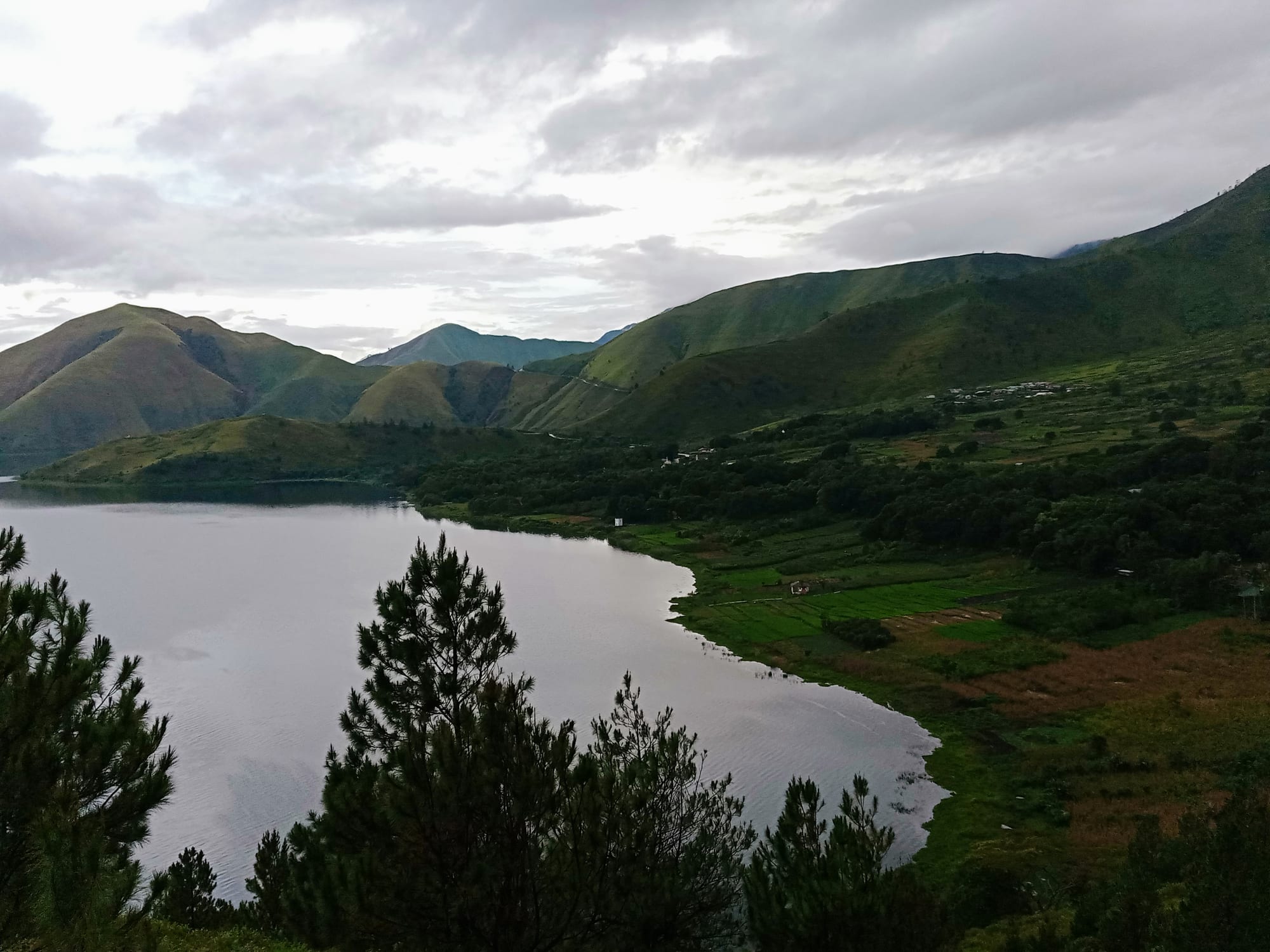
Green hills falling to the still grey water of a wide lake, with rice plots, a few houses and pine trees in the foreground under cloud

Sumatra, Indonesia

Samosir

The shore of Lake Toba on Samosir, with hill farms and pine ridges above the water. (Franklin Daniel Situmorang / Wikimedia Commons · CC BY-SA 4.0)

A large island inside Lake Toba, the crater lake of a supervolcano in the North Sumatran highlands, and the heartland of the Toba Batak people. Stone tombs, carved village courts and tall gabled houses sit among rice terraces and pine ridges, while the lakeside village of Tuktuk lives on guesthouses, swimming and the ferry from Parapat.

Neighbourhoods

  • Tuktuk Siadong
    • First-time visitors
    • Swimming
    • Quiet and residential

    A small peninsula on the eastern shore that holds almost all the island's guesthouses, cafés and bicycle and scooter rental. Gardens run down to the water with jetties for swimming, and the lane around the headland takes about an hour to walk.

    Open in Maps
  • Tomok
    • Historic district
    • Souvenirs
    • Ferry arrivals

    The village just south of Tuktuk where the car ferry docks, built around the stone tombs of the Sidabutar family. A covered lane of stalls sells ulos cloth, wood carvings and coffee on the way up to the graves.

    Open in Maps
  • Ambarita
    • Historic district
    • Village life

    A lakeside village north of Tuktuk, known for the walled compound of stone chairs and tables where the local raja held court. Beyond the compound it is an ordinary working village of fish cages, churches and small shops.

    Open in Maps
  • Pangururan
    • Local life
    • Markets
    • Transport connections

    The island's main town and administrative centre, on the western side where the Tano Ponggol canal, cut in 1906 and widened in 2019, separates Samosir from the mainland. It has the largest market, the banks and the road on towards the Tele viewpoint, with hot springs on the slopes opposite.

    Open in Maps
  • The highland interior
    • Walks and cycling
    • Quiet and residential
    • Views

    The plateau in the middle of the island, several hundred metres above the lake, with rice terraces, pine woods, buffalo and scattered hamlets. Roads climb steeply from the shore, and the small crater lake of Sidihoni lies up here.

    Open in Maps

Things to do

The lake and the island

  • Lake Tobaattraction

    The largest volcanic lake in the world, filling the caldera of an eruption around 74,000 years ago, with deep water swum in from jetties along the shore.

    Open in Maps
  • Lake Sidihoniattraction

    A small lake on the island's high plateau, reached by a steep road through rice terraces and sometimes called a lake within a lake.

    Open in Maps
  • Pangururanneighborhood

    The island's small capital and the seat of Samosir Regency, with a daily market, a church-dominated skyline, hot springs on the slopes opposite and the canal cut through the isthmus to the mainland.

    Open in Maps
  • Huta Bolon Museum, Simanindomuseum

    A museum in the village of Simanindo in the north of the island, in the former house of a Batak king, holding brass utensils, weapons, Dutch and Chinese crockery and Batak carvings, with dance performances for visitors.

    Open in Maps

Short trips

  • Parapatattraction

    The lakeside resort town on the mainland shore, the road head for Medan and the departure point for most ferries to the island.

    Open in Maps
  • Baligeattraction

    A town on the southern shore of the lake with a large market, old Batak houses and a long waterfront, on the road towards the airport at Siborong-Borong.

    Open in Maps

Seasonal events

  • Christmas and New Yearlate December

    The most important holidays on a largely Protestant island, when churches fill, families return from the cities and guesthouses are fully booked.

  • EasterMarch or April

    Services, processions and long family gatherings across the Batak villages, and a second peak in domestic visitors.

Eat and drink

Long-standing places and food districts in Samosir. Hours, ratings and directions come from your maps app, always current.

Where to eat on the island

  • Tuktuk's guesthouse kitchensneighborhood

    The lakeside guesthouses along the peninsula cook both Batak dishes and simple Indonesian and Western food, often on terraces over the water.

    Open in Maps
  • Pangururan marketmarket

    The island's main market, with lake fish, vegetables from the highlands, chillies, andaliman pepper and stalls selling cooked rice plates.

    Open in Maps
  • Tomok food stallsneighborhood

    Warung near the ferry landing serving grilled carp, noodle soups, coffee and the snacks brought out for ferry passengers.

    Open in Maps
  • Lapo tavernsneighborhood

    The open-sided Batak eating houses found in most villages, where grilled pork, saksang and palm wine are served with singing in the evening.

    Open in Maps

Experience Samosir

History

Samosir is the centre of the Toba Batak world. Batak tradition places the origin of the people at Pusuk Buhit, the mountain above the western shore, and the island's villages trace themselves to clans, the marga, whose founders are remembered by name. For centuries these were small independent settlements, each a huta of a few houses behind a bamboo rampart, ruled by a raja and bound to its neighbours by marriage and feud. The stone chairs at Ambarita and the carved sarcophagi at Tomok belong to that order, and ritual cannibalism, well documented before colonial times and reported by early European visitors, was performed on enemies and the condemned.

Christianity arrived with German Rhenish missionaries in the second half of the 19th century, above all Ludwig Ingwer Nommensen, and reshaped Batak life: churches replaced the old rituals, literacy spread, and the island became overwhelmingly Protestant while keeping its clan structures intact. Dutch control followed the long campaign against the Batak resistance led by Sisingamangaraja XII, who was killed in 1907.

After independence the island remained poor and agricultural, and its young people left in large numbers for Medan and Java. Foreign backpackers discovered Tuktuk in the 1970s and 1980s, and guesthouses spread along the peninsula until visitor numbers fell away in the late 1990s. Since then Lake Toba has been named a national tourism priority, the roads and the airport south of the lake have improved, and in 2020 the caldera was recognised as a UNESCO Global Geopark.

Culture & Customs

Batak identity is unusually strong and openly displayed. Everyone belongs to a marga, a patrilineal clan named on a gravestone and in an introduction, and the rules of who may marry whom and who owes respect to whom follow from it. The system of dalihan na tolu, the three hearth stones, defines obligations between a man's own clan, his wife-givers and his wife-takers, and it governs weddings and funerals to this day.

Those ceremonies are the island's great cultural events. A funeral for an elder with many descendants is a celebration lasting days, with gondang ensembles of drums and reed pipes, the tortor dance that the music accompanies, and the presentation of ulos, the woven cloth draped over the shoulders of those being honoured. Concrete tombs, often large and brightly painted, stand in fields beside the houses and are a striking feature of the landscape.

Music runs through everything else as well. Batak choral singing in close harmony is known across Indonesia, and guitars appear in lapo taverns and guesthouses most evenings. The old gabled houses, with their carved facades, soaring roofs and lizard motifs, remain the island's emblem even though most families now live in concrete bungalows. Manners are direct and loud by Javanese standards, and questions to strangers are frank.

Daily Life

About 145,000 people live in Samosir Regency by the 2025 official estimate. The regency takes in the island and a strip of the mainland shore, and Pangururan, its seat, is the only place of any size. Farming is the mainstay: wet rice on the terraces, maize, coffee, onions, chillies, pigs and buffalo, along with fish cages in the shallows and floating fish farms that have become a point of argument over water quality. Tourism supports Tuktuk, Tomok and Ambarita and little else.

Villages are strung along the shore roads and scattered across the plateau, and life is organised around family, church and the marga. Days begin early and finish early; by nine in the evening most places are dark apart from the guesthouses and a lapo or two. Markets rotate between towns, and Pangururan's is the busiest.

The island's central problem is that its young people leave. Batak families place great value on education, and children are sent to school and university in Medan or Java, from where most do not return. Money flows back the other way as remittances and as the crowds that arrive each Christmas. Local government hopes that improved roads, the airport and the geopark designation will bring enough visitors to change that, while residents also worry about falling lake levels and the clarity of the water.

Food

Batak cooking is the most distinctive in Sumatra, and unlike most Indonesian food it is not Muslim: pork is central, and so is the palm wine, tuak, drunk in the lapo. Saksang is minced pork simmered with spices, coconut and traditionally blood; babi panggang is roast pork served with a sour dipping sauce. Both are ordinary lapo food here and almost unobtainable elsewhere in the country.

The defining seasoning is andaliman, a small green peppercorn related to Sichuan pepper that leaves a tingling numbness on the tongue. It flavours arsik, carp cooked slowly with turmeric, garlic, chilli and the fruit of the torch ginger until the sauce is almost dry, and naniura, a dish of raw carp "cooked" in kaffir lime juice that tradition says was once reserved for kings. Lake fish, mostly common carp and tilapia, appear grilled or fried on almost every menu.

Alongside these are the plainer things: rice with vegetables and chilli sambal, sweetcorn roasted at the roadside, and mangoes, avocados and passion fruit from the highlands. Coffee is serious business, since North Sumatra grows some of the most famous arabica in the world, and a cup of strong local coffee with a doughnut-like fried snack is the standard mid-morning pause. Guesthouses in Tuktuk also cook banana pancakes and pasta for visitors who want a break from chillies.

Planning tools

Budget

Samosir is one of the cheapest places to stay in Indonesia. Simple lakeside rooms cost very little, meals in guesthouses and warung are inexpensive, and a day's scooter or bicycle hire is modest. The real costs are getting there: a car with a driver from Medan, a flight into the regional airport, or the ferry crossing with a vehicle.

Daily Budget Midrange
USD 45–95 (comfortable hotel or resort room, restaurant meals, a hired scooter or a car with driver for a day)
Daily Budget Shoestring
USD 15–28 (lakeside guesthouse room, warung meals, a shared minibus or the passenger ferry)

Bring enough cash: ATMs are concentrated in Pangururan and card payment is uncommon in village guesthouses.

Best Time to Visit

The drier months from about May to September give the clearest views over the lake and the best conditions for cycling and walking on the plateau. The island is busiest at Christmas, Easter and in the long school holidays, when Batak families return from Medan and Jakarta. Rain is possible at any time and often comes in the late afternoon.

Suggested Number of Days

Two or three days is enough for the eastern shore and a loop inland. Four or five suits anyone who wants to circle the island slowly or walk in the highlands. Journeys here are slow, so arrival and departure days are largely taken up by travel.

First Visit
2–3 days
With Surroundings
4–5 days

Transportation

A ring road circles the island and a steep road crosses the middle, and most visitors hire a scooter or a bicycle in Tuktuk to use them. Small public minibuses run between the villages but not often, and guesthouses can arrange a car with a driver for the day. Passenger ferries connect Tuktuk, Tomok and Ambarita with Parapat, and a car ferry crosses to Tomok.

Roads inland are steep, narrow and rough in places, so a scooter is only for confident riders; check the last ferry time before going out for the day.

Airport & Station Connections

Most visitors come overland from Medan to Parapat on the eastern shore, a drive of roughly four to five hours, and cross by ferry to Tomok or Tuktuk in under an hour. The nearer alternative is the domestic airport at Siborong-Borong, about 76 kilometres from Parapat, renamed Raja Sisingamangaraja XII Airport in 2018 and still widely called Silangit. Samosir is also joined to the mainland by a bridge over the canal at Pangururan, so it can be reached entirely by road from the west.

Walkability

Tuktuk is walkable end to end, and the lane around the peninsula is the main thing people do on foot, with jetties, cafés and gardens along the way. Beyond it distances are large and the land rises sharply, so walking between villages is a serious undertaking rather than a stroll. There are few pavements on the ring road, and traffic, though light, moves fast.

Safety

Samosir is a quiet, safe place with very little crime, and the risks are practical ones. The lake is deep and cold below the surface, with sudden afternoon winds and few lifeguards. Scooter accidents on steep, gravelly roads are the commonest problem for visitors, medical facilities on the island are basic, and the whole area is volcanic and seismically active. A ferry from Simanindo sank on the lake in 2018 with the loss of more than 160 lives, an accident investigators attributed to severe overloading.

Wear a helmet and only ride a scooter if experienced, avoid cheap cocktails and home-brewed spirits, dress modestly outside Bali and beach resorts, and heed volcano exclusion zones and tsunami warnings. Check current official travel advice before travelling.

Climate

The lake sits at about 900 metres and the island rises several hundred metres above it, so the climate is mild rather than tropical-hot: days of around 26–29°C and nights that can drop to 16–18°C, with more warmth on the shore than on the plateau.

Summer
the drier months, May to September: sunny mornings and clear views, around 27–29°C by day and 17–19°C at night
Winter
the wetter months, October to April: cloudy with heavy showers and hill mist, about 25–27°C by day and 16–18°C at night

Local Customs

The Toba Batak are largely Protestant, and Sunday is quiet, with services filling the village churches. Clan names, the marga, matter greatly, and visitors are often asked where they are from and how they are related to their companions. Ulos cloth is given at weddings and funerals and should be treated respectfully. Funerals are large, public and musical rather than private, and dress on the island is casual but not skimpy away from the lakeside guesthouses.

Ask before photographing ceremonies, tombs or dances, cover up when visiting a church or a village compound, and accept coffee or tuak when it is offered even if only a little is drunk.

Common Payment Methods

The currency is the Indonesian rupiah. Cash is the norm across the island, and many guesthouses, warung and drivers take nothing else, though the QRIS code system is spreading. ATMs are in Pangururan and a few other towns and can run empty at weekends, so it is worth drawing money in Medan or Parapat before crossing.