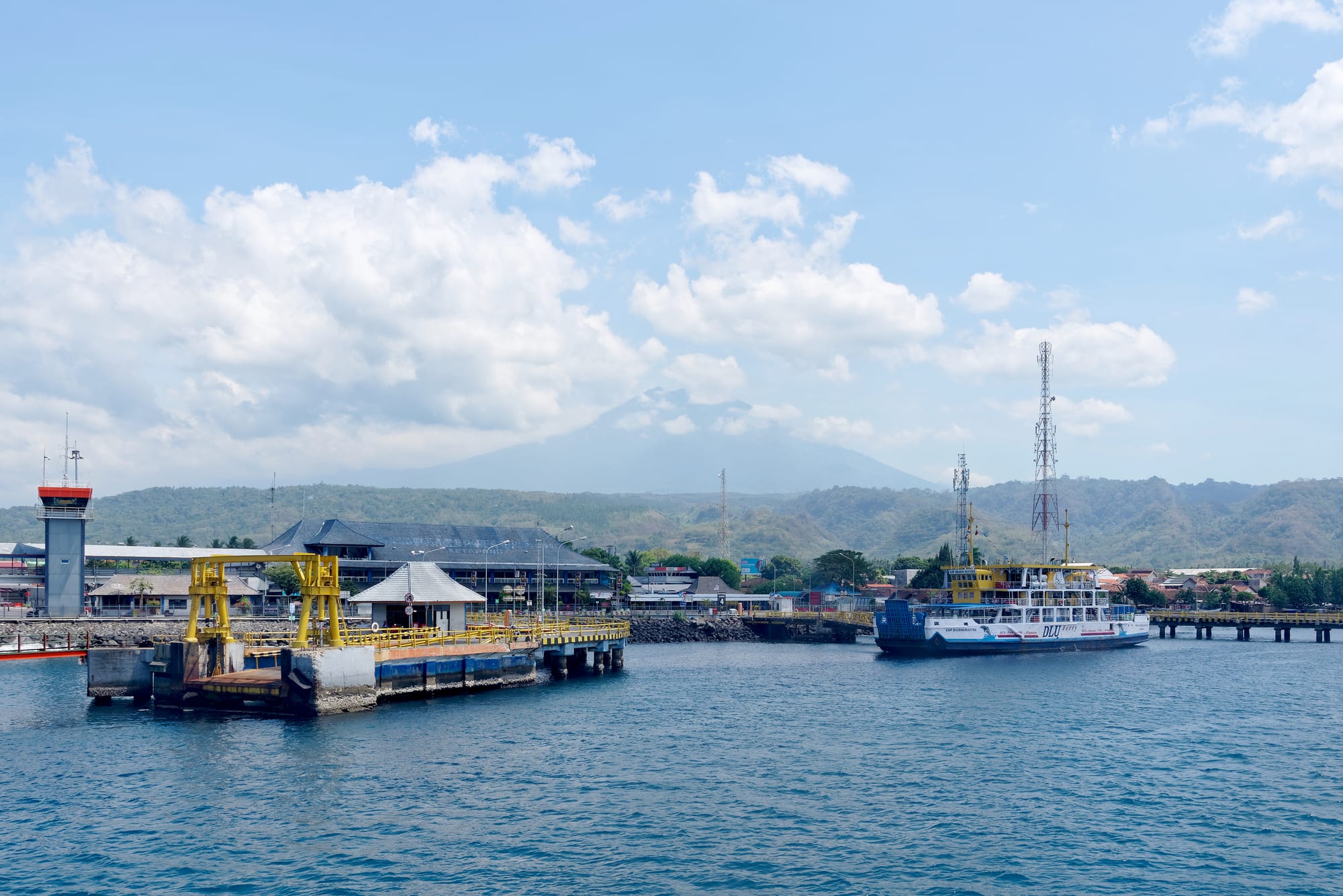
A ferry terminal with yellow loading ramps and a moored ferry, green hills behind and a volcano under cloud in the distance

Java, Indonesia

Banyuwangi

The ferry terminal at Ketapang north of Banyuwangi, where boats cross the strait to Bali, with the Ijen massif behind. (Jakub Hałun / Wikimedia Commons · CC BY-SA 4.0)

The town at the eastern end of Java, facing Bali across a narrow strait crossed by ferries day and night. It is the seat of a large regency of rice fields, coffee slopes and national parks, the home of the Osing people and their gandrung dance, and the usual base for the Ijen crater with its acid lake and sulphur miners.

Neighbourhoods

  • The town centre
    • First-time visitors
    • Close to public transport
    • Best for food

    A low-built grid around the main square, the regency offices and the market, with the town's hotels, coffee shops and the station nearby. It is quiet by Javanese standards and easy to cross on foot or by motorcycle.

    Open in Maps
  • Ketapang
    • Close to public transport
    • Ferries to Bali

    The port district a few kilometres north, where ferries load for Gilimanuk around the clock and the railway station and bus terminal sit beside the terminal. Cheap hotels here suit late arrivals and very early departures.

    Open in Maps
  • Boom beach and the seafront
    • Sunsets
    • Local life

    The town's own stretch of shore, with a promenade, an old jetty, food stalls and an open space used for performances, looking across the strait to the mountains of Bali.

    Open in Maps
  • Kemiren and the western villages
    • Local life
    • Crafts

    Osing villages on the road towards Ijen, where traditional houses, barong performances and coffee-growing continue and several households take guests. The land rises steadily towards the volcano.

    Open in Maps
  • Muncar and the southern coast
    • Markets
    • Local life

    A large fishing port south of the town, one of East Java's national ports, with a harbour full of painted boats, fish processing and its own sea-offering ceremony.

    Open in Maps

Things to do

The Ijen crater and the national parks

  • Ijenviewpoint

    The volcano complex west of the town, whose crater holds a turquoise acidic lake and a hand-worked sulphur mine; the blue flames of ignited sulphurous gas draw guided walks up to the rim and down to the lake around midnight.

    Open in Maps
  • Alas Purwo National Parkpark

    A park of dry forest, savannah, mangrove and coral-fringed beach on the Blambangan Peninsula at the south-eastern tip of Java, with nesting sea turtles, wild banteng on the Sadengan grassland and the surf break at Plengkung on Grajagan Bay.

    Open in Maps
  • Baluran National Parkpark

    Savannah, lowland forest and mangrove below Mount Baluran, 1,247 metres high, north of the town, known for banteng, deer, leopard and birdlife.

    Open in Maps
  • Meru Betiri National Parkpark

    Rainforest and remote beaches along the southern coast, where leatherback, hawksbill, green and olive ridley turtles nest; it was the last refuge of the Javan tiger, recorded here for the last time in 1976.

    Open in Maps

The town and the coast

  • Boom Beachbeach

    The town's own beach and promenade, with fishing boats and views across the strait to Bali, used for open-air events and busy in the evening.

    Open in Maps
  • Ketapang ferry terminaltransit hub

    The crossing point to Bali, where vehicle ferries leave through the day and night for Gilimanuk; there is no bridge, so every vehicle uses this route.

    Open in Maps
  • Muncar fishing portattraction

    A national fishing port packed with brightly painted boats, with fish markets and processing plants along the shore.

    Open in Maps
  • Blambangan Squarepark

    The main square in the centre, ringed by government buildings and the mosque, busy in the evening with families and food stalls.

    Open in Maps

Villages and culture

  • Kemirenneighborhood

    An Osing village west of the town where traditional houses, music and the barong dance are maintained, and where coffee is grown and roasted.

    Open in Maps
  • Ketapang stationtransit hub

    The railway station beside the ferry port, renamed from Banyuwangi Baru in 2019 and the most south-easterly station in South-East Asia, with trains west to Surabaya and on across Java.

    Open in Maps
  • Pulau Merahbeach

    A south-coast beach named for the reddish islet just offshore, with a long stretch of sand and a surf break that has hosted international competitions.

    Open in Maps

Short trips

  • Bali Straitattraction

    The narrow channel between Java and Bali, crossed constantly by ferries and known for its currents and its fishing grounds.

    Open in Maps

Seasonal events

  • Gandrung Sewuannual

    A yearly mass performance of gandrung, the regency's own dance of courtship, with rows of dancers moving together; sewu means a thousand.

  • Banyuwangi Festivalthrough the year

    The regency's own programme of dozens of events, from costumed street parades to music, sport and village ceremonies, which has given the town its label as a town of festivals.

  • Seblangvaries with the village calendar

    An old Osing ritual dance performed by a chosen woman in trance, one of the community's best-known ceremonies alongside gandrung and barong.

  • Barong Ider Bumi2 Syawal, just after Idul Fitri

    A barong procession through an Osing village on 2 Syawal in the Islamic calendar, with music, offerings and a shared meal.

  • Petik Lautvaries with the fishing calendar

    A sea offering in the regency's fishing villages, when crews send a decorated boat of offerings out into the strait and the harbour fills with painted vessels.

  • Dry-season climbing at IjenJune to September

    The months with the clearest conditions on the crater rim, when the pre-dawn queues for the descent are longest.

Eat and drink

Long-standing places and food districts in Banyuwangi. Hours, ratings and directions come from your maps app, always current.

Banyuwangi classics

  • Sego tempongrestaurant

    Steamed rice with boiled vegetables, tofu, tempeh, corn fritter and fried catfish, served with a kencur or shrimp-paste sambal fierce enough that the name means to be slapped.

    Open in Maps
  • Rujak sotorestaurant

    A local combination in which beef soto is poured over a rujak of vegetables and lontong rice cake in petis sauce, credited to a Banyuwangi cook in 1975.

    Open in Maps
  • Pecel pitikrestaurant

    An Osing ceremonial dish of grilled young chicken dressed with coconut and spices, cooked in the villages west of the town.

    Open in Maps

Markets and the coast

  • The town market and night stallsmarket

    Produce, fish and spices in the morning, and stalls of grilled food, noodles and drinks around the square after dark.

    Open in Maps
  • Muncar seafoodneighborhood

    Grilled fish, squid and sardines straight off the boats at Muncar, eaten at simple places near the harbour.

    Open in Maps
  • Osing coffeecafe

    Robusta and arabica from the slopes below Ijen, roasted in the villages and served strong and sweet, often with a cup of ginger drink alongside.

    Open in Maps

Experience Banyuwangi

History

The eastern tip of Java was the seat of Blambangan, the last Hindu kingdom on the island, which survived long after the rest of Java had turned to Islam because of its links across the strait with Bali. The region was contested between Balinese rulers, the Mataram sultanate and finally the Dutch East India Company. The Dutch takeover in the later eighteenth century ended Blambangan's independence, after warfare that devastated its population; the survivors of that period are the ancestors of the Osing, who kept a distinct language and customs.

The Dutch rebuilt the area around a new administrative centre near the coast. The name Banyuwangi, meaning fragrant water, comes from a local legend of a wife whose innocence was proved when the river ran sweet after her death. Plantations of coffee, rubber and later cocoa were laid out on the volcanic slopes, and sulphur mining began at Ijen, worked by hand and carried down the mountain on shoulder poles, as it still is.

A railway reached the town in 1903, completing the line across Java, and the ferry crossing to Bali made the port a corridor for traffic between the islands. The regency's later history includes the mass killings of 1965-66, which fell hardest on East Java, Central Java and Bali, and a witch-hunt in 1998 against people accused of sorcery that spiralled into wider violence in which Islamic clerics were also killed. In recent decades Banyuwangi has promoted itself as a festival and outdoor-tourism destination, opening an airport, restoring Osing villages and building an annual calendar of events around the dances and landscapes of the regency.

Culture & Customs

The Osing are the defining community. Their language, a branch of Javanese with its own vocabulary and word play, is spoken in the villages west and south of the town, and their culture is publicly celebrated rather than kept private. The gandrung is the best-known expression of it: a dance of courtship performed by a woman in a gold headdress and sash, once travelling from village to village and now the regency's emblem, performed en masse at the yearly Gandrung Sewu festival.

Ritual life keeps older layers visible. The seblang trance dance is performed by a chosen woman in the Osing villages, a barong procession passes through the lanes just after Idul Fitri, and the fishing communities hold their sea offering, the petik laut. Islam is observed alongside these practices without much tension, and Balinese Hindu temples and Chinese shrines add to the mix in a place where three islands' cultures meet.

Coffee, surfing and volcanoes have brought a newer layer of visitors and an outward-looking local administration that stages dozens of festivals a year. Manners are East Javanese: direct and cheerful by Central Javanese standards, with strong hospitality and a habit of feeding guests immediately. Photography of ceremonies is generally welcomed if permission is asked first.

Daily Life

The town district counted about 118,000 people at the 2020 census, within a regency of about 1.7 million at the same count, spread over a large area of coast, farmland and forest — the third largest regency on Java by area. The population mixes Osing, Javanese, Madurese and Balinese, and the languages heard in the market shift from street to street.

The economy rests on farming and fishing: rice on the plain, coffee, cocoa and rubber on the volcanic slopes, fruit and vegetables in the hills, and a large fishing fleet at Muncar, with canneries and processing plants behind the harbour. Sulphur is still carried out of the Ijen crater by hand. Tourism has grown quickly around the volcano, the surf beaches and the parks, and the ferry port makes the town a transit point for freight and labour moving to Bali.

Life follows the boats and the fields. The fish market is busiest before dawn, ferries load through the night, and jeeps and motorcycles leave for Ijen around midnight. Afternoon heat empties the streets, and evenings belong to the square and the seafront. Local concerns include the condition of the fishing grounds, crop prices, the safety of the miners, and how far tourism should be pushed in a regency that markets itself hard.

Food

The regency's signature is sego tempong: a plate of rice with boiled vegetables, tofu, tempeh, corn fritter and fried catfish, and a raw sambal of chilli, shrimp paste and lime that gives the dish its name, a word for a slap. Rujak soto is the other local invention, pouring beef soto over a vegetable rujak with lontong in petis sauce — a combination that sounds improbable and is eaten all over the town.

Osing village cooking supplies the ceremonial dishes. Pecel pitik is grilled young chicken mixed with coconut and spices, prepared for communal meals in Kemiren, and the ceremonial meals of the Osing villages keep older rice dishes in use. Cenil, a chewy cassava sweet rolled in grated coconut, appears at markets in the morning.

The sea and the slopes provide the rest. Muncar's boats land sardines, tuna and squid, grilled simply or turned into pindang, and dried and salted fish is a staple. Coffee is the regency's pride, grown on the flanks of Ijen and Raung and roasted in the villages, often drunk with a spoonful of sugar in a glass. Warm ginger drinks suit the cold nights on the mountain, and fruit from the regency's orchards and hill gardens is sold along the roads.

Planning tools

Budget

Banyuwangi is inexpensive, with simple hotels, cheap food and short distances. The costs that matter are the Ijen trip — guide, transport, park entry, which is higher for foreigners and higher again at weekends, and gas-mask hire — and car hire for the national parks, which are spread far apart on poor roads.

Daily Budget Midrange
USD 50–110 (comfortable hotel, restaurants, executive-class trains, a driver or jeep for the volcanoes)
Daily Budget Shoestring
USD 20–35 (guesthouse, warung meals, local transport and the ferry)

Share transport and a guide for the Ijen climb, and treat the national parks as separate day trips rather than combining them.

Best Time to Visit

May to September is drier and gives the most reliable conditions at Ijen and on the park roads, with the clearest nights for the pre-dawn climb. The wet season from November to March brings heavy rain, slippery trails and rougher seas, though the ferries run all year. Surf on the south coast is largest in the dry months.

Suggested Number of Days

The town itself needs little time; most visits are built around the volcano and the parks, which lie in different directions and take a day each. A night's rest is usually needed after the early start at the crater.

First Visit
1–2 days
With Surroundings
3–4 days

Transportation

Ride-hailing cars and motorcycle taxis work in the town, along with angkot minibuses and ojek. A hired car with a driver or a motorcycle is the practical way to reach Ijen, the coast and the parks, where the last stretches are rough and public transport does not go. Ferries to Bali run continuously from Ketapang.

Arrange the Ijen trip through a guesthouse or a licensed operator the day before, since the walk to the rim starts around midnight.

Airport & Station Connections

Banyuwangi Airport at Blimbingsari lies about 12 kilometres from the town and handles domestic flights. Trains run the length of Java to the station beside the ferry port, taking several hours from Surabaya and much longer from the west, and buses use the terminal nearby. Ferries cross from Ketapang to Gilimanuk on Bali through the day and night, and Bali's airport is several hours further by road.

Walkability

The centre is small, flat and easily walked, from the square to the market and down to the seafront. Pavements are patchy, and the heat is heavy in the middle of the day. Everything else — the port, the villages, the beaches and the parks — is too far apart to walk between.

Safety

The town is quiet and crime is low, with opportunist theft at the ferry terminal and the station the main concern. The risks lie on the volcano and the coast: the Ijen crater gives off sulphurous fumes that can be overwhelming when the wind shifts, the climb to the rim and the descent to the lake are steep and loose, and the southern beaches have strong rips and few lifeguards. Roads to the parks are narrow and unlit.

Climb Ijen only with a guide and a proper gas mask, leave the crater immediately if the wind turns the fumes, respect closures and exclusion zones, treat the south-coast surf as unsafe for weak swimmers, and note that drug offences carry severe penalties, including death. Check current official travel advice before travelling.

Climate

Hot and humid at sea level all year, a little drier than much of Java because of the rain shadow of the eastern mountains, with a wet season from about November to March and a dry season from May to September. The Ijen rim is cold at night in every season.

Summer
the dry season, May–September: about 23–32°C in the town, with cold nights on the crater rim
Winter
the wet season, November–March: about 24–31°C, with heavy afternoon rain, mud on the mountain tracks and rougher seas

Local Customs

Banyuwangi is the home of the Osing, descendants of the old Blambangan kingdom, who speak their own language alongside Javanese, Madurese and Balinese heard around the port. Islam is the majority faith, and small Hindu and Christian communities are long established, with Balinese temples in some villages. Dress modestly, cover arms and legs at mosques and shrines, remove shoes indoors and use the right hand for giving and eating. Tipping is not expected.

Ask before photographing ceremonies, dancers or fishing crews, dress warmly and modestly for the night climb at Ijen, and keep a respectful distance from the sulphur miners at work.

Common Payment Methods

The currency is the Indonesian rupiah. Cards work at hotels, the larger shops and the ferry ticket counters, and QRIS code payment is widely accepted in the town. Cash is needed for warungs, guides, park entry and village transport, and cash machines are limited to the town and the port, so money should be drawn before heading into the hills or the parks.