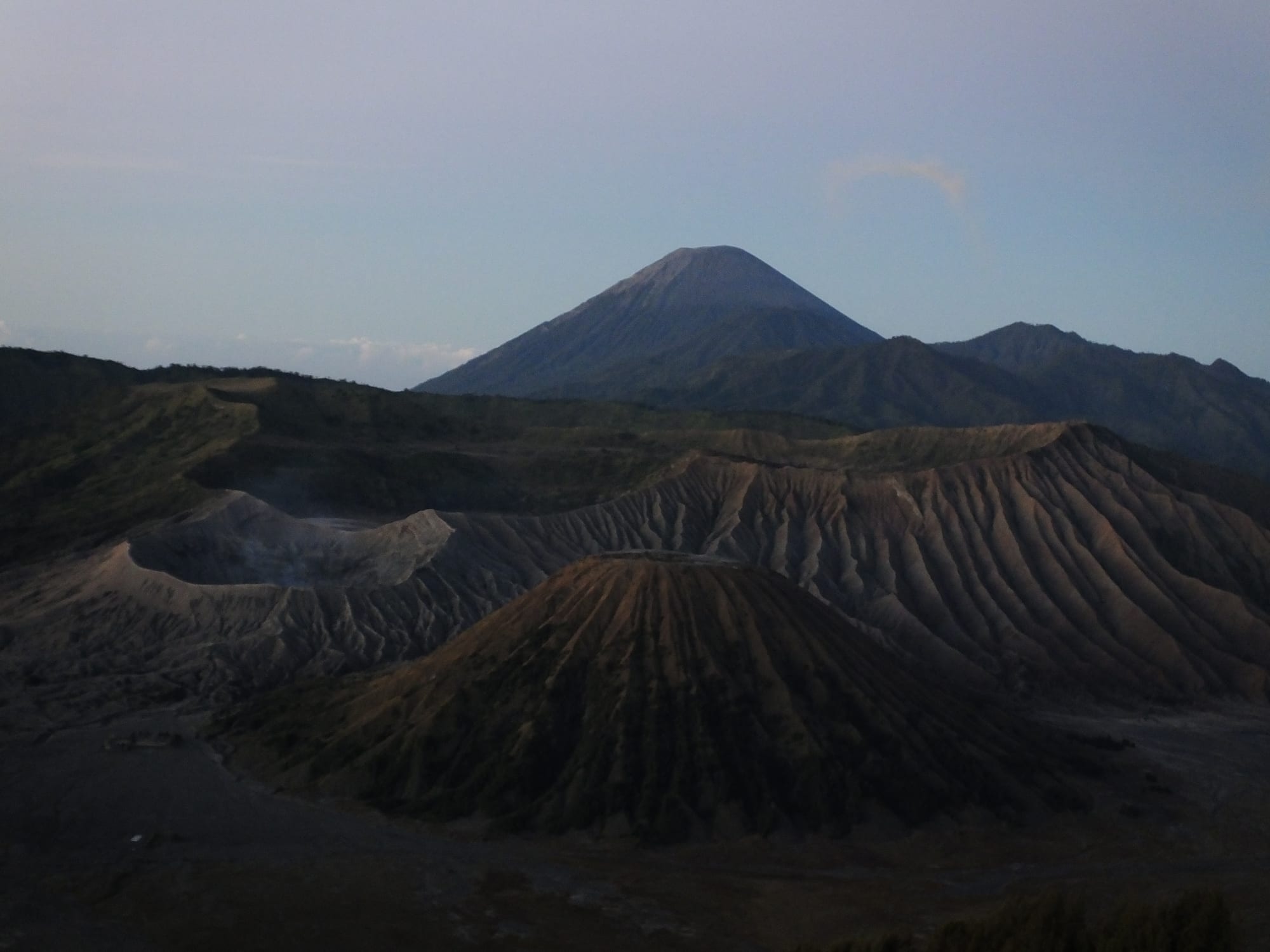
Grey ash cones of Mount Batok and the Bromo crater at dawn, with the peak of Semeru rising behind

Indonesia

Java

The Tengger caldera at first light, with Bromo's crater, the cone of Batok and Semeru in the distance, East Java. (Hugo van den Bos / Wikimedia Commons · CC BY 2.0)

Indonesia's most populous island and political heart, a chain of volcanoes running from Jakarta and the Sundanese uplands of West Java through the old royal courts of Yogyakarta and Solo to Surabaya and the Bromo and Ijen craters in the east — home to more than half of all Indonesians.

Explore Java

History

Java has been inhabited for a very long time: the fossils of "Java Man", an early human ancestor, were found on the Solo River in the 1890s, and the Sangiran site near Solo is a UNESCO World Heritage Site. Indian-influenced kingdoms appear from the 5th century, first Tarumanagara in the west, then in the fertile volcanic plains of Central Java the Buddhist Sailendra and Hindu Mataram dynasties, who raised Borobudur around 800 and Prambanan in the mid-9th century. Power later shifted east to Kediri and Singhasari, and in 1293 to Majapahit, whose chief minister Gajah Mada extended its influence across much of the archipelago.

Islam spread along the north coast through traders and the saints remembered as the Wali Songo, and by the 16th century sultanates at Demak, Banten and later the new Mataram ruled the island. In 1619 the Dutch East India Company seized Jayakarta and rebuilt it as Batavia, its Asian headquarters. The Java War of 1825–30, led by Prince Diponegoro, was followed by the Cultivation System, which forced farmers to grow export crops for the colonial state.

Independence was proclaimed in Jakarta on 17 August 1945. The Battle of Surabaya that November is still marked as Heroes' Day, and Yogyakarta served as the republic's capital during the war with the Dutch; in return its sultanate kept a special status, and the sultan remains governor. Bandung hosted the Asian-African Conference in 1955. Java has since grown into the country's industrial and political core, and the planned move of the capital to Nusantara on Borneo is a response to Jakarta's crowding and sinking land.

Culture & Customs

Java holds three main peoples. The Javanese of the centre and east have their own language, with distinct speech levels for addressing elders and superiors, and a courtly culture kept alive by the palaces of Yogyakarta and Solo: gamelan orchestras, classical dance, the wayang kulit shadow-puppet plays that last all night, and the keris dagger. The Sundanese of West Java and Banten speak a separate language and are known for bamboo music, including the angklung, and the kacapi zither. The Madurese, from the island of Madura off Surabaya, are traders and sailors, famous for their bull races.

Islam is the majority faith, but Javanese practice has long absorbed older mystical traditions, known as kejawen, and the royal courts still stage the Grebeg processions, when mountains of rice are carried out of the palace and scrambled for by crowds. East Java is also the heartland of Nahdlatul Ulama, the largest Muslim organisation in the country, founded in 1926, and of its many pesantren boarding schools. Around Bromo, the Tengger people keep a Hindu faith and throw offerings into the crater during the Yadnya Kasada festival.

Batik is Java's signature craft, with the muted browns of the Yogyakarta and Solo courts contrasting with the brighter coastal styles of Pekalongan and Cirebon. Manners are soft-spoken: open anger is shameful, the right hand is used for giving and eating, and elders are addressed with care.

Daily Life

Java is one of the most densely populated places on Earth, with more than 150 million people on an island the size of England. Jakarta proper has about 11 million residents and the wider metropolitan area over 30 million; Surabaya has close to 3 million, Bandung about 2.5 million, Semarang about 1.7 million, and Yogyakarta city some 400,000, though its wider area and student population are much larger.

The economy runs on manufacturing in the industrial belts around Jakarta, Bekasi, Karawang and Surabaya, on the ports, on government and finance in the capital, and on rice, sugar, tobacco and coffee in the countryside. Kretek clove cigarettes are a large industry in East and Central Java, and Yogyakarta is the country's best-known university city.

Days start early with the dawn call to prayer, breakfast from a street cart, and commutes on scooters, the commuter trains around Jakarta, or the newer MRT line. Evenings bring night markets and angkringan stalls, where students sit on mats over coffee and small parcels of rice. Congestion, flooding, land subsidence along the north coast and air pollution are the constant urban issues, while in the villages land is scarce and many young people leave for the cities or for work abroad.

Food

Javanese food leans sweet, seasoned with palm sugar and sweet soy sauce, kecap manis, while Sundanese and East Javanese cooking is hotter and saltier. Yogyakarta's signature is gudeg, young jackfruit stewed for hours in coconut milk and palm sugar, served with chicken, egg and a spicy stew of crisp beef skin. Solo is known for nasi liwet, rice cooked in coconut milk with chicken and eggs. East Java has rawon, a black beef soup coloured by the keluak nut, rujak cingur, a Surabaya salad with cow's snout in a shrimp-paste dressing, and the charcoal-grilled sate Madura with peanut sauce.

Sundanese meals in West Java centre on lalapan, raw vegetables eaten with sambal, grilled freshwater fish and sayur asem, a tamarind vegetable soup; Bandung adds batagor, fried fish dumplings with peanut sauce. Jakarta's Betawi cooking gives soto Betawi, a beef soup in coconut milk, and kerak telor, a spiced egg and sticky-rice omelette sold at street fairs.

Sweets include bakpia, small bean-filled pastries from Yogyakarta, and klepon, pandan rice balls filled with palm sugar. Jamu, bitter herbal tonics sold by women carrying bottles in baskets, are a daily habit for many, and wedang ronde, a hot ginger drink with glutinous rice balls, warms highland evenings. Java has grown coffee since Dutch times, and tempeh, the fermented soybean cake, originated here.

Attractions & Natural Wonders

Jakarta's old centre, Kota Tua, keeps the Dutch town hall on Fatahillah Square and the Sunda Kelapa harbour with its wooden pinisi schooners; the National Monument (Monas), the Istiqlal Mosque facing the Catholic cathedral, and the National Museum lie at the heart of the modern city, and the Thousand Islands offer beaches offshore. South of the capital, the Bogor Botanical Gardens date from 1817. At the far western tip, Ujung Kulon National Park shelters the last Javan rhinoceroses.

Bandung, in the West Javan highlands, has the colonial Gedung Sate and art deco streets, with the Tangkuban Perahu crater to the north and the pale crater lake of Kawah Putih to the south. Pangandaran on the south coast is the main beach resort.

Central Java's great sights cluster around Yogyakarta: Borobudur, the largest Buddhist monument in the world, its terraces lined with carved panels and bell-shaped stupas; Prambanan, with its tall 9th-century temples to Shiva, Vishnu and Brahma; and in the city the kraton, the Taman Sari water castle and Malioboro. Mount Merapi looms to the north, Solo has two palaces and a batik market, and the Dieng Plateau has ancient Hindu temples among its steaming fields.

In East Java, Surabaya offers the Heroes Monument, the Arab quarter around the Ampel Mosque and the House of Sampoerna tobacco museum. Inland, Bromo Tengger Semeru National Park holds Mount Bromo's smoking crater in its sand sea and Semeru, Java's highest peak, beyond. At the island's eastern end, the Ijen crater has its turquoise acid lake, sulphur miners and pre-dawn blue flames.

Cities in Java

Planning basics

Budget

Java is cheap outside Jakarta. Yogyakarta and the Central Javan towns have some of the lowest prices in the country for guesthouses, warung meals and trains, while Jakarta's hotels and restaurants cost close to regional big-city rates. Volcano trips add jeep hire and park entry fees, which are higher for foreigners, and the temple tickets at Borobudur and Prambanan are the other notable expense.

Daily Budget Midrange
USD 50–110 (comfortable hotel, restaurants, executive-class trains, a driver or jeep for the volcanoes)
Daily Budget Shoestring
USD 20–35 (guesthouse, warung meals, economy trains and local buses)

Book trains through the national railway app a few days ahead, especially at weekends and around holidays.

Safety

Java is generally safe for visitors. The main risks are volcanic — Merapi and Semeru erupt regularly and Ijen's crater gives off toxic sulphur gas — along with heavy traffic, flooding in Jakarta in the wet season, and pickpockets on crowded trains, buses and markets. Air quality in Jakarta is often poor.

Obey volcano exclusion zones, wear a proper gas mask in the Ijen crater, and keep valuables close in crowds. Check current official travel advice before travelling.

Climate

Hot and humid in the lowlands all year, around 30–33°C by day, with a clear dry season from about May to October and heavy rain from November to March, when Jakarta regularly floods. The highlands are much cooler: Bandung is mild, the Dieng Plateau is chilly, and nights at Bromo and Ijen can fall to a few degrees above freezing in the dry season.

Summer
the dry season, May–October: sunny, 30–34°C on the coasts, cold nights on the volcano rims
Winter
the wet season, November–March: heavy afternoon downpours, flooding in Jakarta, muddy trails on the volcanoes

Transportation

Java has Indonesia's best railway, with day and night trains linking Jakarta, Bandung, Semarang, Yogyakarta, Solo, Surabaya and Banyuwangi, and a high-speed line between Jakarta and Bandung that opened in 2023. Toll roads now run most of the length of the island, but city traffic is slow. Jakarta, Surabaya and Yogyakarta have the main airports, and Bromo and Ijen are usually reached by jeep or tour minibus from Malang, Probolinggo or Banyuwangi.

Jakarta to Yogyakarta is roughly seven to eight hours by train; use app-based taxis in the cities to avoid fare disputes.

Best Time to Visit

May to September gives the clearest sunrises at Bromo and Borobudur and the safest conditions for the Ijen descent. July and August coincide with school holidays and foreign arrivals, so Yogyakarta and Bromo are busiest then, and the weeks around Eid al-Fitr, when millions travel home, fill every train and road. The wet season is fine for the cities and temples with early starts.