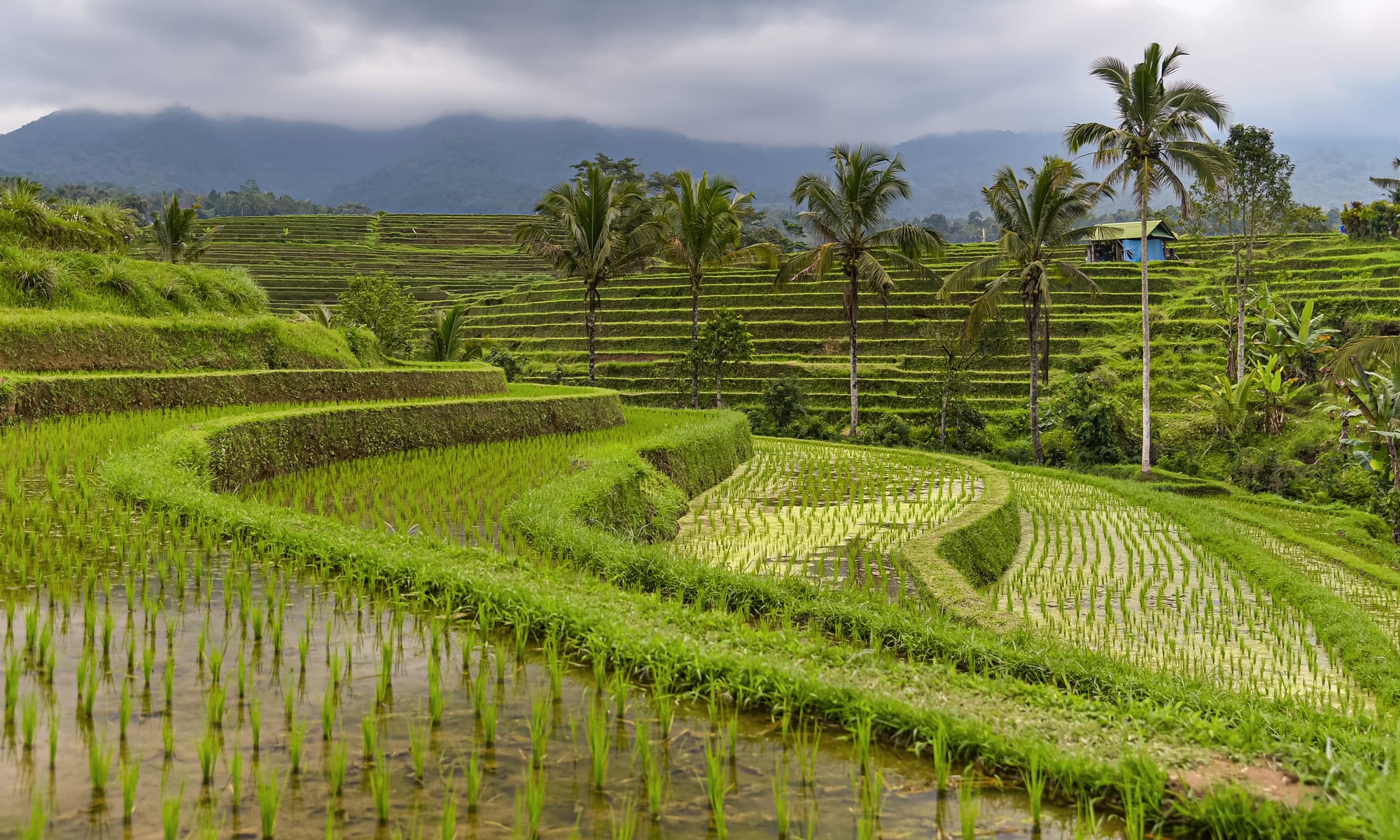
Flooded rice terraces with young green shoots, coconut palms and a hut, below cloud-covered mountains

Indonesia

Bali, Lombok & Nusa Tenggara

Rice terraces at Jatiluwih in central Bali, part of the UNESCO-listed subak landscape. (Jorge Franganillo / Wikimedia Commons · CC BY 2.0)

The Lesser Sunda Islands east of Java, from Hindu Bali through Muslim Lombok and Sumbawa to the largely Christian islands of Flores, Sumba and western Timor — a chain of volcanoes that grows drier and less visited towards the east, and holds Indonesia's busiest resort island alongside the Komodo dragons.

Explore Bali, Lombok & Nusa Tenggara

History

Bali's Hindu-Buddhist kingdoms are recorded from the 9th century, and in 1343 the island came under Majapahit, the East Javan empire. As Islam spread through Java, Majapahit nobles, priests and artists moved to Bali, and the island's court culture grew from theirs. Balinese kingdoms such as Gelgel and later Klungkung ruled the island, and Balinese rulers held all of Lombok by 1750. The Dutch conquered Lombok in 1894 and then south Bali, where the royal courts of Badung in 1906 and Klungkung in 1908 marched into Dutch fire in ritual mass suicides known as puputan.

Further east, Sumbawa was divided among sultanates such as Bima. In April 1815 Mount Tambora on Sumbawa produced the largest eruption in recorded history, killing tens of thousands and causing the "year without a summer" in 1816. Portuguese Dominicans reached Flores and Solor in the 16th century, which is why Larantuka and much of Flores are Catholic. The Dutch held Kupang in western Timor from the 17th century while Portugal kept the east. On Flores, the Liang Bua cave yielded the bones of Homo floresiensis, a small extinct human species, in 2003.

After independence, Bali was a scene of the anti-communist killings of 1965–66 and developed mass tourism from the 1970s. Terrorist bombings in Kuta and Jimbaran in 2002 and 2005 killed more than 200 people. East Timor's independence in 2002 left West Timor as a border province, and Lombok and Labuan Bajo have been developed as new tourist centres.

Culture & Customs

Bali is the only Hindu-majority province in Indonesia, and its religion shapes every day. Small palm-leaf offerings called canang sari are laid on doorsteps and shrines each morning, each village has several temples, and the local banjar, a neighbourhood council, organises ceremonies and cremations. The subak, a cooperative system of water sharing managed through water temples, is a UNESCO World Heritage landscape. Nyepi, the Balinese new year, is a day of total silence, preceded by parades of giant ogoh-ogoh effigies. The island's dance and music — legong, barong, the kecak chant and gamelan — grew within temple life.

Lombok's Sasak people are mostly Muslim; in villages such as Bayan an older blended practice, Wetu Telu, survives. The Bau Nyale festival sees crowds gathering sea worms on the southern beaches before dawn.

East Nusa Tenggara is mostly Christian: Catholic on Flores, Protestant on Sumba and Timor. On Sumba the indigenous Marapu faith continues alongside Christianity, with megalithic tombs in front of clan houses and the Pasola, a mounted spear-throwing contest held after the sea worms appear. Flores has the Holy Week processions of Larantuka and the traditional villages of Bena and Wae Rebo. Hand-woven ikat textiles are the region's main craft from Lombok to Timor, and the island of Rote is known for the sasando, a harp made of palm leaf.

Daily Life

Bali has about 4.4 million people, with Denpasar, the provincial capital, at around 700,000. West Nusa Tenggara, covering Lombok and Sumbawa, has about 5.6 million, most on Lombok, whose capital Mataram has roughly 450,000. East Nusa Tenggara has about 5.6 million people spread across hundreds of islands, with Kupang on Timor the main city.

Bali depends heavily on tourism, which employs a large share of its workforce, and the Covid-19 border closures hit it hard. Growth since then has brought traffic, water shortages, waste and land conversion in the south, and a debate over overtourism and foreign residents. Rice farming, crafts and fishing continue outside the resort belt. Lombok mixes farming and tourism, and many Sasak men work in Malaysia or the Middle East.

East Nusa Tenggara is among the poorest provinces in the country. Its dry islands grow maize, cassava and livestock rather than rice, droughts are common, and many people migrate for work. Labuan Bajo, once a fishing village, has grown into a busy port town serving Komodo boat tours. Days on all the islands start early, with markets at dawn and the heat of midday spent indoors.

Food

Balinese food differs from the rest of Indonesia because pork is widely eaten. Babi guling, spit-roasted suckling pig stuffed with spice paste, is the ceremonial favourite, and lawar, a mix of minced meat, grated coconut, vegetables and spices, often with blood, accompanies feasts. Sate lilit is minced fish or meat wrapped around lemongrass sticks and grilled. Base genep, the Balinese spice paste of shallots, galangal, turmeric and chilli, underlies most dishes, and nasi campur Bali serves a little of each over rice. Sweet rice cakes known as jaje Bali are made for offerings and for breakfast, and Kintamani coffee grows on the northern highlands.

Lombok's food is hot: ayam taliwang, grilled chicken coated in a fiery chilli paste, and plecing kangkung, water spinach with a chilli sambal.

In East Nusa Tenggara, maize is a staple, cooked into jagung bose, a corn stew with beans. Kupang is known for se'i, smoked meat, often pork, served with sambal. Flores grows coffee around Bajawa. Local spirits, moke on Flores and sopi, are distilled from palm sap; home-made arak should be treated with caution because of methanol poisoning.

Attractions & Natural Wonders

Bali's temples come first: Besakih, the mother temple on the slopes of Mount Agung; Tanah Lot on its sea rock; Uluwatu above the southern cliffs, with a kecak performance at sunset; Ulun Danu Beratan on Lake Bratan; and Tirta Empul's holy springs. Ubud is the centre for dance, painting and crafts, near the Tegalalang rice terraces, while Jatiluwih's terraces lie further west. The beaches run from Kuta, Seminyak and Canggu to Nusa Dua, Sanur and the surf breaks of Uluwatu; Nusa Penida's cliffs, sunrise on Mount Batur and the Liberty wreck at Tulamben complete the list.

Off Lombok's north-west coast, the Gili islands offer snorkelling with turtles, from lively Trawangan to quieter Meno and Air. Lombok itself has the southern beaches around Kuta and the Mandalika racing circuit, and Mount Rinjani, over 3,700 metres, with the Segara Anak crater lake, is climbed from Senaru or Sembalun.

On Sumbawa, Mount Tambora can be climbed to its huge crater. Komodo National Park, a UNESCO World Heritage Site, holds Komodo and Rinca, where rangers lead walks to see the dragons, the viewpoint of Padar, a pink beach and manta ray dives, all reached from Labuan Bajo on Flores. The Trans-Flores road passes Wae Rebo and Bena, Bajawa's volcanoes and Kelimutu's three coloured lakes on the way to Maumere and Larantuka.

Sumba offers traditional villages such as Ratenggaro, the Pasola and the Weekuri lagoon. On Timor, Kupang is the gateway to the highland village of Boti and to Rote's surf; Alor is known for diving.

Cities in Bali, Lombok & Nusa Tenggara

Planning basics

Budget

The range is wider here than anywhere in Indonesia. Bali runs from cheap homestays and warungs to some of the most expensive villas in Asia, and Seminyak and Uluwatu cost far more than the rest of the island. Lombok and the Gilis are a little cheaper. East of Lombok, basic accommodation is cheap but transport is not: Komodo boat trips, park fees and flights between the islands add up quickly.

Daily Budget Midrange
USD 55–140 (villa or boutique hotel, restaurants, fast boats, a Komodo day trip or diving)
Daily Budget Shoestring
USD 20–35 (homestay, warung meals, scooter hire, public ferries)

Check entry requirements and any local tourist charges before arrival, and compare Komodo boat operators carefully on safety equipment rather than price alone.

Safety

The islands are generally safe, but Bali has frequent scooter accidents, bag-snatching, drink-spiking and methanol-tainted spirits, and strong rip currents on its south-west beaches. Agung, Batur and Lewotobi on Flores are active volcanoes, Lombok suffered deadly earthquakes in 2018, and rabies is present on Bali and Flores. Malaria occurs in parts of the eastern islands.

Seek treatment at once after any animal bite, swim between the flags, and trek volcanoes with licensed guides. Check current official travel advice before travelling.

Climate

Tropical, with a clear dry season from about April to October and a wet season from November to March. The islands get drier towards the east: Sumba, Timor and the Komodo islands have long, hot dry seasons with brown hills, while Bali's central highlands around Bedugul and Kintamani are cool and often misty.

Summer
the dry season, April–October: sunny and 30–33°C on the coasts, cool nights in the highlands and on Rinjani
Winter
the wet season, November–March: humid, with heavy downpours, rougher seas and Rinjani closed for part of it

Transportation

Bali's airport is the hub for the whole region, with flights to Lombok, Labuan Bajo, Sumba, Kupang and Maumere. Fast boats run from Bali to the Gili islands and Lombok in about two hours, and slower public ferries cross from Padang Bai to Lombok. On the islands, travel is by hired car with driver, scooter or minibus; Bali's southern roads are heavily congested, and the Trans-Flores road takes several days end to end.

Avoid fast boats in rough weather, and allow a spare day around flights to the eastern islands, which are sometimes cancelled.

Best Time to Visit

April to October for beaches, diving, Komodo and the Rinjani climb, with July, August and the Christmas holidays the busiest periods on Bali. Bali shuts down completely for Nyepi, the Day of Silence, usually in March. The Pasola on Sumba is held in February and March, and the Bau Nyale sea-worm festival on Lombok in February or March.