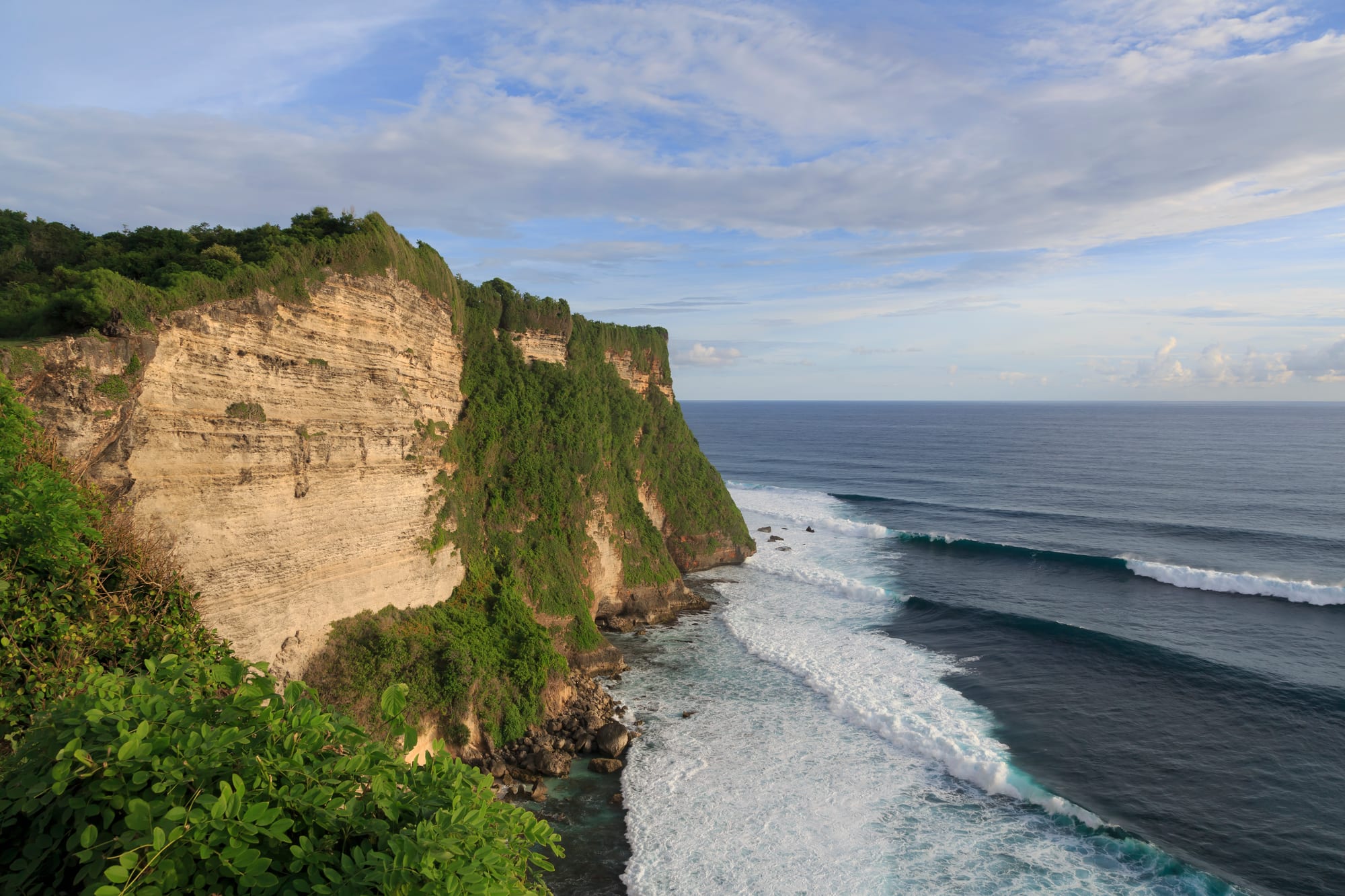
A high pale limestone cliff covered in green scrub dropping to white surf breaking over a reef, with open ocean beyond

Bali, Lombok & Nusa Tenggara, Indonesia

Uluwatu

The limestone cliffs below the temple at Uluwatu, on Bali's Bukit Peninsula. (CEphoto, Uwe Aranas / Wikimedia Commons · CC BY-SA 3.0)

A clifftop area at the south-western tip of Bali's Bukit Peninsula, where limestone headlands drop to reef breaks that made the region famous among surfers in the 1970s. It is known above all for its sea temple, set on a cliff about 70 metres above the water and used for sunset kecak performances, and for the beaches reached through caves and down long flights of steps.

Neighbourhoods

  • Pecatu and the temple road
    • First-time visitors
    • Sunsets
    • Temple performances

    The inland village and the road out to the temple headland, with guesthouses, warungs and shops strung along it. Most traffic to the cliffs passes through, and it is the cheapest part of the area to stay.

    Open in Maps
  • Suluban and the surf cliffs
    • Surfing
    • Cliff views
    • Bars

    The clifftop above the main break, where a cluster of warungs, cafés and bars look straight down on the reef and the beach is reached through a cave at low tide. It fills in the late afternoon.

    Open in Maps
  • Bingin and Padang Padang
    • Beaches
    • Quiet stays
    • Surfing

    A run of small cove beaches below the cliffs to the north-east, each down a long staircase, with simple cliffside rooms and a slower atmosphere than the main break.

    Open in Maps
  • Ungasan and Melasti
    • Resorts
    • Beaches
    • Families

    The southern side of the peninsula, with clifftop resorts and a paved road cut down to a wide white-sand beach. It is spread out, and getting anywhere requires transport.

    Open in Maps

Things to do

Temple and cliffs

  • Uluwatu Templelandmark

    One of Bali's six most sacred sanctuaries, the sad kahyangan, on a cliff about 70 metres above the surf, with a cliff-edge path, resident macaques and a kecak performance in its amphitheatre at sunset.

    Open in Maps
  • Garuda Wisnu Kencana Cultural Parkattraction

    A park on the limestone plateau built around a colossal statue of Vishnu on the bird Garuda, a 121-metre monument completed in 2018.

    Open in Maps

Beaches and bays

  • Padang Padang Beachbeach

    A small cove reached through a gap in the rocks down a stairway, with a demanding reef break offshore that hosts international surf contests.

    Open in Maps
  • Jimbaranbeach

    A long sheltered bay on the north side of the peninsula, with seafood stalls and grill restaurants that set tables on the sand at dusk.

    Open in Maps
  • Nusa Duaneighborhood

    A planned resort enclave on the eastern side of the peninsula, with calm water behind a reef, a coastal promenade and the Water Blow, where ocean surges burst up against the limestone.

    Open in Maps

Short trips

  • Kutaneighborhood

    Bali's original resort strip about 14 kilometres north, with a beginner-friendly beach break, markets and the island's densest nightlife.

    Open in Maps
  • Seminyakneighborhood

    The upmarket beach district further up the west coast, known for restaurants, shops and beach clubs.

    Open in Maps
  • Tanah Lotlandmark

    A temple on a rock in the sea north-west of Denpasar, cut off at high tide and crowded for sunset.

    Open in Maps

Seasonal events

  • NyepiMarch, on the Balinese new year

    The Day of Silence, when the island stops entirely — no travel, work, lights or noise — following a night of ogoh-ogoh effigy parades.

  • Melastidays before Nyepi, usually March

    Processions carry temple heirlooms down to the sea for purification, and the beaches below the cliffs fill with white-clad villagers and gamelan.

  • Galungan and Kuninganevery 210 days on the Balinese pawukon calendar

    Decorated penjor poles line the roads of Pecatu and Ungasan for the main Balinese festival, and temple anniversaries draw families back from the coast.

Eat and drink

Long-standing places and food districts in Uluwatu. Hours, ratings and directions come from your maps app, always current.

Uluwatu classics

  • Warung mealsrestaurant

    Family kitchens along the Pecatu and Ungasan roads serving nasi campur, nasi goreng and sate ayam at a fraction of clifftop prices.

    Open in Maps
  • Babi guling and betuturestaurant

    Spit-roasted suckling pig with crackling, and duck or chicken packed with spices and slow-cooked in leaves, sold at specialist warungs inland.

    Open in Maps
  • Grilled seafood at Jimbaranrestaurant

    Fish, prawns and squid bought at the market and grilled over coconut husks at tables on the sand, a short drive north.

    Open in Maps

Cliffs and beach bars

  • The Suluban clifftopcafe

    Cafés and bars stacked on the cliff above the main surf break, where most people watch the sets and the sunset.

    Open in Maps
  • Bingin and Padang Padang warungsrestaurant

    Simple places at the foot and top of the beach staircases serving fried rice, grilled fish, banana pancakes and cold drinks to surfers.

    Open in Maps

Experience Uluwatu

History

The Bukit Peninsula was for centuries the least useful part of Bali: a raised block of limestone with thin soil, no rivers and no irrigated rice, where villages lived from dry crops, cattle, lime burning and fishing. Its importance was religious. Pura Luhur Uluwatu, on the cliff at the south-western tip, is one of the island's sad kahyangan, the group of temples regarded as spiritual pillars of Bali. Tradition connects it with the 11th-century Javanese priest Mpu Kuturan and, later, with Dang Hyang Nirartha, the 16th-century sage credited with founding or refounding several of the sea temples and said to have attained his release from the world at this spot.

The modern reputation of the place dates from the early 1970s, when surfers were filmed riding the long left-hand wave below the cliffs for Morning of the Earth, released in 1972, which spread the name worldwide. Through the 1970s and 1980s surfers reached the break down a footpath and through the cave at Suluban, staying in simple rooms at Pecatu. Development stayed slow because water had to be trucked in and the roads were poor.

That changed from the 1990s, when resorts appeared on the clifftops and the road network improved, and accelerated after 2010 as southern Bali filled up: villas, hotels and beach clubs spread across the Bukit, and the Garuda Wisnu Kencana statue was completed nearby in 2018. The temple itself remains in active use. Water supply, access roads and cliff erosion are the constant local concerns.

Culture & Customs

Uluwatu's identity rests on the temple and on surfing, an unlikely pairing that works because the two occupy different parts of the same cliff. The temple's evening kecak performance is the best-known cultural event in southern Bali: a circle of men chanting the interlocking chak rhythm without instruments, accompanying an episode from the Ramayana, staged in an open amphitheatre with the sea behind. The form was developed in the 1930s from a trance ritual, partly in collaboration with the German artist Walter Spies, and has been performed for audiences ever since.

The villages of Pecatu and Ungasan keep the ordinary Balinese calendar: banjar councils, temple anniversaries every 210 days, penjor poles for Galungan, processions to the sea before Nyepi, and cremation ceremonies that close the roads. Many families who farmed dry land now work in hotels, drive, run warungs or rent rooms, but customary obligations continue and take priority over work.

The surf culture is international and long-established, with several generations of Balinese professional surfers alongside visitors from Australia, Brazil, Europe and Japan. Rules in the water are informal but real, and crowding at the main break is a frequent complaint. The macaques around the temple are notorious for stealing glasses and phones, sometimes returning them for food, and staff will warn visitors before they enter. Provincial authorities have publicised expectations for visitors after incidents at sacred sites, and behaviour at the temple is watched.

Daily Life

Uluwatu is not a town but a name covering the temple headland and the villages around it, mostly within Pecatu and Ungasan in South Kuta district. Together these villages hold a few tens of thousands of residents, and their population has grown quickly as workers have moved to the peninsula for construction and hospitality jobs. Outside the resorts the settlements are ordinary Balinese villages of walled family compounds, temples, schools and shops.

Almost all work is now tourism: clifftop hotels and villas, restaurants, surf schools, board repair, transport, security and construction, alongside quarrying of the peninsula's limestone for building stone. Some families keep cattle and grow cassava and maize on the dry ground. Water is the persistent constraint, trucked or piped in and expensive, and the growth of villas with pools has made supply a political issue.

The daily rhythm follows the swell and the sun. Surfers and staff are on the road before six, the middle of the day is hot and quiet on the exposed plateau, and everything converges on the cliffs in the late afternoon: temple visitors for the performance, drinkers for the sunset, and the traffic jam that follows on the narrow roads out. Balinese households keep their own earlier timetable of offerings and ceremonies.

Food

Eating at Uluwatu divides between the clifftop and the villages. The cliff cafés and beach clubs serve international menus — grilled fish, burgers, poke bowls, pizza and cocktails — at prices reflecting the view. A few hundred metres inland, warungs on the Pecatu and Ungasan roads serve the food residents eat: nasi campur, a plate of rice with small portions of vegetables in coconut, satay, tempeh and sambal; nasi goreng and mie goreng; gado-gado in peanut dressing; and soto ayam.

Balinese specialities are the reason to eat inland. Babi guling, suckling pig turned on a spit and rubbed with base genep, the island's spice paste of shallot, garlic, galangal, turmeric, ginger and chilli, is sold by the plate at midday. Ayam and bebek betutu are poultry stuffed with spice paste, wrapped in leaves and cooked slowly. Sate lilit, minced fish or pork pressed onto lemongrass sticks, suits a coast where fish is landed daily, and sambal matah of raw shallot, lemongrass, chilli and lime comes alongside.

Seafood is best taken at Jimbaran on the bay to the north, where stalls and restaurants grill the catch over coconut husks in the evening. Fruit stalls sell snakefruit, mangosteen and young coconut, and the Bukit's dry ground yields maize and cassava rather than rice. Drinks run from Bintang beer and coconut water to Kintamani coffee, and to arak, the local palm or rice spirit, which should be treated with caution because of repeated methanol poisonings from illicit batches.

Planning tools

Budget

Uluwatu splits sharply between cheap and very expensive. Surfers' rooms inland and warung meals cost little, while the clifftop resorts on the Bukit are among the priciest on Bali and beach clubs charge accordingly. Transport is a real cost here because the area is spread out and almost nothing is within walking distance.

Daily Budget Midrange
USD 55–140 (hotel or villa, restaurant meals, a car with driver, temple and performance entry)
Daily Budget Shoestring
USD 20–35 (guesthouse, warung meals, scooter hire, board rental)

Check any local tourist charges for foreign visitors before arriving, and budget for a scooter or driver, since taxis between the beaches add up quickly.

Best Time to Visit

April to October is the dry season and the main surf season on this coast, when the south-easterly winds hold the reef breaks open; it is also the busiest and most expensive period. November to March brings rain, humidity and choppier conditions on the west-facing breaks, but quieter beaches and lower room rates.

Suggested Number of Days

A day or two covers the temple, a beach and a performance for most visitors. Surfers and anyone wanting to reach several of the coves stay three to five days or longer, since moving around the peninsula is slow.

First Visit
1–2 days
With Surroundings
3–5 days

Transportation

There is no public transport on the Bukit Peninsula, and the beaches, temple and villages are several kilometres apart on hilly roads. Scooters are the normal way to get around; app-based car and motorbike taxis work but coverage is patchy and some areas restrict pick-ups, and hotels arrange cars with drivers. Parking near the temple and the popular beaches fills up before sunset.

An international driving permit with a motorcycle endorsement is required to ride legally, and the steep access roads to the beaches are hard on inexperienced riders.

Airport & Station Connections

Ngurah Rai International Airport is about 20 kilometres north by road, usually forty minutes to an hour by car depending on traffic through Jimbaran. Most people arrive by pre-booked car or taxi; the toll road across Benoa Bay serves the eastern side of the peninsula, and the coastal road from Kuta and Seminyak is the western approach.

Walkability

Individual pockets are walkable — the clifftop at Suluban, a beach and its warungs — but the area as a whole is not. Distances between beaches run to several kilometres on narrow roads with no pavements, and every cove is reached by a long, steep staircase, some of them slippery and poorly lit after dark. A torch is useful in the evening.

Safety

The sea is the main hazard: the breaks here are over shallow coral reef, currents are strong, and several beaches have no lifeguard. Cliff paths and beach staircases are steep and become slippery in rain, and there have been falls. The macaques at the temple take glasses, phones and hats. Scooter accidents on the hilly roads are common, and any animal bite needs prompt medical attention.

Wear a helmet and only ride a scooter if experienced, avoid cheap cocktails and home-brewed spirits, dress modestly outside Bali and beach resorts, and heed volcano exclusion zones and tsunami warnings. Surf the reef breaks only with experience and reef-appropriate equipment, keep belongings held or zipped away at the temple, and seek medical advice immediately after any animal bite. Check current official travel advice before travelling.

Climate

Tropical and hot, though the Bukit Peninsula is drier and windier than the rest of southern Bali, with thin soil and scrub rather than rice fields. The dry season runs from about April to October, the wet from November to March, when heavy afternoon rain is normal.

Summer
the dry season, April–October: about 27–31°C, breezy on the cliffs, with clear sunsets
Winter
the wet season, November–March: about 26–31°C, humid, with downpours and rougher seas

Local Customs

The temple is an active place of worship, not only a viewpoint: a sarong and sash are required and lent at the entrance, and visitors should keep back from people praying. Offerings are laid on rocks and doorsteps and should not be stepped on. Beachwear belongs on the beach. Bali's authorities have publicised expectations for visitors on dress, behaviour at sacred sites and riding.

Cover shoulders and knees at the temple, remove sunglasses and secure loose items against the macaques, ask before photographing worshippers, and keep noise down in the villages at night.

Common Payment Methods

The currency is the Indonesian rupiah. Clifftop hotels, beach clubs and larger restaurants take cards, but warungs, beach staircases with entry fees, temple donations, scooter hire and parking all need cash. ATMs are concentrated in Pecatu and Ungasan rather than at the beaches, so withdraw before heading down to the coast.