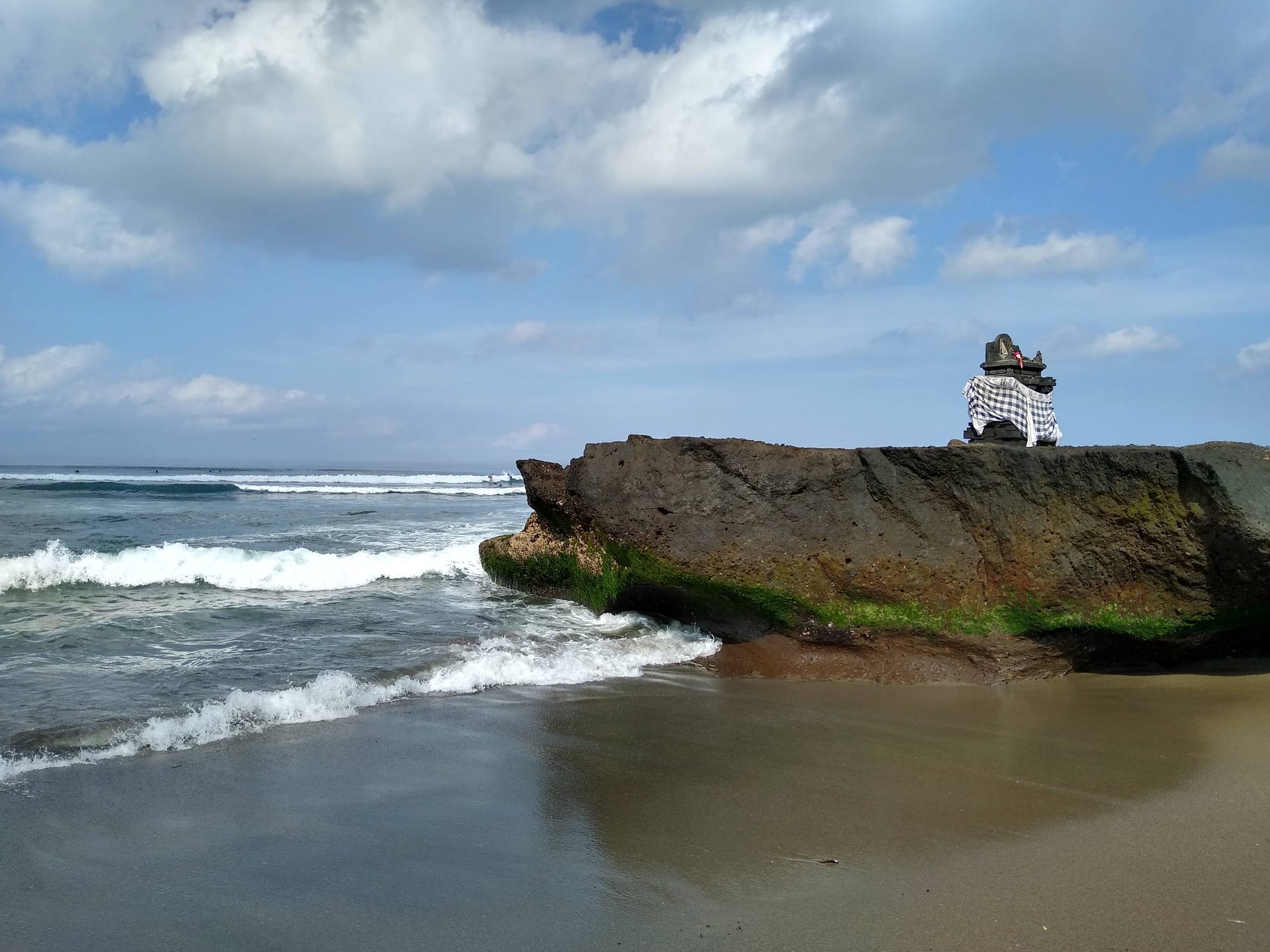
A dark volcanic rock topped by a small shrine wrapped in checked cloth, with breaking waves and surfers beyond it on a sandy beach

Bali, Lombok & Nusa Tenggara, Indonesia

Canggu

A shrine on a rock above the surf on the beach at Canggu, Bali. (Mx. Granger / Wikimedia Commons · CC0)

A stretch of black-sand beach, surf breaks and rice fields on Bali's south-west coast, north of Seminyak and about 20 kilometres by road from the airport. Within two decades it changed from a farming area of villages and temples into one of the island's fastest-growing resort districts, known for its beach clubs, cafés and large population of foreign remote workers.

Neighbourhoods

  • Batu Bolong
    • First-time visitors
    • Surfing
    • Cafés

    The busiest part of the strip, where the main road runs down to a temple above the beach and a long, gentle break. Cafés, surf shops and hotels line the road, and traffic backs up along it for much of the day.

    Open in Maps
  • Berawa
    • Beach clubs
    • Families
    • Restaurants

    The district south towards Seminyak, with large beach clubs, villa complexes, an international school and wide new roads. It feels more built-up and expensive than the rest of Canggu.

    Open in Maps
  • Echo Beach and Pererenan
    • Surfing
    • Quiet and residential
    • Sunsets

    The northern end, where a rockier shore holds more demanding surf breaks and the rice fields start again. Pererenan beyond it is quieter, with warungs and villas among the fields, though building is fast.

    Open in Maps
  • Tibubeneng and the inland villages
    • Local life
    • Long stays

    The residential area behind the coast, where the original villages, their temples and remaining rice land sit among new guesthouses and workshops. Prices drop noticeably away from the beach roads.

    Open in Maps

Things to do

Along the coast

  • Seminyakneighborhood

    The upmarket resort district a few kilometres south, with shops, restaurants and beach clubs behind a long beach.

    Open in Maps
  • Legianbeach

    A long stretch of sand between Seminyak and Kuta, with surf schools and a broad beach for walking.

    Open in Maps
  • Kutabeach

    Bali's original resort strip, about 9 kilometres south, with a forgiving beach break and the island's densest nightlife.

    Open in Maps

Temples nearby

  • Tanah Lotlandmark

    A temple on a rock in the sea about 6 kilometres north-west, cut off at high tide and crowded at sunset.

    Open in Maps
  • Pura Taman Ayunlandmark

    The moated royal temple of the Mengwi kingdom, with rows of tiered meru shrines, part of the UNESCO-listed subak cultural landscape.

    Open in Maps
  • Mengwilandmark

    The inland district north of Canggu, seat of the old Mengwi kingdom, with its royal temple, rice land and quiet village roads.

    Open in Maps

Short trips

  • Ubudneighborhood

    Bali's cultural town in the uplands, about 20 kilometres north-east, with palaces, museums, dance performances and rice terraces.

    Open in Maps
  • Denpasarneighborhood

    The provincial capital about 11 kilometres east, with the Bali Museum, the Jagatnatha temple and large everyday markets.

    Open in Maps
  • Jatiluwihviewpoint

    Wide terraced rice fields on the slopes below Mount Batukaru, inscribed by UNESCO as part of the subak irrigation landscape.

    Open in Maps

Seasonal events

  • NyepiMarch, on the Balinese new year

    The Day of Silence, when the whole island stops — no travel, work, noise or lights — and the airport closes for twenty-four hours.

  • Melastidays before Nyepi, usually March

    Village processions carry temple heirlooms to the sea for purification, filling the beach roads with white and yellow banners.

  • Galungan and Kuninganevery 210 days on the Balinese pawukon calendar

    Penjor poles of bamboo and palm leaf arch over every village street for the main Balinese festival.

Eat and drink

Long-standing places and food districts in Canggu. Hours, ratings and directions come from your maps app, always current.

Canggu classics

  • Warung mealsrestaurant

    Family kitchens on the village roads serving nasi campur, mie goreng and sate ayam for a small fraction of beach-road prices.

    Open in Maps
  • Babi guling and Balinese roastsrestaurant

    Spit-roasted suckling pig with crackling and spiced rice, and slow-cooked betutu duck or chicken, sold at specialist warungs inland.

    Open in Maps
  • Seafood at Seseh and the coastrestaurant

    Grilled fish and squid served at simple places along the shore north of the main breaks, away from the beach clubs.

    Open in Maps

Cafés and beach clubs

  • Batu Bolong café stripcafe

    The road that made Canggu's name, lined with brunch places, coffee roasters, juice bars and co-working cafés popular with long-stay visitors.

    Open in Maps
  • Berawa beach clubsneighborhood

    Large pool-and-daybed venues facing the sunset, the district's best-known attraction and considerably more expensive than anywhere inland.

    Open in Maps
  • Pererenanneighborhood

    The quieter northern village, with small restaurants and cafés among rice fields and a growing share of Canggu's eating.

    Open in Maps

Experience Canggu

History

Canggu was farmland until very recently. The coast here is a line of black volcanic sand broken by rivers, backed by the rice fields of villages such as Tibubeneng, Canggu and Pererenan, all part of the Mengwi kingdom's territory before the Dutch conquest and organised for centuries by subak irrigation societies that divide the water between terraces. Small sea temples stand on rocks along the shore, and the area's temples and cremation grounds remain in use.

Surfers came for the breaks, and the village hosted an international surfing event in 1990, but the beaches were hard to reach and the area stayed quiet long after Kuta, Legian and Seminyak had filled. Development crept north along the coast through the 1990s and 2000s, and villas began appearing among the rice fields. The change came in the 2010s, when cheap flights, a wave of Australian and European visitors, and then remote working turned Canggu into one of the island's fastest-growing districts: cafés, co-working spaces, hostels, gyms and beach clubs multiplied along the Batu Bolong road within a few years.

The Covid-19 border closures from 2020 emptied Bali for about two years, but Canggu recovered faster than the older resorts and attracted long-staying foreign residents in larger numbers than before. Building has continued northwards into Pererenan and Seseh, converting rice land to villas and putting pressure on lanes, water supply and drainage. Provincial authorities have since responded with rules aimed at visitors and with action against foreigners working without permits, much of the debate centred on this stretch of coast.

Culture & Customs

Two cultures share the same lanes. The Balinese one is intact: banjar councils organise ceremonies, temple anniversaries follow the 210-day calendar, penjor poles go up for Galungan, and processions in white walk down to the sea before Nyepi, when the island shuts entirely and even the airport closes. Village temples sit between cafés, and the rocks on the beach carry shrines dressed in checked cloth.

The other is a young international scene built around surfing, wellness and remote work: dawn surf sessions, gyms and yoga studios, cafés full of laptops, skateparks, and beach clubs where the day ends with the sunset. Canggu has become well known among digital nomads and remote workers, and a large foreign population lives here for months at a time, which has produced both a dense service economy and friction over rents, driving, noise and behaviour at sacred sites.

The friction is discussed openly in Bali. Provincial and national authorities have publicised rules on dress and conduct, and acted over unlicensed riding, over foreigners running businesses on tourist visas and over behaviour at sacred sites. For visitors the practical expectations are simple: dress modestly away from the beach, respect a ceremony blocking the road rather than pushing past it, and treat the villages as places where people live and worship rather than as a backdrop.

Daily Life

Canggu is not a single administrative unit but a group of villages mostly in the North Kuta district (Kuta Utara) of Badung Regency, a district of a little under 90,000 residents at recent counts, with a floating population of foreign visitors and long-stay residents that may equal it in the dry season. Many Indonesian workers here come from Java and other islands for jobs in construction, hospitality and transport, and live inland from the beach roads.

The economy is now almost entirely tourism and its services: villas and their management, cafés, restaurants, beach clubs, surf schools, gyms, salons, motorbike hire and delivery riders. Rice farming continues on the fields that remain, and some subak societies still meet, but land values have made conversion hard to resist. Traffic is the defining daily problem, along with waste collection, groundwater use and drainage that floods the lanes in heavy rain.

The rhythm is unusual: surfers and delivery riders are out before six, cafés fill mid-morning with people working, the middle of the day is hot and slow, and the coast fills again for sunset. Nights are earlier and quieter than in Kuta, though the beach clubs run late at weekends. Balinese households keep their own timetable of offerings at dawn, market shopping and ceremonies that take precedence over everything else.

Food

Canggu is known more for cafés than for Balinese cooking, and its café food — brunch plates, smoothie bowls, sourdough, specialty coffee from Kintamani and other Indonesian highlands — is what most visitors eat. The range along the beach roads runs from Mexican and Japanese to Italian and Middle Eastern, and vegetarian and vegan menus are standard rather than exceptional, a legacy of the wellness and yoga scene that arrived with the surfers.

The Indonesian and Balinese food is a street or two inland. Warungs serve nasi campur — rice with lawar, satay, tempeh, urap vegetables and sambal — along with nasi goreng, mie goreng, gado-gado in peanut dressing and soto ayam. Balinese specialities appear at dedicated places: babi guling, the spit-roasted suckling pig rubbed with base genep spice paste; ayam or bebek betutu, poultry packed with spices and cooked slowly in leaves; and sate lilit, minced fish or pork pressed onto lemongrass sticks and grilled.

Sambal matah, a raw relish of sliced shallot, lemongrass, chilli and lime, comes with almost anything grilled, and jukut ares, a soup of banana stem, is a village dish. Fish landed by boats along this coast is grilled over coconut husks. Drinks run from Bintang beer and fresh coconut to arak, the palm or rice spirit best treated with caution given repeated poisonings from illicit batches, and young jackfruit, snakefruit and mangosteen appear on market stalls in season.

Planning tools

Budget

Canggu covers a wide range but is not the bargain it once was. Rooms in guesthouses inland and warung meals remain cheap, while villas, brunch cafés and beach clubs are priced closer to Seminyak. Scooter hire is the standard transport cost, and a day with a car and driver is the usual way to reach the rest of the island.

Daily Budget Midrange
USD 55–140 (villa or boutique hotel, café and restaurant meals, a beach club day, a driver)
Daily Budget Shoestring
USD 20–35 (guesthouse or hostel, warung meals, scooter hire, board rental)

Check any local tourist charges for foreign visitors before arriving, and expect monthly villa rates to be far cheaper than nightly ones.

Best Time to Visit

April to October is the dry season, with the steadiest surf on this coast and the most reliable sunsets, and July, August and Christmas the busiest. November to March brings heavy afternoon rain, humidity and currents that wash debris onto the black sand, but lower prices and green rice fields.

Suggested Number of Days

Two or three days are enough for the beaches and the cafés, and the area is small. Longer stays are the norm rather than the exception here, with many visitors basing themselves in Canggu for weeks and making day trips inland by car or scooter.

First Visit
2–3 days
With Surroundings
4–6 days

Transportation

Almost everyone moves by scooter. The district has no public transport, the roads are narrow lanes between rice fields never designed for the traffic they carry, and journeys of two or three kilometres can take half an hour in the afternoon. App-based car and motorbike taxis operate, but local transport cooperatives restrict pick-ups in some streets, so drivers may ask to meet elsewhere. Cars with drivers are arranged through hotels.

An international driving permit with a motorcycle endorsement is required to ride legally; police check licences and helmets, and travel insurance usually will not pay out without one.

Airport & Station Connections

Ngurah Rai International Airport is about 20 kilometres south by road, typically an hour by car and longer in heavy traffic. Shuttle services and pre-booked cars are the usual arrivals, and fast boats to Lombok and the Gili islands leave from ports on Bali's east coast, reached by road.

Walkability

Walking works within a single district — the Batu Bolong strip, Berawa or Pererenan — but not between them. Pavements are rare or broken, the lanes carry constant scooter traffic in both directions, and there is little shade. The beach itself is the pleasant walking route, continuous for several kilometres at low tide, and paths cross the remaining rice fields inland.

Safety

The two real risks are the sea and the roads. The surf breaks over rock and reef in places and rip currents are strong, with no lifeguard cover on much of the coast; scooter accidents are very common, often involving inexperienced riders on wet roads. Petty theft from villas and bag-snatching occur, and drink-spiking and methanol-tainted spirits are known problems across the island's nightlife.

Wear a helmet and only ride a scooter if experienced, avoid cheap cocktails and home-brewed spirits, dress modestly outside Bali and beach resorts, and heed volcano exclusion zones and tsunami warnings. Never ride after drinking, and check the tide and the break before paddling out. Check current official travel advice before travelling.

Climate

Tropical and hot all year on this coast, with a sea breeze most afternoons. The dry season runs from about April to October, the wet from November to March, when rain falls in heavy bursts and the humidity is constant. Sunset falls at around six in the evening throughout the year.

Summer
the dry season, April–October: about 27–32°C, lower humidity, clear evenings
Winter
the wet season, November–March: about 26–32°C, humid, with storms and darker, rougher water

Local Customs

Canggu is still a cluster of Balinese villages with active temples, and ceremonies regularly close the lanes; traffic waits for a procession. Offerings are laid on pavements and walls each morning and should not be stepped on. Beachwear is for the beach, and temples require a sarong and sash. Bali's authorities have publicised expectations for visitors on dress and behaviour at sacred sites.

Cover shoulders and knees at temples, do not use drones over ceremonies, ask before photographing people at prayer, and keep noise down in residential lanes late at night.

Common Payment Methods

The currency is the Indonesian rupiah. Cards work in cafés, beach clubs and larger businesses, but warungs, markets, scooter hire and drivers usually want cash. ATMs are common along the main roads; those inside bank branches or hotels are the safer choice, and independent money changers offering unusually good rates should be avoided.