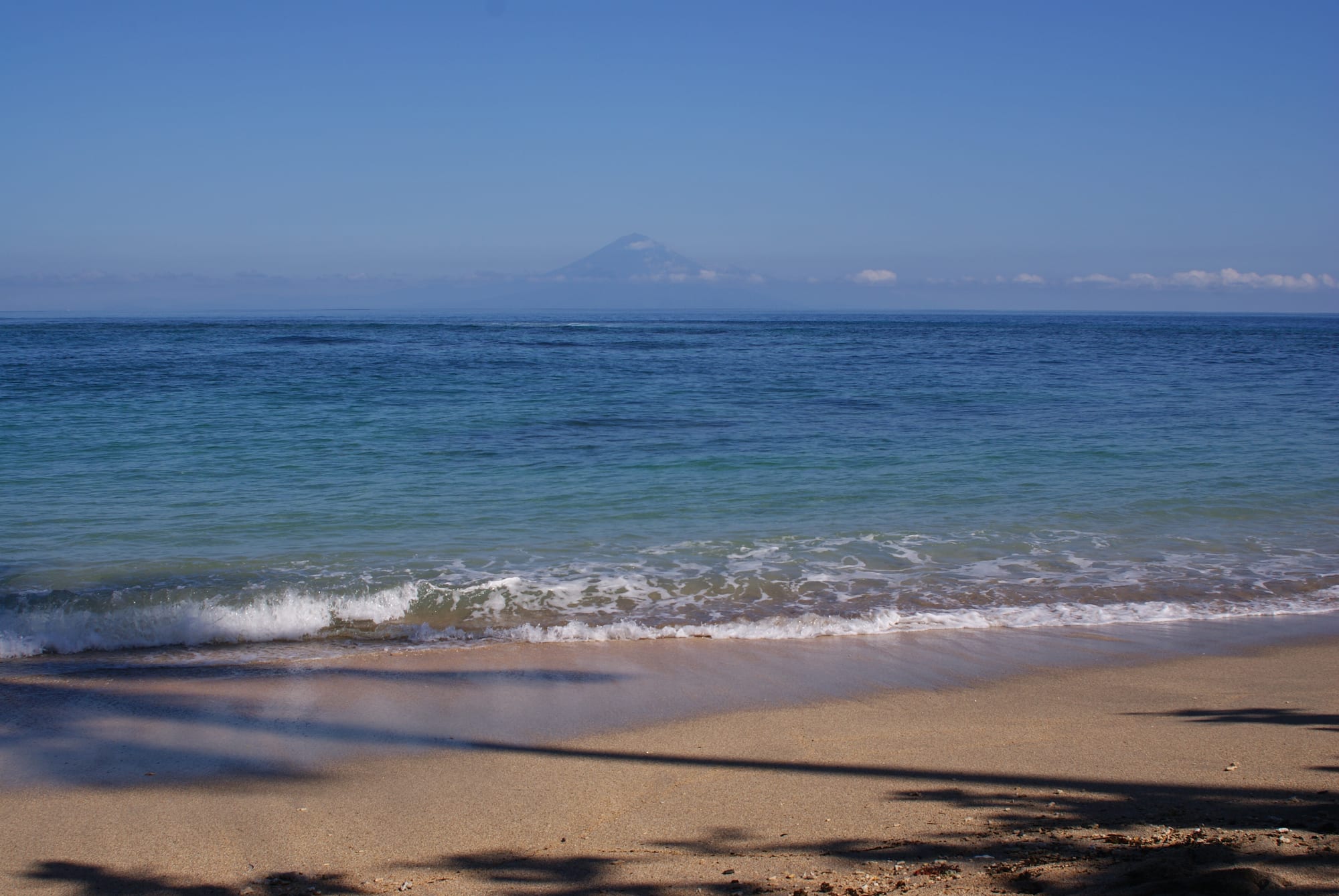
A quiet sand beach with small waves, looking across a calm strait to the cone of a distant volcano

Bali, Lombok & Nusa Tenggara, Indonesia

Senggigi

Senggigi Beach on Lombok's west coast, with Bali's Mount Agung across the Lombok Strait. (Midori / Wikimedia Commons · CC BY 3.0)

Lombok's longest-established beach resort, a string of bays and headlands on the west coast north of Mataram, looking across the Lombok Strait to Bali and Mount Agung. Built up as the island's first tourist strip, above all in the boom of the late 1990s, it remains a low-rise line of hotels, warungs and beach bars between coconut groves and the hills that climb inland towards Mount Rinjani.

Neighbourhoods

  • Senggigi centre
    • First-time visitors
    • Best for food
    • Nightlife

    The short main strip along the coast road, with the art market, most of the restaurants and bars, tour desks, dive shops and the largest hotels behind the beach. Everything here is within a ten-minute walk, and the beach is the widest on this stretch of coast.

    Open in Maps
  • Batu Bolong and the southern headland
    • Sunsets
    • Historic district
    • Views

    The rocky point south of the centre, where a small Balinese Hindu temple sits on a rock above the sea and the road climbs over the headland. Sunsets face Bali directly, and there are a few hotels and cafés on the slope.

    Open in Maps
  • Mangsit and the northern bays
    • Quiet and residential
    • Beaches
    • Swimming

    A series of smaller bays a few kilometres north of the centre, with low-key resorts, black-and-gold sand and calm water inside the reef. Quieter and greener than the strip, with little to do in the evening beyond hotel restaurants.

    Open in Maps
  • The inland village and coast road north
    • Local life
    • Scenery
    • Close to public transport

    Behind and above the hotels lie the working village, the mosque and everyday shops, and the coast road that winds north past Malimbu over headlands with views of the Gili islands. Fishing boats are drawn up on the beaches between the hotels.

    Open in Maps

Things to do

Beaches and viewpoints

  • Senggigi Beachbeach

    A long curve of dark-gold sand with a reef offshore, calm enough for swimming in the dry season and facing straight into the sunset.

    Open in Maps
  • Mangsit Beachbeach

    A quieter bay a few kilometres north, backed by coconut palms and small resorts, with good snorkelling on the reef close in.

    Open in Maps
  • Malimbu viewpointviewpoint

    A roadside hilltop north of Senggigi with a view down over two bays and across to the Gili islands, popular at the end of the day.

    Open in Maps
  • Nipah Baybeach

    A fishing bay further north where boats land the catch and simple grills cook it on the sand.

    Open in Maps

Temples and culture

  • Batu Bolong Templelandmark

    A small Balinese Hindu temple on a pierced rock above the sea south of the centre, still used for offerings and a well-known sunset spot.

    Open in Maps
  • Senggigi art marketmarket

    A row of stalls behind the main beach selling Lombok pottery, woven baskets, pearls and ikat cloth from the island's weaving villages.

    Open in Maps

Short trips from the resort

  • Gili Islandsattraction

    Three car-free coral islands off the north-west coast, reached by boat from Senggigi or from Bangsal harbour to the north.

    Open in Maps
  • Ampenanneighborhood

    Lombok's old port district south of Senggigi, with colonial-era shophouses, an Arab quarter and a Chinatown around the mouth of the river.

    Open in Maps
  • Mataramattraction

    The provincial capital half an hour south, with the Mayura water palace, the Balinese temples of Cakranegara and the island's main markets.

    Open in Maps
  • Narmada Parkpark

    A walled royal garden and water temple east of Mataram, built for a Balinese ruler as a model of Mount Rinjani and its crater lake.

    Open in Maps
  • Mount Rinjaniattraction

    Indonesia's second-highest volcano, over 3,700 metres, climbed over two or three days from villages on its northern and eastern slopes to a rim above the Segara Anak crater lake.

    Open in Maps

Seasonal events

  • Bau NyaleFebruary or March

    The Sasak sea-worm festival on Lombok's southern beaches, when crowds wade in before dawn to gather nyale worms, tied to the legend of Princess Mandalika.

  • Ramadan and Eid al-Fitrvaries with the lunar calendar

    The fasting month is widely observed on Lombok, and the festival that ends it fills the coast road with families visiting relatives.

  • Perang Topatat the sixth full moon of the Balinese year, usually late in the year

    A ritual at Pura Lingsar in which Sasak Muslims and Balinese Hindus throw packets of rice wrapped in palm leaf at each other after a joint ceremony, marking the island's shared history.

  • Peak beach seasonJune to September

    The driest, calmest months, when boat trips to the Gilis run reliably and the resorts are at their busiest.

Eat and drink

Long-standing places and food districts in Senggigi. Hours, ratings and directions come from your maps app, always current.

Senggigi eating

  • The Senggigi strip restaurantsneighborhood

    Open-fronted places along the main road serving grilled fish, Indonesian standards, pizza and cold beer, many with tables facing the sunset.

    Open in Maps
  • Beachside seafood grillsneighborhood

    Stalls and restaurants that cook snapper, squid and prawns over coconut husk with sambal and lime, with the catch chosen from ice at the front.

    Open in Maps
  • Village warungsneighborhood

    Small kitchens behind the strip serving ayam taliwang, plecing kangkung and nasi campur at local prices, usually busiest at lunchtime.

    Open in Maps
  • Ampenan's old shophouse restaurantsneighborhood

    Chinese-Indonesian and Sasak kitchens in the old port district south of Senggigi, known for noodles, satay and seafood.

    Open in Maps

Experience Senggigi

History

Senggigi was a stretch of fishing villages and coconut groves on a coast that had seen far more history than it showed. West Lombok was ruled from Bali for much of the 18th and 19th centuries, after Balinese princes from Karangasem took the island, and the Balinese Hindu temples along this shore — Batu Bolong on its rock above the sea among them — date from that period. Sasak resistance and a Dutch intervention ended Balinese rule in 1894, when the Netherlands took Lombok by force, and the island passed to Indonesia after independence.

The resort grew as Indonesia began to promote Lombok as a quieter alternative to Bali, and a building frenzy along the bays in the late 1990s, when the island was talked of as the next Bali, gave it most of its hotels. The coast road was improved, and Senggigi became the island's first and for a long time its only tourist centre, serving package visitors, divers and travellers heading for the Gili islands. The strip acquired restaurants, bars and a small nightlife, and the art market sold pottery and weaving from villages inland.

Its fortunes have swung hard since. The Asian financial crisis, communal violence around Ampenan and southern Senggigi in January 2000, and the Bali bombings of 2002 and 2005 each cut visitor numbers sharply, and the rise of the Gili islands and of Kuta in the south drew away much of the trade that remained. In August 2018 a series of earthquakes centred on northern Lombok killed hundreds on the island and damaged buildings along this coast; rebuilding was under way when the Covid-19 pandemic closed Indonesia's borders. The strip today is smaller and quieter than it was at its peak, and works mainly as a base for the wider island.

Culture & Customs

The people of Lombok are predominantly Sasak and Muslim, and the island is sometimes called the island of a thousand mosques for the number of minarets along its roads. Senggigi is one of the places where that identity meets a long-established Balinese Hindu minority: temple offerings are laid on the rocks at Batu Bolong, Balinese ceremonies process along the coast road, and Sasak and Balinese communities live side by side in the villages between the hotels.

That coexistence has its own rituals. At Lingsar, inland to the south-east, a temple complex built by the Balinese in 1714 serves both Sasak and Balinese worshippers, and the Perang Topat, in which the two communities pelt each other with packets of rice after a shared ceremony, is the best-known expression of it. Sasak traditions run deeper inland, where villages such as Sade keep thatched rice barns and hand-weaving, and where older blended practices survive in the north.

Everyday manners are those of a conservative Muslim island with a long habit of hospitality. Modest dress away from the beach matters here more than it does in Bali; alcohol is served in the tourist restaurants but not generally elsewhere; and the fasting month reshapes opening hours and mealtimes across the strip. Sasak crafts — ikat and songket weaving, coiled basketry, and the red clay pottery of Banyumulek — are sold in the art market and made in villages within an hour's drive.

Daily Life

Senggigi is a village-sized place, a few thousand residents strung along the coast road within West Lombok Regency, whose population runs to several hundred thousand; the provincial capital Mataram, with roughly 450,000 people, is half an hour to the south and supplies its hospitals, offices and markets. Most households here live from tourism or fishing, and many workers commute in from villages inland and along the coast.

The tourism economy has never fully recovered from the shocks of the past two decades, and the difference is visible: refurbished resorts on the northern bays stand near closed hotels and empty shopfronts on the strip. Fishing continues from the beaches, with outriggers drawn up between hotel frontages and boats going out at night; coconut, banana and cashew are grown on the slopes behind, and Mataram provides government and service jobs.

Days begin with the pre-dawn call to prayer and boats returning with the catch, and end with the whole coast facing west for the sunset, when the strip's restaurants fill. Traffic on the coast road is constant but light by Bali standards. Water supply, waste and the condition of the road north are persistent local issues, along with the slow business of earthquake rebuilding and the question of how much of Lombok's growing tourism — now concentrated in the south around Kuta and the Mandalika circuit — will return to this coast.

Food

Lombok's cooking is the hottest in the region. Ayam taliwang is the dish to know: a young chicken, split, grilled and basted with a paste of dried chilli, garlic, shrimp paste and palm sugar, named after Karang Taliwang in Mataram and served almost everywhere on the island. It comes with plecing kangkung, blanched water spinach served cold with a sambal of chilli, shallot, garlic and shrimp paste, topped with bean sprouts, grated coconut and fried peanuts.

Sate is the other staple. Sate bulayak, small beef skewers served with bulayak, rice cake wrapped in a spiral of palm leaf, comes with a hot, soupy sauce; sate pusut is minced meat or fish mixed with grated coconut and spices and wrapped around lemongrass stalks; and sate rembiga is another Lombok beef satay. Nasi balap puyung, rice with shredded chilli chicken, dried soy beans and squid, is sold in warungs and packed for travellers.

On the coast, the food is simpler: fish grilled over coconut husk with lime and sambal, squid, prawns and whatever the boats brought in, sold from beach grills and restaurant ice counters. Tourist menus add pizza, burgers and banana pancakes. Drinks are coconut water, fresh juices, and kopi Lombok served black and sweet; alcohol is available in the resort restaurants, but home-distilled spirits should be avoided anywhere in Indonesia.

Planning tools

Budget

Senggigi is cheaper than comparable parts of Bali, and cheaper than the Gili islands, because supplies come by road rather than boat. Rooms range from simple guesthouses behind the strip to beachfront resorts on the northern bays; food, transport and drinks are all modest. The costs that add up are boat trips, Rinjani treks and hire cars with drivers.

Daily Budget Midrange
USD 55–140 (beachfront hotel, restaurant meals, car with driver, a Gili boat trip or diving)
Daily Budget Shoestring
USD 20–35 (guesthouse room, warung meals, public bemo and ojek rides, a beach day)

Agree a price before taking a taxi without a meter or hiring a driver for the day, and carry cash for anything outside the hotels.

Best Time to Visit

May to September is the dry season: calm seas, reliable boats to the Gilis and the best conditions for climbing Rinjani, which is hard going in the rains. July and August are busiest. From November to March it is humid and stormy, with rough crossings and quieter beaches, though the hills are green.

Suggested Number of Days

Two or three days are enough for the beaches and headlands of the strip itself. Five to seven suit a base for the wider island — the north coast, the weaving and pottery villages, the capital and the volcano — which is how most people use Senggigi.

First Visit
2–3 days
With Surroundings
5–7 days

Transportation

The resort is strung along one coast road, so most local movement is on foot, by ojek motorcycle taxi or by metered taxi. Bemo minibuses run south towards Mataram and Ampenan, and hired cars with drivers, scooters and tour minibuses cover the rest of the island. Boats to the Gili islands leave from the beach here and from Bangsal harbour to the north.

The coast road north is beautiful but narrow and winding, with blind bends and landslip repairs, so allow more time than the distance suggests and avoid riding it after dark.

Airport & Station Connections

Lombok International Airport, also named Zainuddin Abdul Madjid International Airport, is in the south of the island, about 40 kilometres away and an hour and a half by road, with flights from Bali, Jakarta, Surabaya and Kuala Lumpur. Fast boats from Bali run to Bangsal and to the Gilis, and public ferries cross from Padang Bai on Bali to Lembar in the south of Lombok, a journey of several hours.

Walkability

The centre is walkable: the beach, the art market, the restaurants and most hotels sit within a few hundred metres of each other. Beyond that the resort strings out for kilometres along a road with intermittent pavements, blind bends and no lighting on some stretches, so walking to the northern bays or the southern headland after dark is not advisable.

Safety

Senggigi is quiet and generally safe, with petty theft and occasional overcharging the usual complaints. The practical risks are the coast road, where scooter accidents are common, the sea outside the reef, which has currents and few lifeguards, and drinks made with illicit spirits. Northern Lombok suffered deadly earthquakes in 2018, and buildings along this coast were damaged; the area has since been rebuilt.

Swim inside the reef, use a torch on the unlit stretches of road at night, and buy drinks from established places only. Wear a helmet and only ride a scooter if experienced, avoid cheap cocktails and home-brewed spirits, dress modestly outside Bali and beach resorts, and heed volcano exclusion zones and tsunami warnings. Check current official travel advice before travelling.

Climate

Tropical and drier than Bali, with a clear dry season and a wet season of short heavy storms. The west coast is sheltered by the island's mountains, so rain here is lighter than on Rinjani's slopes, and sea breezes take the edge off the afternoon heat.

Summer
the dry season, April–October: sunny and around 30–33°C, with calm seas and dusty brown hills
Winter
the wet season, November–March: humid and about 29–31°C, with heavy afternoon rain, green hills and rougher water

Local Customs

Lombok is predominantly Muslim and more conservative than Bali, though Senggigi has decades of experience of visitors and a Balinese Hindu minority whose temples stand along the coast. Swimwear is for the beach only; covered shoulders and knees are expected in the village, shops and offices. The call to prayer sounds before dawn, and Ramadan changes the rhythm of the whole island.

Dress modestly away from the sand, ask before photographing people, use the right hand to give and receive, and keep public affection discreet.

Common Payment Methods

The currency is the Indonesian rupiah. Hotels, dive shops and larger restaurants take cards; warungs, markets, bemos, ojeks and boat tickets are cash. ATMs are available along the strip and more plentiful in Mataram, but it is worth drawing cash before heading to the Gili islands or into the hills.