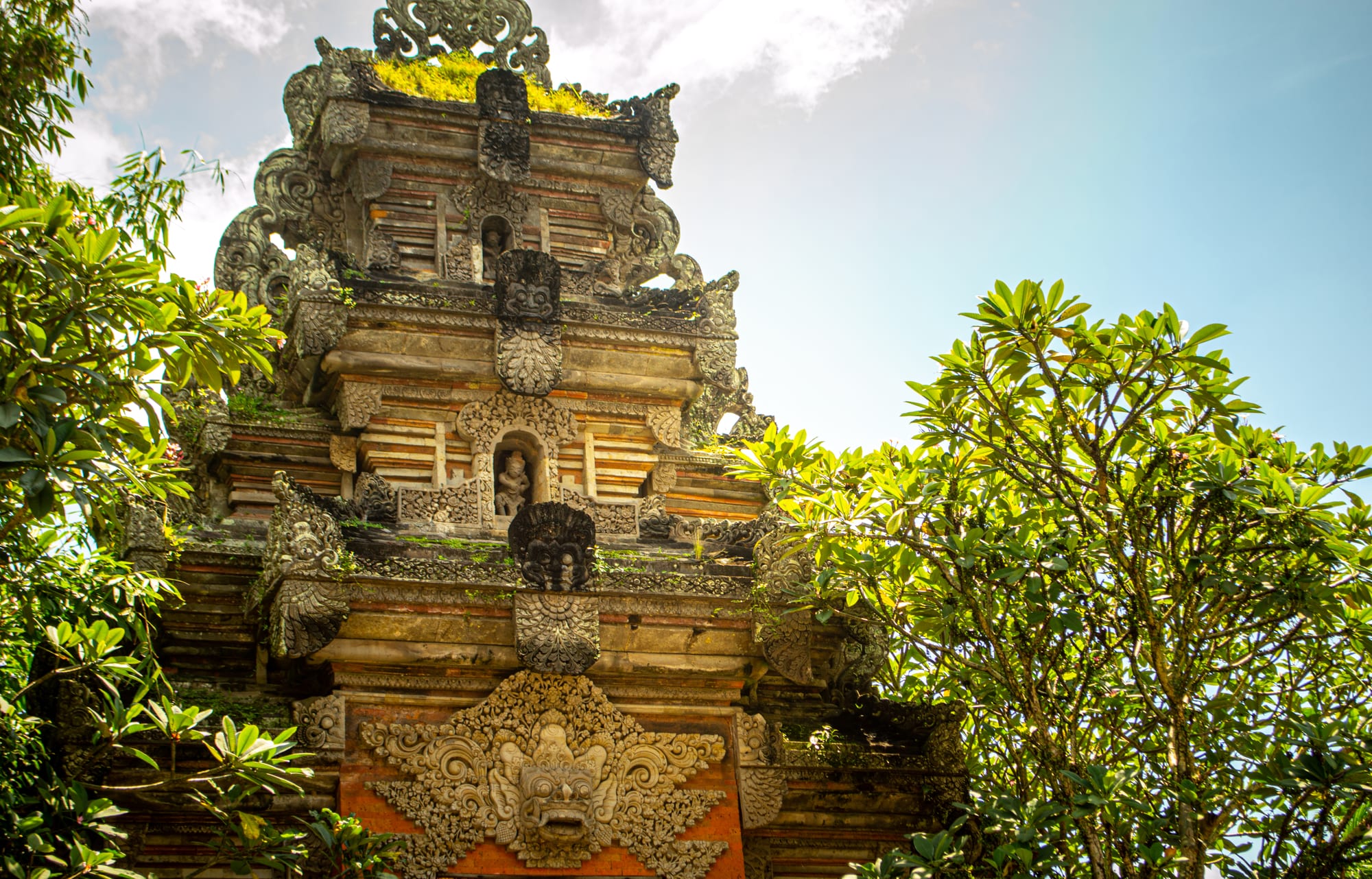
A tall carved stone temple gate with moss, red brick and a demon face above the entrance, framed by green trees

Bali, Lombok & Nusa Tenggara, Indonesia

Ubud

A carved gateway at the Ubud royal palace in central Bali. (Philip Nalangan / Wikimedia Commons · CC BY 4.0)

A town in the uplands of central Bali, set among river ravines and rice terraces about 25 kilometres inland from the south coast. Long the seat of a princely house and a centre of painting, carving and dance, it drew European artists in the 1930s and has since grown into the island's cultural and wellness capital, busy with galleries, temples, craft villages and a forest full of macaques.

Neighbourhoods

  • Central Ubud
    • First-time visitors
    • Markets
    • Dance performances

    The crossroads of Jalan Raya Ubud and Monkey Forest Road, with the palace, the art market, the water palace temple and most of the shops and restaurants. It is the busiest and noisiest part of town, and the easiest to stay in without transport.

    Open in Maps
  • Padangtegal and Monkey Forest Road
    • Nightlife and cafés
    • Close to the forest

    The strip running south from the centre to the monkey forest, lined with guesthouses, spas, yoga studios and restaurants. Padangtegal village behind it keeps its temples and family compounds among the newer buildings.

    Open in Maps
  • Campuhan and Sanggingan
    • Galleries
    • Views
    • Walks

    The west side of town where two rivers meet, climbing towards Sanggingan's museums and galleries. Hotels here look over the ravine, and the ridge path starts just below the road.

    Open in Maps
  • Penestanan
    • Quiet and residential
    • Long stays
    • Art

    A village on the hill above Campuhan, reached by a long flight of steps, known since the 1960s for its painters and now full of villas and cafés among the rice fields. Quieter than the centre but close to it on foot.

    Open in Maps
  • Nyuh Kuning
    • Quiet and residential
    • Families

    A carving village just south of the monkey forest, with a wide village street, wood workshops and a football field, ten minutes' walk from the centre yet much calmer.

    Open in Maps
  • Peliatan
    • Local life
    • Dance and gamelan

    A separate village east of the centre with its own palace and long-established gamelan and legong groups. Rows of art shops and family compounds line the main road towards Denpasar.

    Open in Maps

Things to do

Temples and landmarks

  • Sacred Monkey Forest Sanctuaryattraction

    A temple forest at the southern edge of town where more than a thousand long-tailed macaques live among banyan roots, stone stairways and three temples belonging to Padangtegal village.

    Open in Maps
  • Puri Saren Agunglandmark

    The palace of Ubud's ruling family, built in its present form in the early 19th century and restored after the 1917 earthquake, with carved gateways and a courtyard used for evening dance performances.

    Open in Maps
  • Pura Taman Saraswatilandmark

    A water temple in the centre of town dedicated to the goddess of learning, approached across a pond of lotus flowers and designed by the carver I Gusti Nyoman Lempad.

    Open in Maps
  • Goa Gajahlandmark

    The Elephant Cave, a rock-cut sanctuary dated to between the 9th and 11th centuries, a few kilometres south-east, with a carved demon mouth for a doorway and bathing pools in front.

    Open in Maps

Museums and galleries

  • Museum Puri Lukisanmuseum

    A museum of traditional and modern Balinese painting and wood carving from the 1930s onwards, shown in pavilions set in a garden.

    Open in Maps
  • Neka Art Museummuseum

    A museum in Sanggingan tracing Balinese painting and the work of foreign artists who settled on the island, arranged by style across several buildings.

    Open in Maps
  • Agung Rai Museum of Artmuseum

    A museum and cultural centre in Pengosekan, founded by the collector Agung Rai and opened in 1996, with Balinese and Javanese painting and a programme of dance and gamelan.

    Open in Maps
  • Blanco Renaissance Museummuseum

    The hillside studio-house of the painter Antonio Blanco (1912–1999), who lived and worked in Campuhan, opened as a museum of his work in 1998.

    Open in Maps

Rice terraces

  • Tegalalang rice terracesviewpoint

    Steep terraces cut into a narrow valley about 10 kilometres north of town, watered by the subak system and edged with viewpoints and cafés.

    Open in Maps

Short trips

  • Tirta Empullandmark

    A spring temple at Tampaksiring, about 12 kilometres north, founded around a holy spring in 962, where Balinese Hindus bathe in a row of water spouts for ritual purification.

    Open in Maps
  • Gunung Kawilandmark

    Eleventh-century shrines cut into the cliffs of the Pakerisan river gorge near Tampaksiring, reached down a long stone stairway through rice fields.

    Open in Maps

Seasonal events

  • NyepiMarch, on the Balinese new year

    The Day of Silence, when the whole island stops — no travel, work, lights or noise — preceded the night before by parades of ogoh-ogoh demon effigies.

  • Galungan and Kuningantwice a year on the 210-day Balinese calendar

    The main Balinese festival, when tall decorated penjor poles line every street and families make offerings at their temples.

  • Ubud Writers and Readers FestivalOctober

    An international literary festival founded in 2004 that fills the town's venues with readings, panels and workshops for several days.

  • Saraswatitwice a year on the Balinese calendar

    The day honouring the goddess of learning, when books and manuscripts receive offerings — a notable occasion in a town with her temple at its centre.

Eat and drink

Long-standing places and food districts in Ubud. Hours, ratings and directions come from your maps app, always current.

Ubud classics

  • Babi gulingrestaurant

    Spit-roasted suckling pig rubbed with the Balinese spice paste base genep, carved and served with crackling, sausage and rice at specialist warungs around town.

    Open in Maps
  • Bebek betuturestaurant

    Duck packed with spices, wrapped in leaves and steamed or smoked for hours until it falls apart — a ceremonial dish that Ubud restaurants serve to order.

    Open in Maps
  • Nasi campur Balirestaurant

    A plate of rice with small portions of satay, vegetables in coconut, sambal and fried peanuts, the standard cheap meal in the town's family-run warungs.

    Open in Maps

Markets and food streets

  • Ubud Art Market and the morning marketmarket

    The covered market opposite the palace, a produce and offerings market before dawn and a crafts and textiles market later in the day.

    Open in Maps
  • Monkey Forest Road and Jalan Hanomanneighborhood

    The two parallel streets where most of the town's eating happens, from warungs and coffee roasters to the vegetarian and raw-food places Ubud became known for.

    Open in Maps
  • Penestanan and Sangginganneighborhood

    Cafés and small restaurants among the rice fields and villas on the western hill, quieter than the centre and popular with long-stay visitors.

    Open in Maps

Experience Ubud

History

Ubud's name comes from ubad, the Balinese word for medicine, after the healing plants that grew along the Campuhan river where two streams meet. Tradition holds that the Javanese priest Rsi Markandeya meditated there in about the eighth century and founded the shrine at Pura Gunung Lebah. The surrounding district was settled around temples and irrigation societies, and royal houses descended from the princes of Sukawati established themselves at Ubud, building the palace that still stands in the centre in the early 19th century.

Ubud's ruling family came to terms with the Dutch, and the town was spared the violent conquest that fell on Badung and Klungkung a few years later. The princes continued as patrons of temple arts. The change that made the modern town came in the 1930s, when the German painter and musician Walter Spies and the Dutch artist Rudolf Bonnet settled nearby under the patronage of Cokorda Gde Agung Sukawati. Working with Balinese artists, they helped found the Pita Maha association, which encouraged painting for sale rather than only for temples and shifted subjects towards everyday village life.

Museum Puri Lukisan was founded in the town to hold this work. Visitors arrived slowly through the following decades, drawn by dance, painting and the landscape rather than by beaches, and Penestanan gained its own school of young painters in the 1960s. From the 1990s tourism accelerated sharply, and a bestselling memoir published in 2006, later filmed, brought a wave of wellness and yoga travel. The town has grown outward into the surrounding villages ever since, with traffic and land prices the constant subject of local debate.

Culture & Customs

Ubud has been Bali's cultural centre for a century, and its reputation rests on performance and craft rather than on any single monument. Gamelan gong kebyar groups rehearse in village halls, and legong, barong and kecak are staged most evenings in palace and temple courtyards. Peliatan's dancers and gamelan groups have long toured internationally. Because the performances are drawn from temple repertoire, the same dancers and musicians play at ceremonies that have nothing to do with visitors.

Craft villages ring the town, each with a speciality inherited over generations: wood carving at Mas and Nyuh Kuning, stone carving at Batubulan, silver at Celuk, painting at Batuan and Penestanan. The painting styles that developed here — the crowded Batuan manner, the Young Artists' bright village scenes, the Pita Maha work of the 1930s — fill the museums at Sanggingan and in the centre.

Daily religious life continues regardless. Canang sari offerings appear on doorsteps and scooter seats at dawn, the banjar organises ceremonies and cremations, and a royal cremation draws thousands to watch a tall tower carried through the streets. Temple anniversaries, odalan, follow the 210-day calendar rather than the Gregorian one, so ceremonies can fall on any day. Visitors are welcome at most of them if dressed correctly, standing back and not crossing in front of people at prayer. Foreign residents are numerous, and local patience with immodest dress or behaviour at sacred sites has worn thin, a subject the provincial authorities have addressed with published rules for visitors.

Daily Life

Ubud is a district as much as a town: the central village has about 12,000 people, and the wider administrative district of Ubud, taking in the surrounding villages, had about 75,000 at the 2020 census. Almost everyone is Balinese Hindu, organised through banjar neighbourhood councils that run ceremonies, disputes and community work, and through the subak societies that still divide the irrigation water among the rice fields.

Tourism dominates the economy — hotels, villas, restaurants, spas, yoga schools, galleries and driving — alongside the craft workshops that supply them and rice farming that continues on the terraces between. Many households combine several of these. The Covid-19 border closures emptied the town for two years and pushed people back to farming and fishing, and the recovery since has brought record numbers, along with new villas on former rice land, traffic that can take half an hour to cross the centre, and arguments about water use, waste and foreigners working without permits.

The day begins before six with offerings, market shopping and the cooler hours for work, slows through the heat of midday, and picks up again in the late afternoon when temple bells and gamelan practice start. Evenings are early by Balinese standards; the town is not a nightlife destination. Schools, health posts and temples anchor the villages, and the ceremonial calendar regularly takes precedence over business hours.

Food

Balinese cooking is built on base genep, a paste of shallots, garlic, galangal, turmeric, ginger, chilli, candlenut and shrimp paste, and Ubud is a good place to eat it because the surrounding villages supply the produce. Babi guling, suckling pig turned on a spit over coconut husks, is the celebrated dish, usually eaten at midday and sold out by early afternoon. Bebek and ayam betutu, duck or chicken stuffed with spices and cooked slowly wrapped in leaves, is the other ceremonial speciality.

Everyday eating means nasi campur: rice with a spoonful each of lawar, a mix of vegetables, grated coconut and minced meat, sate lilit of minced fish or pork pressed onto lemongrass sticks, tempeh in sweet soy, urap vegetables and a fierce sambal matah of raw shallot, lemongrass and chilli. Warungs serve it from glass cabinets, and prices are a fraction of those on the main street.

Ubud is also the centre of Bali's meat-free cooking, with long-established vegetarian, vegan and raw-food restaurants, juice bars and health cafés clustered along Jalan Hanoman and Monkey Forest Road — a scene that grew from the yoga community and now sits alongside the warungs. Coffee from the Kintamani highlands is roasted and sold locally, and the plantations north of town offer tastings that include kopi luwak. Sweet snacks are sold at the morning market: jaje Bali rice cakes, pisang goreng, and bubur injin, black sticky rice with grated coconut and palm sugar.

Planning tools

Budget

Ubud spans a wide range. Family homestays in village compounds remain cheap, and warung meals cost very little, while the ravine resorts and spas are among the most expensive on Bali. Yoga classes, cooking courses and drivers for temple trips are the usual extras, and a hired scooter is the cheapest way to move around.

Daily Budget Midrange
USD 55–140 (villa or boutique hotel, restaurant meals, a car with driver, classes and a spa)
Daily Budget Shoestring
USD 20–35 (homestay, warung meals, scooter hire, walking)

Check any local tourist charges for foreign visitors before arriving, and agree a price with a driver before the trip rather than after.

Best Time to Visit

April to October is the dry season, with clearer skies and easier walking, and July, August and the Christmas period the busiest and most expensive. The wet months from November to March bring heavy afternoon rain but the greenest terraces and lower prices. The island closes entirely for Nyepi, usually in March, when nobody may travel.

Suggested Number of Days

Two or three days suit the town itself, which is small enough to cross on foot. Allow four to six to take in the temples, terraces and craft villages spread through the surrounding uplands, or longer for a course or a stay of the kind many visitors extend.

First Visit
2–3 days
With Surroundings
4–6 days

Transportation

The town centre is walkable, and almost everything beyond it is reached by scooter or by a car with driver, arranged through hotels or the men who call out from the pavement. App-based taxis operate but some village cooperatives restrict pick-ups, so drivers may ask to meet further along the road. There is no useful public transport, and the single main road through the centre jams badly in the afternoon.

An international driving permit with a motorcycle endorsement is required to ride legally, and police check for helmets and licences.

Airport & Station Connections

Ngurah Rai International Airport near Kuta is about 35 kilometres south, typically an hour and a half by car and often longer in heavy traffic. Hotels arrange transfers, shuttle minibuses run from the southern resorts, and fast boats from the east-coast ports connect with cars to Ubud.

Walkability

The centre is compact, and the palace, market, water temple and monkey forest are within a fifteen-minute walk of each other. Pavements are narrow, broken in places and often interrupted by drainage covers, and the main road carries constant scooter traffic. Away from the through roads, footpaths run between rice fields to Penestanan and Nyuh Kuning, and the ridge walk is the main walking route out of town.

Safety

Ubud is a safe town with little violent crime. The real risks are traffic, above all scooter accidents on wet or gravelled roads, and the monkeys in the forest sanctuary, which snatch bags, sunglasses and food and can bite or scratch. Rabies is present on Bali. Steep paths and river gorges become slippery in the wet season, and methanol-tainted spirits are a known danger across the island.

Carry nothing loose or edible into the monkey forest and seek medical advice at once after any animal bite. Wear a helmet and only ride a scooter if experienced, avoid cheap cocktails and home-brewed spirits, dress modestly outside Bali and beach resorts, and heed volcano exclusion zones and tsunami warnings. Check current official travel advice before travelling.

Climate

Tropical and a few degrees cooler than the coast because the town sits around 200 metres above sea level, with mist in the valleys on many mornings. The dry season runs from about April to October and the wet season from November to March, when rain usually falls in heavy afternoon bursts rather than all day.

Summer
the dry season, April–October: around 27–31°C by day, cooler and fresher at night than the southern beaches
Winter
the wet season, November–March: humid, about 24–31°C, with daily downpours and very green rice fields

Local Customs

Ubud is a working Balinese town wrapped around a tourist one. Small palm-leaf offerings are laid on pavements and shrines each morning and should be stepped around, not over. Temples require a sarong and sash, which are lent at the entrance, and menstruating women are asked not to enter. Ceremonies and cremation processions close roads without warning and take priority over traffic.

Cover shoulders and knees at temples, keep back from praying worshippers and ask before photographing them, use the right hand to give and receive, and do not touch anyone's head. Tipping is not obligatory but is common in restaurants and spas.

Common Payment Methods

The currency is the Indonesian rupiah. Cards work in hotels, larger restaurants and shops, but warungs, markets, drivers and temple donations need cash. ATMs are plentiful in the centre; use ones attached to banks, and count notes carefully as the largest is 100,000 rupiah.