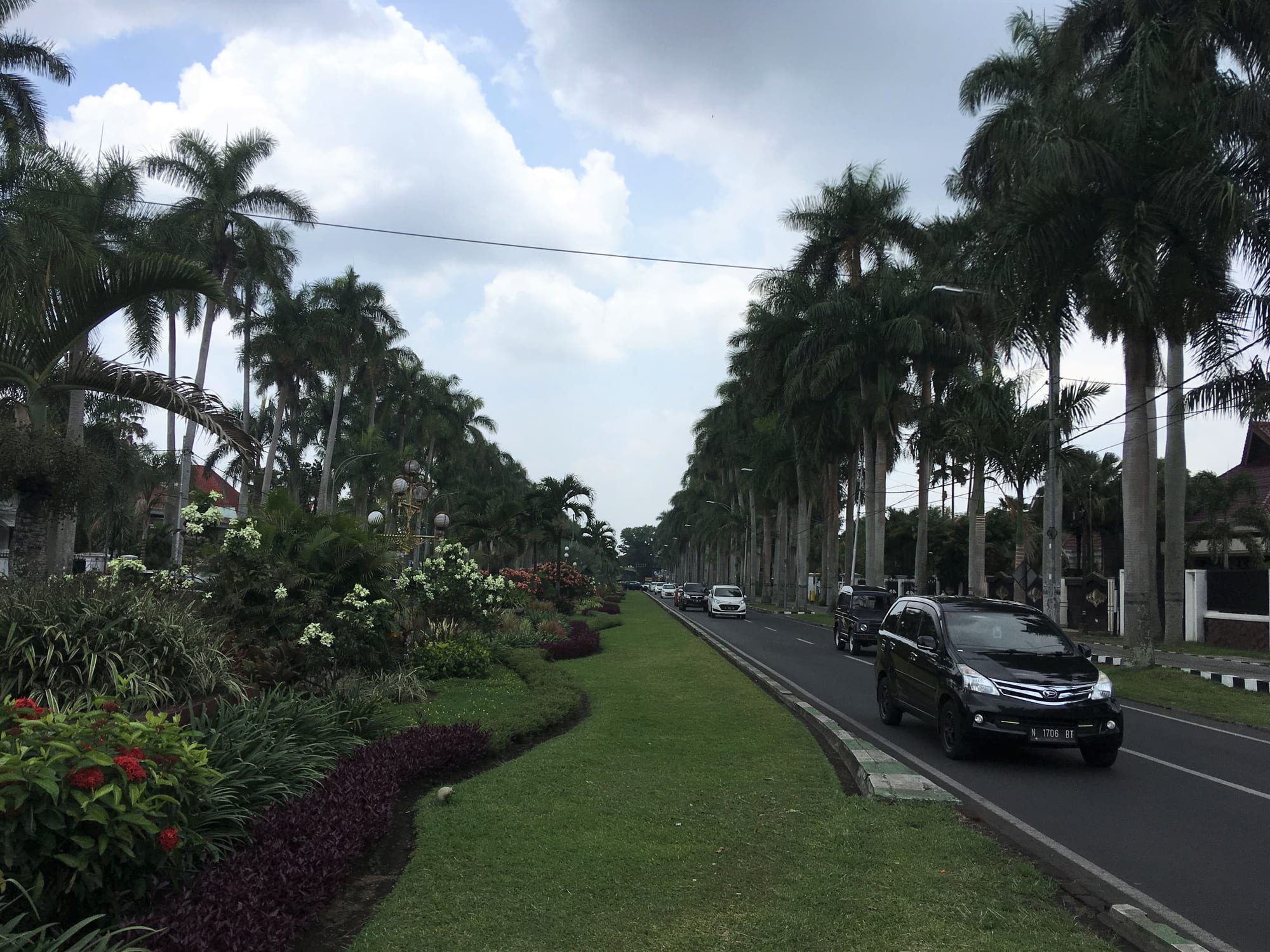
A wide boulevard divided by a grass strip and flowerbeds, lined with tall palm trees and villas, with a few cars passing

Java, Indonesia

Malang

Ijen Boulevard, the palm-lined avenue at the centre of Malang's Dutch-planned quarter. (Christophe95 / Wikimedia Commons · CC BY-SA 4.0)

A university city on a plateau in East Java, between about 440 and 670 metres above sea level and ringed by volcanoes, which gives it cooler air than Surabaya on the coast. It grew around a Dutch hill town of tree-lined boulevards and villas on the site of much older Hindu-Buddhist kingdoms, and is the usual base for trips to Mount Bromo and the waterfalls of the southern hills.

Neighbourhoods

  • The town centre and Kayutangan
    • First-time visitors
    • Historic district
    • Close to public transport

    The area around the Tugu monument, the main square and the old shopping street of Kayutangan, where colonial shopfronts have been restored and turned into cafés. The railway station, the grand mosque and the market are all close by.

    Open in Maps
  • Ijen and the villa quarter
    • Architecture
    • Quiet and residential

    The planned district laid out by the Dutch in the 1920s, centred on a palm-lined boulevard of 1930s villas with deep gardens. It is the calmest part of the city, and the pleasantest part of it to walk in.

    Open in Maps
  • Sukun and the southern districts
    • Local life
    • Best for food

    Residential neighbourhoods spreading south from the centre, including the Sanan area, where tempeh crisps are made in household workshops. Traffic is lighter and prices lower than in the centre.

    Open in Maps
  • Lowokwaru and the campuses
    • Students and nightlife
    • Best for food

    The northern districts around Brawijaya University and several other institutions, filled with student lodgings, cheap warungs, coffee shops and bookshops. The city's young character is most obvious here.

    Open in Maps
  • Jodipan and the riverside kampung
    • Local life
    • Photography

    Dense kampung stacked on the banks of the Brantas river near the centre, where houses were painted in bright colours to draw visitors. The lanes are narrow, steep and lived-in.

    Open in Maps

Things to do

Landmarks and streets

  • Tugu Malanglandmark

    The independence monument at the centre of a circular pond and garden, faced by the Dutch-built town hall and a colonial hotel.

    Open in Maps
  • Malang railway stationtransit hub

    The city's main station, dating from the colonial period and rebuilt since, the arrival point for trains from Surabaya, Yogyakarta and Jakarta.

    Open in Maps
  • Kayutangan heritage streetneighborhood

    The old commercial street through the centre, with restored shopfronts, a kampung of colonial-era houses behind it and cafés along the pavement.

    Open in Maps
  • Ijen Boulevardlandmark

    A wide avenue of palms and 1930s villas on Jalan Ijen, the showpiece of the district laid out on the plans of the architect Thomas Karsten.

    Open in Maps
  • Jodipan colourful villageneighborhood

    A riverside kampung whose houses were painted in blocks of bright colour, the first painted village of its kind in Indonesia and now a fixture of city tourism.

    Open in Maps

Museums and temples

  • Singhasari Templelandmark

    A 13th-century temple in Singosari north of the city, a remnant of the Singhasari kingdom, with a pair of colossal dvarapala guardian statues nearby.

    Open in Maps
  • Brawijaya Museummuseum

    An army museum in the villa quarter covering East Java's part in the independence struggle, with vehicles, weapons and a railway wagon in its grounds.

    Open in Maps
  • Badut Templelandmark

    A small 8th-century Hindu temple about 5 kilometres west of the centre, reckoned the oldest temple in East Java, set in a garden between houses and fields.

    Open in Maps

Markets and parks

  • Great Mosque of Malanglandmark

    The mosque on the central square, built between 1890 and 1903 and still in its original form, with the square busy with families in the evening.

    Open in Maps
  • Malabar City Forestpark

    A block of tall old trees kept as woodland within the villa quarter, with paths, benches and much cooler air than the streets around it.

    Open in Maps
  • Pasar Besarmarket

    The main covered market in the centre, selling produce, spices, clothing and household goods, with food stalls in the surrounding streets.

    Open in Maps

Short trips from the city

  • Mount Bromoviewpoint

    An active crater rising from a sea of volcanic sand inside the Tengger caldera, usually reached before dawn by jeep from Malang or the villages on the rim.

    Open in Maps
  • Bromo Tengger Semeru National Parkpark

    The protected area around the Tengger caldera and Java's highest mountain, with grasslands, savannah and the Tengger Hindu villages.

    Open in Maps
  • Mount Semerutrail

    Java's highest volcano at about 3,670 metres, frequently active, climbed over several days from the village of Ranu Pane.

    Open in Maps
  • Batuattraction

    A cool hill town just north-west of Malang, known for apple orchards, flower markets, hot springs and a cluster of theme parks.

    Open in Maps
  • Tumpak Sewu waterfallattraction

    A wide curtain of falls dropping into a gorge on the southern flank of Semeru, reached by a steep descent from viewpoints on the rim.

    Open in Maps
  • Coban Rondo waterfallattraction

    A single fall in pine forest on the slopes above Batu, one of the easiest waterfalls near the city to reach.

    Open in Maps

Seasonal events

  • Malang's anniversaryApril

    The city marks the anniversary of its establishment as a municipality on 1 April 1914, with parades and street performances in the centre.

  • Yadnya Kasadathe full moon of the Kasada month, usually around July or August

    The Tengger people of the Bromo highlands throw offerings of produce and livestock into the crater in a Hindu ceremony held on the mountain.

  • Ramadan and Idul Fitrivaries with the Islamic calendar

    Evening markets and family meals through the fasting month, then the holiday that empties the campuses and fills the roads.

  • Dry-season climbingJune to September

    The months when the trails on Semeru and the Bromo viewpoints are busiest, and when the national park is most reliably open.

Eat and drink

Long-standing places and food districts in Malang. Hours, ratings and directions come from your maps app, always current.

Malang classics

  • Bakso Malangrestaurant

    The city's best-known food — beef meatballs in clear broth with noodles, fried and steamed dumplings, tofu and crackers, assembled to order at carts and shops all over town.

    Open in Maps
  • Rawonrestaurant

    A black East Javanese beef soup coloured and flavoured by the keluak nut, served with rice, bean sprouts, salted egg and sambal.

    Open in Maps
  • Cwie mierestaurant

    A Malang noodle dish of thin egg noodles with finely minced chicken, wontons and a light broth on the side, milder than its Javanese relatives.

    Open in Maps

Markets and food streets

  • Pasar Besar and the market streetsmarket

    The central market and the stalls around it, where fruit from the hills, spices and cooked food are sold from early morning.

    Open in Maps
  • Sanan tempeh crispsneighborhood

    A district of household workshops making keripik tempe, thin crisp slices of fermented soybean cake fried and sold in packets as the city's standard gift.

    Open in Maps
  • The student eating houses of Lowokwaruneighborhood

    Warungs, noodle stalls and coffee places around the northern campuses, open late and priced for students.

    Open in Maps

Experience Malang

History

The Malang plateau was the heart of two important Javanese kingdoms. Kanjuruhan, known from an inscription of 760, was among the earliest states in East Java, and in 1222 Ken Arok founded Singhasari here, the kingdom whose temples at Singosari and whose statues survive north of the modern city; Singhasari's collapse in 1292 led directly to the founding of Majapahit. The area's early temples, Badut among them, date from this long period of Hindu-Buddhist rule.

The modern city is Dutch. A colonial administrative post was established in the 19th century, and coffee, sugar and later tea plantations on the surrounding slopes made Malang prosperous. Its height and cool air attracted planters and officials, and in 1914 it became a self-governing municipality; the boulevards, squares and villa districts that still define the centre were laid out on plans by the architect Thomas Karsten. Hotels, schools and a military garrison followed.

During the revolution Malang was a republican stronghold, and the KNIP, the national committee that served as Indonesia's parliament, met here; a monument in the city marks the session. Dutch forces reoccupied the city in the fighting that followed. After independence the plantations were nationalised and the city turned to education: Brawijaya University and a string of other institutions made it one of Indonesia's main student cities. Since the 1990s it has grown quickly, absorbing the surrounding countryside, while Batu separated as a city of its own in 2001. The stadium disaster at nearby Kanjuruhan in October 2022, in which more than a hundred people died in a crush after a football match, was a national tragedy that still shapes local feeling about the game.

Culture & Customs

Malang's identity rests on two things: students and football. Around a dozen universities and colleges bring hundreds of thousands of young people from across Indonesia, and the city's cafés, music venues, independent publishing and street art grow out of that. Boso walikan, a local slang that reverses syllables so that Malang becomes Ngalam, began as a resistance code during the revolution and is now a badge of belonging.

Football support here is famous and intense. The city's club and its supporters are a central part of civic life, with their own songs, colours and traditions, and the 2022 disaster at the stadium in the neighbouring regency left a lasting mark on the community and on the way matches are policed.

Javanese culture continues in a quieter register: wayang and gamelan at ceremonies, ritual meals called selamatan, and the calendar of Islamic observance shared with the rest of East Java. In the highlands around Bromo the Tengger people keep a Hindu faith of their own, with priests, temple ceremonies and the annual offering into the crater, and their villages are among the few places in Java where Hinduism survived the spread of Islam. Manners in the city are informal and friendly, less courtly than in Central Java.

Daily Life

About 890,000 people live in the city itself, and some 3.1 million in the valley around it, taking in the surrounding regency and the neighbouring city of Batu, which form a continuous urban area across the plateau. Students make up a substantial share of residents, and the city noticeably empties during long university holidays.

Education is the largest industry, alongside tourism, food processing, cigarette manufacture, and agriculture in the hills — apples, vegetables, flowers, sugar and coffee. Small household workshops making tempeh crisps, ceramics and furniture are a visible part of the economy, and the tourist trade to Bromo supports jeep drivers, guides and guesthouses across the plateau.

The rhythm of the day is set by the climate and the campuses: cool bright mornings, hot middays, rain in the afternoon in the wet months, and evenings spent outdoors at stalls and squares. Motorcycles dominate traffic, which has thickened as the city has grown. Congestion, the conversion of farmland to housing, waste and water supply, and the pressure of weekend visitors on the hill roads are the everyday concerns, along with living within reach of two active volcanoes.

Food

Malang's signature is bakso. The meatballs are served in clear beef broth with noodles, tofu, fried wontons and steamed dumplings, with chilli, sweet soy and vinegar added at the table; the version with a large meatball stuffed with egg is a local speciality. Cwie mie, thin noodles with finely minced chicken and wontons, is the city's other noodle dish, and it is milder than most Javanese cooking.

East Javanese staples fill the warungs: rawon, black beef soup made with keluak nuts; soto ayam and soto daging; pecel, blanched vegetables with a spiced peanut sauce, eaten at breakfast; and orem-orem, tempeh and chicken simmered in coconut milk, which is particular to Malang. Grilled and fried river fish, sate and nasi campur are everywhere, and the food is generally saltier and hotter than in Central Java.

The hills supply the rest. Apples from the orchards around Batu are pressed into juice, dried into crisps and made into sweets; strawberries, milk and yoghurt come from the same slopes. Sanan, a district in the south of the city, is given over to making keripik tempe, wafer-thin fried tempeh crisps sold in flavoured packets and carried home by visitors. Warm drinks suit the climate: angsle, a coconut-milk soup with bread and rice balls, and wedang ronde, ginger with glutinous rice dumplings, are sold from carts after dark.

Planning tools

Budget

Malang is inexpensive by Javanese standards, with cheap food and plenty of guesthouses and mid-range hotels. The costs that stand out are the trips to the volcanoes: jeep hire, national park entry fees, which are higher for foreigners and higher again at weekends, and a guide for Semeru. Prices rise in June and July and around public holidays.

Daily Budget Midrange
USD 50–110 (comfortable hotel, restaurants, executive-class trains, a driver or jeep for the volcanoes)
Daily Budget Shoestring
USD 20–35 (guesthouse, warung meals, angkot minibuses and ride-hailing motorcycles)

Share a jeep to Bromo with others to cut the largest single cost, and budget separately for park entry.

Best Time to Visit

May to September is the dry season, with the clearest dawns at Bromo and the safest conditions in the mountains; nights on the crater rims are cold. The wet season from November to March brings heavy afternoon rain, cloud over the volcanoes and muddy trails, though the city itself stays comfortable. School holidays in June and July are the busiest weeks.

Suggested Number of Days

A day or two covers the city, which is compact and low on famous sights. Most visitors stay longer to use it as a base: the volcanoes, the hill town to the north-west and the southern waterfalls each take the best part of a day, and pre-dawn starts shape the schedule.

First Visit
1–2 days
With Surroundings
3–5 days

Transportation

Ride-hailing cars and motorcycle taxis cover the city cheaply and are what most people use. Angkot minibuses run lettered routes between the terminals for a flat fare. Trips to Bromo and the waterfalls are made by hired car, jeep or tour; the final approach to the crater is on unsealed tracks that need a four-wheel drive.

Book a Bromo jeep through the guesthouse the day before, and expect a departure in the middle of the night to reach the viewpoints for sunrise.

Airport & Station Connections

Trains are the easiest arrival: Malang's central station has services from Surabaya in about two hours, daytime trains from Yogyakarta and overnight trains from Jakarta. Abdul Rachman Saleh Airport, north-east of the city, is domestic only and its commercial services are few — in 2026 a single route to Jakarta — so many visitors fly instead to Surabaya and continue by train, bus or car in roughly two to three hours. Long-distance buses use the Arjosari terminal.

Walkability

The centre around the monument, the square and Kayutangan is walkable, and the villa quarter is pleasant on foot in the cooler hours. Beyond that the city spreads out, pavements are broken or occupied by parked motorcycles, and the ground is hilly, with steep drops to the river. Most journeys are short motorcycle or car rides.

Safety

Malang is a calm city with a low level of crime, mostly opportunist theft in markets and at bus terminals. The risks are outdoors: Semeru erupts frequently and its exclusion zone changes, the Bromo crater gives off gas, mountain roads are narrow and steep, and the waterfall descents are slippery and have claimed lives. Flash floods and landslides follow heavy rain.

Check the current volcano status before planning a climb, keep to marked paths and viewpoints, use a licensed guide for Semeru and the waterfall gorges, and note that drug offences carry severe penalties, including death. Check current official travel advice before travelling.

Climate

Warm days and cool nights all year thanks to the altitude, with the surrounding highlands cooler still. Rain follows the Javanese pattern, a wet season from about November to March and a drier season from May to September, when mornings on the volcanoes are clear and very cold before dawn.

Summer
the dry season, May–September: about 17–28°C in the city, with nights near freezing on the crater rims
Winter
the wet season, November–March: about 19–28°C, with heavy afternoon rain and cloud on the mountains

Local Customs

Malang is Javanese and Muslim-majority, with Chinese Indonesian and Christian communities long established in the centre, and a large student population from across the country. The local slang, boso walikan, reverses the syllables of words and is a point of civic pride. Manners are Javanese: soft speech, deference to elders, the right hand for giving and eating. Dress modestly at mosques and temples and remove shoes when entering. Tipping is not expected.

Ask before photographing homes and residents in the painted kampung, which are lived in rather than staged, dress warmly and modestly for pre-dawn volcano trips, and eat discreetly in daylight during Ramadan.

Common Payment Methods

The currency is the Indonesian rupiah. Cards are accepted in hotels, malls and larger restaurants, and QRIS code payment works almost everywhere in the city. Cash is needed for angkot fares, market stalls, park entry and jeep drivers, and there are no cash machines once the mountain roads begin, so money should be drawn in town.