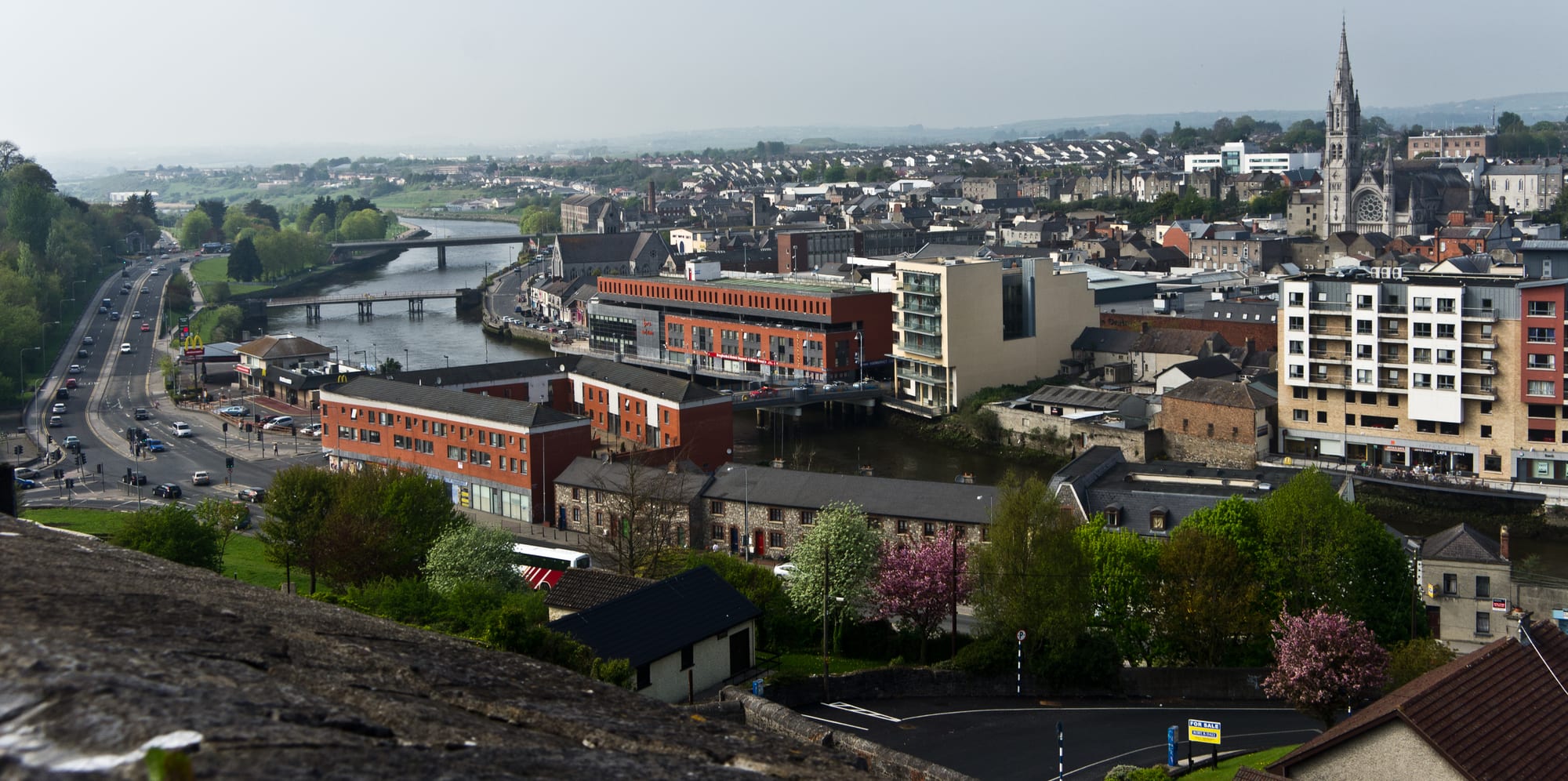
Drogheda's rooftops and the River Boyne seen from a height, with bridges on the left and a tall church spire on the right

Dublin & the East, Ireland

Drogheda

Drogheda and the River Boyne seen from Millmount Fort. (William Murphy / Wikimedia Commons · CC BY-SA 2.0)

An industrial and port town at the last bridging point on the River Boyne before the Irish Sea, about 40 km north of Dublin. A walled Norman town of the English Pale, it was sacked by Cromwell in 1649 and lies a few kilometres from the Battle of the Boyne site and the passage tombs of Newgrange. It is now the largest town in the Republic.

Neighbourhoods

  • West Street and the old town
    • First-time visitors
    • Historic district
    • Shopping

    The north bank of the Boyne, inside the line of the medieval walls. West Street, the main street, holds the Tholsel and St Peter's Church; St Laurence Street leads east to St Laurence Gate and the Highlanes Gallery, and the Magdalene Tower stands on the high ground to the north.

    Open in Maps
  • Millmount and the south bank
    • Viewpoints
    • Close to public transport

    Across the river, the great mound of Millmount Fort rises above the town, with its museum and Martello tower. Below it are the bus station, near the river, and the old Buttergate.

    Open in Maps

Things to do

Walls, forts and churches

  • St Laurence Gatelandmark

    A 13th-century barbican, a defended fore-work outside the old east gate of the walled town, described as one of the finest of its kind.

    Open in Maps
  • Millmount Fortlandmark

    A fortified complex on a great mound on the south bank, a feature of the town from Norman times to the Civil War of 1922, with a museum and views from its Martello tower.

    Open in Maps
  • St Peter's Churchlandmark

    A French Gothic church of local limestone on West Street, known for its tall west gable and rose window and as the national shrine of St Oliver Plunkett, whose preserved head is displayed here.

    Open in Maps
  • Magdalene Towerlandmark

    The 14th-century belfry tower that is all that remains of a Dominican friary founded in about 1224, on the highest point of the northern town; Cromwell's cannon damaged its battlements in 1649.

    Open in Maps
  • The Tholsellandmark

    The old municipal building on West Street, completed in 1770, which now serves as the tourist information office.

    Open in Maps
  • Highlanes Gallerymuseum

    The town's public art gallery on St Laurence Street, opened in 2006, which cares for the Drogheda municipal art collection.

    Open in Maps
  • Boyne Viaductlandmark

    A 30-metre-high railway viaduct over the Boyne that carries the main Dublin–Belfast line across the town.

    Open in Maps
  • Beaulieu House and Gardensattraction

    An estate about 3 km east of the town, with a house of around 1715 in the Dutch style — one of the earliest unfortified major houses in Ireland — and a terraced walled garden.

    Open in Maps

Short trips into the Boyne Valley

  • Brú na Bóinnelandmark

    The Neolithic passage tombs of Newgrange, Knowth and Dowth in a bend of the Boyne about 8 km west, a UNESCO World Heritage Site since 1993; several tombs are aligned with the winter solstice.

    Open in Maps
  • Battle of the Boyne siteattraction

    The riverbank at Oldbridge, about 6 km west of the town, where William III defeated the army of James II in 1690.

    Open in Maps
  • Monasterboicelandmark

    The ruins of an early Christian monastic settlement north of the town, a national monument famous for its high crosses.

    Open in Maps
  • Mellifont Abbeylandmark

    The ruins of the first Cistercian abbey in Ireland, which hosted the Synod of Kells-Mellifont in 1152 and became a manor house after its dissolution in 1539.

    Open in Maps

Seasonal events

  • Drogheda Arts FestivalMay bank holiday weekend

    Music, live performance and street entertainment across the town.

  • National Sandcastle and Sand-Sculpting Competitionlate June

    A sand-sculpting contest on the beach at Bettystown, to the south of the town.

Eat and drink

Long-standing places and food districts in Drogheda. Hours, ratings and directions come from your maps app, always current.

Food streets and drink

  • West Streetneighborhood

    The town's main street, home to St Peter's Church and the Tholsel, with cafés and pubs among the shops.

    Open in Maps
  • Boann Distilleryrestaurant

    A distillery founded in 2016 that has made single pot still whiskey since 2019 and exports to some 60 countries.

    Open in Maps

Experience Drogheda

History

Drogheda's Irish name, Droichead Átha, means "bridge at the ford", and the town grew where the last crossing of the Boyne met the sea. Despite local tradition, there is no evidence of a settlement before the Normans. The Norman lord of Meath, Hugh de Lacy, probably raised the motte now called Millmount before 1186, and Walter de Lacy granted the earliest known charter in 1194. Two towns grew up on either bank, Drogheda-in-Meath and Drogheda-in-Oriel, divided by an old boundary between Irish kingdoms; in 1412, with the abbot of the Dominican friary as peacemaker, they were united as the County of the Town of Drogheda.

It became an important walled town of the English Pale, guarded by gates such as St Laurence Gate. In September 1649 Oliver Cromwell breached the walls from the south and took the town, and his men massacred the Royalist defenders; in his own words, the officers "were knocked on the head, and every tenth man of the soldiers killed and the rest shipped to Barbados." In 1690 the Battle of the Boyne was fought about 6 km upstream at Oldbridge, though the town itself was undamaged.

Harbour commissioners took charge of the port in 1790, and the railway arrived in 1844, crossing the river on the Boyne Viaduct to reach Belfast in 1852. In the Civil War of 1922 anti-Treaty forces holding Millmount were shelled by the army of the Irish Free State. In 1921 the preserved head of St Oliver Plunkett, executed in London in 1681, was put on display in St Peter's Church. Much of the medieval town was lost to 19th- and 20th-century development, and the loss of traditional industries hollowed out the town centre.

Culture & Customs

The star and crescent on Drogheda's coat of arms is tied to a story the town tells with pride: in a 2010 speech President Mary McAleese said that it was added in gratitude for food sent by the Ottoman Sultan Abdülmecid I during the Great Famine. In 2011 Drogheda United became a sister club of Turkey's Trabzonspor, citing their matching colours and that history.

Traditional music is strong here. The town hosted Fleadh Cheoil na hÉireann, the national traditional-music festival and competition, in 2018 and 2019, and the community event Music at the Gate, led by the uilleann piper Darragh Ó Heiligh, gathers musicians beside St Laurence Gate. The Drogheda Arts Festival fills the town with music and street performance over the May bank holiday weekend, the Highlanes Gallery holds the municipal art collection, and the Droichead Arts Centre has a gallery and theatre.

Sport centres on Drogheda United, founded in its present form in 1975, which won the FAI Cup in 2005 and again in 2024, and on the rugby club Boyne RFC. The Boyne still divides the town between the dioceses of Armagh and Meath, and St Peter's Church on West Street is the national shrine of St Oliver Plunkett.

Daily Life

At the 2022 census Drogheda had about 44,000 people, making it the largest town in the Republic by population and area and the eleventh-largest settlement in Ireland. Most of the town lies in County Louth, with its southern fringe in County Meath. In 2022 about 68 per cent of residents described themselves as white Irish; at the 2016 census Polish and Lithuanian citizens were among the largest groups of foreign nationals.

The economy mixes the port, food, finance and commuting. Nature's Best, one of Ireland's largest salad producers, employs about 400 people, and State Street, the Drogheda Port Company and Glanbia are other employers; but in July 2024 it was announced that the medical-technology plant opened by BD in 1964 would close, and the energy company Flogas moved its head office to Dublin Airport in 2025. Our Lady of Lourdes Hospital, the town's main hospital, has an emergency department serving Louth, Meath and the north-east.

Drogheda has become a commuter town for Dublin, and it has grown fast: more than 1,000 new homes were built in each of 2024 and 2025. The old centre has struggled as shoppers moved to retail parks, and a regeneration plan for the area around Narrow West Street was published in 2018.

Food

Drogheda has a long record in brewing and distilling. Cairnes Brewery, founded in 1825 on the Marsh Road, made ale and stout, and Preston Brothers Distillery, founded in 1886, sold its whiskey in Ireland and the United States until it closed in 1968. Both traditions have returned: Boann Distillery, founded in 2016, has made single pot still whiskey since 2019 and exports to some 60 countries, and Jack Cody's Brewery opened in 2014.

Food also links the town to its proudest story. The star and crescent on its arms commemorates, by the account President McAleese gave in 2010, the food sent by the Ottoman Sultan during the Famine. Today Nature's Best, based in the town, is one of the largest producers and distributors of salads in Ireland.

Cafés and pubs sit among the shops on West Street, and there are places to eat and drink on the North Quay. Representative Irish dishes include Irish stew, bacon and cabbage, boxty, colcannon and soda bread.

Planning tools

Budget

Drogheda is considerably cheaper than Dublin for rooms and meals, and makes a practical base for the Boyne Valley, with fast trains to the capital. Many of the town's sights, from St Laurence Gate to St Peter's Church, cost nothing to see; the Boyne Valley tomb tours charge.

Daily Budget Midrange
USD 180–320 (mid-range hotel or B&B, restaurant dinners, Brú na Bóinne tour, a hire car or taxi for the valley)
Daily Budget Shoestring
USD 80–130 (hostel or simple guesthouse, pub food and cafés, trains and buses)

Newgrange is visited only on guided tours that start from the Brú na Bóinne Visitor Centre, and numbers are tightly restricted, so allow for a set slot time in summer.

Best Time to Visit

May to September gives the longest days for the Boyne Valley sites and the coast, with the arts festival in May and sand sculpture on the beach at Bettystown in June. December brings the winter solstice at Newgrange, when sunrise lights the chamber — seen inside only by lottery winners. Winter is otherwise quiet and damp.

Suggested Number of Days

The town itself can be seen in a day. Three or four days allow time for the Boyne Valley tombs, the battle site and the monasteries of County Louth, which are easiest by car or tour; booked slot times at the tombs can stretch a visit.

First Visit
1–2 days
With Surroundings
3–4 days

Transportation

The centre is compact and walkable, and a town bus loops from West Street through the suburbs. Buses run every half hour to Bettystown and Laytown on the coast, and regional routes go to Dublin, Dundalk, Athlone and Monaghan. The Boyne Valley sites are easiest by car; the M1 crosses the Boyne just west of the town on the Mary McAleese Boyne Valley Bridge.

Drive rather than walk to the battle site and Brú na Bóinne, as the country roads have few footpaths.

Airport & Station Connections

Dublin Airport is 42 km south of Drogheda by the M1 motorway. MacBride station has Enterprise trains north to Dundalk, Newry, Portadown and Belfast Grand Central and south to Dublin Connolly, as well as frequent commuter trains along the coast to Dublin. The bus station is on the south bank near the river.

Walkability

Easy on foot: West Street, St Laurence Gate, the Highlanes Gallery and the Magdalene Tower are a few minutes apart, and Millmount is a short, steep climb across the river. The streets are hilly on both banks. The Boyne Valley sites are too far to walk to from the centre.

Safety

Ireland is a very safe country, with low levels of violent crime. Drogheda is a busy working town; the main concerns for visitors are ordinary petty theft and thefts from cars at the car parks of rural heritage sites.

Keep valuables out of sight in parked cars at the Boyne Valley sites and take normal care in the town centre late at night. Check current official travel advice before travelling.

Climate

A mild, changeable oceanic climate. Dublin, on the same coast, is the driest place in Ireland, but showers are possible at any time of year.

Summer
mild — in Dublin, July highs average about 20°C, with long light evenings
Winter
cool and damp — in Dublin, February lows average about 4°C

Local Customs

The town is proud of its long history, from Cromwell's siege to the star and crescent on its coat of arms, and of Drogheda United, the League of Ireland football club. The pub is the centre of social life, and traditional musicians gather regularly at St Laurence Gate. Signs are in Irish and English.

A percentage tip is not usually expected, though 10–15% is standard in restaurants; leaving a few coins is considered polite, tipping is not expected in pubs, and a tip should reflect satisfaction with the service. Respect services and the shrine at St Peter's Church, a place of pilgrimage.

Common Payment Methods

The currency is the euro. Cards are accepted in most outlets, and ATMs are easy to find in the town centre. Carry a little cash for small shops and rural sites.