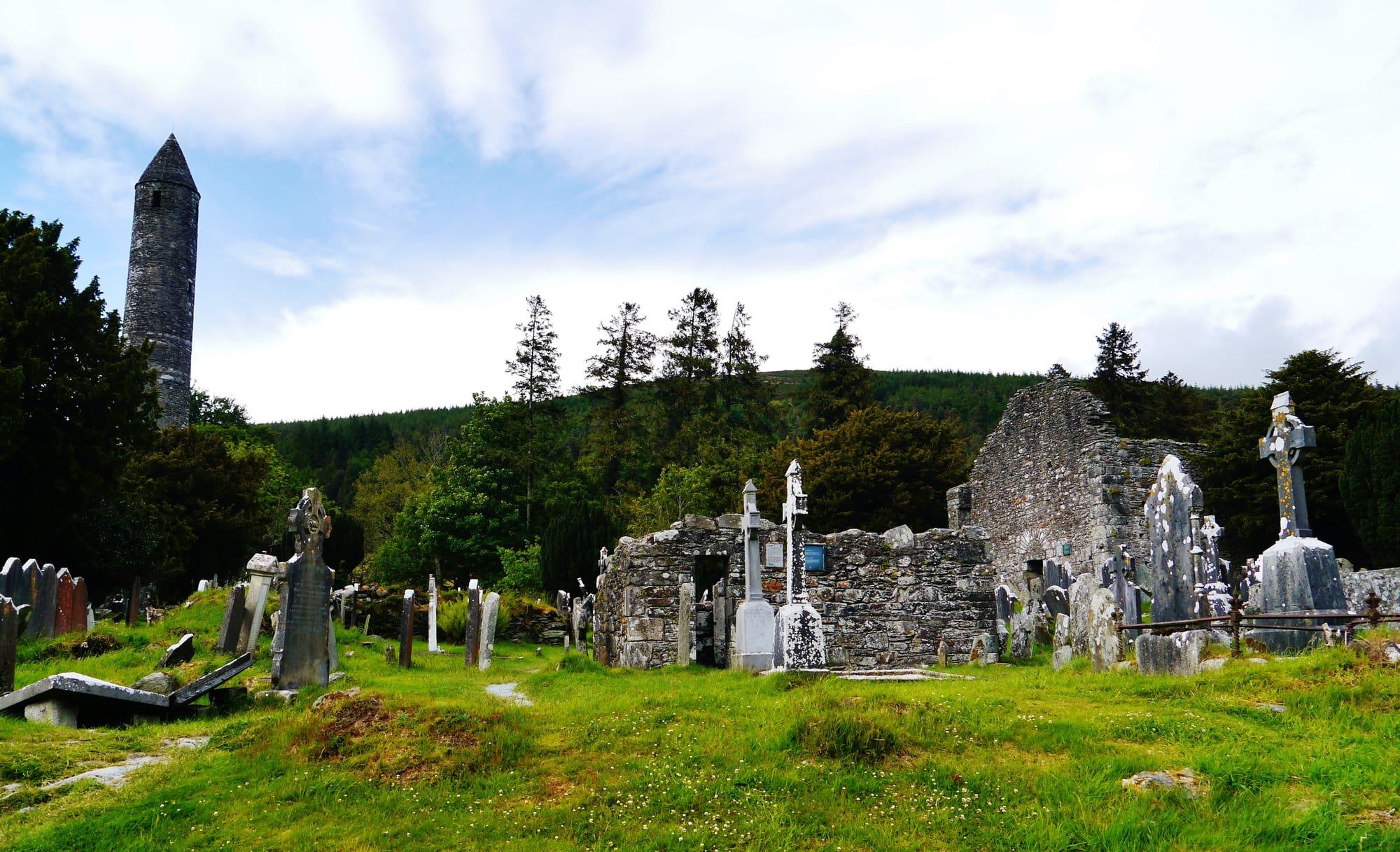
A tall stone round tower beside a grassy graveyard of crosses and the roofless stone walls of a ruined cathedral, with forested hills behind

Dublin & the East, Ireland

Glendalough

The round tower, graveyard and ruined cathedral of the monastic city at Glendalough, County Wicklow. (Zairon / Wikimedia Commons · CC BY 4.0)

A glacial valley of two lakes in the Wicklow Mountains, south of Dublin, where St Kevin founded a monastery in the 6th century. Its round tower, ruined churches and graveyards became a place of learning and later of pilgrimage. Today the valley lies within Wicklow Mountains National Park and is busy with walkers, climbers and day-trippers.

Neighbourhoods

  • The monastic city and the Lower Lake
    • First-time visitors
    • Historic district

    The heart of the old monastery, entered through a stone gateway near the Lower Lake. The round tower, the roofless cathedral, St Kevin's Kitchen and crowded graveyards stand here beside the visitor centre, and flat paths lead on through the woods towards the Upper Lake.

    Open in Maps
  • The Upper Lake
    • Walking
    • Scenery

    The larger lake at the head of the valley, under the cliffs of the Spinc and the slopes of Camaderry. A path along the north shore leads to the ruined miners' village, St Kevin's Bed is a small cave in the rock above the south shore, and boardwalk trails climb the ridges above.

    Open in Maps
  • Laragh
    • Places to eat
    • Places to stay

    A small village about 3 km down the valley at the junction of three mountain roads, with most of the area's places to eat and stay. Walkers, cyclists and motorcyclists use it as a stopping point on runs over the Wicklow Gap.

    Open in Maps

Things to do

The monastic city

  • Round towerlandmark

    A tower about 30 metres high of mica-slate and granite, with its doorway 3.5 metres above the ground; such towers were bell towers that could also serve as stores and places of refuge.

    Open in Maps
  • St Peter and St Paul's Cathedrallandmark

    The largest and most imposing building of the monastery, built in several phases, which ceased to be a cathedral when the diocese was joined to Dublin in 1214.

    Open in Maps
  • St Kevin's Kitchenlandmark

    A small stone-roofed church whose belfry, rising from the west end like a miniature round tower, reminded people of a kitchen chimney.

    Open in Maps
  • The Gatewaylandmark

    The entrance to the monastic city, originally two storeys high with two granite arches, a monument unique in Ireland; part of the paved causeway beyond survives.

    Open in Maps

Lakes and walks

  • St Kevin's Bedviewpoint

    A small, partly man-made cave about 8 metres above the Upper Lake beneath the Spinc cliffs, linked by tradition to St Kevin and later to St Laurence O'Toole.

    Open in Maps
  • The Spinc and Poulanass Waterfalltrail

    A zig-zag path from the waterfall climbs to a viewing platform on the Spinc ridge above the Upper Lake; the 9 km White Route continues along the cliffs and back by the miners' village.

    Open in Maps
  • Miners' villageattraction

    The ruins of cottages and processing works at the head of the valley, where lead ore was mined in phases from 1825 until 1957.

    Open in Maps
  • Wicklow Waytrail

    A waymarked long-distance trail of 131 km from Marlay Park in south Dublin to Clonegal in County Carlow, which passes through the valley.

    Open in Maps
  • Saint Kevin's Waytrail

    A 30 km pilgrim path from Hollywood over the Wicklow Gap to the monastery, following the route Kevin is said to have taken across the mountains.

    Open in Maps

Short trips from the valley

  • Glenmacnass Waterfallviewpoint

    An 80-metre waterfall at the head of the Glenmacnass Valley north of Laragh, a popular viewpoint on the mountain road.

    Open in Maps
  • Lough Tayviewpoint

    A small lake on private land beneath the granite cliffs of Luggala, seen from car parks along the R759 road.

    Open in Maps
  • Powerscourt Estateattraction

    A country estate at Enniskerry whose house, begun as a 13th-century castle, was remodelled in the 18th century, set in large landscaped gardens.

    Open in Maps

Seasonal events

  • St Kevin's feast day3 June

    The feast of the monastery's founder, who died in about 618, traditionally on 3 June.

  • Wicklow Walking FestivalOctober

    Guided walks in the mountains, starting from the Brockagh Centre between Laragh and Glendalough.

  • St Laurence's pattern day14 November

    The day of St Laurence O'Toole, abbot of Glendalough and later Archbishop of Dublin, a quieter time to visit the valley.

Eat and drink

Long-standing places and food districts in Glendalough. Hours, ratings and directions come from your maps app, always current.

Eating in the valley

  • Laragh villageneighborhood

    The service village 3 km down the valley, with more choice of places to eat than Glendalough itself, including cafés and restaurant bars.

    Open in Maps
  • Wicklow Heatherrestaurant

    A restaurant on the Glendalough road at the west edge of Laragh, often recommended among the best places to eat in the area.

    Open in Maps
  • Glendalough Greencafe

    A café among the area's places to eat.

    Open in Maps

Experience Glendalough

History

Glendalough, Gleann Dá Loch in Irish, the "valley of two lakes", was carved by a glacier in the last ice age; a moraine was left across its mouth, and the delta of the Poulanass River later divided the original lake in two. In the 6th century Kevin, a descendant of one of the ruling families of Leinster, came here to live as a hermit and founded a monastery. He died in about 618, traditionally on 3 June, and his foundation grew into one of the great monastic cities of early Ireland, with workshops, places for writing and copying manuscripts, guest houses, an infirmary, farms and a large lay population.

The settlement suffered repeated raids, and in about 1042 oak from the valley was used to build one of the longest Viking longships ever recorded. Laurence O'Toole, born in 1128, became abbot here and returned to the solitude of St Kevin's Bed even after becoming Archbishop of Dublin in 1162. In 1214 the dioceses of Glendalough and Dublin were united, and the valley lost much of its importance. English forces destroyed the settlement in 1398, but it remained a church of local importance and a place of pilgrimage.

The valley had a second, industrial life. Lead ore was mined in the valley and neighbouring Glendasan from the early 19th century, with a miners' village and processing works at the head of the Upper Lake; the mines reopened briefly from 1948 and closed for good in 1957. The valley is now part of Wicklow Mountains National Park.

Culture & Customs

Glendalough's identity is bound up with St Kevin and the pilgrims who followed him. His own writings speak of fighting "knights", which scholars read as his struggle with temptation, and stories of the hermit saint have gathered around the cave above the Upper Lake. Pilgrims long made their way here; the 30 km Saint Kevin's Way from Hollywood over the Wicklow Gap revives one of their routes and in 2016 became part of the National Pilgrim Passport for Ireland. Small crosses near the stone enclosure between the lakes seem to have been stations on a pilgrims' circuit.

The valley is also a place of outdoor recreation for people from Dublin. Walkers take the trails around the lakes and up to the Spinc, the Wicklow Way passes through, and the granite cliffs above the miners' village have been used for rock climbing since 1948. The Wicklow Walking Festival in October runs guided walks from the Brockagh Centre nearby.

The Church of Ireland still joins Glendalough's name to the capital's in its Diocese of Dublin and Glendalough. Visitors are expected to treat the graveyards and crosses with respect.

Daily Life

Glendalough is a valley and a monument rather than a town. Development is restricted, and apart from the visitor centre and one hotel near the monastic city, most homes, shops and places to stay are in Laragh, 3 km down the road at the junction of the routes over the mountains.

Life here revolves around visitors and the land. On summer weekends parking spaces are hard to find and the only eating place beside the sights is mobbed. Bus excursions run from Dublin every day, while the cold, wet days of late autumn are far quieter. The national park staff look after the trails and the wildlife, including the herds of red deer in the Glenealo Valley above the Upper Lake.

Weekends bring hill walkers heading for the higher summits, cyclists and motorcyclists stopping in Laragh after a run over the Wicklow Gap, and climbers on the granite crags. Walkers on the Wicklow Way pass through on their way south.

Food

There is little to eat inside the valley itself: the hotel by the monastic city is the only place to eat beside the sights. Most visitors eat in Laragh, 3 km down the road, which has cafés and restaurants, among them Wicklow Heather on the Glendalough road and the Glendalough Green café, and bars serving food. Many walkers simply bring a picnic: the valley has long been a place for picnics by the lakes.

Representative Irish dishes include Irish stew, traditionally made with lamb or mutton, potatoes and onions, along with bacon and cabbage, colcannon and soda bread. Guinness, the country's best-known drink, has been brewed at St James's Gate in Dublin since 1759.

Because there are no cash machines in Glendalough or Laragh, and the valley's cafés and car parks are busiest at lunchtime on summer weekends, it pays to bring cash and some food from a larger town such as Dublin, Bray or Wicklow.

Planning tools

Budget

The monastic city itself costs nothing to wander; parking and the visitor centre exhibition are the main charges. Accommodation in the valley is limited, so many visitors come on a day trip from Dublin or stay in Laragh. There are no cash machines in Glendalough or Laragh.

Daily Budget Midrange
USD 180–320 (guesthouse or country hotel, restaurant dinners, a hire car or a guided tour)
Daily Budget Shoestring
USD 80–130 (hostel bed, packed lunches, café meals, bus from Dublin)

Bring cash from Dublin or another town, and arrive early on summer weekends, when the car parks fill.

Best Time to Visit

Late spring to early autumn gives the longest days and the best walking, but the valley is very crowded on summer weekends. Weekdays, early mornings and the shoulder months are quieter; winter brings rain, short days and snow on the higher summits, with a much emptier valley.

Suggested Number of Days

Most visitors come for a single day, which is enough for the monastic city and a walk by the lakes. Two or three days, staying in the valley or at Laragh, allow the longer ridge walks and the mountain roads beyond.

First Visit
1 day
With Surroundings
2–3 days

Transportation

A car is the easiest way to reach the valley, by the N11 and the R755 through Roundwood and Annamoe. Once there, the sights are on foot or by bicycle: cycling is allowed on the hard-surfaced roads, forest tracks and some of the waymarked routes. Local Link buses run a few times a day from Wicklow town via Laragh.

On summer weekends park once and walk between the Lower and Upper Lakes rather than moving the car.

Airport & Station Connections

Glendalough is about 40 km south of Dublin. Most people arrive by car or on a coach tour from the capital; the long-running St Kevin's Bus runs twice a day from St Stephen's Green in Dublin, taking about 90 minutes via Bray, where it meets DART trains. Dublin Airport is the nearest international airport.

Walkability

The valley is made for walking. The monastic city to the Upper Lake is an easy, mostly flat walk on maintained paths such as the Green Road, and waymarked routes climb from there. The higher trails are steep and exposed, and Laragh is a 3 km walk down the road.

Safety

Ireland is a very safe country, with low levels of violent crime. At Glendalough the main risks are thefts from cars in the busy car parks, narrow mountain roads, and changeable weather on the high ground, where mist can come down suddenly.

Leave nothing on view in parked cars, carry waterproofs and a map on the upper trails, and keep to the paths near the cliffs. Check current official travel advice before travelling.

Climate

A temperate oceanic climate with mild, damp summers and cool, wet winters; rainfall reaches 2,000 mm a year on the highest mountains. Showers can arrive in any season, and conditions on the ridges can differ sharply from those by the lakes.

Summer
mild — in Dublin, July highs average about 20°C; the mountains are cooler and wetter
Winter
cold and damp — in Dublin, February lows average about 4°C; snow cover can reach an average of 50 days a year on the highest Wicklow peaks

Local Customs

Glendalough remains a place of pilgrimage as well as a beauty spot, with graveyards and crosses among the ruins. A percentage tip is not usually expected, though 10–15% is standard in restaurants; leaving a few coins is considered polite, and tipping is not expected in pubs.

Do not climb on the ruins, crosses or gravestones; the Deer Stone, an ancient bullaun stone, was permanently damaged by vandalism in 2023.

Common Payment Methods

The currency is the euro. Cards are accepted in most outlets in Ireland, but there are no ATMs or banks in Glendalough or Laragh, so bring some cash, including for parking.