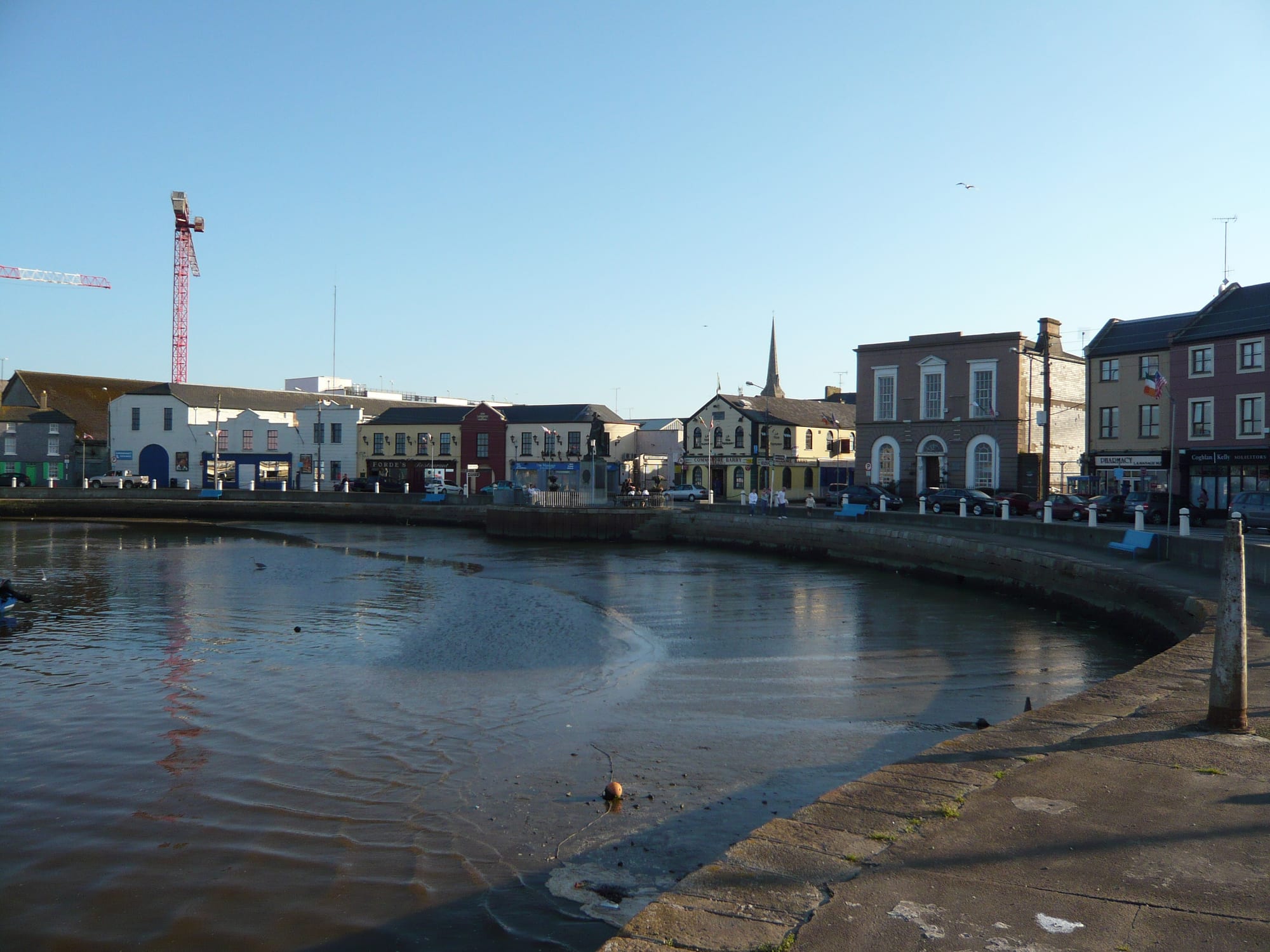
The curved stone wall of Crescent Quay in Wexford, with low tide water and a row of painted buildings under a clear sky

Dublin & the East, Ireland

Wexford

Crescent Quay on the Wexford waterfront, with the town's buildings and a church spire behind. (georama / Wikimedia Commons · CC BY 3.0)

The county town of County Wexford, on the south side of Wexford Harbour where the River Slaney meets the sea in Ireland's south-eastern corner. Founded by Vikings and taken by the Normans in 1169, it was sacked by Cromwell and held by the rebels of 1798; today it is a compact harbour town of narrow lanes, quays and an internationally known opera festival.

Neighbourhoods

  • Main Street and the old town
    • First-time visitors
    • Historic district
    • Shopping

    The town centre keeps its Viking street pattern, with the pedestrianised Main Street winding south from Selskar Abbey past the Bull Ring, gabled 18th-century houses, churches, cafés and pubs. Fragments of the medieval town wall survive on Abbey Street and Mallin Street.

    Open in Maps
  • The Quays
    • Waterfront
    • Close to public transport

    The long harbour front, redeveloped in the early 21st century after the old timber wharves were removed, runs from the railway and bus station past Crescent Quay. Narrow lanes climb from the water into the town, and mussel dredgers and leisure boats tie up along the river.

    Open in Maps
  • Ferrybank
    • Quiet and residential
    • Views of the town

    The east bank of the Slaney, reached across the long Wexford Bridge, with the town's swimming pool, a campsite and the best views back across the water to the quays and church spires. The road north towards Curracloe starts here.

    Open in Maps
  • Clonard and the western edge
    • Quiet and residential
    • Sport

    Newer housing to the west of the centre, around Clonard village and the hospital, where much of the town's recent residential development has taken place. The county's Gaelic games ground, Wexford Park, and the racecourse are on this side of town.

    Open in Maps

Things to do

Historic town

  • Selskar Abbeylandmark

    The ruins of an Augustinian priory founded about 1190, with a square bell tower thought to date from the 14th century; it was wrecked after Cromwell took the town in 1649 and is seen on guided tours in summer.

    Open in Maps
  • St Iberius' Churchlandmark

    An 18th-century Protestant church on North Main Street with a Renaissance Revival front and a Georgian interior, dedicated to St Ibar of Beggerin.

    Open in Maps
  • Wexford Arts Centreattraction

    The former Cornmarket and town hall, now an arts centre with exhibitions, theatre, music and dance.

    Open in Maps
  • National Opera Houseattraction

    The town's opera house, opened in 2008 on the site of the old Theatre Royal, with a 771-seat main auditorium; it is the home of Wexford Festival Opera.

    Open in Maps

Heritage parks and houses

  • Irish National Heritage Parkmuseum

    An open-air museum at Ferrycarrig, opened in 1987, with 16 reconstructed dwellings — from a Mesolithic camp to a crannóg, a ringfort and a Viking harbour — telling the story of settlement in Ireland up to 1169.

    Open in Maps
  • Johnstown Castlemuseum

    A Gothic Revival castle on a 61-hectare estate south-west of the town, with lakes, gardens, an 86-metre servants' tunnel and the Irish Agricultural Museum in the old stable yard.

    Open in Maps

Harbour, wildlife and beaches

  • Wexford Wildfowl Reservepark

    A nature reserve on the North Slob, mudflats reclaimed in the 19th century, where thousands of ducks, geese, swans and waders stop over, including a large share of the world's Greenland white-fronted geese in winter.

    Open in Maps
  • Curracloebeach

    A village north-east of the town linked to the long, sandy Curracloe Strand, where the D-Day sequence of Saving Private Ryan was filmed in 1997.

    Open in Maps
  • The Raven Nature Reservepark

    A national nature reserve and Ramsar site of sand dunes, lagoons and conifer woodland on a former sand spit at the entrance to Wexford Harbour.

    Open in Maps

Short trips from the town

  • Enniscorthy Castlemuseum

    A Norman castle up the Slaney in Enniscorthy, begun in the late 1190s and first occupied in 1203.

    Open in Maps
  • Kilmore Quayattraction

    A small fishing village on the south coast of the county, busy with sailing and sea-angling boats.

    Open in Maps
  • Hook Lighthouselandmark

    A medieval tower at the tip of the Hook Peninsula, standing for over 800 years and still marking the entrance to Waterford Harbour — one of the oldest working lighthouses in the world.

    Open in Maps

Seasonal events

  • Wexford Festival OperaOctober and November

    An opera festival founded by Dr Tom Walsh in 1951, held since 2008 at the National Opera House, sometimes with fireworks over the harbour.

  • Enniscorthy Strawberry Fairlate June

    A festival in Enniscorthy, up the Slaney from Wexford, celebrating the county's strawberries, at which a Strawberry Queen is crowned.

Eat and drink

Long-standing places and food districts in Wexford. Hours, ratings and directions come from your maps app, always current.

Wexford classics

  • Wexford strawberriesmarket

    County Wexford's strawberries are famous across Ireland and are sold in shops and at roadside stalls through the summer, traditionally eaten with cream.

    Open in Maps
  • Main Street cafés and restaurantsneighborhood

    North and South Main Street hold most of the town's cafés, delis, bakeries and restaurants, Thai and Indian kitchens among them.

    Open in Maps

Pubs

  • South Main Street pubsneighborhood

    The southern end of Main Street and the Bull Ring hold a run of pubs, including one serving traditional food and beer from Wexford's Yellowbelly brewery.

    Open in Maps

Experience Wexford

History

Vikings founded Wexford in about 800 AD, calling it Veisafjǫrðr, "inlet of the mudflats", a name that became Weiseforthe in the local medieval dialect and Wexford in modern English. From the 9th to the early 12th century it was a largely independent Norse town, paying only token dues to the kings of Leinster. In May 1169 Dermot MacMurrough and his Norman ally Robert Fitz-Stephen besieged it, and after the Bishop of Ferns brokered a settlement it became an Anglo-Norman town. The Knights Templar had a presence here, the town received its first charter in 1318, and an Anglo-Frisian dialect called Yola was spoken in the south of the county until the 19th century.

In the 1640s a fleet of Confederate privateers sailed from Wexford to raid English shipping, and in 1649 Cromwell's army sacked the town, killing between 1,500 and 2,000 soldiers and civilians. Gabled "Dutch Billy" houses on Main Street survive from the quieter 18th century. In 1798 Wexford was held by the United Irishmen throughout the rebellion, and executions and reprisals took place at Wexford Bridge.

The shifting sands of the harbour slowly ended Wexford's life as a port. A deepwater harbour was built at Rosslare in the early 20th century, and in 1968 dredging the channel to the quays became uneconomic and the port closed. The timber wharves were cleared in the 1990s, and since then the quay front has been redeveloped as a public waterfront.

Culture & Customs

Opera has made Wexford's name abroad. Dr Tom Walsh started Wexford Festival Opera in 1951 in the small Theatre Royal, and the festival's success led to a new opera house on the same site, opened in 2008 and renamed Ireland's National Opera House in 2014. The festival fills the town every October and November. Wexford also has an arts centre in the old town hall, the community Dun Mhuire Theatre, concerts in St Iberius' Church and a cluster of amateur companies, including the Buí Bolg street theatre group and the Wexford Light Opera Society.

Traditional music had its biggest moment in 2024 and 2025, when the town hosted Fleadh Cheoil, the all-Ireland festival of traditional music; the 2025 event drew what was then a record crowd of more than 800,000. The town's skyline is defined by its "twin churches" on Rowe Street and Bride Street, whose matching spires can be seen from all over Wexford and which celebrated their 150th anniversary in 2008.

Sport follows the county pattern. Wexford Park in Clonard is home to the county's hurling and Gaelic football teams, and the town's GAA clubs have long rivalries; Wexford FC plays in the League of Ireland at Ferrycarrig, and the racecourse stages jump racing. Local identity draws on a distinct history of Norse and Norman settlement, and a few Yola words and place names are still used, particularly in the south.

Daily Life

The town had about 21,500 people at the 2022 census, out of about 163,500 in County Wexford. It is the county's administrative centre: Wexford County Council and Wexford General Hospital are large employers, and the Johnstown Castle estate just outside town is headquarters to Teagasc, the agriculture and food development authority, the Environmental Protection Agency and the Department of Agriculture, Food and the Marine. Private employers include Wexford Creamery, linen, glass and engineering firms, financial services companies and a Coca-Cola research plant.

The borough council was merged into Wexford County Council in 2014, but the town keeps the right to call itself a borough, and the chair of its district still uses the title of mayor. Recent residential development has centred on Clonard village on the western side. The harbour, once the town's main business, is now used by mussel dredgers and pleasure boats, while freight and ferries go through Rosslare Europort to the south.

Life centres on Main Street by day, with its shops and cafés, and on the pubs and the opera house in the evening. Commuters use the railway line along the quays and the bus routes to Dublin and Waterford, and at weekends people head for the beaches at Curracloe and Rosslare or a club match at Wexford Park.

Food

The county's most famous food is the Wexford strawberry. Strawberries grown in the county are sold in shops and from roadside stalls throughout the summer, and strawberries and cream is the local treat; every year near the end of June the town of Enniscorthy holds a Strawberry Fair and crowns a Strawberry Queen. Dairy is the other mainstay: Wexford Irish Cheddar is a well-known brand, and Carrigbyrne, a full-flavoured soft cheese, is made near New Ross.

Fishing shaped the town for centuries — in the 15th and 16th centuries Wexford was Ireland's leading fishing port, sending catches to the west coast of England and Wales — and the harbour's mudflats were worked from the Wexford cot, a flat-bottomed fishing boat. Today the harbour is mainly the base of mussel dredgers, and seafood appears on menus in the town's restaurants, alongside fish and chips from the takeaways.

Eating out is concentrated on North and South Main Street and the lanes off it, where cafés, delis and bakeries sit beside Thai, Indian and Asian restaurants and pubs serving traditional food. Beer comes from local craft brewers such as Yellowbelly as well as the national brands.

Planning tools

Budget

Wexford is noticeably cheaper than Dublin. Rooms in the town's hotels, guesthouses and B&Bs cost a fraction of capital prices for most of the year, though the opera festival in autumn and summer weekends fill them quickly. Much of the town — the quays, Main Street, the abbey grounds and the wildfowl reserve — costs nothing, and the heritage park and castle estate are the main paid sights.

Daily Budget Midrange
USD 180–320 (town hotel or B&B, restaurant dinners, heritage park and castle tickets, some car hire)
Daily Budget Shoestring
USD 80–130 (campsite or budget room, pub food and supermarket picnics, town buses)

Book well ahead for the opera festival; the hourly Bridge Loop bus reaches the heritage park, while the castle and Curracloe are easiest by car.

Best Time to Visit

May to September brings the longest days, strawberry season and the best weather for Curracloe and the coast. October and early November are the time of the opera festival, when the town is at its liveliest. Winter is quiet but is the season for the geese on the North Slob.

Suggested Number of Days

The town itself is small and can be seen in a day or two. Allow three or four days to include the beaches, the castle estates and the rest of the county's south coast, and more during the opera festival, when evening performances shape the schedule.

First Visit
1–2 days
With Surroundings
3–4 days

Transportation

The town centre is walkable. Wexford Bus runs two town loops from Redmond Square, by the railway station, and an hourly loop out to the racecourse, the Irish National Heritage Park and Castlebridge. Buses link the town with Waterford, Carlow, Kilmore Quay and Rosslare, and a dozen taxi firms operate. The beaches, the Hook Peninsula and the castles are far easier by car.

Driving is on the left; rural roads in the south of the county are narrow and winding, so allow more time than the map suggests.

Airport & Station Connections

Dublin Airport is the nearest with commercial flights, about two hours away by road; Expressway and Wexford Bus coaches run from the airport and central Dublin, and the M11 links the town with the capital, about 155 km away. Trains from Dublin Connolly take about two and a half hours down the Wicklow coast to O'Hanrahan station on the quays. Rosslare Europort, 19 km south, has car ferries to Fishguard and Pembroke in Wales and to Cherbourg and Roscoff in France.

Walkability

Very good. The old town is compact, Main Street is pedestrianised, and the station, the quays, the abbey and the opera house are all within a few minutes' walk of each other. The lanes running down to the quays are narrow and some are steep. Ferrybank is a walk across the long bridge; the heritage park, the castle and the beaches need transport.

Safety

Ireland is a very safe country, with low levels of violent crime. Wexford is a quiet county town, and the usual cautions apply: busy pubs on weekend nights, theft from cars left at beach and nature reserve car parks, and strong currents and changeable weather on the open coast.

Keep valuables out of parked cars at beaches and viewpoints, swim only where lifeguards are on duty, and take care on narrow rural roads. Check current official travel advice before travelling.

Climate

An oceanic climate, mild and changeable, with winters moderated by the North Atlantic Drift. The east of Ireland is drier and sunnier than the west, though rain is possible in any month and the harbour can be windy.

Summer
July and August are the warmest months — across County Wexford they average 13–19°C on the coast and 12–22°C inland
Winter
January and February are the coldest months, averaging 4–9°C across County Wexford, with little snow

Local Customs

Wexford is proud of its Viking, Norman and 1798 history, and a few words of Yola, the old dialect of the south of the county, survive in local speech and place names. Hurling and Gaelic football inspire strong county loyalty. Tipping is not a general habit in Ireland, but 10–15 per cent is standard in restaurants; it is not expected in pubs.

Smoking is banned inside pubs, restaurants and enclosed public places across Ireland. Dress is casual; churches welcome visitors outside services.

Common Payment Methods

The currency is the euro. Cards are accepted in most outlets, and ATMs are easy to find in the town centre. A little cash is useful for roadside strawberry stalls and some small pubs and shops.