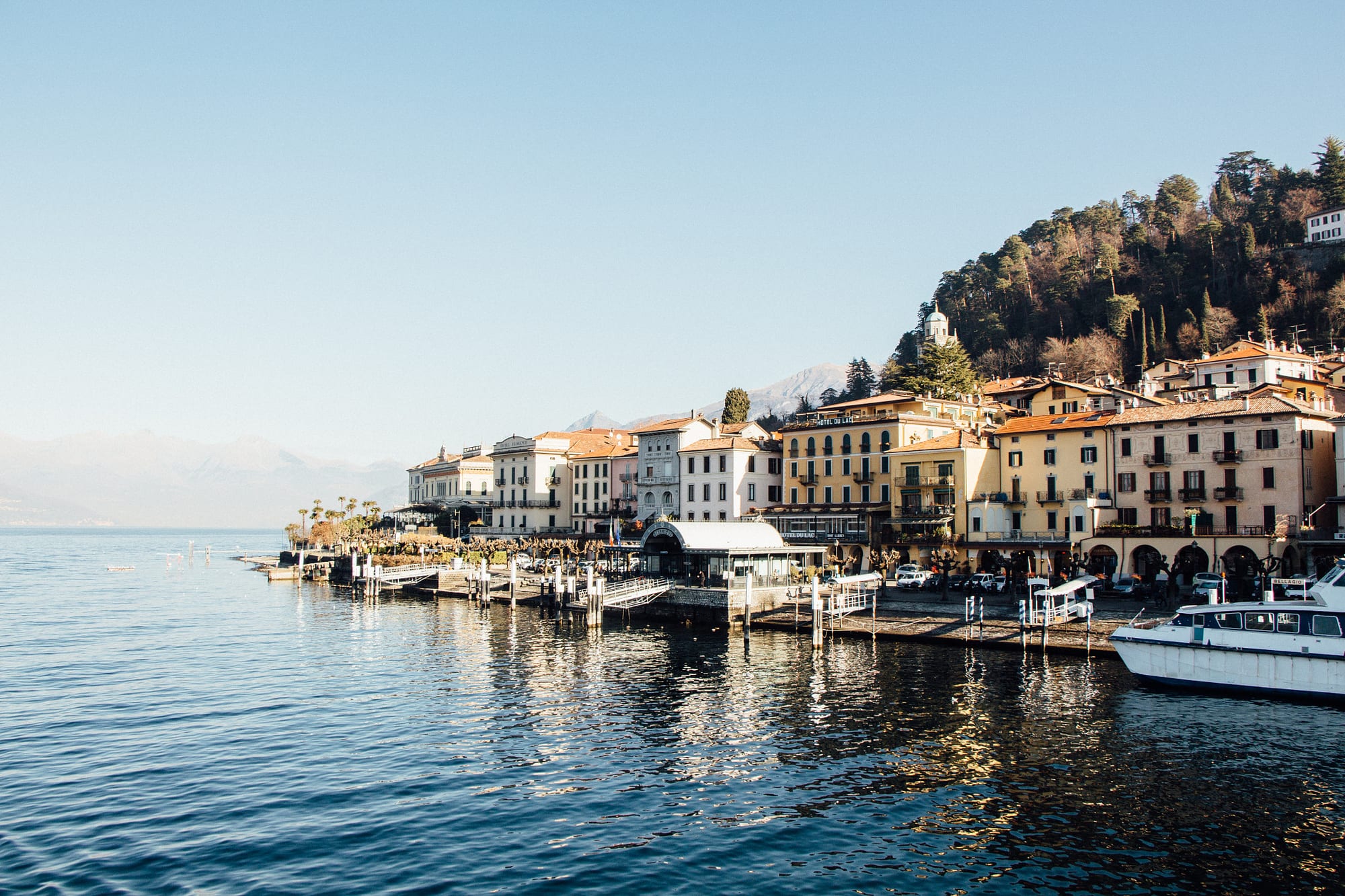
Pastel lakefront buildings and ferry piers of Bellagio on calm blue water, with a wooded hill and snowy peaks behind

Lombardy, Italy

Bellagio

Bellagio's lakefront and ferry piers on Lake Como, with the wooded hill of the promontory behind. (Sira Sripairojkul / Wikimedia Commons · CC BY 3.0)

A small lakeside village on the tip of the promontory where Lake Como splits into its two southern arms, looking north across the water to the Alps. Silk weaving and candle-making once kept it going; since the early 19th century Milanese nobles' villas and gardens, and the hotels that followed them, have made it one of the best-known resorts on the lake.

Neighbourhoods

  • The Borgo
    • First-time visitors
    • Historic district
    • Close to the ferries

    The historic centre, a short way south-west of the promontory's tip, between the hill of Villa Serbelloni and the Como arm of the lake. Three streets — Mazzini, Centrale and Garibaldi — run parallel to the shore one above the other, linked by stepped lanes, with the Basilica of San Giacomo and a medieval tower on the square at the top.

    Open in Maps
  • Loppia and San Giovanni
    • Gardens
    • Quiet and residential

    The lakeshore south of the centre along the Como arm. Loppia, a natural inlet once used by Roman warships and one of Bellagio's earliest suburbs, lies beside the gardens of Villa Melzi; the hamlet of San Giovanni beyond is quieter and residential.

    Open in Maps
  • Pescallo
    • Quiet and residential
    • Lake views

    A small hamlet on the Lecco side of the promontory, facing the eastern arm of the lake. Its square stone tower was built in 1493 to defend Bellagio's eastern harbour, and the church of San Biagio stands nearby.

    Open in Maps

Things to do

Villas and gardens

  • Villa Melzipark

    A neoclassical villa built in 1808–1815 for Napoleon's vice-president Francesco Melzi d'Eril, whose English-style gardens along the lakefront hold camellias, azaleas, Egyptian statues and a Venetian gondola; the gardens, chapel and a small museum are open to visitors.

    Open in Maps
  • Villa Serbelloni gardenspark

    The wooded park covering most of the promontory behind the Borgo, with paths, terraces and viewpoints over both arms of the lake; the villa, owned by the Rockefeller Foundation since 1959, is closed, but the gardens can be visited.

    Open in Maps

In the village

  • Basilica of San Giacomolandmark

    A Lombard-Romanesque church of 1075–1125 on Piazza della Chiesa at the top of the Borgo, beside the medieval tower that houses a local information office.

    Open in Maps
  • The lake ferriestransit hub

    Boats and car ferries leave the piers on the lakefront for Varenna, Menaggio, Cadenabbia, Como and Lecco, and a crossing is itself the classic way to see the promontory from the water.

    Open in Maps

Short trips across the lake

  • Varenna and Villa Monasteropark

    Across the lake on the eastern shore, a short ferry ride away: a villa on the site of a former Cistercian convent, with a botanical garden and a park running along the shore to the Fiumelatte stream.

    Open in Maps
  • Villa Carlottamuseum

    A villa completed in 1745 at Tremezzo on the western shore, now a museum with sculpture by Canova and Thorvaldsen and paintings by Hayez, set in a large botanical garden.

    Open in Maps
  • Villa del Balbianellopark

    A villa at the tip of a small wooded peninsula at Lenno on the western shore, famous for its elaborate terraced gardens above the lake.

    Open in Maps
  • Menaggioattraction

    A lakeside town on the western shore at the mouth of the Senagra river, linked to Bellagio by ferry and the stop for buses from Lugano.

    Open in Maps
  • Madonna del Ghisallolandmark

    A Marian sanctuary in Magreglio, on the hill road south of Bellagio, proclaimed patroness of cyclists by Pope Pius XII in 1949 and the goal of a famous climb from the village.

    Open in Maps

Eat and drink

Long-standing places and food districts in Bellagio. Hours, ratings and directions come from your maps app, always current.

Bellagio classics

  • Tóch and lake fish in the Borgoneighborhood

    The village's traditional dish is tóch, polenta cooked with butter and local cheese and eaten with a wooden spoon, served with dried lake fish, cold stuffed chicken or homemade salami; restaurants in the old centre's lanes are the place to look for lake fish.

    Open in Maps

Cafés and bars

  • Cafés on the lakefrontcafe

    Cafés and bars along Piazza Mazzini by the ferry piers, facing the lake and the mountains.

    Open in Maps
  • Pescalloneighborhood

    The small harbour hamlet on the Lecco side of the promontory, a short walk over the hill from the Borgo and much quieter.

    Open in Maps

Experience Bellagio

History

Celtic Insubres are the first inhabitants recorded on the promontory, from around 400 BC, and the Romans later wintered troops in the sheltered area near today's Villa Serbelloni, with a harbour for warships at Loppia. Pliny the Younger kept a summer villa he called "Tragedy" near the summit and described his Bellagio retreats in his letters. In 1169, after Como destroyed Isola Comacina, its inhabitants fled to Varenna and Bellagio, then considered strongholds.

In the Renaissance the village passed between the lords of Milan and their favourites. It was among the first towns on the lake to back Francesco Sforza in 1449; in 1508 Ludovico il Moro gave the estate to the Marquis Stanga, who built a villa on the hill; the defensive tower at Pescallo had been built by Marchesino Stanga in 1493. Lombardy came under Spanish rule in 1535; the Sfondrati family, lords of Bellagio from 1533, renovated the villa, and Ercole Sfondrati built a Capuchin church and convent in 1614. Silk weaving, mulberry trees and candle-making supported the village.

Its modern story begins with Francesco Melzi d'Eril, Napoleon's vice-president of the Italian Republic, who built Villa Melzi on the shore in 1808–1815 and drew the Milanese nobility after him. Emperor Francis I of Austria stayed in 1816 and 1825, the first lake steamer, the Lario, was launched in 1826, and the first hotel opened in 1825. Tourism became the main business. Villa Serbelloni passed to the Rockefeller Foundation in 1959, and in 2014 the neighbouring village of Civenna was merged into the municipality.

Culture & Customs

Bellagio's reputation was made by visitors. Stendhal wrote about it while staying at Villa Melzi, and Franz Liszt spent four months here in 1837 with the Comtesse Marie d'Agoult, composing piano pieces that became his Album d'un voyageur. Celebrity visits are a point of local pride — some shops display photographs of famous people who have passed through.

Religious life is organised around the old parish church of San Giacomo and the churches of the hamlets, from San Biagio in Pescallo to San Martino in Visgnola, and the confraternity of the Holy Sacrament keeps its feast on Saint George's day, 23 April. Bellagio is also a member of the Douzelage, a European town-twinning association that holds markets and festivals among its members.

Cycling is part of the identity. The road from the village climbs to the sanctuary of the Madonna del Ghisallo, patroness of cyclists, and the local climbs are part of the Tris del Lario competition, so road cyclists are a familiar sight in summer. The village otherwise follows the rhythm of the lake: boats, garden seasons and an evening stroll along the waterfront.

Daily Life

About 3,500 people live in the municipality, which takes in the Borgo, a string of lakeside and hillside hamlets and, since 2014, the former municipality of Civenna. Tourism is the backbone of the economy, supporting family-run hotels, restaurants, shops and boat services, and much of the trade is seasonal: the tourist office closes from mid-November to mid-March and the villa gardens close in winter.

The working day follows the boats. Ferries and car ferries link the village to Varenna, Menaggio, Cadenabbia, Como and Lecco, and for many residents and workers the lake is a faster route than the road. Buses run to Como and to Canzo's railway station, but the road from Como is narrow and winding and becomes heavily congested in summer.

Life in the Borgo is lived on three parallel streets and the stepped lanes between them, with homes above the shops. In high season day visitors arriving by boat fill the lakefront and lanes by late morning; in the evenings and out of season the village returns to its residents.

Food

Bellagio's traditional dish is tóch, polenta cooked with butter and local cheese, eaten with a wooden spoon and served on festive occasions with dried lake fish, cold stuffed chicken or homemade salami. It belongs to the wider Lombard kitchen, which relies on butter, rice, polenta and slow-cooked meat more than olive oil and dry pasta.

The lake supplies fish. Around Lake Como sun-dried shad, called missoltini, are grilled, and lake fish appear on menus in the Borgo and along the shore. Restaurants in the old centre's lanes and around the lakefront serve the regional classics alongside them, among them risotto alla milanese, coloured yellow with saffron, and the cotoletta alla milanese, a fried breaded veal cutlet.

Cheese is a Lombard strength, from Gorgonzola and Taleggio to Grana Padano, and in winter the regional kitchen turns to cassoeula, a stew of pork and cabbage. Cafés along Piazza Mazzini serve coffee by day and an aperitivo, a drink with something to eat, in the early evening, facing the lake and the mountains.

Planning tools

Budget

Bellagio is one of the most expensive places on Lake Como to stay, with grand historic hotels on the waterfront and few budget beds; prices are highest in summer. Staying in Varenna, Menaggio or Como and arriving by ferry or bus costs less, and the lake ferries themselves are a modest expense.

Daily Budget Midrange
USD 220–420 (mid-range hotel, restaurant dinners, villa garden tickets, lake ferries)
Daily Budget Shoestring
USD 100–170 (guesthouse room or a base elsewhere on the lake, bakery and café lunches, buses and ferries)

Book summer rooms early, and consider staying across the lake and visiting by ferry; the lakefront, the Borgo's lanes and the walk to Pescallo cost nothing.

Best Time to Visit

April to June and September to October, when the villa gardens are open and the weather is mild; camellias, azaleas and rhododendrons flower in spring. July and August are the busiest months, when the road from Como is congested and the boats are crowded. In winter the villa gardens close and the village is very quiet.

Suggested Number of Days

The village can be seen in a day, but one or two nights allow it to be enjoyed in the evening after the day visitors leave. Three or four days allow time for ferries to the other lake towns and their villas; out of season, with fewer boats, crossings take more planning.

First Visit
1–2 days
With Surroundings
3–4 days

Transportation

Inside the village everything is on foot. The lake ferries run by the state lake navigation service link Bellagio with Varenna, Menaggio, Cadenabbia, Como and Lecco, and car ferries cross to Varenna and Cadenabbia in under fifteen minutes. A bus runs along the western side of the promontory to Como, and another route serves Canzo's railway station.

The road from Como is narrow, winding and heavily congested in summer, when the drive can take up to 90 minutes; the car ferry from Cadenabbia or Varenna is often faster.

Airport & Station Connections

The nearest airports are Milan Malpensa, Milan Linate, Bergamo Orio al Serio and Lugano; trains from them reach Como and Lecco. Varenna, across the lake, is the closest railway station, with a ferry connection to Bellagio. Buses from Como take a little over an hour, and from Lugano buses run to Menaggio, from where ferries cross to Bellagio.

Walkability

The Borgo is compact and car-free in its lanes, but steep: stepped alleys climb from the lakefront to Via Garibaldi and the church square. The lakeside walk south to Villa Melzi and Loppia is flat, while Pescallo and the Villa Serbelloni park mean uphill walking. Outside the centre, roads are narrow and often have no pavement.

Safety

Italy is generally safe, with low levels of violent crime against visitors. Bellagio is a quiet village with little crime; the practical hazards are crowded ferry piers in summer and narrow roads without pavements outside the centre.

Keep an eye on bags in the summer crowds on the boats, and take care walking on the narrow roads beyond the village. Check current official travel advice before travelling.

Climate

The lake gives Bellagio a mild climate that supports lush, almost Mediterranean gardens. Summer heat is moderated by the breva, a gentle afternoon breeze off the lake, and winters are milder than on the plain around Milan.

Summer
warm — summer temperatures average 25–28°C, eased by the afternoon breva breeze
Winter
mild for the north — daytime temperatures rarely fall below 6–7°C

Local Customs

Coffee is drunk standing at the bar, more cheaply than seated, and cappuccino is a morning drink. Lunch and dinner are taken at set times, and the evening stroll along the lakefront is part of village life. A few words of Italian are appreciated, though English is common in the hotels, shops and boats that serve visitors.

Cover shoulders and knees in San Giacomo and the village churches, keep voices down during services, and ask before photographing people in their homes and gardens.

Common Payment Methods

The currency is the euro. Cards are accepted almost everywhere, but a little cash is useful for small bars and bus tickets. A per-night tourist tax may be collected by accommodation.