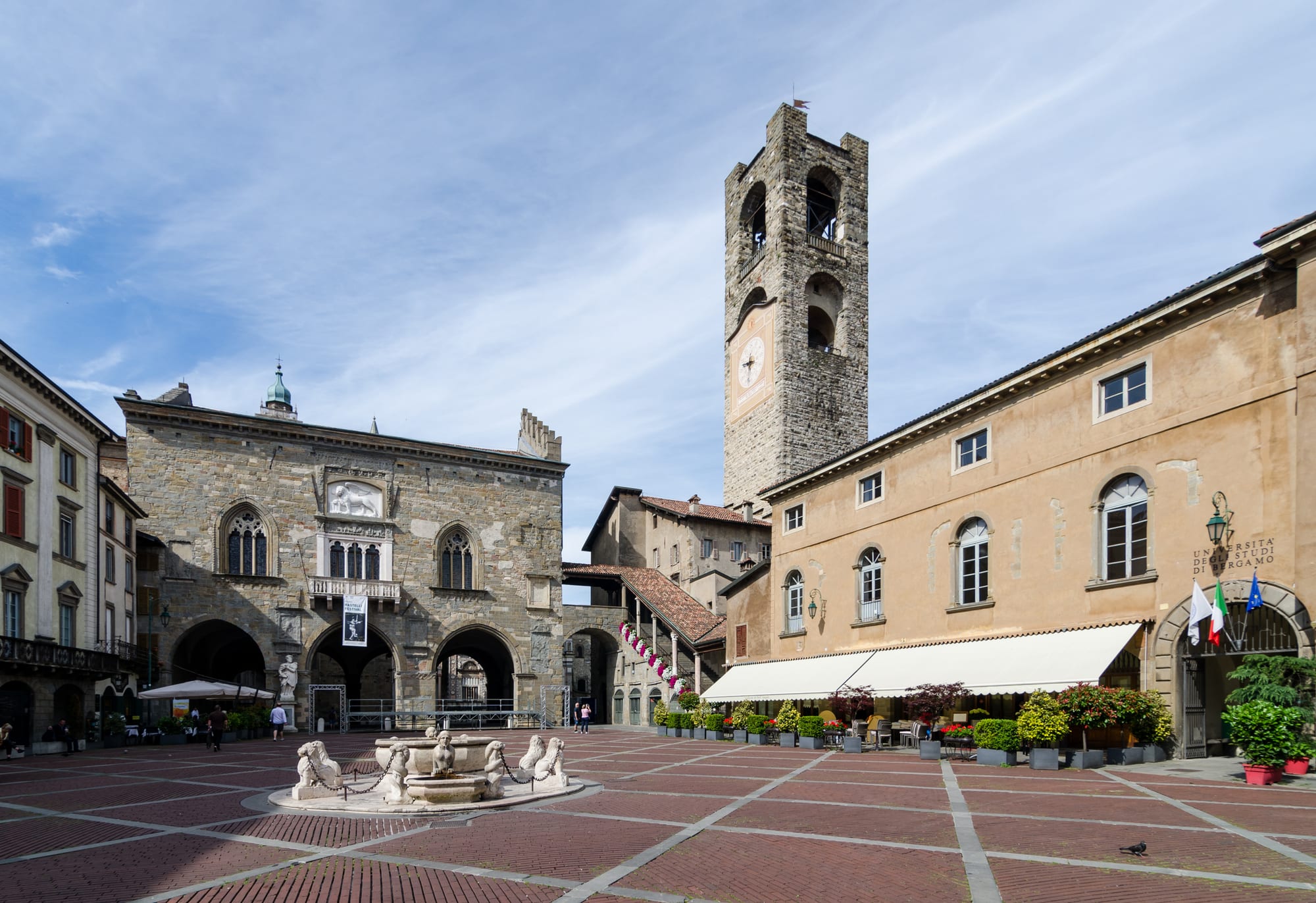
A brick-paved square with a marble fountain, an arcaded stone palace and a tall square bell tower under a blue sky

Lombardy, Italy

Bergamo

Piazza Vecchia in the upper town, with the Palazzo della Ragione and the Campanone. (Steffen Schmitz / Wikimedia Commons · CC BY-SA 4.0)

A city of two levels about 40 kilometres north-east of Milan, where the Bergamo Alps meet the plain. The hilltop Città Alta, ringed by 16th-century Venetian walls that are a UNESCO World Heritage Site, keeps its medieval squares and churches, while the Città Bassa below is a modern provincial capital of banks, industry and an airport busy with low-cost flights.

Neighbourhoods

  • Città Alta
    • First-time visitors
    • Historic district
    • Best for food

    The upper town on its hill, entirely enclosed by the Venetian walls. Via Colleoni, known as the Corsarola, runs from Piazza Vecchia to the Cittadella past churches, palaces, shops and restaurants, and the university occupies old buildings among them. It is reached by funicular, bus or on foot.

    Open in Maps
  • Lower city centre
    • Close to public transport
    • Shopping
    • Theatre

    The modern centre on the plain, laid out to a 20th-century master plan by Marcello Piacentini around the city's institutional buildings. The railway station, the Teatro Donizetti and the lower station of the funicular are here, and a straight avenue leads from the station towards the upper town.

    Open in Maps
  • Borgo Santa Caterina
    • Local life
    • Best for food

    One of the old borghi that grew along the roads out of the city, this one on the way to the Serio valley, listed among I Borghi più belli d'Italia. Its long street of old houses, shops and bars has a neighbourhood feel close to the centre.

    Open in Maps
  • Borgo Pignolo and Borgo Palazzo
    • Historic district
    • Quiet and residential

    Two historic borghi east of the centre: Pignolo, climbing towards the upper town, with the church of San Bernardino, and Borgo Palazzo on the old road to Brescia. Both are largely residential, with old palaces and churches between the newer buildings.

    Open in Maps
  • San Vigilio
    • Viewpoints
    • Walks

    The green hill above the western edge of the upper town, reached by its own funicular since 1912, with walks and views over the upper town.

    Open in Maps

Things to do

The upper town

  • Piazza Vecchialandmark

    The heart of the Città Alta, with the Contarini fountain, the Palazzo Nuovo library and the Palazzo della Ragione, whose façade bears the Lion of Saint Mark from the centuries of Venetian rule.

    Open in Maps
  • Campanonelandmark

    The civic tower on Piazza Vecchia, whose bell still strikes more than 100 times at 10 p.m., the signal that once announced the closing of the city gates.

    Open in Maps
  • Basilica of Santa Maria Maggiorelandmark

    A Romanesque church founded in 1137 and modified in the 17th century, with a 14th-century crucifix and the tomb of the composer Gaetano Donizetti.

    Open in Maps
  • Colleoni Chapellandmark

    The Renaissance funerary chapel built in 1470–1476 to designs by Giovanni Antonio Amadeo for the condottiero Bartolomeo Colleoni, beside Santa Maria Maggiore, holding his tomb and that of his daughter Medea.

    Open in Maps
  • Bergamo Cathedrallandmark

    The cathedral of Sant'Alessandro, dedicated to the city's patron saint, refurbished to designs by Carlo Fontana in 1689 and given a neoclassical west front in 1889.

    Open in Maps
  • San Michele al Pozzo Biancolandmark

    A church near Porta Sant'Agostino, founded in the 8th century and rebuilt many times, with frescoes that include Lorenzo Lotto's Scenes from the Life of the Virgin of 1525.

    Open in Maps
  • Venetian wallstrail

    The 16th-century ramparts that still enclose the whole upper town, part of the UNESCO World Heritage Site of Venetian defence works since 2017; the walk along them gives views over the lower city and the plain.

    Open in Maps
  • Roccaviewpoint

    The fortress begun in 1331 on the hill of Sant'Eufemia and completed by Azzone Visconti, overlooking the upper town.

    Open in Maps

Museums and galleries

  • Accademia Carraramuseum

    The city's art gallery and academy of fine arts, officially the Accademia Carrara di Belle Arti di Bergamo.

    Open in Maps
  • GAMeCmuseum

    The gallery of modern and contemporary art, opened in 1991 in a 15th-century former monastery opposite the Accademia Carrara, with a collection of around 3,000 works.

    Open in Maps
  • Museo Civico Archeologicomuseum

    The city's archaeological museum on the Cittadella square in the upper town, where the natural history museum also stands.

    Open in Maps

Funiculars and the lower town

  • Città Alta funiculartransit hub

    The funicular railway linking the lower city with the historic core of the upper town, the classic way up the hill.

    Open in Maps
  • San Vigilio funiculartransit hub

    A short funicular opened in 1912 that climbs from near Porta Sant'Alessandro to the top of San Vigilio hill in under three minutes.

    Open in Maps
  • Teatro Donizettilandmark

    The city's opera house, opened in 1800 after a fire destroyed its predecessor, renamed after Donizetti in 1897; Verdi made his debut there with Ernani.

    Open in Maps
  • Stadio di Bergamoattraction

    The home of Atalanta, the Serie A club that won the UEFA Europa League, with about 23,400 seats.

    Open in Maps

Short trips from the city

  • Astino Abbeylandmark

    A former monastery in the green Astino valley on the city's western edge, no longer a religious house.

    Open in Maps
  • Crespi d'Addaattraction

    A historic settlement in the province, regarded as an outstanding example of a 19th- and early 20th-century workers' village.

    Open in Maps
  • Sotto il Monte Giovanni XXIIIattraction

    The village of the province that carries the name of Pope John XXIII.

    Open in Maps
  • Lake Iseopark

    The fourth-largest lake in Lombardy, divided between the provinces of Bergamo and Brescia, with Monte Isola rising from its middle and the towns of Iseo and Sarnico on its shores.

    Open in Maps

Seasonal events

  • Bergamo Film MeetingMarch

    An international festival of art-house cinema founded in 1983, with more than 150 screenings and about 70,000 visitors.

  • Festa di Sant'AlessandroAugust

    The feast of the patron saint, Alexander, martyred according to legend on 26 August 303, with religious celebrations, a concert, a livestock fair, a funfair and a circus.

Eat and drink

Long-standing places and food districts in Bergamo. Hours, ratings and directions come from your maps app, always current.

Bergamo classics

  • Restaurants on the Corsarolaneighborhood

    Via Colleoni and Via Gombito in the upper town are lined with restaurants serving casoncelli, polenta and local cheeses, and with pastry shops selling polenta e osei.

    Open in Maps
  • Borgo Santa Caterinaneighborhood

    Bars, cafés and trattorias along the old street of one of the city's historic borghi.

    Open in Maps

Cafés and gelato

  • Gelato in the upper towncafe

    Stracciatella, milk gelato with fine strands of chocolate, was invented in Bergamo in 1961, and ice-cream shops in the upper town still serve it.

    Open in Maps

Experience Bergamo

History

The Orobii, a Ligurian tribe, first settled the hill in the Iron Age, and around 550 BC it was taken by the Celtic Cenomani. Bergomum became a Roman municipality in 49 BC, a town of about 10,000 on the military road between Friuli and Raetia, until Attila destroyed it in the 5th century. Under the Lombards it was the seat of one of their main duchies, and after Charlemagne a county.

From the 11th century Bergamo was a free commune and joined the Lombard League against Frederick Barbarossa, while its Guelph and Ghibelline factions, the Colleoni and the Suardi, feuded within the walls. In the 13th century Omodeo Tasso organised the city's couriers, the start of the Thurn und Taxis family's postal service. After a spell under the Malatesta from 1407, Milan ceded Bergamo to Venice in 1428, and Venetian rule lasted more than three and a half centuries; in the 16th century Venice ringed the upper town with the massive walls that still stand.

The French ended Venetian rule in 1797, and after 1815 Bergamo passed to Austrian Lombardy–Venetia; its railway station opened in 1857. Garibaldi took the city in 1859, and so many of his Thousand came from here that it is called the Città dei Mille. In the 20th century the province became one of Italy's most industrialised, and Piacentini's plan of 1912–27 created a new lower centre. The walls became a UNESCO World Heritage Site in 2017, and in early 2020 Bergamo was among the places in Europe hit hardest by Covid-19, when images of army trucks carrying the dead out of the city went round the world.

Culture & Customs

Music is Bergamo's great pride. Gaetano Donizetti, one of the leading composers of bel canto opera, was born here in 1797, is buried in Santa Maria Maggiore and gives his name to the opera house, where Verdi made his debut with Ernani; an opera season in his name continues the tradition. The historic Teatro Sociale in the upper town adds to the stage, and the city hosts a jazz festival and, with Brescia, an international piano festival.

Art is the other strength. The Accademia Carrara combines an art gallery with an academy of fine arts, Lorenzo Lotto painted frescoes in San Michele al Pozzo Bianco, and the GAMeC shows modern and contemporary work. The Bergamo Film Meeting brings art-house cinema each March. The sculptor Giacomo Manzù and the fashion designers Nicola Trussardi and Mariuccia Mandelli of Krizia were all born here.

The upper and lower towns have their own names in the Bergamasque dialect, Bèrghem de sura and Bèrghem de sóta. The Campanone still sounds its old curfew each night, the patron saint's feast fills the city in August, and football loyalty runs deep: Atalanta, a Coppa Italia and UEFA Europa League winner, is followed with passion, and its old rivalry with Brescia carries on with that city's new club.

Daily Life

About 120,600 people lived in Bergamo in 2026, making it the fourth-largest city in Lombardy, and just under 500,000 live in its wider urban area, itself part of Milan's metropolitan region. Around five in six residents were born in Italy; the largest groups born abroad come from Bolivia, Morocco, Albania, Romania and Bangladesh. The city is divided into twenty-five neighbourhoods, from the old borghi to postwar districts.

The economy rests on banking, retail and services linked to the industries of the province, where companies such as the brake maker Brembo and the steel group Tenaris have strong ties to the city. The airport, one of the busiest in Italy, and its role as the second most visited city in Lombardy after Milan make tourism increasingly important. The University of Bergamo, founded in 1968, has campuses in the upper town and the lower city.

Daily life moves between the two levels: offices, shops and the station below, students and visitors on the hill. The loss of so many older residents in 2020 left a lasting mark on the city.

Food

Bergamo's signature dish is casoncelli alla bergamasca, stuffed pasta filled with breadcrumbs, eggs, Parmesan, minced beef and salami or sausage, sometimes with raisins, amaretti or pear, and served with melted butter flavoured with sage. Polenta, as across Lombardy, is the everyday partner for meat and cheese.

The valleys north of the city make some of Italy's best-known cheeses. Taleggio, named after the Val Taleggio, is a semi-soft washed-rind cow's-milk cheese with a thin edible rind, a strong aroma and a comparatively mild flavour, and the same valley makes Strachitunt. The city's best-known sweet is polenta e osei, a sweet version of the old dish of small birds served with polenta: sweet polenta covered with yellow almond paste and decorated with chocolate or marzipan birds.

Stracciatella, milk gelato with fine strands of drizzled chocolate, was first made in Bergamo at the Ristorante La Marianna in 1961 and is now served across Italy. Many restaurants and pastry shops line the Corsarola and Via Gombito in the upper town, while Borgo Santa Caterina has more everyday bars and trattorias.

Planning tools

Budget

Bergamo is noticeably cheaper than Milan, and makes a convenient base for travellers using its airport. Rooms in the upper town cost the most; the lower city has more choice. Public transport tickets cover buses, both funiculars and the tram, and the walls, squares and churches are free to visit.

Daily Budget Midrange
USD 170–340 (mid-range hotel, restaurant dinners, museum tickets, trains to Milan or the lakes)
Daily Budget Shoestring
USD 80–130 (hostel or simple guesthouse, bakery and pizza lunches, buses and funiculars)

Stay in the lower city near the station for the best prices and transport links; a day ticket covers repeated rides up and down the funicular.

Best Time to Visit

April to June and September to October are the most comfortable seasons for walking the walls and the upper town. July is the warmest month and can be humid; January is the coldest, with averages around 3°C. The film festival comes in March, the patron saint's feast in August.

Suggested Number of Days

One or two days are enough for the upper town, the walls and the main galleries. Three or four days allow time for the surrounding valleys, lakes and cities, which are easy to reach by train and bus.

First Visit
1–2 days
With Surroundings
3–4 days

Transportation

The city transport company ATB runs buses, a tram line and two funiculars, all on the same tickets. Bus line 1 is the most useful for visitors, linking the airport, the railway station and the upper town. The funicular, the bus or the climb on foot are the usual ways up the hill.

Tickets can be bought at the station, the airport and the lower funicular station, or paid by card on board; the walk from the station to the lower funicular takes 20–30 minutes.

Airport & Station Connections

Milan Bergamo Airport, at Orio al Serio, is 3.7 kilometres south-east of the city and mostly serves low-cost airlines; bus line 1 reaches the railway station in about 20 minutes. Trains from Milan take around an hour, and Bergamo station is also the junction for lines to Brescia, Lecco and Treviglio. The A4 motorway links the city with Milan, Verona and Venice.

Walkability

The upper town is compact and best explored on foot, though its streets are steep and cobbled; the walls make a fine circuit with views. The lower city is flat and easy to walk, and the climb between the two levels takes a while but passes through quiet old streets. The funiculars save the steepest stretches.

Safety

Italy is generally safe, with low levels of violent crime against visitors. Bergamo is a calm provincial city; the usual care with bags is enough on crowded buses, at the station and in the busy upper town on weekends.

Wear sturdy shoes for the cobbled, steep streets of the upper town, which can be slippery in rain. Check current official travel advice before travelling.

Climate

A humid subtropical climate, with warm, often humid summers and cool to cold winters, sheltered to the north by the Bergamo Alps. Spring and autumn are mild, and the hills around the upper town are greener and a little fresher than the plain.

Summer
warm and often humid — July, the warmest month, averages about 23.8°C
Winter
cool to cold — January, the coldest month, averages about 3.1°C

Local Customs

Bergamo's people are proud of a separate identity from Milan, with their own Bergamasque dialect, in which the city is Bèrghem, and a strong attachment to Atalanta. The city's part in Garibaldi's Expedition of the Thousand earned it the name Città dei Mille. Tips are not customary in Italy but are given for special service; restaurants usually add a cover charge, the coperto, and tips cannot be added to a card bill.

Keep quiet in Santa Maria Maggiore, the Colleoni Chapel and the cathedral during services; the memory of the 2020 pandemic is still raw, and is best approached with tact.

Common Payment Methods

The currency is the euro. Cards work widely, and bus tickets can be paid by card or phone on board; keep a little cash for small bars and pastry shops. A per-night tourist tax may be collected by accommodation.