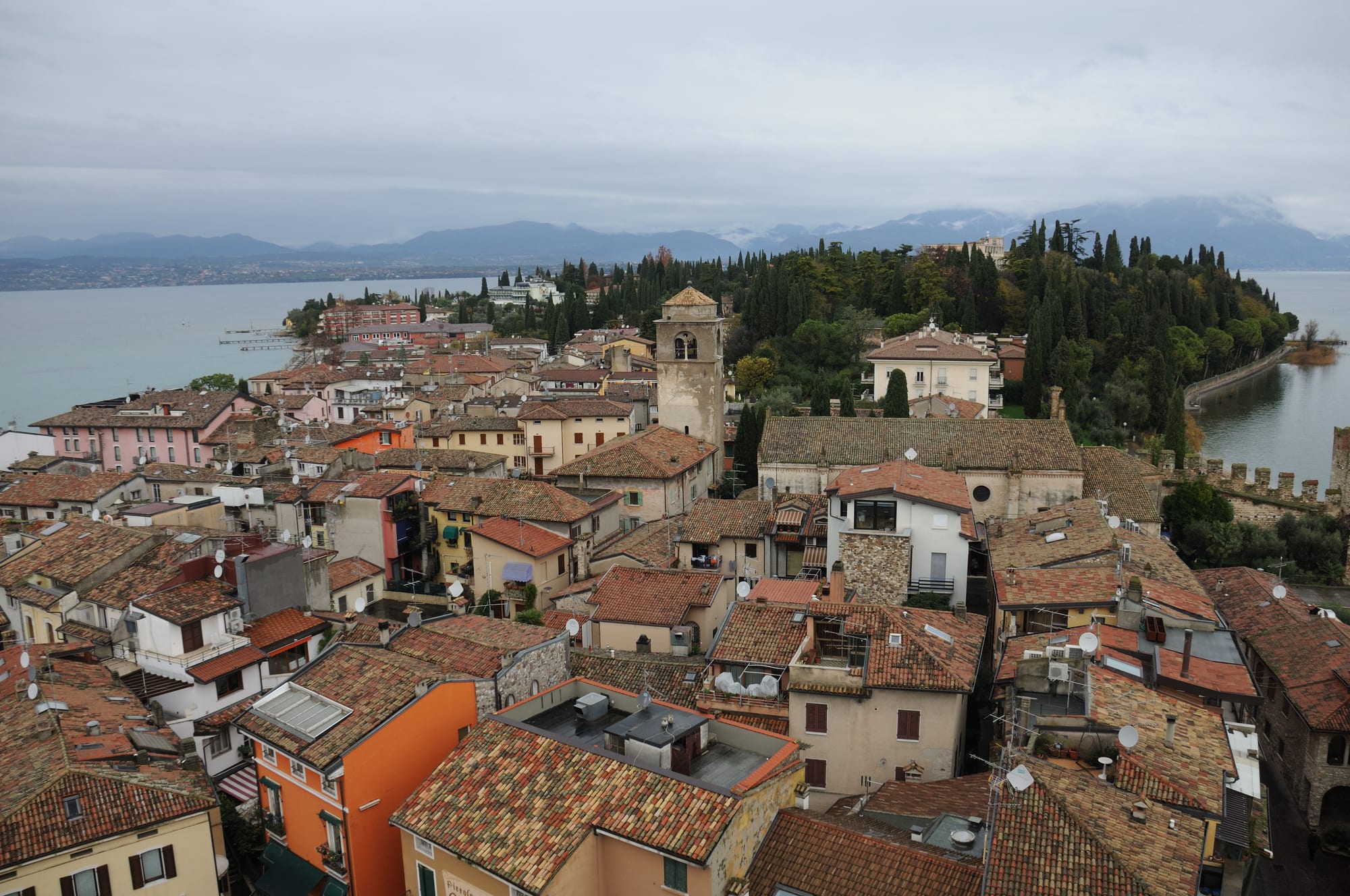
Red-tiled roofs and a bell tower of Sirmione's old town, with cypress woods and Lake Garda on both sides under grey cloud

Lombardy, Italy

Sirmione

Sirmione's historic centre and the wooded tip of the peninsula, seen from the tower of the Scaligero Castle. (Josep M. Gracia / Wikimedia Commons · CC BY-SA 4.0)

A lake town on the southern shore of Lake Garda whose old centre fills the tip of a narrow peninsula reaching into the water. A Roman resort for wealthy Veronese families and later a Scaliger stronghold, it lives today from its moated castle, the ruins of a great Roman villa and the sulphurous thermal water that rises beneath the lake.

Neighbourhoods

  • Centro storico
    • First-time visitors
    • Historic district
    • Close to the ferries

    The old town on the peninsula, entered past the moated Scaligero Castle. Narrow streets of shops, cafés and hotels lead to Piazza Carducci and on through olive and cypress groves to the Roman villa at the northern tip. Car access is restricted, and the streets are packed on holidays.

    Open in Maps
  • Colombare
    • Thermal baths
    • Close to public transport

    The district at the base of the peninsula on the old main road, where buses between Brescia and Verona stop and a seasonal shuttle runs to the old town. One of the town's two spa establishments, the Virgilio, is here, and accommodation is generally easier to find than in the centre.

    Open in Maps
  • Lugana
    • Wine country
    • Quiet and residential

    The south-eastern part of the municipality towards Peschiera, among the vineyards that make Lugana white wine. A submerged prehistoric pile-dwelling site lies offshore between Lugana and Colombare, and until 1866 the Austrian border and its customs post stood nearby.

    Open in Maps

Things to do

On the peninsula

  • Scaligero Castlelandmark

    A moated fortress begun in 1277 by Mastino I della Scala at the entrance to the old town, with swallowtail battlements, two drawbridges and a rare fortified harbour once used by the Scaliger fleet; it is one of Italy's best-preserved castles.

    Open in Maps
  • Grottoes of Catullusmuseum

    The ruins of a vast Roman villa built around the turn of the 1st century BC and AD at the northern tip of the peninsula, the most striking Roman private building found in northern Italy, with the town's archaeological museum.

    Open in Maps
  • San Pietro in Mavinolandmark

    A church built in Lombard times, in 765, and renovated in the early 14th century, standing apart on the hill among the old vineyards, with frescoes from the 12th to 16th centuries and a Romanesque bell tower of 1070.

    Open in Maps
  • Santa Maria Maggiorelandmark

    The late 15th-century church in the town centre, built on the site of an 8th-century Lombard church and decorated with early 15th-century frescoes.

    Open in Maps
  • Terme di Sirmioneattraction

    The spa that uses the sulphurous thermal water rising from 19 metres below the lake, piped ashore in the late 19th century; its Catullo establishment stands near the Roman villa.

    Open in Maps

Short trips from the town

  • Desenzano del Gardaattraction

    The neighbouring lake town to the west, with the railway station that serves Sirmione and ferry connections across the southern lake.

    Open in Maps
  • Peschiera del Gardaattraction

    The neighbouring town to the east, across the regional border in Veneto, with a second railway station on the Milan–Venice line.

    Open in Maps
  • Gardalandattraction

    An amusement park resort beside the lake at Castelnuovo del Garda, opened in 1975 and ranked among the most visited theme parks in Europe.

    Open in Maps
  • Veronaattraction

    The Roman and Scaliger city on the Adige whose wealthy families made the southern lake their resort in antiquity, about half an hour away by regional train from Desenzano.

    Open in Maps

Eat and drink

Long-standing places and food districts in Sirmione. Hours, ratings and directions come from your maps app, always current.

Sirmione classics

  • Old-town restaurantsneighborhood

    Restaurants and trattorias in the lanes and on the lakeshore of the peninsula, serving lake fish, Lombard pasta and the local Lugana white wine.

    Open in Maps
  • Lugana wineriesneighborhood

    Wine producers in the Lugana area at the base of the peninsula, part of the zone that makes the white Lugana wine; the town also lies in the area of Garda Bresciano DOP olive oil.

    Open in Maps

Cafés and bars

  • Piazza Carduccicafe

    The central square of the old town, with cafés around it and the 17th-century Palazzo Maria Callas on one side.

    Open in Maps

Experience Sirmione

History

People were living around Sirmione by the 6th–5th millennia BC, and in the 3rd and 2nd millennia BC villages of houses on piles stood along the shore; the submerged site of Lugana Vecchia is part of the UNESCO-listed Prehistoric Pile dwellings around the Alps. From the 1st century BC the southern lake became a resort for rich families from Verona. The poet Catullus, whose family owned a villa here, wrote of his joy at returning to Sirmione, and the vast villa ruins at the tip of the peninsula have carried his name since the 15th century, although they were built after his death.

In the late Roman period the peninsula was fortified to guard the southern shore. Under the Lombards it was the capital of a judicial district answering directly to the king, and Ansa, wife of King Desiderius, founded a monastery and church here. Around 1000 the town was probably a free commune before passing to the Scaligers of Verona in the 13th century; Mastino I della Scala began the castle in 1277. Venice held Sirmione from 1405 to 1797, and after Napoleonic and Habsburg rule it joined the Kingdom of Italy in 1860, while Veneto across the border stayed Austrian until 1866.

The thermal spring, known since the 16th century, rises 19 metres below the lake and could not be used until it was piped ashore at the end of the 19th century, when the first spa opened. Tourism grew from the baths and the ruins, and in 2007 a new road was built to carry through-traffic south of Sirmione and Desenzano.

Culture & Customs

Sirmione has long drawn writers. Tennyson recorded his impressions of the summer of 1880 in his poem Frater Ave atque Vale; Carducci, Fogazzaro and D'Annunzio wrote about the town; and Ezra Pound and James Joyce met here in 1920. The English writer Naomi Jacob lived here until her death in 1964, and a small plaque remembers her.

The soprano Maria Callas lived in a villa in Sirmione in the 1950s with her husband, the businessman Meneghini, and the town has dedicated the 17th-century palazzo on its central square, Piazza Carducci, to her. The memory of the wars of unification is also close: the 1859 battle fought at San Martino, just to the south, is remembered at the tower of San Martino della Battaglia, a monument and museum dedicated to King Victor Emmanuel II and the unification of Italy.

Religious life centres on Santa Maria Maggiore in the old town and on the parishes of Colombare and Lugana, and an oratory between Colombare and the centre is dedicated to Saints Vitus and Modestus, the town's original patrons. In front of San Pietro in Mavino hangs a bell commemorating the dead of the wars. The town's identity is tied to the lake: the passeggiata along the shore, the ferries from the castle pier and the olive groves at the tip of the peninsula.

Daily Life

About 8,500 people live in the municipality, which takes in the old town on the peninsula and the districts of Colombare, Lugana and Rovizza, along the old main road and among the vineyards inland. Tourism is the main business, built on the lake, the Roman villa and the thermal springs, whose sulphurous water feeds two establishments, the Catullo near the Grottoes and the Virgilio in Colombare.

The countryside around the town is part of the production zone of Lugana wine and of Garda Bresciano DOP olive oil, and the morainic hills behind the southern shore are farmed with vines. Many residents work in hotels, restaurants, shops and spa services, and the rhythm of the year follows the season: crowded summers, a busy shoulder season for the baths, and a much quieter winter.

Traffic is a constant subject. Car access to the old town is regulated, yet the narrow streets fill with visitors on holidays, and the opening of the southern bypass in 2007 took through-traffic off the old main road through Colombare and Lugana. Luisa Lavelli has led the town since 2018 and was re-elected mayor in 2024.

Food

Sirmione's kitchen draws on Lombardy and the lake. Lombard cooking uses butter, rice, polenta and slow-cooked meat more than olive oil and dry pasta; the province of Brescia makes casoncelli, stuffed pasta dressed with butter and sage, while polenta taragna, made with maize and buckwheat flour, is typical of the alpine areas of Bergamo and Brescia. Lake fish appear on restaurant menus in the old town and along the shore.

The mild lake climate lets olive trees grow on the southern shore, and Sirmione lies within the area of Garda Bresciano DOP olive oil. The town is better known for wine: the inland district of Lugana gives its name to Lugana, a white wine from Lake Garda's southern shore.

Lombardy is also a great cheese region, from Grana Padano to Gorgonzola and Taleggio, and nearby Mantua is known for sbrisolona, a crumbly almond cake. Cafés stand around Piazza Carducci and along the old town's streets, and an aperitivo, a drink with something to eat, by the water is the usual way to end the day.

Planning tools

Budget

Hotels inside the old town are the most expensive and fill early in summer; Colombare, Lugana and neighbouring Desenzano have more choice and lower prices. Day visitors pay entrance fees for the castle and the Roman villa, and the thermal baths are an extra cost.

Daily Budget Midrange
USD 190–370 (mid-range hotel, restaurant dinners, castle and villa tickets, lake ferries)
Daily Budget Shoestring
USD 90–150 (guesthouse or a room in Desenzano, pizza and gelato, buses and the shuttle)

Visit the peninsula early in the morning or in the evening to avoid the busiest hours, and stay outside the old town for better value.

Best Time to Visit

April to June and September to October bring warm weather and fewer crowds; July and August are hot and the old town is packed, especially on holidays and weekends. Winter is quiet and grey, with some hotels and restaurants closed, but the castle remains open.

Suggested Number of Days

One full day covers the peninsula; a night or two allows for the spa and a quieter evening once the day visitors leave. Three or four days give time for the wider southern lake by ferry, bus or car.

First Visit
1–2 days
With Surroundings
3–4 days

Transportation

The old town is explored on foot. A seasonal shuttle bus runs between Colombare and the centre in spring and summer, and the Brescia–Verona bus stops at Colombare. Ferries from the pier by the castle serve towns around the lake, especially in its southern half.

Car access to the old town is regulated; park outside the centre and walk or take the shuttle.

Airport & Station Connections

The nearest railway station is Desenzano del Garda–Sirmione, on the Milan–Venice line in neighbouring Desenzano, about 30 minutes by regional train from Verona or Brescia; from there a bus, taxi or ferry completes the journey. Peschiera del Garda station is an alternative. Verona Villafranca Airport has summer bus links to the lake's towns.

Walkability

The peninsula is compact and flat for most of its length, with a gentle climb to San Pietro in Mavino and through the groves at the tip. Streets are narrow and crowded at peak times. From the old town to Colombare is a longer walk along the road, where the shuttle bus is more convenient.

Safety

Italy is generally safe, with low levels of violent crime against visitors. Sirmione has little serious crime; the main concerns are pickpockets in the summer crowds and the heat on midsummer afternoons.

Keep bags closed in the crowded old town and on ferries, and carry water in July and August. Check current official travel advice before travelling.

Climate

The lake moderates the climate enough for olive trees, cypresses and palms to grow along the shore. Summers are warm to hot and humid; winters are cool and grey. In nearby Brescia spring and autumn temperatures generally range between 10 and 20°C.

Summer
warm to hot and humid — in nearby Brescia summer highs are about 28–30°C, with peaks of up to 35°C
Winter
cool and often grey — in nearby Brescia winter lows are around −1.5 to 0.6°C

Local Customs

Coffee is drunk standing at the bar, more cheaply than seated, and cappuccino belongs to the morning. Meals are taken at set times, and the evening stroll along the lakefront is part of local life. Respectful dress is expected in the old churches.

Cover shoulders and knees in San Pietro in Mavino and Santa Maria Maggiore, and keep to the paths inside the Roman villa site.

Common Payment Methods

The currency is the euro. Cards are accepted almost everywhere, but a little cash is useful for small bars, the shuttle and bus tickets. A per-night tourist tax may be collected by accommodation.