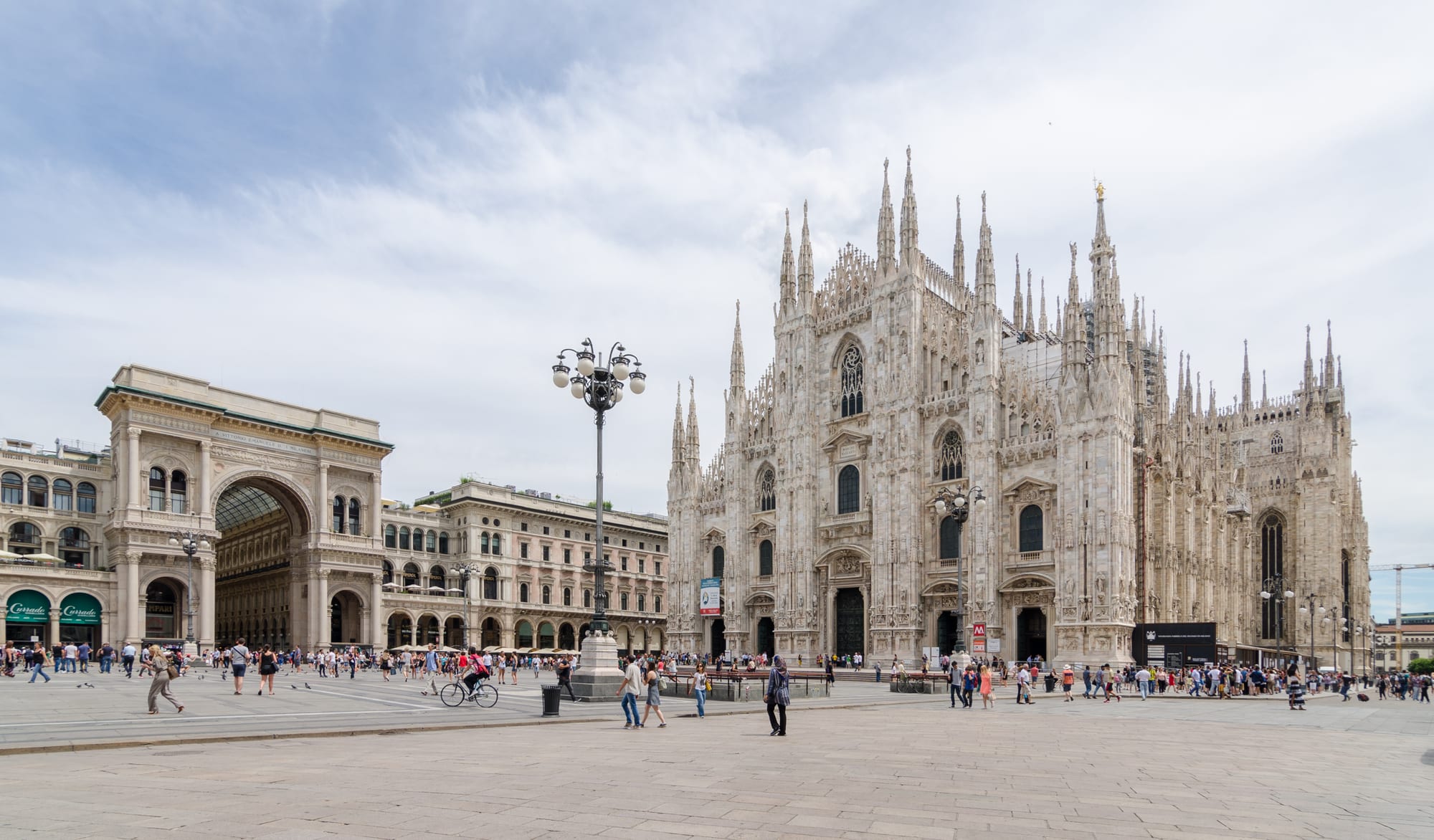
The white marble Gothic façade and spires of Milan Cathedral beside the arched entrance of the Galleria on a wide paved square

Lombardy, Italy

Milan

Piazza del Duomo, with Milan Cathedral and the triumphal arch of the Galleria Vittorio Emanuele II. (Steffen Schmitz / Wikimedia Commons · CC BY-SA 4.0)

The capital of Lombardy and Italy's second city, on the plain between the Alps and the Po. A Roman imperial capital, then the seat of the Visconti and Sforza dukes, it became the country's centre of industry, banking, fashion and design. Today it mixes a Gothic cathedral, La Scala and Leonardo's Last Supper with canal-side bars and new skyscraper districts.

Neighbourhoods

  • Centro Storico
    • First-time visitors
    • Historic district
    • Close to public transport

    The historic core inside the ring of the old canals, centred on Piazza del Duomo. The cathedral, the Galleria, La Scala, Piazza Mercanti and the Sforza Castle are all within walking distance, and the fashion streets of the Quadrilatero della moda lie just to the north-east. Busy by day and expensive to stay in.

    Open in Maps
  • Brera
    • Arts and culture
    • Best for food
    • Evening strolls

    A district of narrow streets north of La Scala, centred on Via Brera, home to the Brera Academy and the Pinacoteca di Brera. Its artists' past earned it the nickname of Milan's Montmartre; today it is full of galleries, boutiques, cafés and restaurants, and lively at night.

    Open in Maps
  • Navigli and Porta Ticinese
    • Nightlife
    • Canals
    • Bars and aperitivo

    The south-western quarter where the Naviglio Grande and Naviglio Pavese canals reach the city. Small pubs, open-air cafés and restaurants line the water, the area is known for its artists, and the Colonne di San Lorenzo nearby draw crowds in the evening.

    Open in Maps
  • Porta Nuova and Isola
    • Modern architecture
    • Business travellers
    • Nightlife

    The business district built in the 21st century around Piazza Gae Aulenti, with the Bosco Verticale towers and the Biblioteca degli Alberi park. Isola, the older neighbourhood beside it, takes its name from being cut off from the centre by the railway; Corso Como's bars and clubs are close by.

    Open in Maps
  • Porta Venezia
    • Local life
    • Shopping
    • LGBT-friendly

    The district around the old eastern gate, beside the Montanelli Gardens and Corso Buenos Aires, which has the highest concentration of clothing stores in Europe. Via Lecco and the streets around it are Milan's LGBT-friendly quarter, with bars and restaurants and a strong aperitivo scene.

    Open in Maps
  • Chinatown
    • Best for food
    • Shopping

    The oldest and largest Chinese community in Italy, founded in the 1920s by migrants from Wencheng County in Zhejiang. Its main street, the largely pedestrian Via Paolo Sarpi, is lined with shops, restaurants and takeaways.

    Open in Maps

Things to do

Famous landmarks

  • Milan Cathedrallandmark

    The Duomo, the largest church in Italy outside the Vatican, begun in 1386 and finished only in 1965; its marble forest of spires is topped by the gilded Madonnina at 108.5 metres.

    Open in Maps
  • Galleria Vittorio Emanuele IIlandmark

    Italy's oldest active shopping arcade, a glass-roofed double arcade built by Giuseppe Mengoni between 1865 and 1877, with historic cafés and a mosaic bull that visitors spin on for luck.

    Open in Maps
  • La Scalalandmark

    The opera house inaugurated in 1778, one of the leading opera and ballet theatres in the world, where Verdi's Nabucco and Puccini's Madama Butterfly had their premieres.

    Open in Maps
  • Santa Maria delle Grazie and the Last Supperlandmark

    A Dominican church and convent, a UNESCO World Heritage Site, whose refectory holds Leonardo da Vinci's mural of the Last Supper, painted around 1495–1498 for Ludovico Sforza.

    Open in Maps
  • Sforza Castlelandmark

    The brick fortress built in the 15th century by Francesco Sforza and rebuilt in 1891–1905, which now houses several of the city's museums and art collections.

    Open in Maps
  • Basilica of Sant'Ambrogiolandmark

    The Romanesque basilica first built by Saint Ambrose, the city's patron, in 379–386 on a burial ground of early Christian martyrs.

    Open in Maps
  • Colonne di San Lorenzolandmark

    A row of ancient Roman columns in front of the Basilica of San Lorenzo, one of the oldest churches in the city, and a popular evening meeting place.

    Open in Maps

Museums and galleries

  • Pinacoteca di Breramuseum

    The city's main picture gallery, with one of the foremost collections of Italian painting from the 13th to the 20th century, including Piero della Francesca's Brera Madonna.

    Open in Maps
  • Museo del Novecentomuseum

    About 400 works of 20th-century art, most of them Italian, in the Palazzo dell'Arengario beside Piazza del Duomo, opened in 2010.

    Open in Maps
  • Museo Nazionale Scienza e Tecnologia Leonardo da Vincimuseum

    Italy's largest science and technology museum, opened in 1953 in a former monastery, with galleries on Leonardo and a transport section that includes a submarine.

    Open in Maps
  • Triennale di Milanomuseum

    A museum of art and design in the Palazzo dell'Arte in Parco Sempione, built in 1931–33, with a permanent museum of Italian design opened in 2007.

    Open in Maps
  • Fondazione Pradamuseum

    A contemporary art and culture institution whose permanent Milan site opened in 2015.

    Open in Maps
  • Pirelli HangarBicoccamuseum

    A former Pirelli factory in the Bicocca district converted in 2012 into 10,900 square metres of galleries for contemporary art exhibitions.

    Open in Maps

Modern Milan

  • Bosco Verticalelandmark

    Two residential towers in Porta Nuova, inaugurated in 2014, whose façades carry trees and shrubs of more than ninety plant species.

    Open in Maps
  • Pirelli Towerlandmark

    The 127-metre Pirellone, among the first skyscrapers to abandon the block form and the tallest building in Italy until 1961.

    Open in Maps
  • Torre Velascalandmark

    A 106-metre tower near the Duomo by the BBPR partnership, completed in 1958 that has been protected as a historic building since 2011.

    Open in Maps

Parks and canals

  • Parco Sempionepark

    The large English-style park behind the Sforza Castle, laid out at the end of the 19th century, with the civic aquarium, the Triennale and a steel panoramic tower.

    Open in Maps
  • Navigliattraction

    The surviving canals of a medieval system once improved by Leonardo, now lined with homes, bars and restaurants, and known for its artists, along the Naviglio Grande and Naviglio Pavese.

    Open in Maps
  • Cimitero Monumentaleattraction

    A cemetery opened in 1866 and filled with artistic tombs, temples and obelisks, entered through the marble Famedio, the hall of fame of the city's most honoured citizens.

    Open in Maps
  • Parco Biblioteca degli Alberipark

    A public park among the towers of Porta Nuova, between Piazza Gae Aulenti and Via Melchiorre Gioia.

    Open in Maps

Sport and nights out

  • San Siroattraction

    The Stadio Giuseppe Meazza, nicknamed 'La Scala of football', shared by AC Milan and Inter, with more than 75,000 seats; it is due to be replaced by a new stadium.

    Open in Maps

Short trips from the city

  • Chiaravalle Abbeylandmark

    A Cistercian abbey on the southern edge of the city, founded in 1135 as a daughter house of Clairvaux and one of the first examples of Gothic architecture in Italy.

    Open in Maps
  • Monza Circuit and the Royal Villaattraction

    In Monza, north of Milan, the neoclassical Habsburg palace and its enclosed park, one of the largest in Europe, which also holds the 1922 motor-racing circuit where the Italian Grand Prix is held.

    Open in Maps
  • Certosa di Pavialandmark

    A vast Carthusian monastery built from 1396 to 1495, a short way north of Pavia.

    Open in Maps

Seasonal events

  • Milan Fashion WeekFebruary–March and September–October

    The twice-yearly clothing trade show at which the fashion houses present their next collections, filling the city's hotels and showrooms.

  • Salone del MobileApril

    The world's largest furniture fair, with design events and exhibitions spreading across the city during Milan Design Week.

  • Milano City MarathonApril

    The city's marathon, held each April since moving from its original November date.

  • Oh bej! Oh bej!from 7 December

    Milan's most important and traditional Christmas fair, opening on Saint Ambrose's Day, with sweets, winter food, crafts, toys and antiques.

  • La Scala season opening7 December

    The opera season opens on the feast of Saint Ambrose, the city's patron, one of the great social occasions of the Milanese year.

Eat and drink

Long-standing places and food districts in Milan. Hours, ratings and directions come from your maps app, always current.

Milanese classics

  • Caffè Covacafe

    One of the city's oldest pastry shops and coffeehouses, founded in 1817 near La Scala by Antonio Cova, a soldier; it now stands in the fashion district.

    Open in Maps
  • Cafés of the Galleriacafe

    The arcade is home to some of the oldest cafés and restaurants in Milan, among them Biffi, founded in 1867 by the royal pastry chef Paolo Biffi.

    Open in Maps

Food districts and aperitivo

  • Navigli bars and restaurantsneighborhood

    Canal-side restaurants, pubs and open-air cafés along the Naviglio Grande and Naviglio Pavese, the city's favourite place for an evening aperitivo.

    Open in Maps
  • Breraneighborhood

    Historic restaurants, refined cafés and wine bars in the old artists' quarter behind La Scala.

    Open in Maps
  • Via Paolo Sarpineighborhood

    The main street of Chinatown, largely pedestrian, with Chinese restaurants and takeaways.

    Open in Maps
  • Corso Buenos Aires and Porta Venezianeighborhood

    A busy area for aperitivo close to the centre, with bars and restaurants around Via Lecco and the long shopping street of Corso Buenos Aires.

    Open in Maps

Experience Milan

History

Milan was founded by Celts as Medhelanon, "the settlement in the middle of the plain", and taken by Rome in 222 BC. As Mediolanum it grew into the chief city of northern Italy, and in 286 Diocletian made it the capital of the Western Roman Empire. Here in 313 Constantine issued the Edict of Milan granting tolerance to all religions, and Saint Ambrose, bishop from 374, became the city's patron. Visigoths, Attila's Huns and the Ostrogoths besieged or sacked it, and the Lombards took it in 569.

In the Middle Ages Milan warred with its Lombard neighbours and was largely destroyed by Frederick Barbarossa in 1162, but it recovered as one of Europe's largest cities. Gian Galeazzo Visconti became its first duke in 1395, and from 1450 the Sforza made it a centre of the Renaissance, bringing Leonardo da Vinci, who painted the Last Supper and improved the canals, and Bramante. Spanish rule followed from 1535, with the great plague of 1629–31 killing about 60,000 of 130,000 inhabitants, then Austrian rule from 1714. Napoleon was crowned King of Italy in the cathedral.

The Five Days of 1848 briefly drove out the Austrians, and after 1859 Milan joined the new Italian state, becoming its railway hub and financial capital. Mussolini launched Fascism here, and in April 1945 the resistance took the city before Allied troops arrived. Postwar migration from the south lifted the population to a peak of about 1.74 million in 1973. The 1969 Piazza Fontana bombing, which killed 17 people, opened the "years of lead"; the 1980s brought global fashion fame, and the 1990s the Tangentopoli corruption scandal. Since then new districts such as Porta Nuova and CityLife have changed the skyline, and the city hosted Expo 2015 and, with Cortina d'Ampezzo, the 2026 Winter Olympics.

Culture & Customs

Milan is one of the world's fashion capitals, alongside Paris, London and New York, a role it took in the 1980s with houses such as Armani, Prada, Versace and Dolce & Gabbana. Fashion weeks twice a year and the Salone del Mobile, the world's largest furniture fair, bring in buyers and designers, and Fiera Milano is Europe's largest permanent trade exhibition. Design runs deep: the signs and architecture of the metro won the Compasso d'Oro award in 1964, and the postwar Pirelli and Velasca towers announced a modern city.

Music is the other great tradition. La Scala has given the premieres of Verdi's Nabucco, Puccini's Madama Butterfly and many more, and its season opens each 7 December, the feast of Saint Ambrose, the day the Oh bej! Oh bej! Christmas fair begins. The city has a symphony orchestra and a conservatory, and its football is split between AC Milan and Inter, who share the San Siro stadium.

The Milanese are known for working hard and moving fast. The early-evening aperitivo is a social ritual, Brera keeps its artists' reputation, and Porta Venezia is the city's LGBT-friendly quarter. Small customs survive in the centre: visitors spin on the mosaic bull in the Galleria for luck, and a clear view of the gilded Madonnina on the cathedral still means a fine day.

Daily Life

About 1.36 million people lived in the city in 2026, and the wider metropolitan area, the largest in Italy, has more than six million. The population fell for decades as families moved to the suburbs but has grown again in recent years. Around a fifth of residents are foreign citizens; the largest foreign countries of birth include Egypt, the Philippines and China, and Chinatown around Via Paolo Sarpi is the oldest Chinese community in Italy.

Milan is Italy's economic capital: its metropolitan area produces about a fifth of the country's output, the Borsa Italiana stock exchange and many national companies have their headquarters here, and finance, fashion, publishing, media, technology and tourism have replaced most of the old factories. Several major universities draw students from across Italy, and the Via Monte Napoleone was described in 2024 as the most expensive street in the world.

The day starts early, with coffee standing at the bar, quick lunches and long working hours, and evenings begin with the aperitivo. Housing costs are a constant complaint, winter air pollution is a serious problem, and AC Milan and Inter, who bought San Siro in November 2025, plan to replace it, with demolition expected in 2031 or 2032. In August the city empties and many restaurants close.

Food

Milanese cooking uses butter, rice and slow-cooked meat. The cotoletta alla milanese is a breaded veal cutlet cooked with the bone in and traditionally fried in clarified butter, often called "elephant's ear" for its shape. Risotto alla milanese is coloured and flavoured with saffron and enriched with beef marrow, and is often served with ossobuco, cross-cut veal shank braised with vegetables, white wine and broth and finished with gremolata. Winter brings cassoeula, pork rib chops and sausage stewed with Savoy cabbage, and busecca, tripe stewed with beans.

Panettone, the tall sweet bread with dried fruit eaten at Christmas, is associated above all with Milan, and its name comes from the Milanese dialect. Other pastries follow the calendar: chiacchiere and tortelli at Carnival, colomba, a dove-shaped cake, at Easter, and cinnamon-flavoured pane dei morti for All Souls' Day. The everyday bread is the michetta, a puffed white roll.

Many historic restaurants and bars are in the centre, Brera and the Navigli, and the Caffè Cova has served pastries since 1817. Campari has long been a favourite Milanese aperitif, and the Negroni sbagliato, the "mistaken Negroni" made with sparkling wine instead of gin, is a fixture of the aperitivo hour, when bars from the Navigli to Porta Venezia set out snacks with drinks.

Planning tools

Budget

Milan is one of Italy's most expensive cities. Hotel prices rise steeply during the fashion weeks and the Salone del Mobile in April, and the centre and the fashion district cost the most. Eating can be cheaper than the hotels suggest: bakeries and bars serve quick lunches, and the early-evening aperitivo comes with snacks. Public transport is good value.

Daily Budget Midrange
USD 200–400 (mid-range hotel, restaurant dinners, museum tickets, taxis now and then)
Daily Budget Shoestring
USD 90–150 (hostel bed, bakery lunches and aperitivo snacks, metro and trams)

Check the trade-fair calendar before booking a room; the aperitivo is a cheap way to eat early in the evening.

Best Time to Visit

April to June and September to October are the most pleasant, with temperatures between about 10 and 20°C, though April and May are among the wettest months. Summers are hot and humid, and in August many Milanese leave and some restaurants close. Winters are cold and damp, but bring the La Scala opening and the Christmas fair.

Suggested Number of Days

Two or three days cover the main sights of the centre, with more time needed for the museums and the outer districts. Five days to a week allow trips to the lakes and the other cities of Lombardy, which are an hour or so away by train.

First Visit
2–3 days
With Surroundings
5–7 days

Transportation

The municipal company ATM runs five metro lines, 18 tram lines and more than 130 bus lines, and 12 suburban S lines cross the city with connections to the metro. Line 4 of the metro runs to Linate Airport. Driving is slow, parking is hard, and a congestion charge applies in the centre.

Use trains and the metro rather than a car; the centre has a congestion charge and parking is scarce.

Airport & Station Connections

Milan Malpensa Airport, the largest in northern Italy, is 49 kilometres north-west of the city and linked by train, shuttle bus and taxi. Milan Linate Airport is only 7 kilometres east of the centre, and budget airlines also use Milan Bergamo Airport near Bergamo. Milano Centrale is the main station, with high-speed trains to Turin, Rome and Naples and lines through the Alps to Switzerland.

Walkability

The historic centre is flat and compact: the Duomo, La Scala, Brera and the Sforza Castle are within a short walk of each other, and many central streets are pedestrianised. The Navigli, Porta Nuova and Porta Venezia are each a few metro stops away. Cobbles and tram tracks call for care, and summer heat makes long walks tiring.

Safety

Italy is generally safe, with low levels of violent crime against visitors. In Milan the common problems are pickpockets and bag-snatchers on the metro, at Centrale station, in Piazza del Duomo and the Galleria, along with the bracelet and pigeon-feed scams around the cathedral. Winter smog and summer heat can be heavy.

Keep bags closed and in front on the metro and in crowded squares, and politely refuse anyone offering a 'free' bracelet. Check current official travel advice before travelling.

Climate

A humid subtropical climate typical of the northern Italian plain, with hot, humid summers and cold, foggy winters; the fog has become rarer since the rice fields to the south were built over. Milan is among the least windy cities in Europe, and winter temperature inversions make it one of Europe's most polluted cities.

Summer
hot and humid, with peaks above 35°C, muggy nights and occasional thunderstorms with hail
Winter
cold and damp, with daily averages that can fall below 0°C, fog, and about seven days of snow a year

Local Customs

The Milanese pride themselves on a fast, businesslike pace, and the aperitivo, a drink with snacks before dinner, is a social ritual rather than a drinking session. Tips are not customary in Italy but are given for special service; restaurants usually add a cover charge, the coperto, which is not a tip, and tips cannot be added to a card bill. Locals say it is a fine day when the Madonnina on the cathedral can be seen from afar.

Dress respectfully to enter the cathedral and churches, keep quiet during services, do not treat the aperitivo snacks as a free dinner.

Common Payment Methods

The currency is the euro. Cards and contactless payment work almost everywhere, including on public transport; keep a little cash for small bars and markets. A per-night tourist tax may be collected by accommodation.