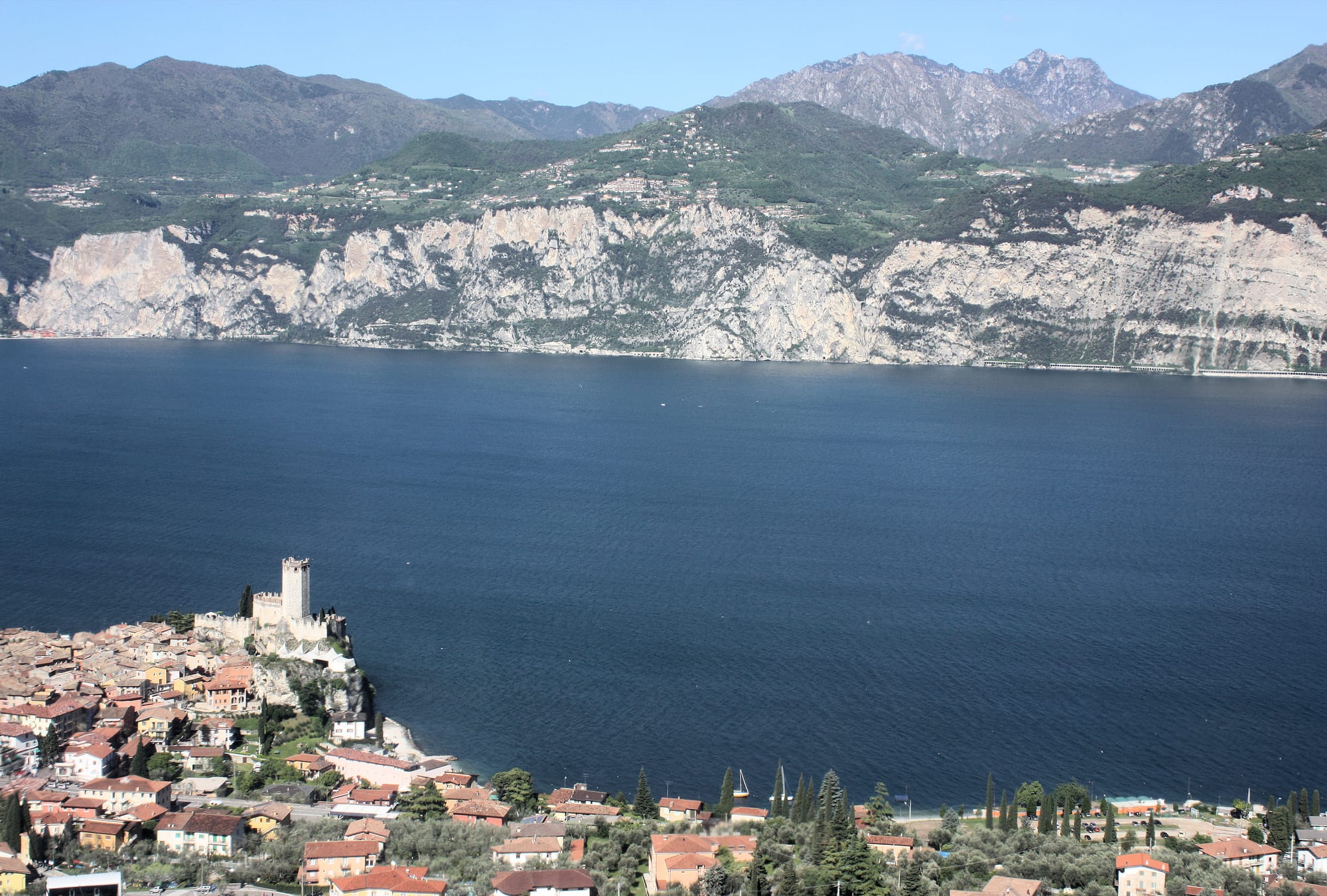
A castle tower on a rocky point above red-roofed houses at the edge of a deep blue lake, with pale cliffs and mountains across the water

Veneto, Italy

Malcesine

Malcesine and its Scaliger castle on Lake Garda, seen from the Monte Baldo cable car. (Dguendel / Wikimedia Commons · CC BY 4.0)

The northernmost town on the Veneto shore of Lake Garda, squeezed between the water and the slopes of Monte Baldo in the province of Verona. A Scaliger castle on a rock, a Venetian captains' palace and steep medieval lanes recall centuries of Veronese and Venetian rule; today it lives from tourism, sailing, windsurfing and the cable car to the mountain.

Neighbourhoods

  • The old town and harbour
    • First-time visitors
    • Historic district
    • Best for food

    A knot of steep, winding lanes climbing from the small harbour to the castle rock, with the Palazzo dei Capitani on the waterfront, the parish church of Santo Stefano and most of the town's cafés, shops and restaurants. The Paina beach below the castle is the setting for the July festival.

    Open in Maps
  • Cassone
    • Quiet and residential
    • Lakeside walks

    A village on the shore about 4 kilometres south of the centre, where the Aril, around 175 metres long and counted among the shortest rivers in the world, runs into the lake.

    Open in Maps
  • Navene and Val di Sogno
    • Beaches
    • Water sports
    • Quiet

    The shore villages north and south of the town. Val di Sogno faces the Isola del Sogno, one of the largest islands in the lake, while Navene is the northernmost village of the comune, close to the border with Trentino.

    Open in Maps

Things to do

In the town

  • Castello Scaligerolandmark

    The white-stone castle on its rock above the lake, with swallow-tail battlements and a tower, mostly built under the della Scala lords of Verona; it holds small museums of Lake Garda and Monte Baldo and a room devoted to Goethe.

    Open in Maps
  • Palazzo dei Capitanilandmark

    A lakeside palace begun by the della Scala and remodelled in Venetian style by 1477, later the seat of the Venetian Capitano del Lago and now used for exhibitions and the public library.

    Open in Maps
  • Pieve di Santo Stefanolandmark

    The parish church, first recorded in the 9th century and rebuilt in Baroque style in the 18th, with a Deposition attributed to Girolamo dai Libri.

    Open in Maps

The mountain and the lake

  • Monte Baldoviewpoint

    The long ridge rising to 2,218 metres behind the town, reached by a two-stage cable car whose upper cabins rotate on the way to about 1,750 metres, with ski runs in winter and walking and mountain-bike trails in summer.

    Open in Maps
  • Lake Gardapark

    Italy's largest lake, whose steady winds on the upper basin — the Pelèr from the north in the morning and the Ora from the south in the afternoon — make Malcesine a centre for sailing, windsurfing and kitesurfing.

    Open in Maps

Short trips from the town

  • Limone sul Gardaattraction

    The village on the opposite, Lombard shore, linked to Malcesine by a car ferry in summer and known for the lemon gardens that Goethe described as he passed by boat.

    Open in Maps
  • Nago–Torboleattraction

    The town at the northern tip of the lake in Trentino, reached from Malcesine by a panoramic path between Tempesta and the Busatte park.

    Open in Maps
  • Riva del Gardaattraction

    The Trentino town at the northern tip of the lake, reached from Malcesine by boat or by bus along the shore.

    Open in Maps
  • Sanctuary of Our Lady of the Crownlandmark

    A sanctuary built into a cliff face at about 775 metres above the Adige valley, on the far side of Monte Baldo, reached on foot from Spiazzi or by a long flight of steps from Brentino.

    Open in Maps
  • Castle of Aviolandmark

    A medieval castle at Sabbionara, in the comune of Avio in Trentino, on the other side of Monte Baldo.

    Open in Maps

Seasonal events

  • TriduoFebruary

    Three days of prayer for the souls in purgatory in the parish church, set with hundreds of candles, when the local choir sings Lorenzo Perosi's Miserere.

  • Festa di Sant'Annalate July

    A procession for the town's co-patrons, Saints Benigno and Caro, followed by an evening of food and music on the Paina beach and fireworks over the castle set to music.

  • Summer concerts at the Teatro Lacaorsummer

    Concerts in a natural open-air arena at the foot of the castle, alongside painting and sculpture exhibitions in the town.

Eat and drink

Long-standing places and food districts in Malcesine. Hours, ratings and directions come from your maps app, always current.

Malcesine classics

  • Old-town restaurantsneighborhood

    Trattorie and restaurants in the lanes and around the harbour, serving lake fish, polenta and dishes dressed with the local olive oil.

    Open in Maps
  • Local olive oilmarket

    Olive groves have been recorded around Malcesine since the 9th–10th centuries, and olive oil is still the town's main farm product.

    Open in Maps

Cafés and bars

  • The harbourneighborhood

    Café tables around the little port and the waterfront below the Palazzo dei Capitani, busy from morning coffee to evening drinks in summer.

    Open in Maps

Experience Malcesine

History

People have lived in the area since prehistory, and the first recorded inhabitants, around 500 BC, are thought to have been Etruscans. After Tiberius defeated the Rhaetians in 15 BC the area passed to Rome, and after Rome's fall to Ostrogoths, Alemanni and Lombards. The Lombards built a castle on the rock in the 5th or 6th century; the Franks destroyed it in 590, rebuilt it, and in 806 King Pepin stayed there. The name first appears in 844 as Manessicelles; its meaning is uncertain.

After Hungarian raids the castle passed to the bishops of Verona, and in 1277 to Alberto della Scala, whose family held it until 1387 and gave it its name. The Visconti of Milan followed, then the Republic of Venice from 1405 to 1797, interrupted only by imperial rule under Maximilian I in 1506–16. From 1618 the Palazzo dei Capitani housed the Capitano del Lago, head of the Gardesana dell'Acqua, a self-governing territory under Venice. Napoleon's troops came in 1797–98, then Austria, which turned the castle into a garrison, and in 1866 Malcesine joined Italy.

In September 1786 Goethe was questioned as a suspected Austrian spy after sketching the castle, an episode he told in his Italian Journey. Tourism grew along the Gardesana Orientale road that follows the Veronese shore, and after the Second World War a polio rehabilitation centre opened in a lakeside villa. Since then the town has become one of the lake's best-known resorts.

Culture & Customs

Malcesine's identity is tied to the lake and the mountain. Sailing is the oldest and most practised sport, thanks to the dependable winds of the upper lake: five local sailors have competed at the Olympics, from Munich in 1972 to Paris in 2024. Italy's first windsurfing school opened here in 1976, kitesurfing followed, and paragliders use the height above the lake for acrobatics. The town hosted rounds of the Red Bull Cliff Diving world series in 2011 and 2013.

Goethe is the town's adopted hero. Plaques mark where he sat to draw the castle, and since 2004 a room in the castle, created with the Casa di Goethe museum in Rome, has displayed his drawings of the lake and the castle, with a bronze bust on one of its terraces. Malcesine belongs to the association of the most beautiful villages of Italy.

Religious tradition remains strong. In February the parish church holds the Triduo, three days of prayer for the dead, lit by hundreds of candles, with Perosi's Miserere sung by the local choir. On 26 July a procession honours the co-patrons, Saints Benigno and Caro, followed by the Sant'Anna festival on the beach and fireworks over the castle. In summer the Teatro Lacaor, a natural arena at the foot of the castle, stages concerts, and the town organises a children's choir competition in alternate years.

Daily Life

About 3,500 people live in the comune, spread from Navene in the north through Malcesine itself to Cassone in the south. The territory climbs from the lake at 89 metres to the crest of Monte Baldo at 2,218 metres, and the town is the northernmost comune on the Veneto shore of the lake, bordering both Trentino and Lombardy across the water.

The economy is mainly tourism — hotels, campsites, restaurants, boat services, sailing and windsurf schools, mountain-bike hire and the cable car — with some farming, chiefly olive oil, and livestock. Olive growing has shrunk since the second half of the 20th century, as tourism drew people from the land and the cost of tending terraces and harvesting rose. Since the late 1940s the town has also had a hospital, which began as a rehabilitation centre for polio and grew into an orthopaedic and rehabilitation hospital at Val di Sogno.

Life follows the seasons. From spring to autumn the town is crowded with visitors, and the shore road is busy. In winter the town is quiet, many businesses close, and residents look to the Monte Baldo ski runs, among the few on Lake Garda.

Food

Malcesine's food belongs to the Veronese shore of Lake Garda, where the mild climate allows olive trees, vines and even lemons to grow far further north than usual. Olive oil is the defining local product: groves are documented from the 9th and 10th centuries, and in the Middle Ages much of the oil was used to light church lamps. Today it remains the town's main farm product.

The town's characteristic dish is polenta carbonera, a hearty dish from the Valle del Chiese that arrived over Monte Baldo; in Malcesine it is made with olive oil instead of butter. As elsewhere in the Veneto, polenta and rice are staples, and the cheeses of the Veronese mountains, such as Monte Veronese, are common.

The lake supplies fish, among them the rare carpione, a salmonid found only in Lake Garda and now endangered by overfishing and pollution. The local wine is Bardolino, a red from the morainic hills east of the lake, named after the lakeside town further south.

Planning tools

Budget

Malcesine is a resort town, and prices rise in July and August, when visitors fill the lake. Rooms are generally reasonably priced for Lake Garda, especially in spring and autumn. The cable car, boat trips and water-sports hire are the main extra costs.

Daily Budget Midrange
USD 190–340 (mid-range hotel, restaurant dinners, the cable car, boat trips or windsurf hire)
Daily Budget Shoestring
USD 80–130 (campsite or simple guesthouse, pizza and bakery food, buses and walking)

Many businesses close or shorten their hours outside the main season; the cable car does not run all year.

Best Time to Visit

May, June and September are the best months for walking, sailing and the cable car without the August crowds. July and August are hot and busy, with the Sant'Anna festival and summer concerts. Winter is mild by the lake, quiet in the town, and brings skiing on Monte Baldo.

Suggested Number of Days

Two days give time for the town and the mountain. Four or five allow for other lake towns by boat and for walking, cycling or water sports; windy or cloudy days can change plans on the water and the ridge, so extra time helps.

First Visit
2 days
With Surroundings
4–5 days

Transportation

There is no railway. Buses run along the Gardesana Orientale road that follows the eastern shore, and passenger boats, including fast hydrofoils, link the lake towns, with a car ferry across to Limone in summer. The old town is pedestrian, and the shore road is narrow and busy in high season. Bicycles and mountain bikes can be hired near the cable car station.

Parking near the old town fills quickly in summer; arriving by boat or bus avoids the traffic on the shore road.

Airport & Station Connections

Most visitors arrive by road along the eastern shore from Verona, about 40 kilometres to the south-east, or by boat from other towns on the lake. Verona, with its airport and main railway station, is the usual gateway; the town has no railway of its own, and buses run along the lake road.

Walkability

The old town is small and car-free but steep, with stepped lanes and cobbles climbing to the castle. The shore offers level walks between the villages, while the mountain trails above, including the stepped path north towards Torbole, are demanding and exposed in places.

Safety

Italy is generally safe, with low levels of violent crime against visitors. Malcesine has little crime; the risks are outdoors — strong winds and sudden storms on the lake, exposed mountain paths, steep mountain-bike descents from Monte Baldo, and heavy traffic on the narrow shore road.

Check the wind forecast before sailing or windsurfing, wear protective gear for mountain biking, and take care walking along the shore road. Check current official travel advice before travelling.

Climate

A sub-Mediterranean climate, unusually mild for its latitude, moderated by the lake. Winds are part of daily life: the Pelèr blows from the north in the morning and the Ora from the south in the afternoon, cooling the summer and keeping day and night temperatures close.

Summer
warm to hot — temperatures reach around 30°C, eased by the lake winds
Winter
mild by the lake — temperatures stay above 0°C almost all the time, and have passed 20°C on record days; snow on Monte Baldo

Local Customs

Malcesine is a resort with a strong local identity: the July feast of its patrons and the February Triduo are community events, and sailing is the town's sport, with five local sailors at the Olympics since 1972. The parish church is a place of worship.

Bills often include a cover charge (coperto); rounding up is a courtesy rather than an obligation. Cover up when leaving the beach for the town's churches.

Common Payment Methods

The currency is the euro. Cards are accepted at most hotels, shops and restaurants, and there are ATMs in the town; carry some cash for small purchases.