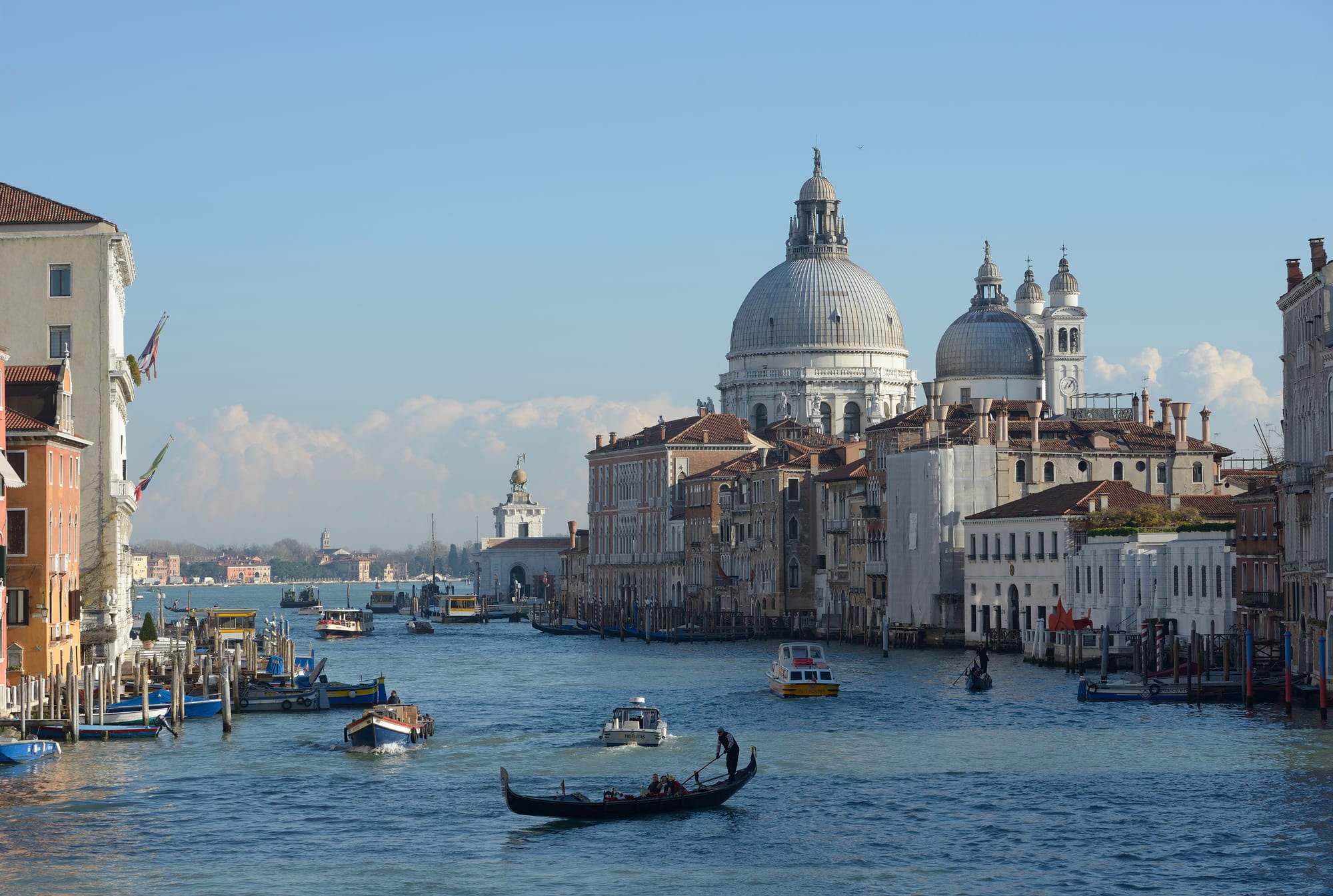
A gondola and motorboats on the Grand Canal, lined with palaces and moorings, with the grey domes of the Salute church behind

Veneto, Italy

Venice

The Grand Canal and Santa Maria della Salute, seen from the Accademia Bridge in Venice. (Wolfgang Moroder / Wikimedia Commons · CC BY-SA 3.0)

The capital of the Veneto, built on more than a hundred islands in a shallow lagoon and linked by hundreds of bridges. For almost a thousand years the seat of a maritime republic, it left canals lined with palaces, churches and art. Today fewer than 50,000 people live in the historic centre, which struggles with floods and overtourism.

Neighbourhoods

  • San Marco
    • First-time visitors
    • Famous landmarks

    The central sestiere around St Mark's Square, with the basilica, the Doge's Palace, La Fenice and the historic cafés of the Piazza. It is the busiest and most expensive part of the city, and the lowest-lying, so it floods first at high tide.

    Open in Maps
  • Cannaregio
    • Local life
    • Best for food
    • Close to the station

    The northern district between the railway station and the Rialto, crossed by the Strada Nova, the busy pedestrian route through it. Away from that thoroughfare it is one of the most residential parts of the old city, and it holds the historic Jewish Ghetto.

    Open in Maps
  • Castello
    • Local life
    • Quiet and residential

    The largest of the six sestieri, home to the Venetian Arsenal, the old shipyards of the republic, and to residential neighbourhoods away from the crowds of St Mark's.

    Open in Maps
  • Dorsoduro
    • Museums
    • Students and nightlife

    The southern district facing the Giudecca Canal, with the Accademia galleries, the Peggy Guggenheim Collection, Ca' Rezzonico and the Salute church at its tip. Ca' Foscari University gives parts of it a student crowd.

    Open in Maps
  • San Polo and Santa Croce
    • Markets
    • Best for food
    • Churches

    Two sestieri across the Grand Canal from San Marco. San Polo, the smallest, holds the Rialto market, the Frari and the Scuola Grande di San Rocco; Santa Croce runs west to Piazzale Roma, where buses and cars arrive.

    Open in Maps
  • Giudecca
    • Quiet and residential
    • Views

    A long island across the Giudecca Canal, part of the Dorsoduro sestiere, dominated by Palladio's Redentore church and looking back at the city across the water.

    Open in Maps
  • Lido
    • Beaches
    • Film festival

    An 11-km barrier island between the lagoon and the Adriatic, with about 20,000 residents, beaches and road traffic, unlike the old city. The Venice Film Festival is held here in late August and early September.

    Open in Maps
  • Mestre
    • Budget stays
    • Close to public transport

    The mainland borough and the most populated urban centre of the municipality, with the Venezia Mestre railway station and two tram lines, one of which crosses the bridge to Piazzale Roma.

    Open in Maps

Things to do

St Mark's and the Grand Canal

  • St Mark's Basilicalandmark

    The cathedral of Venice, begun probably in 1063 on the model of the Church of the Holy Apostles in Constantinople, and until 1797 the doge's own chapel.

    Open in Maps
  • Doge's Palacemuseum

    The Venetian Gothic palace that held the republic's government offices, a jail and the doge's residence, linked by the Bridge of Sighs to the New Prison.

    Open in Maps
  • Piazza San Marcolandmark

    The principal square of Venice, known simply as la Piazza, the former political and religious centre of the republic.

    Open in Maps
  • St Mark's Campanileviewpoint

    The 98.6-metre bell tower of the basilica, rebuilt and completed in 1912 after the previous tower collapsed in 1902.

    Open in Maps
  • Rialto Bridgelandmark

    The oldest of the four bridges over the Grand Canal, a single stone span completed in 1591 to a design by Antonio da Ponte, with rows of shops along its ramps.

    Open in Maps
  • Grand Canalattraction

    The 3.8-km reverse-S waterway from the railway station to the basin of San Marco, lined with palaces and best seen from a vaporetto.

    Open in Maps

Churches

  • Santa Maria della Salutelandmark

    The domed Baroque church at the Punta della Dogana, vowed by the republic after the plague of 1630 and painted by Canaletto, Guardi and Turner.

    Open in Maps
  • Frarilandmark

    One of the largest churches in the city, a brick Venetian Gothic basilica in San Polo filled with tombs of doges and great works of Venetian sculpture and painting.

    Open in Maps
  • San Giorgio Maggiorelandmark

    The island east of the Giudecca whose Palladian church faces St Mark's across the water, one of the city's most painted views.

    Open in Maps
  • Il Redentorelandmark

    Palladio's 16th-century votive church on the Giudecca, built in thanks for the end of a plague and the focus of the July Redentore festival.

    Open in Maps

Museums and galleries

  • Gallerie dell'Accademiamuseum

    The great collection of pre-19th-century Venetian painting, which also owns Leonardo's Vitruvian Man, shown only for a few weeks every six years.

    Open in Maps
  • Peggy Guggenheim Collectionmuseum

    Modern art in the 18th-century Palazzo Venier dei Leoni on the Grand Canal, the American collector's home for three decades, with Cubist, Surrealist and abstract expressionist works.

    Open in Maps
  • Scuola Grande di San Roccomuseum

    A confraternity building whose halls are covered with paintings by Tintoretto, including some of his finest work.

    Open in Maps
  • Ca' Rezzonicomuseum

    A palazzo on the Grand Canal displaying 18th-century Venetian baroque and rococo interiors and paintings.

    Open in Maps
  • La Feniceattraction

    The opera house whose name, 'the phoenix', recalls its rebuilding after three fires; many famous operas had their premieres here in the 19th century.

    Open in Maps

Districts with a story

  • Venetian Ghettoneighborhood

    The area of Cannaregio where Jews were forced to live from 1516 until Napoleon ended its separation in 1797 — the origin of the word 'ghetto'.

    Open in Maps
  • Venetian Arsenallandmark

    The walled complex of former shipyards and armouries that built the bulk of the republic's naval power.

    Open in Maps

The lagoon islands

  • Muranoattraction

    A cluster of islands linked by bridges about 1.5 km north of the city, famous for its glass-making.

    Open in Maps
  • Buranoattraction

    An island at the northern end of the lagoon known for its lace and its brightly coloured houses.

    Open in Maps
  • Torcelloattraction

    A sparsely populated island first settled in 452, once a town with its own cathedral and bishops, often called the parent island of Venice.

    Open in Maps
  • Isola di San Micheleattraction

    The cemetery island between the city and Murano, with the church of San Michele in Isola; the poet Ezra Pound is buried here.

    Open in Maps

Seasonal events

  • Carnival of Venicethe weeks before Shrove Tuesday, in February or early March

    The costume and mask festival, abolished in 1797 and revived in 1979, which now draws around three million visitors.

  • Venice BiennaleMay to November

    The international exhibition held since 1895, with the Art Biennale in even years and the Architecture Biennale in odd years.

  • Festa del Redentorethird Sunday of July and the evening before

    Thanksgiving for the end of the plague of 1576, marked by boats crowding St Mark's basin and fireworks on the Saturday night.

  • Venice Film Festivallate August to early September

    The oldest film festival in the world, founded in 1932, held on the Lido.

  • Regata Storicafirst Sunday of September

    The culminating event of the rowing season, with races on the Grand Canal.

Eat and drink

Long-standing places and food districts in Venice. Hours, ratings and directions come from your maps app, always current.

Venice classics

  • Bacari and cicchettineighborhood

    Simple Venetian wine bars, often standing room only, serving small glasses of wine called ombre with cicchetti — small snacks laid out on the counter, more traditional around the Rialto.

    Open in Maps
  • Caffè Floriancafe

    The coffee house in the Procuratie Nuove on St Mark's Square, opened in 1720 and the oldest in continuous operation in Italy.

    Open in Maps
  • Harry's Barrestaurant

    The restaurant and bar in Calle Vallaresso near St Mark's, known as the home of the Bellini cocktail and of carpaccio.

    Open in Maps

Markets

  • Rialto marketmarket

    The open-air produce and fish market beside the Rialto Bridge in San Polo, with the Pescheria fish hall, still used by local shoppers and surrounded by bakeries and bacari.

    Open in Maps

Experience Venice

History

No records describe the founding of Venice, but tradition dates it to the dedication of the church of San Giacomo on the islet of Rialto in 421, and late Roman sources mention fishermen living in the marshy lagoon. Refugees from the Lombard invasion of 568 swelled the settlements, which remained a Byzantine outpost. The lagoon's people elected their own leader, the doge, in the 8th century; the ducal seat moved from Malamocco to the safer Rialto under Agnello Particiaco, and in 828 relics said to be those of St Mark arrived from Alexandria, giving the city its patron and its winged lion.

From the 9th to the 12th centuries Venice grew into a maritime republic that controlled trade between Western Europe and the East. The Fourth Crusade, which sacked Constantinople in 1204, brought it Byzantine plunder — the bronze horses of St Mark's among it — and an empire that included Crete. By the late 13th century it was the most prosperous city in Europe, with some 3,300 ships, and by 1482 it was the printing capital of the world.

Decline began in the 15th century with the Ottoman wars and the opening of the sea route to India. Plague killed some 50,000 people in 1575–77 and a third of the population in 1630. Napoleon ended the republic on 12 May 1797; Austrian rule followed, interrupted by Daniele Manin's short-lived republic of 1848–49, and in 1866 Venice joined Italy. The city and its lagoon became a UNESCO World Heritage Site in 1987, and the great flood of November 2019, the highest since 1966, was followed in October 2020 by the first raising of the MOSE flood barriers.

Culture & Customs

Few cities have shaped European art and music as much. The Bellini and Vivarini families, Giorgione, Titian, Tintoretto and Veronese made Venice a centre of Renaissance painting, and Canaletto and Guardi painted its views for Grand Tour travellers. Venice is the birthplace of the Baroque composers Vivaldi and Albinoni, and La Fenice saw many famous opera premieres. Carlo Goldoni wrote comedies in Venetian dialect, and Shakespeare, Thomas Mann and Henry James set stories here.

The calendar is crowded. The Carnival, abolished in 1797 and revived in 1979, fills the city with masks in the weeks before Lent. The Biennale, held since 1895, alternates art and architecture exhibitions, and the Venice Film Festival on the Lido is the oldest in the world. Venetians' own festivals are older: the Festa del Redentore in July, with fireworks over St Mark's basin, gives thanks for the end of the plague of 1576, and rowing races culminate in the Regata Storica on the Grand Canal each September.

Local identity is tied to the water and to the sestieri, each with its own house numbering. The six prongs on a gondola's prow represent the six districts. There are about 400 licensed gondoliers, down from 10,000 boats two centuries ago, and gondolas now carry mostly visitors and ceremonies.

Daily Life

The municipality had about 249,000 inhabitants in 2026, but nearly 50,000 of them live in the historic island city; most live on the mainland in Mestre and Marghera, and others on the Lido, Murano and the other lagoon islands. The historic centre's population keeps falling as rising rents push residents out, and many fear it is turning into a museum.

The economy rests on tourism, shipbuilding, services, trade and industrial exports, with Murano glass and Burano lace still important. Estimates of annual visitors run from 22 to 30 million, with up to 60,000 a day at peak. The city has responded with limits: since August 2021 large cruise ships of over 25,000 tonnes have been barred from the Giudecca Canal, a €5 access fee for day-trippers began in April 2024 and has been extended to more days since, and new take-away food outlets have been banned. Ca' Foscari University and the Iuav architecture university bring thousands of students.

Daily routines revolve around the water: commuting by vaporetto, shopping at the Rialto market, and watching the tide forecasts. Between autumn and spring acqua alta can flood the lowest streets, and in many old houses the former ground floors are no longer habitable.

Food

Venetian cooking is built on seafood, vegetables from the island of Sant'Erasmo, rice from the mainland, game and polenta, and some dishes use exotic spices and sauces. Classic dishes include sarde in saór, fried sardines marinated with onions and vinegar; bacalà mantecato, made from stockfish and extra-virgin olive oil; risi e bisi, rice with peas and pancetta; and fegato alla veneziana, veal liver in the Venetian style. Tiramisù, thought to have been invented in nearby Treviso, is popular across the Veneto.

The everyday way to eat is in a bacaro, a simple wine bar, often standing room only, where cicchetti — small snacks such as these — are laid out on the counter and washed down with an ombra, a small glass of wine; the word means 'shadow'. Around the Rialto the cicchetti tend to be simple and traditional.

The spritz, made with prosecco, sparkling water and a bitter liqueur such as Aperol, Campari or Select, is the local aperitif, and Harry's Bar near St Mark's is known as the home of the Bellini. The Rialto market, with its fish hall, remains the place to see what the lagoon and the mainland produce, and Caffè Florian on St Mark's Square has served coffee since 1720.

Planning tools

Budget

Venice is one of the most expensive cities in Italy. Rooms in the historic centre cost far more than on the mainland in Mestre, and eating near St Mark's costs much more than in Cannaregio or Castello. Vaporetto tickets add up quickly, so passes are worth considering. Day-trippers who do not stay overnight pay an access fee on set days in the busy season.

Daily Budget Midrange
USD 200–380 (mid-range hotel, restaurant dinners, museum passes, vaporetto passes)
Daily Budget Shoestring
USD 100–160 (hostel bed or a room in Mestre, cicchetti and bakery food, a vaporetto pass)

Check prices before sitting down, especially near St Mark's, and remember that a cover charge and service may be added to the bill.

Best Time to Visit

April to June and September to October bring mild weather; the Biennale runs from May to November and the film festival and the Regata Storica fall in early September. July and August are hot, humid and crowded. Winter is quieter and atmospheric, with the Carnival in February, but flood tides are most likely between autumn and early spring.

Suggested Number of Days

Two or three days cover the historic centre for a first visit. Four or five allow time for the lagoon islands and a slower pace. Staying overnight rather than visiting for the day avoids the access fee and gives the city at its quietest, early and late.

First Visit
2–3 days
With Surroundings
4–5 days

Transportation

The historic centre is Europe's largest car-free urban area: everything moves on foot or by water. ACTV's vaporetti, motorised waterbuses, run along the Grand Canal and out to the islands; water taxis are private and expensive. Traghetti, gondolas rowed by two oarsmen, ferry foot passengers across the Grand Canal where there is no bridge. On the mainland, buses and two tram lines serve Mestre.

Tour groups are limited to 25 people and loudspeakers are banned, a rule in force since June 2024.

Airport & Station Connections

Marco Polo Airport lies on the mainland near Tessera, about 7.5 km from the centre; buses run to Piazzale Roma and Alilaguna boats to the city, the Lido and Murano. Treviso Airport serves low-cost airlines. Trains arrive at Santa Lucia station on the Grand Canal, about two and a half hours from Milan and under four from Rome, with international trains to Munich and Vienna. Cars and buses stop at Piazzale Roma or Tronchetto, linked by the People Mover.

Walkability

Walking is the way to get around, but it is slow: the lanes are narrow, crowded in season and full of dead ends, and most of the 400-plus bridges have steps, which makes wheeled luggage and pushchairs hard work. Floodwater can cover the lowest streets during acqua alta, so waterproof footwear helps in the flood season.

Safety

Italy is generally safe, with low levels of violent crime against visitors. In Venice the problems are pickpockets on crowded vaporetti and around the Rialto and St Mark's, restaurant bills with hidden cover and service charges, and slippery walkways during acqua alta.

Keep bags closed and in front on crowded boats and bridges, check menus for prices before sitting down, and follow the flood sirens and tide forecasts between autumn and spring. Check current official travel advice before travelling.

Climate

A humid subtropical climate with four seasons: cool, damp winters and warm, humid summers, with rain spread through the year. Snow is not unusual between late November and early March, and flood tides push in from the Adriatic between autumn and early spring.

Summer
warm and humid — the 24-hour average in July is about 24°C
Winter
cool and damp — the 24-hour average in January is about 4°C, with fog, occasional snow and acqua alta

Local Customs

Venice is a living city as well as a sight, and residents value visitors who keep noise down in residential lanes. Tips are not customary in Italy; restaurants often add a coperto cover charge, and a euro or two is welcome for good service. A small glass of wine is an 'ombra', and the spritz is the city's everyday aperitif.

Dress modestly to enter St Mark's and other churches, and step aside rather than stopping on busy bridges and narrow lanes to take photographs.

Common Payment Methods

The currency is the euro. Cards are widely accepted, though bacari, small bars and market stalls may prefer cash, and ATMs are easy to find. Day-trippers pay the access fee on designated days.