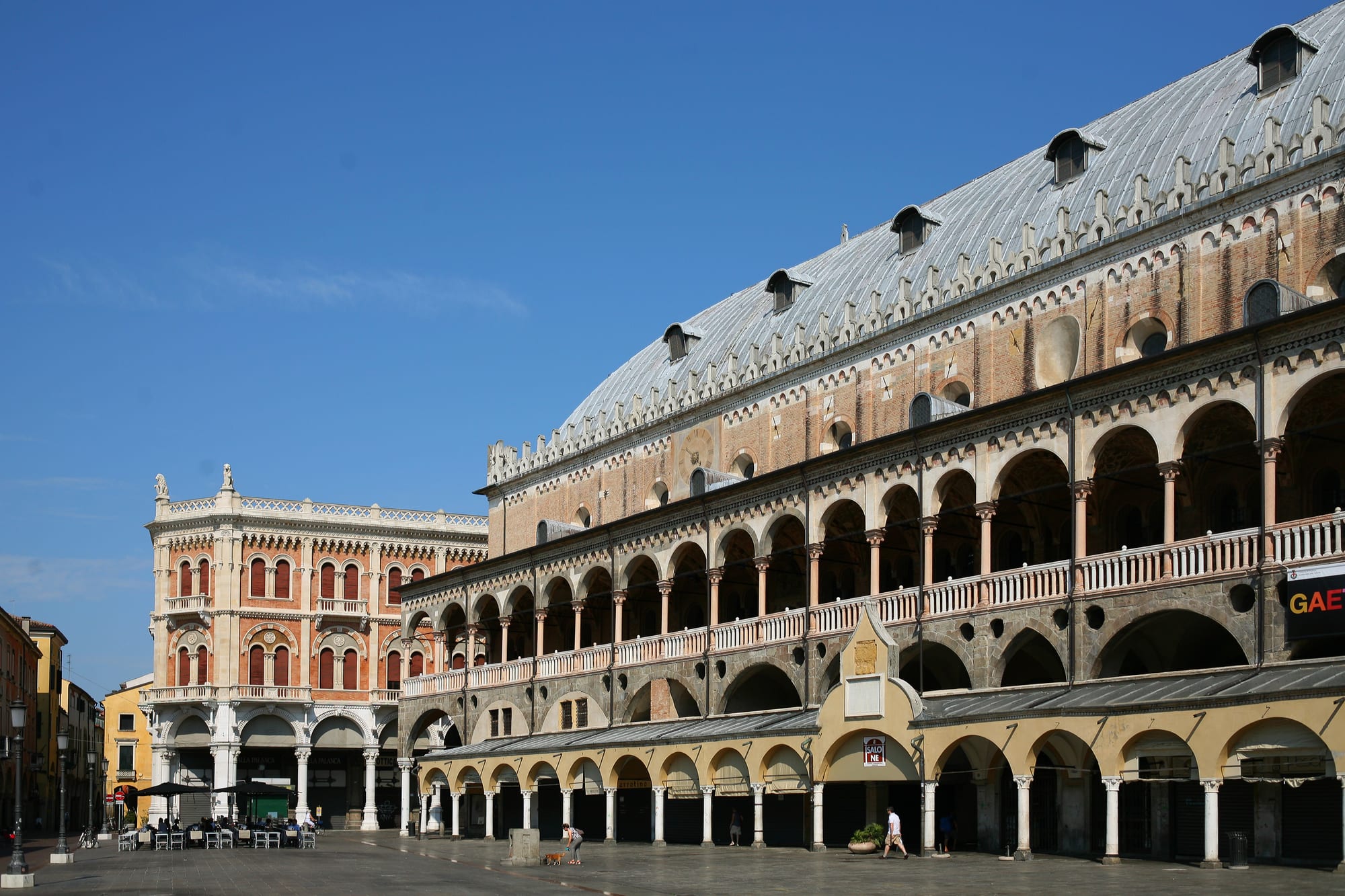
The long arcaded Palazzo della Ragione with its curved grey roof beside a pale palazzo on a quiet square under a blue sky

Veneto, Italy

Padua

Piazza delle Erbe in Padua, overlooked by the medieval Palazzo della Ragione. (Paolobon140 / Wikimedia Commons · CC BY-SA 4.0)

A university city on the Bacchiglione in the Venetian Plain, about 40 kilometres west of Venice. Roman Patavium, a medieval commune and then a Venetian possession for almost four centuries, it holds Giotto's Scrovegni Chapel, the pilgrim basilica of Saint Anthony and the world's oldest academic botanical garden, and today lives to the rhythm of some 72,000 students.

Neighbourhoods

  • The Piazze
    • First-time visitors
    • Markets
    • Nightlife

    The heart of the old city: Piazza delle Erbe and Piazza della Frutta on either side of the Palazzo della Ragione, with Piazza dei Signori and its clock tower next door. Markets fill the squares by day, and in the evening students and locals gather here for the spritz hour.

    Open in Maps
  • The Ghetto
    • Historic district
    • Bars

    The former Jewish quarter between Piazza della Frutta, the cathedral and Via Roma — narrow streets with small galleries and bars, and the Padua Synagogue, completed in 1548 and still in use.

    Open in Maps
  • Santo and Prato della Valle
    • Pilgrims
    • Parks
    • Close to public transport

    The southern part of the centre, around the Basilica of Saint Anthony and the huge elliptical Prato della Valle, with the Abbey of Santa Giustina and the botanical garden close by. The tram runs through it, and the Saturday market spreads across the square.

    Open in Maps
  • Eremitani and the station
    • Museums
    • Close to public transport

    The northern edge of the old city, where the Scrovegni Chapel and the civic museums stand in the gardens around the Roman arena, a short walk from the railway station along Corso del Popolo and Corso Garibaldi.

    Open in Maps
  • Arcella
    • Local life
    • Quiet and residential

    The large residential district north of the railway, where Saint Anthony died in 1231 at the convent that is now the Santuario di Sant'Antonio d'Arcella. Almost entirely destroyed by bombing in the Second World War, it was rebuilt as an everyday neighbourhood of flats and shops.

    Open in Maps

Things to do

Famous landmarks

  • Scrovegni Chapellandmark

    A small chapel built for the banker Enrico degli Scrovegni and covered in Giotto's fresco cycle of around 1305, one of the most important works in the history of European painting; visitors wait in an air-conditioned chamber before entering.

    Open in Maps
  • Basilica of Saint Anthonylandmark

    Il Santo, the domed basilica begun around 1232 over the tomb of Saint Anthony, one of the major pilgrimage churches of Italy, with altar sculptures by Donatello.

    Open in Maps
  • Palazzo della Ragionelandmark

    The medieval hall of justice between the two market squares, whose frescoed upper hall, il Salone, is one of the largest medieval halls still standing, while the ground floor still houses the covered market.

    Open in Maps
  • Prato della Vallelandmark

    A 90,000-square-metre elliptical square laid out in the late 18th century, with a green island ringed by a small canal and two rings of statues.

    Open in Maps
  • Abbey of Santa Giustinalandmark

    A Benedictine abbey on Prato della Valle whose vast basilica holds the tombs of several saints and Paolo Veronese's Martyrdom of Saint Justina.

    Open in Maps
  • Equestrian statue of Gattamelatalandmark

    Donatello's bronze of the Venetian commander Erasmo da Narni, dating from 1453, in front of the basilica — the first full-size equestrian statue of the Italian Renaissance.

    Open in Maps
  • Piazza dei Signorilandmark

    The square of civic ceremony for centuries, dominated by its clock tower and lined with the Loggia della Gran Guardia and the Palazzo del Capitanio of the Venetian governors.

    Open in Maps

Churches, frescoes and museums

  • Padua Cathedrallandmark

    The seat of the bishop, rebuilt from 1551 on a design associated with Michelangelo, behind a façade that was never finished, on Piazza del Duomo.

    Open in Maps
  • Padua Baptisterylandmark

    The small baptistery beside the cathedral, its interior decorated with Giusto de' Menabuoi's 14th-century frescoes.

    Open in Maps
  • Oratory of San Giorgiolandmark

    A Gothic prayer hall on Piazza del Santo with frescoes by Altichiero, part of the city's UNESCO World Heritage Site of 14th-century fresco cycles.

    Open in Maps
  • Church of the Eremitanilandmark

    A 13th-century Augustinian church whose chapel of Mantegna frescoes was largely destroyed by Allied bombing in 1944; only fragments survive.

    Open in Maps
  • Musei Civici di Padovamuseum

    The civic museums in the former Eremitani convent, with an archaeological section and a picture gallery holding works by Giotto, Jacopo Bellini, Veronese and Tintoretto.

    Open in Maps
  • Palazzo del Bomuseum

    The seat of the university since 1493, home to the oldest surviving permanent anatomical theatre in Europe, built in 1594.

    Open in Maps
  • Orto botanico di Padovapark

    Founded by the Venetian Republic in 1545 to grow medicinal plants, the world's oldest academic botanical garden still in its original place, a UNESCO World Heritage Site.

    Open in Maps
  • La Specolaviewpoint

    A tower of the medieval castle converted in 1767 into an astronomical observatory, now a museum of astronomy.

    Open in Maps
  • Padua Synagoguelandmark

    The Great Italian Synagogue in the old ghetto, completed in 1548 and the only one of the city's several historic synagogues still in use.

    Open in Maps

Short trips from the city

  • Euganean Hillspark

    Volcanic hills rising from the plain a few kilometres south-west of the city, the first regional park established in the Veneto.

    Open in Maps
  • Abano Termeattraction

    A spa town on the eastern slope of the Euganean Hills, about 10 kilometres from Padua, built on hot springs and mud baths.

    Open in Maps
  • Arquà Petrarcaattraction

    A small medieval hill village in the Euganean Hills, listed among the most beautiful villages of Italy, where the poet Petrarch spent his last years.

    Open in Maps
  • Monseliceattraction

    A walled town at the southern edge of the Euganean Hills, about 20 kilometres south-west of Padua, below a hill with the ruins of a castle.

    Open in Maps
  • Villa Pisanilandmark

    A monumental late-Baroque villa at Stra on the Brenta Canal, one of the largest of the Venetian villas along the Riviera del Brenta between Padua and Venice.

    Open in Maps

Seasonal events

  • Festa di Sant'AntonioJune

    The city's great feast day, on 13 June, when a relic of the saint is carried in procession through the centre after solemn masses at the basilica; a historical re-enactment also recalls his last journey to Arcella.

  • Fiera campionariaMay

    The largest general trade fair of north-eastern Italy, held at the exhibition centre each May.

  • Sherwood FestivalJune–July

    A month of concerts organised by the independent local station Radio Sherwood, in the grounds of the city's main football stadium.

  • Padova Pride VillageSummer

    A summer festival of music, theatre, film and debate, held since 2008 and open to all.

  • Padova Vintage FestivalSeptember

    A festival of vintage fashion and design at the San Gaetano cultural centre.

Eat and drink

Long-standing places and food districts in Padua. Hours, ratings and directions come from your maps app, always current.

Padua classics

  • Pedrocchi Cafécafe

    The historic café in the centre, its rooms decorated in different styles by Giuseppe Jappelli, once known as the café without doors because it never closed, and owned by the city since 1891.

    Open in Maps
  • Spritz in the piazzasneighborhood

    The early-evening spritz around Piazza delle Erbe, Piazza della Frutta and Piazza dei Signori, crowded with students — in the city where Aperol was first produced in 1919.

    Open in Maps

Food districts and markets

  • Sotto il Salonemarket

    The covered market in the arcades beneath the Palazzo della Ragione, with butchers, cheese sellers, fishmongers and fresh pasta shops.

    Open in Maps
  • Piazza delle Erbe and Piazza della Frutta marketsmarket

    The open-air markets on the two squares either side of the Palazzo della Ragione, held every weekday and on Saturday — fruit and vegetables, with some clothing and bric-à-brac on Piazza della Frutta.

    Open in Maps
  • Prato della Valle Saturday marketmarket

    A large Saturday market around the square selling clothing, household goods, plants and antiques.

    Open in Maps
  • Ghetto barsneighborhood

    The narrow streets of the old Jewish quarter, lined with small bars for a spritz and a snack.

    Open in Maps

Experience Padua

History

Tradition says Padua was founded by the Trojan prince Antenor, and archaeology places the first town between the 11th and 10th centuries BC, and it became one of the main centres of the Veneti. Allied with Rome by the 3rd century BC and made a Roman municipium in the 1st century BC, Patavium grew so rich on horses and wool that by the end of that century it seems to have been the wealthiest city in Italy outside Rome. The historian Livy was born at nearby Abano. Attila sacked the city in 450, and after a revolt in 601 the Lombards besieged it for twelve years before storming and burning it; little of Roman Padua survives beyond the arena and some bridge foundations.

The medieval commune rebuilt it. The university was founded in 1222, the basilica of the Santo was begun after Saint Anthony's death in 1231, and from 1318 the Carrara family ruled as lords. In 1405 Venice took the city and held it, apart from a few weeks in 1509, until 1797, ringing it with new walls between 1507 and 1544. Under Austrian rule, students and townspeople fought troops at the university and the Pedrocchi café in February 1848, and in 1866 Padua joined Italy.

In the First World War the city was the Italian army's headquarters, and the armistice with Austria-Hungary was signed at Villa Giusti in November 1918. Allied bombing in 1943–45 killed some 2,000 people, flattened the Arcella district and destroyed Mantegna's frescoes in the Eremitani. Since the war Padua has grown with the Veneto's rise to prosperity, and in 2021 its 14th-century fresco cycles became a UNESCO World Heritage Site.

Culture & Customs

The university shapes the city's identity. Galileo taught here and watched the moons of Jupiter through his telescope in 1610, Copernicus and William Harvey studied here, and in 1678 Elena Lucrezia Cornaro Piscopia became the first woman in the world to receive a university degree. The anatomical theatre of the 1590s and the botanical garden of 1545 survive, and graduation is still a public event, with friends singing 'Dottore, dottore' to the new graduate.

The city is equally important in the history of art. Giotto, Donatello and Fra Filippo Lippi worked here, Mantegna trained in the local school of Francesco Squarcione, and Petrarch was a canon of the cathedral. Andrea Palladio was born in Padua, and the young Antonio Canova made his first works here. Shakespeare set most of The Taming of the Shrew in the city.

Religion remains visible: the Basilica of Saint Anthony, known simply as il Santo, draws pilgrims from all over the world, and the saint's feast on 13 June, with its procession through the centre, is the year's biggest day. Politically, the university has given Padua a more left-leaning character than the rest of the traditionally conservative Veneto. Sport is followed keenly — Calcio Padova plays football in Serie B, Petrarca Rugby has won 14 national championships, and the city's volleyball club plays in the top division.

Daily Life

About 208,000 people lived in Padua in 2026, making it the third-largest city of the Veneto, and the university's roughly 72,000 students give the centre a young population in term time. Some 20 per cent of residents are immigrants, the largest groups born in Romania, Moldova, Bangladesh, China and Morocco.

Padua is the economic hub of its area. The industrial zone laid out in the east of the city in 1946 is one of the largest in Europe, with the main offices of about 1,300 companies employing some 50,000 people, and declared incomes are well above the Italian average. The railway station, with more than 450 departures a day, makes the city a commuter base for Venice, Vicenza and Verona.

Most residents live outside the walls, in districts such as Arcella and San Carlo to the north, Guizza and Sant'Osvaldo to the south and the western suburbs. The day turns on the markets around the Palazzo della Ragione, which trade every weekday and on Saturday, and on the evening spritz in the piazzas. Since 2017 the city has been led by Sergio Giordani, an independent backed by the centre-left, and a guided tram line runs through the centre, with two more lines under construction.

Food

Paduan cooking is built on fresh produce and peasant traditions. Its best-known dishes are bigoli, thick strands of pasta pressed through a bigolaro and originally made with buckwheat flour and now more often with wholewheat flour, sometimes with duck eggs; second courses based on the Padovana, an ancient local breed of hen known for its large crest; and the torta pazientina, a cake typical of the city, probably dating from the 17th century and regarded as Padua's own dessert. As elsewhere in the Veneto, rice and polenta appear more often than in much of Italy.

The markets are the centre of food life. The arcades under the Palazzo della Ragione, known as Sotto il Salone, house butchers, cheese sellers, fishmongers and fresh pasta makers, and the open squares on either side, Piazza delle Erbe and Piazza della Frutta, sell fruit and vegetables every weekday and on Saturday. Tramezzini, small soft sandwiches with many fillings, are the usual light lunch in cafés.

Padua has a strong claim on the spritz. Aperol, the orange bitter apéritif, was first produced by the Barbieri company in Padua in 1919, and in the 1920s and 1930s the local spritz of wine and soda was combined with such bitters in Venice or Padua. Today the early-evening spritz in the market squares is a nightly ritual, and the historic Pedrocchi Café, once open day and night, still serves coffee and pastries in its 19th-century rooms.

Planning tools

Budget

Padua is much cheaper than Venice, and many visitors use it as a base for the lagoon city, half an hour away by train. Sit-down meals, cafés and rooms are priced for a university town, and the market squares and the spritz hour keep costs down. The Scrovegni Chapel needs a timed ticket, and prices rise around big trade fairs at the exhibition centre.

Daily Budget Midrange
USD 170–300 (mid-range hotel, restaurant dinners, the Scrovegni Chapel and museum tickets, a day trip by train)
Daily Budget Shoestring
USD 70–120 (hostel or simple guesthouse, market food, pizza and tramezzini, the tram and regional trains)

A city museum card that combines the main sights with public transport can save money; book the Scrovegni Chapel time slot before arriving.

Best Time to Visit

April to June and September to October are the most comfortable months; May brings the first warm days and the trade fair, and June has the feast of Saint Anthony, when the city fills with pilgrims. July and August are hot and very humid, and from November to February fog and cold are common, though the museums are quiet.

Suggested Number of Days

Two days cover the centre at an unhurried pace. Allow three or four to include the hills, spa towns and villas around the city, more if Padua is also the base for visiting Venice and Vicenza by train.

First Visit
2 days
With Surroundings
3–4 days

Transportation

The centre is best covered on foot or by bicycle, since the city is flat. A single tram line, SIR 1, runs about 10 kilometres north to south from the railway station past the Eremitani, the Santo and Prato della Valle, and some 40 bus lines cover the rest of the city. A camera-controlled limited-traffic zone covers the centre during the day, so drivers are better off parking outside it.

Cobbles and narrow lanes make parts of the centre awkward for road bikes; validate tickets before boarding.

Airport & Station Connections

Venice Marco Polo Airport, the nearest with regular flights, is about 50 kilometres away, roughly an hour by direct bus; Treviso Airport, used by low-cost airlines, is also about an hour away by bus. Padua's main station has more than 450 departures a day: high-speed trains reach Venice in about 30 minutes, Milan in about two hours and Rome in a little over three, and there are international trains to Zurich and Munich and overnight sleepers to Munich and Vienna.

Walkability

Very walkable. The historic centre inside the 16th-century walls is compact and flat, and the station to the Scrovegni Chapel is a short walk. Pedestrian squares and streets link the market piazzas, the Santo and Prato della Valle. Paving is often cobbled, and cyclists share many of the lanes.

Safety

Italy is generally safe, with low levels of violent crime against visitors. Padua is a busy university and pilgrimage city rather than a centre of mass tourism, and the main risks are petty theft in crowded squares, on the tram and around the railway station.

Keep bags closed in crowds and at the station, and watch for cyclists in pedestrian areas. Check current official travel advice before travelling.

Climate

A humid subtropical climate typical of the Po plain, moderated a little by the nearby Adriatic. Summers are long, hot and muggy with violent thunderstorms and hail; winters are cold, with fog and frost, and snow falls in some years. Spring and autumn are changeable and the wettest seasons.

Summer
hot and humid — maximum temperatures are around 34–35°C, sometimes for several days, with hailstorms most likely in early June and late August
Winter
cold and often foggy — minimum temperatures are often below 0°C from late December to mid-February, and the city has historically averaged 15–20 cm of snow a year

Local Customs

Coffee is drunk standing at the bar, and the spritz in the piazzas between about seven and eight in the evening is the city's social ritual. Graduating students are celebrated by friends singing in the streets and restaurants. The Basilica of Saint Anthony is a working shrine visited by pilgrims: dress modestly, keep voices low and avoid photographing people at prayer.

Restaurant bills often include a cover charge (coperto); rounding up for good service is a courtesy, not an obligation. Shoulders and knees should be covered in churches.

Common Payment Methods

The currency is the euro. Cards and contactless payment are accepted in most shops, restaurants and cafés, and ATMs are easy to find in the centre; carry some cash for market stalls and small bars.