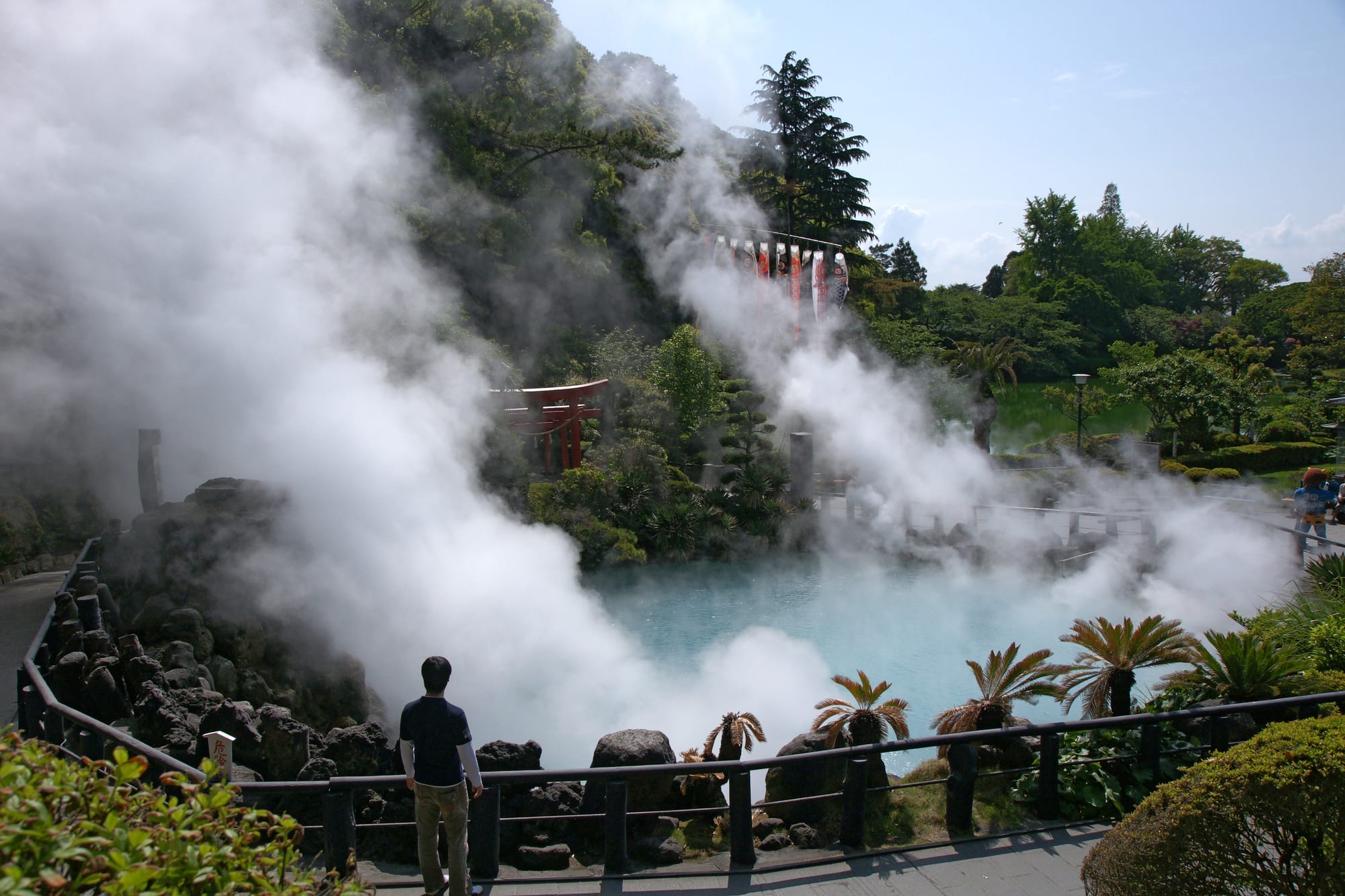
A steaming milky-blue hot spring pool surrounded by rocks, clipped shrubs and trees, with a small red torii gate on the far bank

Kyushu & Okinawa, Japan

Beppu

Umi Jigoku, one of the hot-spring 'hells' in the Kannawa district of Beppu. (663highland / Wikimedia Commons · CC BY 2.5)

A hot-spring city on the east coast of Kyushu, in Oita Prefecture, built on a bay below the volcanic Mount Tsurumi. Steam rises from drains and hillsides all over town, the springs feed hundreds of baths from tiled neighbourhood bathhouses to expensive inns, and the boiling coloured pools known as the hells are visited rather than bathed in.

Neighbourhoods

  • Beppu Station and the centre
    • First-time visitors
    • Close to public transport
    • Budget stays

    The flat grid between the station and the seafront, with most of the city's shops, restaurants, business hotels and bus routes. Several of the old public bathhouses stand within a few streets of each other here, including the wooden-fronted Takegawara.

    Open in Maps
  • Kannawa
    • Hot springs
    • Steam-cooked food
    • Atmosphere

    The steamiest district, on the slope about four kilometres north-west of the station, where vapour pours from vents between the houses. Most of the hells are here, along with old inns, small bathhouses and steam kitchens where food is cooked over the vents.

    Open in Maps
  • Myoban
    • Hot springs
    • Mud baths
    • Views

    The highest of the hot-spring districts, up the hillside above Kannawa. Thatched huts here collect yunohana, mineral crystals that grow on the ground and are sold as bath salts, and the milky, sulphurous water is the strongest smelling in the city.

    Open in Maps
  • Kankaiji and the hill inns
    • Views
    • Ryokan stays
    • Quiet and residential

    A slope of ryokan and hotels above the town with open-air baths looking out over the bay and the lights of the city at night. It is a short bus ride from the centre and quiet after dark.

    Open in Maps
  • Kamegawa and Shibaseki
    • Local life
    • Beaches
    • Quiet and residential

    The northern coastal districts, with an old station and modest neighbourhood bathhouses used mainly by residents. The pace here is slower than in the centre.

    Open in Maps

Things to do

The hells

  • Umi Jigokuattraction

    The 'sea hell', a pond of milky cobalt-blue water at around 98°C, hot enough to cook eggs in, set in a landscaped garden.

    Open in Maps
  • Chinoike Jigokuattraction

    The 'blood pond hell', a pool coloured deep red by iron-rich mud, and one of the hells that together form a nationally designated Place of Scenic Beauty.

    Open in Maps
  • Tatsumaki Jigokuattraction

    The only geyser among the hells, in Shibaseki beside the blood pond, erupting at intervals under a roof built so that it can be watched from close by.

    Open in Maps
  • Shiraike Jigokuattraction

    The 'white pond hell', where water leaving the vent turns a pale opaque blue as it cools in the pond, next to a small tropical fish aquarium.

    Open in Maps
  • Kamado Jigokuattraction

    The 'cooking-pot hell', a cluster of small pools, one of which changes colour with the temperature and the weather, with steam demonstrations.

    Open in Maps

Baths and bathhouses

  • Beppu Onsenattraction

    The collective name for the city's eight main hot-spring areas, the Beppu Hatto, which together discharge more thermal water than anywhere else in Japan and, by volume, are second in the world only to Yellowstone.

    Open in Maps
  • Takegawara Onsenlandmark

    A public bathhouse first opened in 1879 and later rebuilt with a heavy tiled roof, now a registered national tangible cultural property, known for its sand bath, where bathers are buried in hot black sand.

    Open in Maps
  • Myoban yunohana hutsattraction

    Thatched huts on the upper slopes where mineral crystals are still farmed from spring gas by a method recognised as an important intangible cultural property.

    Open in Maps
  • Hyotan Onsenattraction

    A bathhouse in Kannawa open since 1922, with waterfall baths, outdoor pools and one of the sand baths for which the city is known.

    Open in Maps

Hills, parks and views

  • Mount Tsurumiviewpoint

    The volcano of about 1,375 metres behind the city, reached by a ropeway, with views over Beppu Bay and across to Shikoku on clear days.

    Open in Maps
  • Beppu Parkpark

    A long green park between the station and the hills, laid out on the site of a former army camp and used for festivals and weekend walks.

    Open in Maps
  • Beppu Towerviewpoint

    A 100-metre lattice tower near the seafront, opened in 1957 and now used mainly as a transmitter, with an observation deck about 55 metres up.

    Open in Maps
  • Beppu Ropewaytransit hub

    The aerial cable car, running since 1962, that climbs the flank of Mount Tsurumi from the edge of the city to near the summit ridge.

    Open in Maps
  • Jigokumushi Kobo Kannawaattraction

    A public steam kitchen in Kannawa where visitors cook their own vegetables, eggs and seafood in wooden boxes over hot-spring vents.

    Open in Maps

Short trips from the city

  • Yufuinneighborhood

    A hot-spring town about 15 kilometres inland below Mount Yufu, with craft shops, galleries, a small lake and a gentler, more rural feel than Beppu.

    Open in Maps
  • Mount Yufutrail

    A twin-peaked volcano of about 1,580 metres between Beppu and Yufuin, climbed in a few hours on a clear path from the saddle road.

    Open in Maps
  • Ritsumeikan Asia Pacific Universityattraction

    An international university on the hills above the city, opened in 2000, whose students from across Asia and beyond have changed the town's make-up.

    Open in Maps
  • Usuki Stone Buddhaslandmark

    Sixty-one Buddhist figures carved into cliffs at Usuki, roughly 35 kilometres south, dating mostly from the late Heian period, fifty-nine of them designated national treasures.

    Open in Maps
  • Oitaneighborhood

    The prefectural capital, about 15 kilometres south along the bay, with a prefectural art museum, a large stadium and the region's main shopping streets.

    Open in Maps

Seasonal events

  • Beppu Hatto Onsen Festivalearly April

    A spring festival marking the city's springs, with parades, a mikoshi procession and free entry at many public bathhouses.

  • Ogiyama fire festivalMarch

    The controlled burning of the grass slopes of Mount Ogi behind the city, watched from the town as a line of fire crosses the hillside.

  • Cherry blossom seasonlate March to early April

    Cherry trees in the city's parks and along the hill roads draw picnics and evening crowds for the short flowering season.

  • Beppu Fireworks Festivallate July

    A summer festival on the seafront, with several thousand fireworks set off from boats on the bay in one of the largest displays in Oita Prefecture.

Eat and drink

Long-standing places and food districts in Beppu. Hours, ratings and directions come from your maps app, always current.

Beppu classics

  • Jigoku-mushi steamed foodrestaurant

    Vegetables, eggs, prawns and chicken steamed in wooden boxes over hot-spring vents, salty from the mineral water and eaten plain; several Kannawa kitchens let customers do the cooking.

    Open in Maps
  • Beppu reimenrestaurant

    Chewy cold noodles in a cold broth with kimchi and sliced beef or pork, brought from Korean cooking after the war and now a local speciality.

    Open in Maps
  • Toritenrestaurant

    Chicken tempura, an Oita Prefecture dish of battered chicken served with ponzu and mustard, on the menu of most local izakaya and set-meal shops.

    Open in Maps

Food streets and markets

  • Beppu Station shopping streetsneighborhood

    The covered Ginza and Yayoi arcades and the lanes around them hold izakaya, noodle shops and old cafés, busiest in the evening.

    Open in Maps
  • Kannawa food stallsneighborhood

    Steam kitchens, pudding shops and small restaurants cluster around the hot-spring vents in the upper district, many using the steam to cook.

    Open in Maps
  • Beppu Kitahama seafrontneighborhood

    Sushi counters and seafood restaurants near the bay serve the catch of the Seto Inland Sea, including horse mackerel and flying fish.

    Open in Maps

Experience Beppu

History

People have used the springs at Beppu for a very long time: the eighth-century Bungo Fudoki describes the boiling pools of the area, and the fiercest of them were called hells and left alone as dangerous ground rather than bathed in. Through the medieval and Edo periods a few small spa settlements grew around the gentler springs, with Hamawaki and Kannawa the best known, and the Buddhist monk Ippen is credited in local tradition with opening baths at Kannawa in the 13th century.

The modern city was made by transport and drilling. Beppu Station opened in 1911, a passenger sailing from Osaka followed in 1912 on a route that is still the longest-running of its kind in Japan, and new boring techniques opened thousands of wells, so that Beppu's output of hot water became the largest in the country. Aburaya Kumahachi, who founded the Kameno-i inn here in 1911, promoted the resort energetically: in 1928 he started regular sightseeing buses round the hells with Japan's first women bus guides, and he is generally credited with turning a group of spa hamlets into a tourist town. Beppu was incorporated as a city in 1924.

Growth continued through the 20th century, with company outings, honeymooners and health cures filling the inns, and it peaked in the boom years before tastes shifted towards quieter, smaller resorts such as neighbouring Yufuin. The opening of Ritsumeikan Asia Pacific University in 2000 brought several thousand international students to the hills above the town, and the city has since worked to present its bathing culture, rather than its nightlife, as the reason to come.

Culture & Customs

Beppu's culture is bathing culture. The eight hot-spring areas known together as the Beppu Hatto each have their own water and their own character, and the city keeps a large number of small communal bathhouses, some run by neighbourhood associations for residents, which charge a coin or two and work on trust. Stamp books encourage bathers to collect visits across the eight areas. The forms of bathing are unusually varied: hot sand, steam boxes, mud, and the grey-white sulphur water of Myoban.

The hells are treated differently, as a sight rather than a bath, and several of them are nationally designated Places of Scenic Beauty. Around them a whole minor industry has grown up of steamed puddings, hot-spring eggs and bath salts. At Myoban the collection of yunohana crystals in thatched huts continues by a method that has been recognised as an important intangible folk cultural property.

Festivals turn on the springs and the hills: the April hot-spring festival opens bathhouses free of charge, and the burning of the grass on Mount Ogi lights the skyline in early spring. The university has given Beppu a sizeable foreign population for a Japanese city of its size, so shops and restaurants signpost in several languages and the student districts feel international. Oita people have a reputation for being easy-going and hospitable, and conversation in a bathhouse with a stranger is normal here in a way it is not everywhere in Japan.

Daily Life

About 113,000 people live in Beppu, on a narrow shelf of land between the bay and the mountains, with the hot-spring districts climbing the slope behind. The population has been falling slowly and the city is ageing, a pattern common to regional Japan, though the university offsets it: several thousand students, many from other parts of Asia, live and work here and make up an unusually large share of the town.

Tourism and hot-spring hospitality are the main employers, together with hospitals, care homes and services for older residents who move here for the climate and the water. Steam is a utility as much as an attraction: it heats greenhouses and buildings, cooks food in public kitchens, and rises from drains and manholes in ordinary streets all winter.

Life is quiet outside the tourist districts. The shopping arcades near the station have empty units, as in many Japanese provincial cities, and much everyday trade has moved to roadside stores. Residents still use the small neighbourhood baths in the evening, the fish and vegetables come from the bay and the Oita countryside, and weekends are spent on the hill roads towards Yufuin or on the coast. Attracting younger residents and keeping the older bathhouses in repair are long-running concerns.

Food

Beppu cooks with its steam. Jigoku-mushi, hell steaming, uses the vents directly: baskets of vegetables, eggs, prawns, shellfish and chicken are set over the hole and cooked in minutes, picking up a faint saltiness from the mineral water. Public steam kitchens in Kannawa let people do this themselves, and hot-spring eggs and steamed puddings are sold all along the same lanes.

The city's best-known restaurant dish is Beppu reimen, cold chewy noodles in a chilled broth with kimchi and sliced meat, adapted from Korean cold noodles after the war and now made in a Beppu style that is heartier than its original. From the wider prefecture come toriten, chicken tempura eaten with ponzu and mustard, and dango-jiru, a country soup of flat wheat dumplings with root vegetables and miso; its sweet cousin, yaseuma, serves the same dough with roasted soybean flour and sugar. Kabosu, a green citrus grown across Oita, is squeezed over almost everything.

The bay supplies horse mackerel and mackerel, often eaten raw, along with flying fish and shellfish, and the hills behind produce shiitake mushrooms, which Oita grows in quantity on oak logs. Shochu, distilled in Oita mainly from barley, is the usual drink, served with hot water in winter, and hot-spring water itself is sold to drink at some of the springs.

Planning tools

Budget

Beppu is inexpensive by Japanese standards. Public bathhouses cost very little, business hotels near the station are cheap, and food is straightforward. The cost rises steeply for a night at a ryokan with its own spring bath and a kaiseki dinner, which is what many visitors come for; entry to the hells is charged individually or by combined ticket.

Daily Budget Midrange
USD 110–220 (business hotel or a mid-range ryokan with dinner, restaurant meals, the hells and the ropeway)
Daily Budget Shoestring
USD 45–75 (guesthouse or budget hotel, public bathhouses, noodle shops, local buses)

A combined ticket covers the seven main hells; neighbourhood bathhouses charge a token fee and are the cheapest way to try the water.

Best Time to Visit

Autumn, from October to early December, is the most reliable season, with clear air, colour on Mount Tsurumi and comfortable walking. Spring brings cherry blossom and the April festivals. Winter is mild on the coast and suits bathing, with steam most visible in cold weather. June and July bring heavy rain, and typhoons are possible from late summer into autumn.

Suggested Number of Days

A night or two covers the hot-spring districts, the hells and a bath or two. Three or four days allow the neighbouring hot-spring towns, the mountains inland and the coast. Anyone chiefly interested in bathing can fill more time without leaving the city.

First Visit
1–2 days
With Surroundings
3–4 days

Transportation

Buses run from Beppu Station up to Kannawa, Myoban and the hill inns, and are the usual way to move between the hot-spring districts, which are spread over several kilometres of slope. The JR Nippo line links the central station with Kamegawa and with Oita. Taxis are easy to find, and a hire car helps for the mountains and Yufuin, though parking in Kannawa is tight.

Day passes on the local buses cover the hot-spring districts and the hells; check return times, as services thin out in the evening.

Airport & Station Connections

Limited express trains run along the coast from Hakata in Fukuoka in about two hours, and from Oita in around ten minutes. Oita Airport lies on the far side of the bay and has no rail link, so airport buses are the usual connection. Ferries cross overnight from Osaka to Beppu's port, and long-distance buses serve the city from across Kyushu.

Walkability

The central grid between the station and the sea is flat and easily walked. The hot-spring districts sit on a hillside several kilometres away, and the streets there are steep and narrow, so most people take a bus up and walk within a district. Kannawa itself is best seen on foot, with steam crossing the lanes and small baths tucked between houses.

Safety

Beppu is a safe city with very little crime. The hazards are geothermal and natural: the hells and many vents are scalding, the barriers around them are there for good reason, and hot water and steam appear in unexpected places. Heat exhaustion after long bathing, slippery bathhouse floors, typhoons and heavy summer rain that can cause landslides on the hill roads are the other risks.

Stay behind the railings at the hells, drink water and limit time in very hot baths, and follow weather warnings in the rainy season. Check current official travel advice before travelling.

Climate

A mild, humid climate sheltered from the worst of the cold by the bay and the mountains. Rainfall is heavy in June and July, summers are hot and sticky, and winters are cool rather than cold, with snow more likely on Mount Tsurumi than in the town.

Summer
hot and humid, often 28–33°C, with heavy rain in the June and July rainy season
Winter
cool and mostly dry on the coast, around 3–12°C, with snow on the hills above the city

Local Customs

Bathing etiquette matters here more than anywhere. Bathers wash and rinse thoroughly at the taps before entering the water, take in nothing but a small towel, which does not go into the bath, and do not swim or splash. Baths are separated by sex and taken without clothing, and long hair is tied up. Tattoos are refused at some establishments, though attitudes vary and some baths allow them or provide covers.

Tipping is not practised; do not photograph inside bathhouses or changing rooms, and ask before photographing people working around the steam vents.

Common Payment Methods

The currency is the Japanese yen. Hotels, larger restaurants and the main attractions take cards, but small public bathhouses, local buses and some family restaurants are cash only, and several bathhouses use coin boxes. Convenience stores and post offices have cash machines that accept foreign cards.