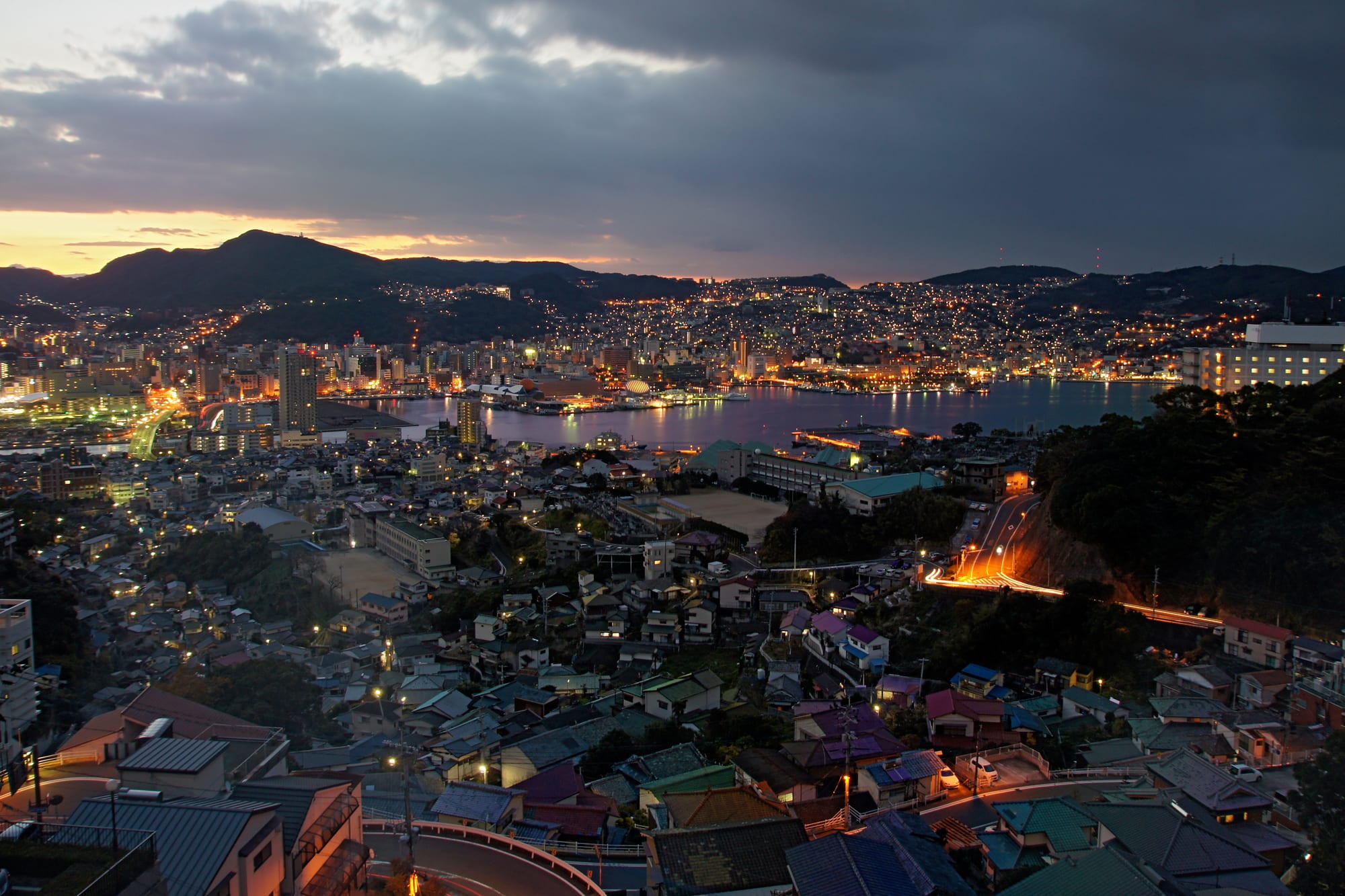
Nagasaki at dusk seen from a hill, with lit houses packed on slopes above a narrow harbour and mountains behind

Kyushu & Okinawa, Japan

Nagasaki

Nagasaki and its harbour at dusk, seen from Mount Inasa. (663highland / Wikimedia Commons · CC BY 2.5)

A port city in western Kyushu, built on steep slopes around a long, narrow harbour. Opened to Portuguese ships in 1571, it became Japan's only window on Europe through the Dutch post at Dejima and kept a large Chinese community, and its churches, temples and hillside terraces reflect that mixture. On 9 August 1945 an atomic bomb destroyed the Urakami district, and remembrance remains central to the city.

Neighbourhoods

  • Around Nagasaki Station and Dejima
    • First-time visitors
    • Close to public transport
    • History

    The flat strip along the east side of the harbour, where the Shinkansen terminus, the bus centre and many hotels stand. Trams run south past the reconstructed Dejima trading post and the prefectural art museum towards the waterfront promenade.

    Open in Maps
  • Hamamachi and Shianbashi
    • Shopping
    • Nightlife
    • Best for food

    The covered shopping arcades and the bar quarter behind them form the commercial centre, a short walk from the Chinatown gates and the stone bridges over the Nakashima River. Restaurants and small drinking places fill the lanes around Shianbashi in the evening.

    Open in Maps
  • Shinchi Chinatown
    • Best for food
    • Historic district

    A small grid of Chinese restaurants and shops behind four ornamental gates, on land reclaimed in the 17th century to store Chinese cargo. It is the centre of the city's Lunar New Year lantern festival.

    Open in Maps
  • Minamiyamate and Oura
    • Historic district
    • Views
    • Museums

    The southern hillside where foreign merchants settled after the port reopened in 1859. Glover Garden's Western houses, Oura Church and the cobbled Dutch Slope look out over the harbour, reached by steep lanes, stairs and a slope lift.

    Open in Maps
  • Urakami
    • History
    • Quiet and residential

    The valley north of the centre, once a farming district with a large Catholic population, and the area over which the 1945 bomb exploded. The Peace Park, the hypocentre, the Atomic Bomb Museum and the rebuilt cathedral are here, among ordinary residential streets.

    Open in Maps
  • Inasa
    • Views
    • Quiet and residential

    The western shore across the harbour, backed by Mount Inasa, whose summit is reached by ropeway and road for the view over the city. Housing climbs the slopes and the shipyards line the water below.

    Open in Maps

Things to do

History and remembrance

  • Nagasaki Peace Parkpark

    The memorial park above the hypocentre in Urakami, with the seated Peace Statue unveiled in 1955 and monuments donated by many countries.

    Open in Maps
  • Nagasaki Atomic Bomb Museummuseum

    The city's museum of the 1945 bombing, tracing the attack, its victims and the later history of nuclear weapons.

    Open in Maps
  • Urakami Cathedrallandmark

    A brick Catholic cathedral rebuilt in 1959 near the hypocentre, with damaged statues from the destroyed building kept outside.

    Open in Maps
  • Dejimaattraction

    The fan-shaped artificial island that held the Dutch trading post from 1641, now surrounded by the city and rebuilt with its warehouses and residences.

    Open in Maps
  • Twenty-Six Martyrs Museummuseum

    A museum and monument on Nishizaka hill to the Christians executed there in 1597, with material on the centuries of hidden faith that followed.

    Open in Maps
  • Nagasaki Museum of History and Culturemuseum

    A museum of the port's overseas trade, built on the site of the magistrate's office, part of which has been reconstructed.

    Open in Maps

Temples, churches and bridges

  • Oura Churchlandmark

    A wooden Gothic church of 1864 built for foreign residents, where hidden Christians revealed themselves the following year; it is a National Treasure and part of the UNESCO-listed Hidden Christian Sites.

    Open in Maps
  • Sofuku-jilandmark

    A Chinese Obaku Zen temple founded in 1629 by Fujian residents, with a bright red gate and halls that are National Treasures.

    Open in Maps
  • Kofuku-jilandmark

    The oldest of the city's Chinese temples, founded in 1624 and associated with the introduction of Obaku Zen to Japan.

    Open in Maps
  • Suwa Shrinelandmark

    The city's chief shrine, reached by a long flight of steps, and the setting for the October Kunchi festival.

    Open in Maps
  • Meganebashilandmark

    A double-arched stone bridge of 1634 over the Nakashima River, whose reflection gives it the name Spectacles Bridge.

    Open in Maps
  • Confucius Shrinelandmark

    A brightly coloured shrine built in 1893 by the Chinese community below the Dutch Slope, with a museum of Chinese history behind it.

    Open in Maps

Views and walks

  • Mount Inasaviewpoint

    A hill of 333 metres across the harbour, reached by ropeway, bus or road, giving the wide view of the city that Nagasaki is known for at night.

    Open in Maps
  • Glover Gardenattraction

    An open-air museum of Western merchants' houses on the Minamiyamate slope, including Glover House, the oldest surviving Western-style house in Japan.

    Open in Maps
  • Dutch Slopeneighborhood

    Cobbled lanes of former foreign residences climbing the hill above the old settlement, quiet and lined with wooden Western-style houses.

    Open in Maps
  • Nagasaki Seaside Parkpark

    A waterfront promenade of lawns and walkways beside the harbour at Dejima, used for evening strolls and summer events.

    Open in Maps

Short trips from the city

  • Hashima Islandattraction

    The abandoned coal-mining island known as Gunkanjima, 'battleship island', about 15 kilometres offshore, listed by UNESCO in 2015 among the sites of Japan's Meiji industrial revolution and visited by licensed boat tours.

    Open in Maps
  • Iojimaattraction

    An island in Nagasaki Bay, now joined to the mainland by bridge, with beaches and hot-spring bathing.

    Open in Maps
  • Shimabara Castlelandmark

    A reconstructed keep across the peninsula east of the city, in a town of samurai houses and spring-fed water channels.

    Open in Maps
  • Mount Unzenattraction

    An active volcanic group on the Shimabara Peninsula, with a hot-spring town, steaming vents and the lava dome formed in the eruptions of 1990–95.

    Open in Maps

Seasonal events

  • Nagasaki Lantern FestivalLunar New Year, January or February

    Tens of thousands of Chinese lanterns are hung across Chinatown and the central streets over the first fifteen days of the Chinese New Year, with dragon dances and a lit display in the parks.

  • Peace Memorial Ceremony9 August

    The annual ceremony in the Peace Park marking the 1945 bombing, with a silence at the moment of the explosion and the ringing of bells across the city.

  • Shoro Nagashimid-August

    At the end of Obon, families pull decorated straw boats carrying the year's dead through the streets towards the harbour amid loud firecrackers.

  • Nagasaki Kunchi7–9 October

    The autumn festival of Suwa Shrine, performed by rotating neighbourhood teams, mixing Chinese dragon dances with Dutch-inspired ship floats.

Eat and drink

Long-standing places and food districts in Nagasaki. Hours, ratings and directions come from your maps app, always current.

Nagasaki classics

  • Champonrestaurant

    Thick noodles in a pork-and-chicken broth crowded with seafood, pork and vegetables, created in the city by a Chinese restaurateur for poor students.

    Open in Maps
  • Sara udonrestaurant

    The same toppings served as a thick sauce over noodles fried crisp, eaten with a splash of Worcestershire sauce.

    Open in Maps
  • Shippoku cuisinerestaurant

    A banquet style peculiar to the city, in which Japanese, Chinese and European dishes are set on one round table and shared.

    Open in Maps
  • Castellacafe

    A dense honey sponge cake brought by the Portuguese in the 16th century and sold in long boxes by old confectioners in the centre.

    Open in Maps

Food districts and markets

  • Shinchi Chinatownneighborhood

    A compact quarter of Chinese restaurants and shops selling champon, sara udon and steamed pork buns, busiest during the lantern festival.

    Open in Maps
  • Shianbashineighborhood

    The central eating and drinking district, a grid of lanes with izakaya, small bars and seafood restaurants behind the shopping arcades.

    Open in Maps
  • Hamamachi arcadesneighborhood

    Covered shopping streets lined with confectioners, tea shops and casual restaurants, a good place to buy castella and local sweets.

    Open in Maps

Experience Nagasaki

History

Nagasaki was a fishing village until the local lord Omura Sumitada, a convert to Christianity, opened its deep harbour to Portuguese ships in 1571. The town grew quickly around the trade and was for a time administered by the Jesuits, until Toyotomi Hideyoshi took it under direct control in 1588. As the authorities turned against the foreign religion, twenty-six Christians were executed on Nishizaka hill in 1597, and persecution intensified after the Shimabara Rebellion of the 1630s.

Under the seclusion policy that followed, Nagasaki became the single place where foreign trade was permitted. The fan-shaped island of Dejima, built in 1636, housed first the Portuguese and then, from 1641, the Dutch East India Company; Chinese merchants were confined to a separate walled compound. Through this narrow channel came books, medicine, astronomy and painting, studied across Japan as rangaku, Dutch learning, and Nagasaki acquired temples founded by Chinese residents and a cosmopolitan reputation unlike anywhere else in the country.

The port opened fully after the treaties of 1858. Western merchants built houses on the Minamiyamate slope — among them the Scot Thomas Blake Glover, who helped bring modern coal mining and shipbuilding to Japan — and the harbour became one of the country's great shipyards. At 11.02 on 9 August 1945 an atomic bomb exploded over the Urakami valley, killing tens of thousands of people, destroying the cathedral and the district around it, and leaving effects that lasted for decades. The city rebuilt around the memory: Urakami Cathedral was raised again in 1959, and successive mayors have made nuclear disarmament the city's public cause.

Culture & Customs

Few Japanese cities carry so many foreign layers. Chinese influence runs through the Obaku Zen temples, the Confucius Shrine, the lantern festival and the food; Portuguese and Dutch traces survive in sponge cake, in loan words and in the Western houses of Glover Garden. Catholic Christianity, hidden for two centuries in the villages and islands of the prefecture, is still practised here, and the Hidden Christian Sites in the Nagasaki Region are a UNESCO World Heritage Site.

The festivals show the same mixture. Kunchi, held at Suwa Shrine in early October, is performed by a rotation of neighbourhood teams and combines Chinese dragon dances with floats shaped as foreign ships. At the close of Obon in August, families pull straw spirit boats through the streets towards the water in Shoro Nagashi, accompanied by strings of firecrackers loud enough to be heard across the valley — a send-off rather than a mourning procession.

Remembrance shapes public life. Survivors of the bombing, the hibakusha, have given testimony for generations, schools take part in peace education, and the ceremony each 9 August is attended by foreign delegations. Local manners are otherwise those of provincial Kyushu: easygoing, talkative, fond of shochu and of long meals. The city also keeps its own dialect and a strong sense of being a port that looked outwards when the rest of the country did not.

Daily Life

About 400,000 people live in the city, down from a peak in the 1970s, and the population is falling and ageing faster than the national average as young people leave for Fukuoka and the larger cities. Housing climbs the slopes in tight terraces reached by steps, and some hillside streets are served only by stairways and slope lifts, which makes daily life demanding for older residents.

Shipbuilding and heavy engineering on the harbour remain the industrial base, alongside fishing, food processing, the prefectural government and hospitals. Tourism matters a great deal: cruise ships call at the harbour, and the memorials, Dejima, Glover Garden and the Hashima boat trips draw visitors year-round. The Shinkansen's arrival in 2022 and the redevelopment around the station and the former stadium site have changed the northern centre considerably.

The rhythm is that of a compact provincial city. Trams rattle along the valley from early morning, shoppers fill the Hamamachi arcades in the afternoon, and the bars of Shianbashi are busy in the evening. Depopulation, the future of the shipyards, landslide risk on the slopes and the ageing of the surviving hibakusha are the issues most discussed locally.

Food

Nagasaki's cooking is the clearest evidence of its history. Champon, thick noodles in a milky pork-and-chicken broth loaded with squid, prawns, pork, cabbage and bean sprouts, was created in the city by a Chinese restaurateur to feed students cheaply; sara udon serves the same toppings as a thick sauce over noodles fried until crisp. Both are eaten across Japan now but belong here. Shippoku is the city's banquet tradition, a round table of Japanese, Chinese and European dishes shared by everyone present.

Sweet things came with the Portuguese. Castella, a dense honey sponge baked in long loaves, has been made in Nagasaki since the 16th century and is the standard gift from the city. Chinatown sells steamed pork buns and sesame dumplings, and kakuni manju — a slab of slow-braised pork belly in a folded steamed bun — is sold from counters and stalls.

The harbour supplies the rest. Nagasaki Prefecture lands a great deal of Japan's fish, and mackerel, horse mackerel, sea bream and squid appear on izakaya menus; hatoshi, a shrimp paste sandwich deep-fried, is a local snack of Chinese origin. Toruko rice, a plate of pilaf, spaghetti and a breaded pork cutlet under curry sauce, is a post-war invention found in the city's older Western-style restaurants. Loquats grown in the prefecture appear in early summer, and shochu and local sake are the usual drinks.

Planning tools

Budget

Nagasaki costs less than Japan's big cities. Business hotels near the station and the arcades are inexpensive, a bowl of champon is cheap, and the Peace Park, the hypocentre, the Dutch Slope and the stone bridges cost nothing. Museum entry, the Mount Inasa ropeway and boat trips to Hashima are the main extras, and rooms fill for the August ceremony and the lantern festival.

Daily Budget Midrange
USD 100–220 (business hotel, restaurants, museums, the ropeway and day trips by train or bus)
Daily Budget Shoestring
USD 45–75 (hostel or budget business hotel, champon and set meals, trams)

Trams charge a flat fare and a one-day pass covers them; many of the city's sights sit within walking distance of a tram stop.

Best Time to Visit

Spring and autumn are the most comfortable, with the Kunchi festival in early October and clear views from Mount Inasa. The lantern festival falls at Lunar New Year in the cool season and is the busiest time of the year. June and early July bring the rainy season, when the slopes are slippery and landslide warnings are common, and August is hot, humid and marked by the peace ceremony and Shoro Nagashi.

Suggested Number of Days

Two days are enough to take in the central districts, the southern hillside and the Urakami memorials without rushing. Three or four allow the harbour islands and the Shimabara Peninsula. The steep ground slows walking, so allow more than the distances suggest.

First Visit
2 days
With Surroundings
3–4 days

Transportation

Trams are the backbone of the city: five routes run along the valley floor from the station past Chinatown to the southern hillside, at a flat fare. Buses climb the slopes where trams cannot go, ferries cross the harbour to the western shore, and a ropeway and a slope lift carry people up to viewpoints and hillside housing. Driving is awkward in the narrow centre.

IC cards work on trams and buses; check whether a tram route requires a change at the Tsukimachi junction before boarding.

Airport & Station Connections

The Nishi Kyushu Shinkansen has run to Nagasaki Station since 2022, with a change at Takeo-Onsen for trains from Hakata, giving a journey of about ninety minutes from Fukuoka. Nagasaki Airport, built on an island in Omura Bay to the north, is linked to the city by airport buses and has flights to Tokyo, Osaka and other domestic airports. Long-distance buses serve Fukuoka and the rest of Kyushu, and cruise ships dock in the harbour.

Walkability

The flat corridor along the harbour — station, Dejima, Chinatown and the arcades — is easy on foot, and the main sights cluster near tram stops. Beyond it the city rises sharply: Glover Garden, the Dutch Slope and the residential hillsides involve long flights of steps, and some housing is reached only by stairs or a slope lift. Stairs and stone lanes can be slick in the rainy season.

Safety

Nagasaki is a safe city with very little crime affecting visitors. The real hazards are natural and topographic: heavy rain in June and July can trigger landslides on the steep slopes, typhoons cross in late summer and autumn, and the volcanic Shimabara Peninsula nearby is monitored for activity. Steps and narrow lanes are tiring in heat and slippery when wet.

Heed landslide and flood warnings during heavy rain, carry water for the hill climbs in summer, and treat the memorial sites as places of mourning rather than sightseeing. Check current official travel advice before travelling.

Climate

A humid subtropical climate, wetter than most of Japan. The rainy season runs from June into July and brings some of the country's heaviest downpours; late summer and autumn carry the typhoon risk, and winters are mild on the coast with occasional snow showers.

Summer
hot and humid, generally 27–33°C by day, with very heavy rain in June and July
Winter
mild and changeable, generally 4–12°C, with cold winds off the sea and rare snow

Local Customs

Tipping is not practised in Japan. Shoes are removed in homes, ryokan and some restaurants, and visitors rinse their hands at a shrine's basin before approaching. The atomic bomb sites are memorials and graves as much as museums: quiet behaviour is expected, and many visitors leave paper cranes. Churches here remain in use by Catholic congregations, and services should not be disturbed.

Ask before photographing people at the memorials or in churches, keep voices low at the Peace Park and the hypocentre, and follow any photography restrictions inside temples and museums.

Common Payment Methods

The currency is the Japanese yen. Cards and IC cards are accepted in hotels, department stores, chain restaurants and on trams, but small restaurants, market stalls, shrines and boat operators often take cash only. Cash machines at convenience stores and post offices accept foreign cards.