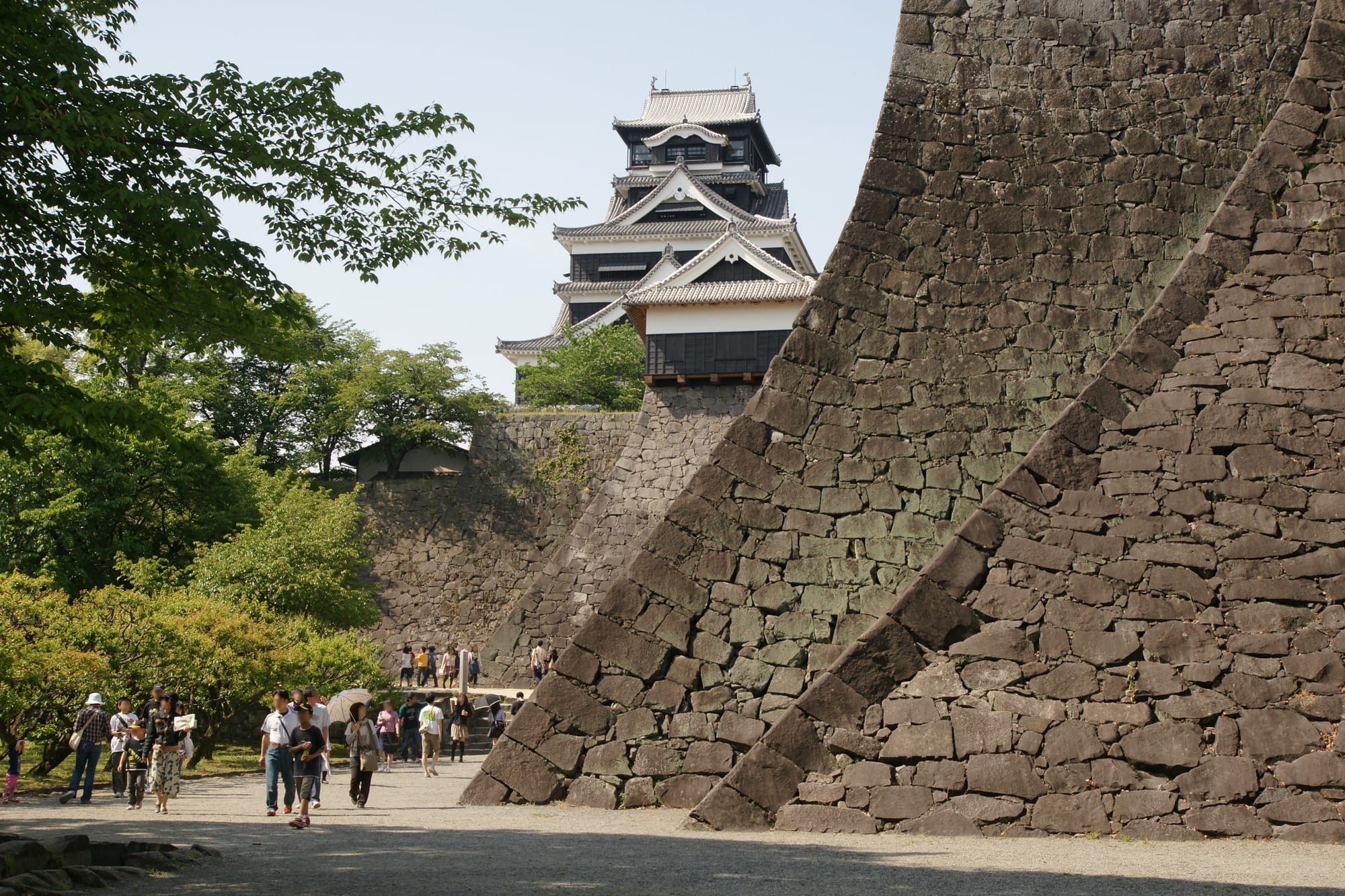
The dark keep of Kumamoto Castle rising behind a long curving stone rampart, with trees and a gravel path below

Kyushu & Okinawa, Japan

Kumamoto

The keep of Kumamoto Castle above its curved stone walls. (663highland / Wikimedia Commons · CC BY 2.5)

The largest city of central Kyushu, built around one of Japan's great castles on the plain between the Ariake Sea and the Mount Aso caldera. Founded as a castle town by Katō Kiyomasa in the early 17th century and besieged during the Satsuma Rebellion, it is now a prefectural capital of about 740,000 people, rebuilding after the 2016 earthquakes.

Neighbourhoods

  • The castle district
    • First-time visitors
    • Historic district
    • Walks

    The wooded hill in the middle of the city, ringed by the castle's black walls and long stone ramparts. Museums, the prefectural art museum and a reconstructed Edo-period street of shops and food stalls stand around its edges, and the grounds are the city's main place to walk.

    Open in Maps
  • Shimotori and Kamitori
    • Best for food
    • Shopping
    • Nightlife

    The covered shopping arcades just south of the castle form the commercial heart of Kumamoto, with department stores, cafés and hundreds of small bars and restaurants in the lanes behind them. Trams run along the street between them, and most of the city's hotels are within a few minutes' walk.

    Open in Maps
  • Around Kumamoto Station
    • Close to public transport
    • Quiet and residential

    The Shinkansen station sits west of the centre near the Shirakawa river, with a shopping complex, hotels and offices around it. It is convenient for early trains but quieter in the evening than the arcades, which are about ten minutes away by tram.

    Open in Maps
  • Suizenji
    • Gardens
    • Quiet and residential

    A settled residential quarter in the east of the city, built around the Hosokawa family's 17th-century strolling garden and its spring-fed pond. Prefectural offices, a sports park and neighbourhood restaurants fill the surrounding streets, all on the tram line to the centre.

    Open in Maps
  • Kami-Kumamoto and the north
    • Local life
    • Temples

    Older working districts spread north-west of the castle towards the hill temple of Honmyō-ji, with shotengai shopping streets, small workshops and university buildings. It shows the everyday city rather than the sights.

    Open in Maps

Things to do

Famous landmarks

  • Kumamoto Castlelandmark

    One of Japan's three premier castles, alongside Himeji and Matsumoto, greatly expanded by Katō Kiyomasa between 1601 and 1607 and known for the steep curving stone walls called musha-gaeshi.

    Open in Maps
  • Katō Shrinelandmark

    A shrine on the castle hill dedicated to Katō Kiyomasa, the castle's builder, with a view across the moat towards the keep.

    Open in Maps
  • Honmyō-jilandmark

    A Nichiren temple on a hillside north-west of the centre, reached by a long flight of steps, where Katō Kiyomasa is buried.

    Open in Maps
  • Fujisaki Hachimangūlandmark

    The city's principal shrine, founded in the 10th century on a site west of the castle and later moved, best known for the horse parade of its September festival.

    Open in Maps

Gardens and parks

  • Suizen-ji Jōju-enpark

    A strolling garden laid out by the Hosokawa lords from 1636 around a clear spring-fed pond, its lawns shaped into a miniature landscape that includes a small grassy cone standing for Mount Fuji.

    Open in Maps
  • Kumamoto City Zoological and Botanical Gardenspark

    A combined zoo and botanical garden beside Lake Ezu in the east of the city, a long-standing outing for local families.

    Open in Maps

Museums

  • Kumamoto Prefectural Museum of Artmuseum

    The prefecture's art museum, opened in 1976 in the castle precincts, with Kumamoto crafts, works by Renoir and Rodin, and a room of replicas of the region's decorated Kofun-period tombs.

    Open in Maps
  • Reigandōattraction

    The cave in the hills west of the city where Miyamoto Musashi spent many of his last months from 1643, meditating and writing The Book of Five Rings.

    Open in Maps

Short trips from the city

  • Mount Asolandmark

    One of the world's largest volcanic calderas, about forty kilometres east, with farmland and towns inside the rim and the steaming Nakadake crater at its centre; access to the crater depends on the volcanic alert level.

    Open in Maps
  • Aso Shrinelandmark

    An ancient shrine on the caldera floor whose eighteen-metre tower gate and hall of worship collapsed in the 2016 earthquakes.

    Open in Maps
  • Amakusaattraction

    An island group reached by bridges south-west of the city, with fishing harbours, dolphin-watching boats and churches linked to the Hidden Christian history of the coast.

    Open in Maps
  • Shimabara Castlelandmark

    A white-walled castle across the Ariake Sea, reached by ferry from the Kumamoto coast, in a town of spring-fed canals below Mount Unzen.

    Open in Maps

Seasonal events

  • Fujisaki Hachimangū Autumn FestivalSeptember

    The city's largest festival, in which decorated horses and groups of chanting attendants parade through the streets over several days.

  • Hinokuni MatsuriAugust

    Kumamoto's summer festival, centred on a mass street dance along the main avenue near the castle.

  • Cherry blossom in the castle groundslate March to early April

    Hundreds of cherry trees flower inside the castle walls, and the grounds are lit in the evening during the season.

  • Kumamoto Castle MarathonFebruary

    A road race run through the city each winter, with routes of several lengths passing the castle.

Eat and drink

Long-standing places and food districts in Kumamoto. Hours, ratings and directions come from your maps app, always current.

Kumamoto classics

  • Basashirestaurant

    Raw horse meat, sliced thin and eaten with grated ginger, garlic and soy sauce — the dish Kumamoto is most associated with, served in izakaya across the centre.

    Open in Maps
  • Karashi renkonrestaurant

    Lotus root packed with mustard-spiked miso, coated in a turmeric batter and fried, said to have been made for an ailing lord of the Hosokawa clan and now sold as a souvenir as well as a side dish.

    Open in Maps
  • Taipīen and Kumamoto ramenrestaurant

    Taipīen is a light soup of glass noodles, pork, seafood and vegetables that came from Fujianese cooking and is eaten even in school lunches here; Kumamoto ramen is a pork-bone broth finished with fried garlic oil.

    Open in Maps

Food districts and markets

  • Shimotori and Kamitori arcadesneighborhood

    The covered arcades and the narrow lanes around them hold most of the city's eating and drinking, from standing bars and yakitori counters to older restaurants serving horse meat and local beef.

    Open in Maps
  • Sakuranobaba Jōsaienmarket

    A row of shops and food stalls built in Edo-period style at the foot of the castle, selling prefectural produce, sweets and quick versions of Kumamoto dishes.

    Open in Maps
  • Kumamoto Station food hallsmarket

    The shopping complex at the Shinkansen station gathers regional restaurants and confectioners, useful for ikinari dango — sweet potato and red bean in a steamed wrapper — and other things to take away.

    Open in Maps

Experience Kumamoto

History

The plain around the Shirakawa river was settled long before the city existed — decorated Kofun-period tombs are scattered across the prefecture — and a fortified house stood on the hill of Chausuyama by the 15th century. The city proper dates from 1588, when Katō Kiyomasa, a general in the service of Toyotomi Hideyoshi, was given half of the province of Higo. He rebuilt the hill fortress into the vast castle completed around 1607, famous for stone walls that curve outward so steeply that they were nicknamed musha-gaeshi, "repelling warriors", and he drained and diked the plain below it. The Katō were dispossessed in 1632 and replaced by the Hosokawa, who ruled Higo until the abolition of the domains and who laid out the garden at Suizen-ji.

In February 1877 Saigō Takamori's rebel army from Satsuma besieged the castle for some fifty days. The garrison held, but the keep and much of the interior had burned down two days before the general assault, in a fire whose cause was never established. The city that grew afterwards was a garrison and school town: the Fifth High School drew teachers including Lafcadio Hearn, who lived here in the early 1890s, and Natsume Sōseki, who taught English from 1896 to 1900 and wrote about the town's fogs and hot springs.

An Allied air raid in July 1945 destroyed about a fifth of the city. A concrete replica of the keep went up in 1960 and the castle became the city's emblem again. Kumamoto became a government-designated city in 2012. Four years later, in April 2016, two large earthquakes killed dozens of people, wrecked houses across the prefecture and brought down walls, turrets and roofs at the castle; restoration of the keep was completed in 2021, and the full repair of the walls and turrets is now scheduled to run to 2052.

Culture & Customs

Kumamoto thinks of itself as a samurai town, and the two figures it keeps closest are Katō Kiyomasa, remembered less as a warrior than as the engineer who tamed the rivers, and Miyamoto Musashi, the swordsman who spent his last years in Higo and wrote The Book of Five Rings in a cave in the hills west of the city. Local character is summed up in the word higo mokkosu, meaning stubborn, blunt and unwilling to bend, which people here use with some pride.

The crafts are distinctive. Higo zōgan is inlay work in which gold and silver are hammered into blackened iron, developed for sword fittings and now used for jewellery and ornaments. Yamaga, north of the city, makes paper lanterns, which dancers balance on their heads at its Bon lantern festival each August. Painted wooden toys — the popping Obake no Kinta puppet among them — are sold as souvenirs.

Festivals are loud. The Fujisaki Hachimangū autumn festival fills the streets with decorated horses and chanting teams, and summer brings the Hinokuni dance along the main avenue. The prefecture's black bear mascot, created in 2010 to promote the opening of the Shinkansen, became a national phenomenon and is now part of the city's public face, appearing on trams, shop fronts and packaging. Sport has a strong following, with rugby matches at the stadium beside the prefectural park and a long tradition of kendo and archery in the old schools.

Daily Life

About 740,000 people live in the city and roughly a million more across the prefecture. The compact centre is unusually lively for a Japanese city of its size, because the arcades kept their shops when others lost them to out-of-town malls, and because the trams make the middle of the city easy to reach without a car. Families mostly live in the outer wards and along the tram lines, in a mix of low blocks of flats and detached houses with small gardens.

Agriculture is the prefecture's traditional strength — tomatoes, watermelons, mandarins, rice and beef — and the city is its market and administrative centre, with prefectural offices, hospitals and Kumamoto University providing much of the steady employment. Since the early 2020s semiconductor manufacturing has changed the local economy sharply: a large chip plant built near the airport, east of the city, has drawn suppliers, raised wages and pushed up land prices and rents in the eastern suburbs, along with complaints about traffic and water use.

The rhythm of the day is provincial and unhurried. Shops in the arcades open mid-morning, offices empty into the izakaya lanes from early evening, and the last trams run well before midnight. Rebuilding after 2016 is still visible in scaffolding on temples and in the castle's roped-off stone walls, and the city runs regular disaster drills. Groundwater is a point of local pride: Kumamoto draws effectively all of its tap water from aquifers fed by rain on the Aso highlands.

Food

Basashi, raw horse meat, is the dish visitors are steered towards first. It is sliced thin, marbled cuts alongside lean ones, and eaten with grated ginger, garlic, sliced onion and a sweet soy sauce; horse is also grilled, simmered or served as a sushi topping, and Kumamoto is one of the places in Japan, with Nagano and Ōita, best known for the dish. Karashi renkon is the other emblem: a lotus root stuffed with mustard and miso, battered with turmeric and deep-fried, which is said to have been devised to strengthen an unwell Hosokawa lord and is now sold sliced into yellow-ringed rounds.

Taipīen shows a different lineage. Brought by Chinese cooks and adapted here, it is a clear soup of glass noodles with pork, squid, prawns, cabbage and a fried egg, so ordinary in Kumamoto that it appears in school lunches. Kumamoto ramen is a tonkotsu broth softened with chicken bones and finished with mayu, black oil of fried garlic, over straight medium noodles. Dagojiru, a country soup of flat wheat-flour dumplings with root vegetables, belongs to the same plain tradition.

Local produce runs to akaushi, the red-brown Japanese beef raised on the Aso grasslands, to tomatoes and watermelons from the plain, and to mandarins from the Ariake coast. Ikinari dango, a steamed dumpling of sweet potato and red bean paste, is the everyday sweet, and honey-glazed karashi renkon or kumamon-stamped biscuits fill the souvenir shelves. The regional drink is shochu: rice shochu from Hitoyoshi in the south of the prefecture, protected under its own geographical name, and sweet-potato shochu from further down Kyushu.

Planning tools

Budget

Kumamoto is inexpensive by Japanese standards. Business hotels near the station and the arcades are cheap, meals in the arcades cost little, and the castle and museums charge modest admission. The real costs are the Shinkansen and a hire car, which most visitors need in order to reach Aso and the hot-spring villages.

Daily Budget Midrange
USD 110–210 (business hotel or ryokan, restaurant dinners with horse meat and local beef, museum entry, a hire car or Shinkansen legs)
Daily Budget Shoestring
USD 50–80 (guest house or budget business hotel, ramen and arcade meals, trams and local buses)

A one-day tram pass covers the castle, Suizenji and the station; buses to Aso and the hot springs run far less often than trains, so check return times before setting out.

Best Time to Visit

Late March to May and October to November are the most comfortable months, with cherry blossom in the castle grounds in early spring and clear air over the Aso caldera in autumn. June and early July bring heavy rain, and August is hot and humid. Winter is mild in the city although Aso can have snow.

Suggested Number of Days

The castle, the garden and the arcades fill a day or two. Three or four days allow the volcanic highlands and the coast as well. Travelling without a car adds time, because the mountain buses are infrequent.

First Visit
1–2 days
With Surroundings
3–4 days

Transportation

Trams are the backbone of city travel: two lines run from the eastern and northern suburbs through the centre past the castle and out to Kumamoto Station, and they accept national IC cards and contactless bank cards. City buses fill the gaps and gather at the Sakuramachi terminal beside the castle, which is also the departure point for long-distance coaches. A hire car is the practical way to see Aso, Kikuchi and the Amakusa islands.

Trams are boarded at the rear and paid on leaving; day passes are sold on board and at the station.

Airport & Station Connections

Kyushu Shinkansen trains reach Kumamoto Station from Hakata in Fukuoka in around forty minutes and from Kagoshima in under an hour, with through services from Osaka. Kumamoto Airport lies about twenty kilometres east of the centre at Mashiki, with domestic flights and a bus link to the city and the station. Ferries cross the Ariake Sea to Shimabara in Nagasaki Prefecture, and express buses run from Fukuoka and Nagasaki.

Walkability

The centre is flat and easy to cover on foot: the arcades, the castle and the bus terminal are all within a fifteen-minute walk of each other, and the covered streets help in rain and summer heat. Suizenji, the station and Honmyō-ji are too far to walk comfortably and are better reached by tram. Pavements are wide and crossings are well marked.

Safety

Kumamoto is a very safe city and street crime is rare. The risks are natural: the region was struck by strong earthquakes in April 2016, typhoons and torrential rain arrive between June and October, and Mount Aso is an active volcano whose crater is closed to visitors when the alert level rises.

Check the volcanic alert level before travelling to the Nakadake crater, take heavy rain and typhoon warnings seriously, and note where evacuation routes are marked. Check current official travel advice before travelling.

Climate

A humid subtropical climate in a basin ringed by hills, which makes summers hotter and more still than on the coast. The rainy season falls in June and early July, typhoons can cross in late summer, and winters are mild with occasional light snow.

Summer
hot and humid, with daytime highs around 32–35°C and warm nights
Winter
mild, with daytime highs around 10–12°C and frosty mornings

Local Customs

Kumamoto follows the usual Japanese etiquette: no tipping, quiet on public transport, shoes off in homes, ryokan and some restaurants, and queuing at marked places on tram and bus stops. Shrines and temples ask for hats off, a short bow at the gate and no photography where it is signed. The prefecture's black bear mascot appears on almost everything sold here, and locals take the joke seriously.

Tattoos may bar entry to some public baths; ask first or choose a bath that allows them. Cover shoulders and knees at shrines, and do not photograph people in festival processions at close range without asking.

Common Payment Methods

The currency is the Japanese yen. Cards and IC cards work in hotels, department stores, chain restaurants and on the trams, but small izakaya, market stalls and rural buses may still be cash only. ATMs in convenience stores and at post offices accept foreign cards.