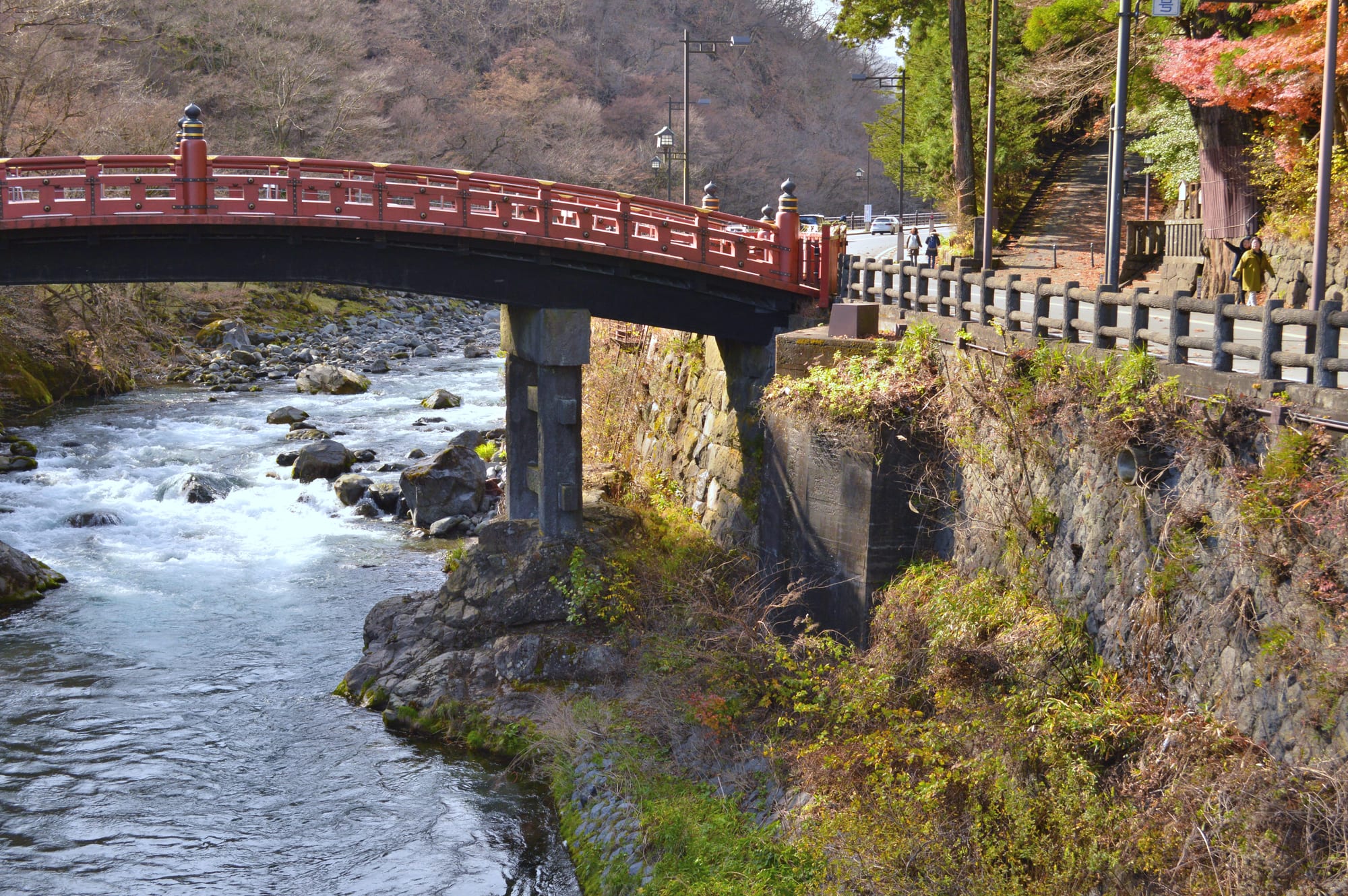
A vermilion arched wooden bridge crossing a rocky mountain river, with a road and wooded slopes behind it

Tokyo & Kanto, Japan

Nikko

The vermilion Shinkyo bridge over the Daiya River at the entrance to Nikko's shrine precinct. (Saigen Jiro / Wikimedia Commons · CC0)

A mountain city in western Tochigi prefecture, where a centre of mountain worship founded in the 8th century became the burial place of Tokugawa Ieyasu. Its shrines and temples in cedar forest are a UNESCO World Heritage Site, and the high country behind them holds Lake Chuzenji, waterfalls, marshes and hot springs.

Neighbourhoods

  • The shrine precinct
    • First-time visitors
    • Historic district

    The wooded slope above the Daiya River where the Toshogu, Rinnoji and Futarasan stand among cedars, entered past the red Shinkyo bridge. Paths, stone stairways and teahouses connect the halls, and the ground is quiet early and crowded by mid-morning.

    Open in Maps
  • Central Nikko
    • Close to public transport
    • Best for food
    • Budget stays

    The main street running from the two railway stations up to the bridge, lined with soba and yuba restaurants, sweet shops, guesthouses and small hotels. It is the practical base for anyone arriving by train.

    Open in Maps
  • Chuzenji and Okunikko
    • Lake views
    • Hot springs
    • Walks and viewpoints

    The high country above the hairpin road, around Lake Chuzenji and the settlement at its eastern end, with hotels, boats, the Kegon Falls and trailheads for the marshes and peaks. Several hundred metres higher than the town and noticeably colder.

    Open in Maps
  • Kinugawa and the northern valleys
    • Hot springs
    • Families

    North-east of the centre, the Kinugawa river valley is a long-established hot-spring resort of large riverside hotels, with theme attractions and gorge walks nearby. It is reached by its own railway line from Tokyo.

    Open in Maps

Things to do

Shrines and temples

  • Nikko Toshogulandmark

    The mausoleum shrine of Tokugawa Ieyasu, rebuilt in the 1630s with carved and gilded gates, including the Yomeimon and the carving of the three wise monkeys.

    Open in Maps
  • Rinnojilandmark

    The Tendai Buddhist temple founded in the 8th century, whose Sanbutsudo hall holds three large gilded statues of the Buddhist forms of the Nikko mountain deities.

    Open in Maps
  • Futarasan Shrinelandmark

    The Shinto shrine dedicated to the mountains Nantai, Nyoho and Taro, with its main hall by the Toshogu and further shrines at the lake and on the summit.

    Open in Maps
  • Taiyuinbyolandmark

    The mausoleum of Iemitsu, Ieyasu's grandson, built in 1653 on a wooded slope in a deliberately more restrained style than his grandfather's shrine.

    Open in Maps
  • Shinkyolandmark

    The vermilion arched bridge over the Daiya River at the foot of the shrine approach, rebuilt in 1904 after a flood swept it away, and belonging to Futarasan Shrine.

    Open in Maps

Lakes, falls and mountains

  • Lake Chuzenjiattraction

    A lake at about 1,270 metres formed when lava from Mount Nantai dammed a valley, with boat trips, a shoreline road and lakeside villas built for foreign embassies, one of which is open to visitors.

    Open in Maps
  • Kegon Fallsattraction

    The lake's outflow dropping some 97 metres in a single plunge, viewed from a free platform or from a lower gallery reached by lift.

    Open in Maps
  • Mount Nantaiviewpoint

    The conical volcano above the lake, sacred to Futarasan Shrine, climbed by pilgrims and walkers from the shrine gate during the summer season.

    Open in Maps
  • Senjogaharatrail

    A high marshland plateau above the lake crossed by boardwalks, known for its alpine flowers in summer and russet grasses in autumn.

    Open in Maps
  • Ryuzu Fallsattraction

    A wide cascade splitting around a rock at the foot of the Senjogahara plateau, popular when the maples turn in autumn.

    Open in Maps
  • Irohazakaviewpoint

    The pair of one-way hairpin roads climbing between the town and the lake, with 48 bends named after the syllables of an old alphabet poem and a viewpoint at Akechidaira.

    Open in Maps
  • Kanmangafuchi Abysstrail

    A short riverside walk through a lava gorge lined by a row of weathered stone Jizo statues, west of the town centre.

    Open in Maps

Hot springs and other sights

  • Kinugawa Onsenattraction

    A hot-spring resort of large hotels along a gorge north-east of the centre, on the Kinugawa, a river whose name means angry demon river.

    Open in Maps
  • Edo Wonderland Nikko Edomuraattraction

    A theme park recreating an Edo-period town with costumed staff, ninja shows and period streets, near Kinugawa.

    Open in Maps
  • Ashio Copper Mineattraction

    A mine in the south of the city whose pollution caused Japan's first major industrial environmental dispute in the 1890s; part of the workings can be visited.

    Open in Maps

Seasonal events

  • Yayoi FestivalApril

    Futarasan Shrine's spring festival, when decorated floats are brought through the town by neighbourhood teams.

  • Toshogu spring grand festivalMay

    A procession of participants in armour recreating the transfer of Ieyasu's remains to Nikko, with horseback archery on the cedar avenue.

  • Autumn colour seasonOctober to early November

    Colour moves down from the lake and marshes in early October to the shrines and gorges in early November, bringing heavy traffic on the mountain road.

  • Toshogu autumn festivalOctober

    A smaller autumn repeat of the armoured procession and archery displays at the shrine.

Eat and drink

Long-standing places and food districts in Nikko. Hours, ratings and directions come from your maps app, always current.

Nikko classics

  • Yubarestaurant

    The skin lifted from heated soy milk, served rolled, simmered, fried or raw; a temple food that became the town's speciality, appearing in set meals across the centre.

    Open in Maps
  • Soba restaurantsrestaurant

    Buckwheat noodles made with mountain water, served cold with dipping sauce or hot, often with tempura of wild vegetables.

    Open in Maps
  • Himemasu from Lake Chuzenjirestaurant

    Landlocked salmon and trout from the lake, grilled with salt or served as sashimi in the lakeside restaurants.

    Open in Maps

Streets, shops and hotels

  • Nikko main streetneighborhood

    The road between the stations and the bridge, with noodle houses, cafés, bakeries and shops selling yuba, pickles and the local sweet yokan.

    Open in Maps
  • Nikko Kanaya Hotelrestaurant

    Japan's oldest Western-style resort hotel, opened in 1873 for foreign visitors, whose dining rooms keep a Western menu from that era.

    Open in Maps

Experience Nikko

History

The mountains here were sacred long before the shoguns arrived. Tradition holds that the monk Shodo founded a hermitage at the foot of Mount Nantai in 766 and later climbed the peak, establishing a centre of shugendo, the mountain asceticism that blended Buddhist and Shinto practice. Rinnoji and Futarasan grew from those beginnings, and by the medieval period the complex held large monastic estates, though it suffered when it backed the losing side in the wars of the 16th century.

Its transformation came after the death of Tokugawa Ieyasu in 1616. The founder of the shogunate was enshrined here as a deity, and from 1634 his grandson Iemitsu had the Toshogu rebuilt on an extraordinary scale, employing thousands of craftsmen for work covered in carving, lacquer and gold leaf that broke with the restraint of earlier Japanese religious architecture. Iemitsu's own mausoleum, Taiyuinbyo, was built nearby in 1653. Shoguns travelled the road from Edo to pay their respects, and the cedar avenue planted along the approach — tens of thousands of trees given over two decades by a single retainer — still lines the way in.

After 1868 the shrines lost their state patronage and the Buddhist and Shinto institutions were separated by law. The town found a second life as a resort: Western diplomats built summer villas at Lake Chuzenji to escape the heat of Tokyo, the Kanaya Hotel opened in 1873, and railways from Tokyo arrived in the early 20th century. To the south, the Ashio copper mine poisoned the Watarase valley and provoked Japan's first great environmental protest. The shrines and temples were inscribed as a UNESCO World Heritage Site in 1999, and municipal mergers in 2006 made Nikko one of the largest cities in Japan by area.

Culture & Customs

Nikko's identity rests on the meeting of mountain religion and shogunal power. Priests still perform the rituals of Futarasan on the summit of Mount Nantai in summer, and the shrine's festivals fill the streets with floats in spring. The best known event is the procession of a thousand armoured marchers held in May and repeated on a smaller scale in autumn, which recreates the journey of Ieyasu's remains to the mountain and is accompanied by horseback archery along the cedar avenue.

The craft tradition follows the buildings. Generations of carpenters, carvers, lacquer workers and gilders have maintained the shrines, whose surfaces are repainted and regilded in long restoration cycles, and Nikko-bori woodcarving is sold in the town. The carvings themselves have entered everyday Japanese culture: the three monkeys who see, hear and speak no evil are on a stable in the precinct, and the sleeping cat above a corridor is almost as familiar.

Visitors have been part of local life for 150 years. The lake villas of foreign diplomats, the old hotels and the mountaineering and fishing clubs left a distinctly international layer on a small mountain town, and the tourist trade still shapes the calendar: quiet winters, a busy spring, and an autumn when the whole district fills. Residents of the outlying valleys keep their own festivals, including the winter snow-hut celebrations of Yunishigawa.

Daily Life

About 80,000 people live in the city of Nikko, spread very thinly across more than 1,400 square kilometres of mountains, forest and river valleys — the result of a 2006 merger that joined the old shrine town with Imaichi, Ashio, Kuriyama and Fujihara. Most residents live in the lower eastern districts around Imaichi rather than by the shrines.

Tourism, forestry, hydroelectric power and food production dominate the economy, along with the hotels of Kinugawa and the lake. The population is ageing and falling, schools in the upland villages have closed or combined, and the city works to keep bus services running to settlements with few residents. Heavy snow, road closures and wildlife damage to crops are ordinary parts of the year.

The rhythm of the town follows the day-trippers: coaches and trains arrive through the morning, the shrine precinct empties by late afternoon, and evenings are quiet enough that many restaurants close early. In the high country the seasons are sharper still, with the lake settlement busy from spring to late autumn and much of it shut through the deepest part of winter.

Food

Yuba is the dish that belongs to Nikko. The delicate skin that forms on heated soy milk was developed as protein for monks and priests on a meat-free diet, and the town serves it rolled into bundles, simmered in broth, fried, wrapped around vegetables or laid raw with soy sauce and wasabi. Set meals built around it are on menus all along the main street, and shops sell it dried to take away.

Buckwheat is the other staple, made into soba with clear mountain water and eaten cold with a dipping sauce or hot with wild vegetables and tempura. Freshwater fish matter here in a way they do not on the coast: trout and himemasu, a landlocked salmon, come from Lake Chuzenji and are grilled with salt or served raw in the lakeside restaurants. In winter, hotpots of local chicken, mushrooms and root vegetables suit the cold.

Sweets and preserves fill the shops. Nikko yokan, a firm sweet bean jelly, is a long-standing souvenir, sold plain or with chestnut, and steamed manju buns are eaten hot near the bridge. The surrounding prefecture contributes strawberries, which Tochigi is known for across Japan, and sake from small breweries in the valleys. Ice cream flavoured with soy milk or strawberry is the standard walking snack on the shrine approach.

Planning tools

Budget

Nikko is cheaper than Tokyo for both rooms and food, though shrine entry adds up when several precincts are visited and the lake hotels and Kinugawa resorts are priced like the ryokan they are. Buses up the mountain are the other recurring cost for anyone without a car.

Daily Budget Midrange
USD 130–250 (hotel or onsen inn with dinner, shrine entry, buses to the lake or a hire car)
Daily Budget Shoestring
USD 50–85 (guesthouse or hostel, soba and set lunches, local buses and trains)

The private railway sells combined travel and bus passes from Tokyo, and a single ticket covers several of the shrine precincts together.

Best Time to Visit

Late October to early November for autumn colour, which is the year's peak and its busiest period, and late spring for fresh green and the May festival. Summer is cooler than the plain and good for the marshes and the mountain. Winter is cold and snowy, with fewer visitors, and some higher roads close from around December to April.

Suggested Number of Days

A day covers the main precinct if the trip starts early from Tokyo, but an overnight stay makes the shrines and the high country manageable together. Three or four days suit the marshes, the hot springs and walking. Autumn traffic can add hours to short journeys.

First Visit
1–2 days
With Surroundings
3–4 days

Transportation

Buses run from the two stations through the town to the shrines and on up the hairpin road to the lake and the marshes, and they are the usual way to move about. The city covers a very large mountainous area, so a car helps for the northern valleys and the southern mines, though the lake road backs up badly in autumn.

Buy a bus day pass for the zone that matches the plan, and allow extra time on autumn weekends, when the climb to the lake can be slow.

Airport & Station Connections

Trains from Tokyo take roughly two hours: Tobu limited expresses run from Asakusa to Tobu-Nikko, and JR services connect through Utsunomiya on the Tohoku Shinkansen to Nikko Station, which stands beside the Tobu terminus. By road the city is about 140 kilometres from central Tokyo by expressway.

Walkability

The centre is a single long street and the shrine precinct above it is walked throughout, though the ground is sloping and the cedar-shaded paths between halls add up to several kilometres. The gap between the stations and the bridge is about two kilometres uphill. Everything beyond the town — the lake, the falls, the valleys — needs a bus or a car.

Safety

Crime is very low. The risks are outdoor ones: mountain weather that changes quickly, ice and snow on the hairpin road in winter, bears and monkeys in the forests, and slippery stone steps in the shrine precinct after rain. Monkeys near the lake road will take food from bags.

Carry a bear bell on forest trails, keep food out of sight where monkeys gather, use shoes with grip on the stone stairways, and check road conditions in winter. Check current official travel advice before travelling.

Climate

Cooler and wetter than the Kanto plain, and colder again at the lake, which lies several hundred metres higher than the town. Summer afternoons bring cloud and thunderstorms to the mountains, autumn is clear, and winter brings snow that lies for months on the high ground.

Summer
mild, generally 22–28°C in the town and several degrees cooler at the lake, with frequent afternoon cloud
Winter
cold, about -4 to 6°C, with regular snow in the town and deep snow at the lake and marshes

Local Customs

The shrines and temples are working religious sites as well as monuments. Visitors bow at torii gates, rinse hands and mouth at the water basin, and keep quiet in the halls; photography is often forbidden inside buildings and always where signs say so. Shoes are removed at temple entrances, and hot-spring etiquette applies in the inns.

Tipping is not practised. Do not feed the monkeys, stay on the boardwalks in the marshes, and dress warmly for the lake even in summer.

Common Payment Methods

The currency is the Japanese yen. Hotels, the railways and larger restaurants take cards, and IC cards work on the trains and most buses, but shrine entry desks, small shops and some mountain services expect cash. Convenience store machines in the centre accept foreign cards.