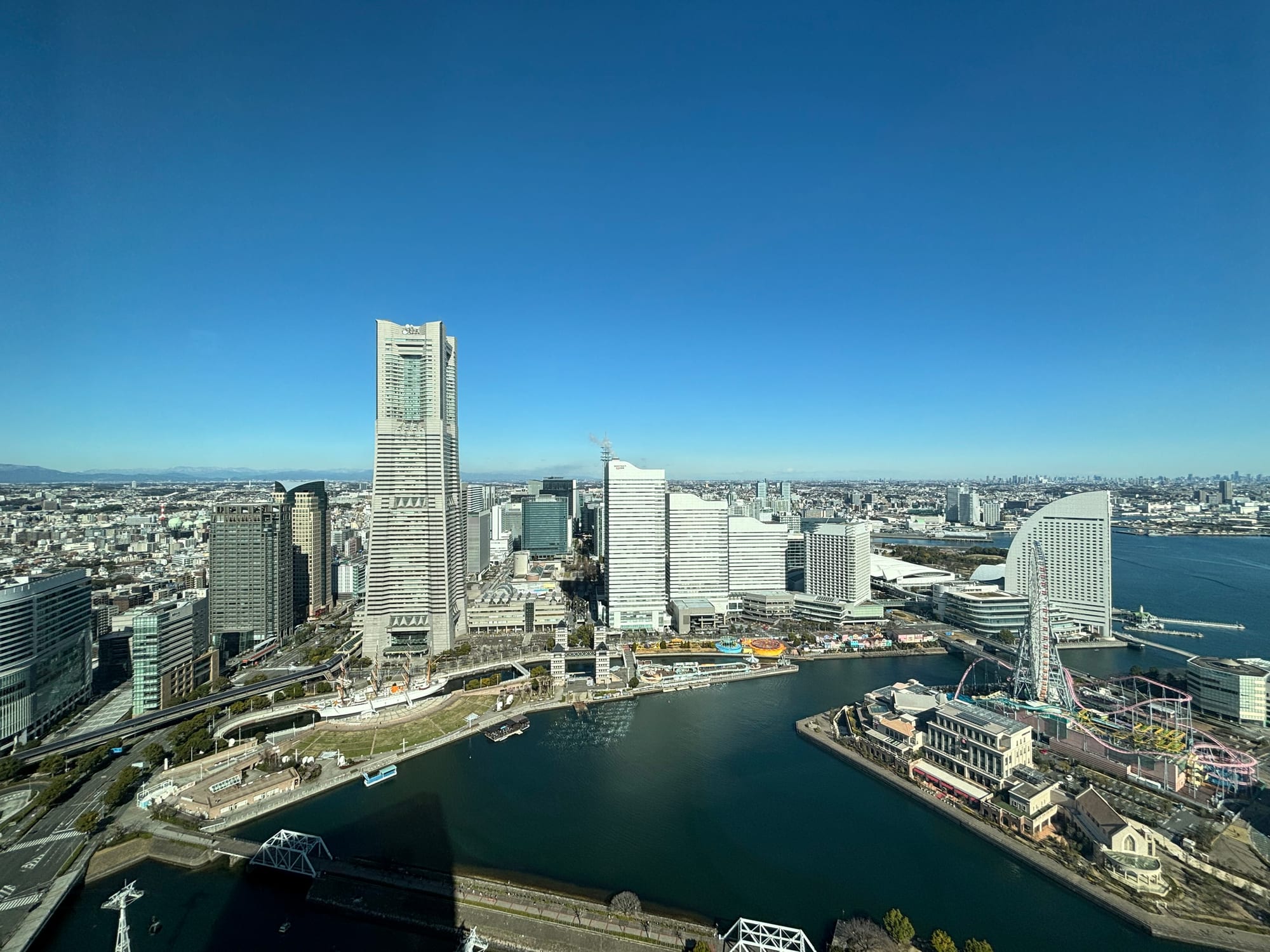
High view over a harbour district of towers, a tall stepped skyscraper, a ferris wheel and an inner dock of dark water

Tokyo & Kanto, Japan

Yokohama

The Minato Mirai 21 waterfront in Yokohama, with the Landmark Tower and the Cosmo Clock 21 ferris wheel above the inner harbour. (Sunwater~jawiki / Wikimedia Commons · CC BY-SA 4.0)

Japan's second-largest city by population, on Tokyo Bay about 30 kilometres south of the capital. A fishing village until it opened to foreign trade in 1859, it became the country's main window on the West, and today mixes the harbour-front towers of Minato Mirai 21 with the largest Chinatown in Japan, hillside Western houses at Yamate and the old garden of Sankei-en.

Neighbourhoods

  • Minato Mirai 21
    • First-time visitors
    • Waterfront
    • Close to public transport

    The harbour district built from the 1980s on former shipyard and railway land, with the Landmark Tower, a ferris wheel, concert halls, shopping centres and a broad promenade along the water. Most of the city's newer hotels are here, and two stations put it minutes from central Tokyo.

    Open in Maps
  • Kannai and Bashamichi
    • Historic district
    • Architecture
    • Close to public transport

    The old foreign settlement south of the inner harbour, laid out on a grid after 1859 and rebuilt after the 1923 earthquake. Brick and stone public buildings, the baseball stadium, wide tree-lined Bashamichi and the city's oldest business streets are all within a few blocks.

    Open in Maps
  • Chinatown
    • Best for food
    • Street life

    The largest Chinatown in Japan, a dense grid of around 250 Chinese restaurants, food stalls and shops behind painted gates, with the Kanteibyo temple at its centre. It is busiest at weekends and around the Lunar New Year.

    Open in Maps
  • Yamashita and Motomachi
    • Waterfront
    • Shopping
    • Quiet and residential

    The park along the harbour edge, laid out on earthquake rubble, runs past a moored ocean liner towards Motomachi, a narrow shopping street that grew up to serve foreign residents. Boutiques, bakeries and cafés line it below the hill.

    Open in Maps
  • Yamate
    • Quiet and residential
    • Walks and views
    • Historic district

    The bluff above the harbour, given to foreign residents in the 19th century and still lined with Western-style houses, churches, schools and cemeteries among gardens. Paths along the ridge give views over the port.

    Open in Maps
  • Noge and Isezakicho
    • Nightlife
    • Best for food
    • Local life

    Two old districts inland from the water, a short walk from Minato Mirai. Noge is a warren of tiny bars, izakaya and jazz clubs that grew out of the postwar black market; Isezakicho is a long pedestrian shopping street with many Chinese, Korean and South-East Asian businesses.

    Open in Maps
  • Shin-Yokohama
    • Close to public transport
    • Sport

    A business district several kilometres inland built around the Shinkansen station, with hotels, offices, the city's main arena and the large football stadium nearby. It is convenient rather than atmospheric.

    Open in Maps

Things to do

The waterfront and landmarks

  • Yokohama Landmark Towerlandmark

    A 296-metre tower of 1993, the tallest building in Japan until Abeno Harukas overtook it in 2014, and the centrepiece of the Minato Mirai skyline.

    Open in Maps
  • Yokohama Red Brick Warehouselandmark

    Two customs warehouses of 1911 and 1913 on the harbour, restored as halls for shops, restaurants, exhibitions and seasonal markets.

    Open in Maps
  • Cosmo Clock 21attraction

    The lit ferris wheel on the inner harbour, with a clock face on its hub, a fixture of the Minato Mirai skyline.

    Open in Maps
  • Yokohama Marine Towerlandmark

    A 106-metre lattice tower of 1961 beside Yamashita Park, carrying an observation deck and a navigation light.

    Open in Maps
  • Yokohama Bay Bridgelandmark

    A cable-stayed bridge of 1989 carrying the expressway across the mouth of the harbour, best seen from the waterfront parks.

    Open in Maps

Museums

  • Yokohama Museum of Artmuseum

    The city's main art museum in Minato Mirai, in a symmetrical building by Kenzo Tange, strong on modern Japanese and Western art and photography.

    Open in Maps
  • Cup Noodles Museummuseum

    A museum of instant noodles run by Nissin on the harbour, part design history and part workshop, where visitors can assemble their own cup.

    Open in Maps
  • Shin-Yokohama Ramen Museummuseum

    Part exhibition, part food hall, with branches of regional ramen shops arranged in a basement built as a 1950s street scene.

    Open in Maps
  • Kanagawa Prefectural Museum of Cultural Historymuseum

    The history of Kanagawa from prehistory to the modern port, housed in the domed former head office of the Yokohama Specie Bank in Bashamichi.

    Open in Maps

Gardens, parks and temples

  • Sankei-enpark

    A large Japanese garden opened to the public in 1906 by a silk merchant, filled with historic buildings brought from Kyoto, Kamakura and elsewhere, including a three-storey pagoda.

    Open in Maps
  • Sōji-jilandmark

    One of the two head temples of the Soto school of Zen, moved to the Tsurumi district of Yokohama in 1911 after a fire, with a large complex of halls and a training monastery.

    Open in Maps
  • Yamashita Parkpark

    A long seafront park laid out on rubble from the Great Kanto earthquake, with rose beds, a fountain and the liner Hikawa Maru moored alongside.

    Open in Maps

Sport and nights out

  • Yokohama Stadiumattraction

    The baseball park in Yokohama Park, home of the Yokohama DeNA BayStars, in the middle of the old settlement grid.

    Open in Maps
  • Nissan Stadiumattraction

    Japan's largest stadium, which staged the 2002 FIFA World Cup final, home to the Yokohama F. Marinos football club.

    Open in Maps
  • Yokohama Arenaattraction

    A large indoor arena near Shin-Yokohama station used for concerts and sporting events.

    Open in Maps

Short trips from the city

  • Kamakuraattraction

    The seat of Japan's first shogunate, half an hour south by train, with the bronze Great Buddha of Kotoku-in and Zen temples in wooded valleys.

    Open in Maps
  • Enoshimaattraction

    A small island linked to the Shonan coast by a bridge, with shrines, caves and, on clear days, a view of Mount Fuji across the bay.

    Open in Maps
  • Kawasaki Daishilandmark

    A Shingon temple in neighbouring Kawasaki, one of the busiest temples in Japan for hatsumode, the first temple visit of the new year.

    Open in Maps

Seasonal events

  • Lunar New Year in Chinatownlate January or February

    Lion and dragon dances, firecrackers and a parade through the Chinatown streets over about two weeks.

  • Port opening anniversaryearly June

    The city marks the opening of the port in 1859 with harbour events and fireworks over the bay.

  • Yokohama Triennalesummer and autumn, every three years

    An international contemporary art exhibition spread across the art museum, warehouses and other venues.

  • Yokohama MarathonMarch

    A road race through the waterfront districts and along the bayside expressway.

Eat and drink

Long-standing places and food districts in Yokohama. Hours, ratings and directions come from your maps app, always current.

Yokohama classics

  • Iekei ramen shopsrestaurant

    The city's own style of ramen, developed in the 1970s — thick straight noodles in a rich pork-bone and soy broth with spinach, sheets of nori and braised pork. Dozens of shops across the city serve it.

    Open in Maps
  • Hotel New Grandrestaurant

    A 1927 hotel facing Yamashita Park whose kitchens are credited with creating two Japanese Western-style dishes, spaghetti Napolitan and seafood doria.

    Open in Maps
  • Shumairestaurant

    Steamed pork-and-scallop dumplings are the city's best-known souvenir food, sold hot in Chinatown and boxed with rice as a station bento.

    Open in Maps

Food districts and markets

  • Yokohama Chinatownneighborhood

    Around 250 Chinese restaurants and shops in a few blocks, from Cantonese banquet halls to Sichuan kitchens, with steamed buns, sesame balls and roast meats sold to eat on the street.

    Open in Maps
  • Nogeneighborhood

    Lanes of small izakaya, standing bars, yakitori counters and jazz bars behind Sakuragicho station, busy from early evening.

    Open in Maps
  • Motomachi shopping streetneighborhood

    A street of boutiques, bakeries and coffee shops below the Yamate bluff, with a long tradition of Western-style baking dating from the foreign settlement.

    Open in Maps

Experience Yokohama

History

Yokohama was a village of a few hundred people on a shallow bay when Commodore Perry's squadron anchored off the coast, and the Convention of Kanagawa was signed nearby in 1854. The shogunate chose the village, rather than the post-station of Kanagawa on the main highway, as the foreign settlement it had agreed to open, and the port began trade in 1859. Raw silk from the hills of Kanagawa, Gunma and Nagano poured through it, and foreign merchants, missionaries and engineers made it the place where much of modern Japan arrived: the first Japanese daily newspapers in English and Japanese, gas street lighting, an early photographic trade, ice cream, beer brewing and, in 1872, the country's first railway, which ran to Shimbashi in Tokyo.

The 20th century twice destroyed the city. The Great Kanto earthquake of September 1923 and the fires that followed levelled almost the entire built-up area and killed more than 30,000 people in Yokohama alone. Rebuilding produced Yamashita Park, laid out over the rubble, and the brick and stone civic buildings of Kannai. Air raids in May 1945 burned much of what remained, and after the surrender the Allied occupation took over the port and large tracts of land for years.

Industry and container shipping drove postwar growth, and the population passed Osaka's to make Yokohama the largest municipality in Japan. From the 1980s the Minato Mirai 21 project rebuilt a shipyard and railway yards into a new harbour centre, crowned by the Landmark Tower in 1993.

Culture & Customs

Yokohama's self-image is of the open, outward-looking port — the hama-kko, the child of the harbour, as against the Edokko of Tokyo — and much of its culture came in by sea. The Chinese community that settled after 1859 built Japan's largest Chinatown, with its own temples, schools and clan associations, while the Yamate bluff kept churches, a foreign cemetery and streets of Western houses that are now museums.

Music is the clearest inheritance. Jazz arrived through the port and the postwar occupation, and the bars of Noge still carry it; the city holds a large jazz festival each autumn and has long supported classical music at the concert halls of Minato Mirai. Contemporary art has a major platform in the Yokohama Triennale, which takes over the art museum and warehouse spaces.

Sport matters: the DeNA BayStars fill the baseball stadium in the middle of the old settlement, and the Yokohama F. Marinos play at the country's largest stadium, which staged the 2002 World Cup final. The festival calendar mixes imports and tradition — Lunar New Year dances in Chinatown, harbour fireworks in summer, and the anniversary of the port's opening in June. Manners are standard Japanese ones, with the extra courtesy of a city long used to foreign visitors.

Daily Life

About 3.7 million people live in Yokohama's eighteen wards, making it the most populous single municipality in Japan, though it is thoroughly bound to Tokyo: hundreds of thousands commute into the capital each morning, and the city has long been called a bedroom of it. That said, the port remains one of Japan's busiest, and Nissan has its head office in the city, alongside technology, shipping and engineering firms drawn to the waterfront.

Most residents live away from the harbour, in the hilly wards inland and in planned suburbs such as Kohoku New Town, reached by the Tokyu and subway lines. Housing is cheaper than in central Tokyo, which keeps young families arriving, but the population has begun to level off and, as across Japan, is ageing. The city runs a large public hospital and university system and a well-used network of local buses on the hills the trains do not reach.

The daily rhythm is commuter-shaped: crowded morning trains, quiet residential streets in the middle of the day, and an evening surge into Noge, Isezakicho and the station basements. Weekends belong to the waterfront, when families, cyclists and wedding parties fill the promenade, and Chinatown is at its busiest. Earthquake preparation, the cost of maintaining ageing suburbs and the future of port land are recurring local concerns.

Food

Chinese food is the city's signature. Yokohama's Chinatown grew out of the treaty port and serves Cantonese, Shanghainese, Sichuan and Taiwanese cooking, but the dish most associated with the city is shumai — small steamed pork dumplings, often made with scallop, sold hot from shop fronts and boxed with rice as one of Japan's best-known station bentos. Sanma-men, ramen topped with stir-fried vegetables in a thickened sauce, is another local Chinese-Japanese invention.

The city's own ramen style, iekei, appeared in the 1970s: thick straight noodles in a broth of pork bone and soy sauce, topped with spinach, sheets of nori and braised pork, with the richness and saltiness adjusted to order. Shops serving it have spread across Japan, and the Shin-Yokohama museum devoted to ramen keeps the regional styles side by side.

Because so much Western food entered Japan here, Yokohama also claims a set of yoshoku dishes — Japanese versions of European cooking. Spaghetti Napolitan, made with ketchup, and seafood doria, a baked rice gratin, are both credited to the kitchens of the Hotel New Grand, and gyunabe, the beef hotpot that introduced many Japanese to eating beef in the Meiji era, spread from the port's early restaurants. Motomachi's bakeries and cafés continue the same inheritance, and beer brewing in Japan began commercially on these hillsides.

Planning tools

Budget

Yokohama is a little cheaper than central Tokyo, especially for hotels, and many visitors use it as a base for the wider bay area. Chinatown, ramen counters and department-store food halls keep eating costs low, while harbour-view rooms in Minato Mirai and tickets for concerts or baseball are the main extras. Museum entry is modest.

Daily Budget Midrange
USD 120–220 (waterfront or station hotel, restaurant dinners, museum entry, taxis and day trips)
Daily Budget Shoestring
USD 55–90 (hostel or business hotel, ramen and convenience-store meals, local trains and the subway)

Rooms near Yokohama or Shin-Yokohama station cost less than those on the harbour, and a rechargeable IC card covers every railway, subway and bus in the area.

Best Time to Visit

Late March and April for cherry blossom along the canals and in the parks, and October and November for clear air, roses in Yamashita Park and autumn colour at Sankei-en. June brings the rainy season, and July and August are hot and humid, though the harbour has evening breezes, festivals and fireworks. Winter is cool, dry and bright, with illuminations in Minato Mirai.

Suggested Number of Days

One full day covers the harbour districts comfortably, and two allow the gardens, outlying museums and hill walks as well. Three or four make sense for anyone adding the coastal towns nearby, or combining the city with Tokyo.

First Visit
1–2 days
With Surroundings
3–4 days

Transportation

Trains do most of the work. JR, the Tokyu Toyoko line, the Keikyu line, the city subway and the short elevated Minatomirai line all meet at or near Yokohama station, and the Minatomirai line runs under the waterfront to Chinatown. A sea bus crosses the harbour between Yokohama station, Minato Mirai and Yamashita Park, and buses fill in the hills and suburbs. An aerial cable car links Sakuragicho station with Cosmo World in Minato Mirai.

Yokohama station is large and confusing with several operators under one roof, so follow the line name rather than the exits, and avoid the Tokyo-bound trains in the morning rush.

Airport & Station Connections

Haneda Airport is about 30 minutes away by Keikyu train or limousine bus, and Narita roughly 90 minutes by airport express or coach. Shin-Yokohama station is on the Tokaido Shinkansen, under 20 minutes from Tokyo and about two hours from Kyoto, while ordinary JR trains reach Yokohama station from Tokyo station in around half an hour and from Shibuya by Tokyu in a similar time. Cruise ships dock at the Osanbashi pier.

Walkability

The waterfront strip is made for walking: a continuous promenade runs from Minato Mirai past the red brick warehouses and the pier to Yamashita Park and Chinatown, a few kilometres in all, on level ground with plenty of places to stop. Yamate is a steep climb from Motomachi, rewarded with views. The rest of the city is spread out and hilly, so trains and buses are needed beyond the centre.

Safety

Yokohama is a very safe city, including late at night in the bar districts. The realistic concerns are summer heat and humidity, crowds at festivals and in Chinatown at weekends, earthquakes, and typhoons between August and October, which can stop trains and ferries.

Drink water and keep out of the midday sun in summer, note the evacuation signs near the harbour, and follow rail and weather announcements during a typhoon. Check current official travel advice before travelling.

Climate

A humid subtropical climate moderated by the bay. A rainy season runs from early June to mid-July, late summer brings typhoons, and winters are dry and sunny with little snow.

Summer
hot and humid — days typically 28–33°C with warm nights, and heavy showers during the rainy season
Winter
cool and dry — days around 10°C and nights near freezing, with clear skies and occasional snow

Local Customs

Manners follow the national pattern: shoes come off in homes, temples and some restaurants, queues form neatly on station platforms, and eating or speaking loudly on trains is avoided. Tipping is not practised and can cause confusion. Bins are scarce, so rubbish is carried until a station or convenience store is reached.

Tattoos may bar entry to public baths and pools; at the Kanteibyo temple and other places of worship keep voices low and check before photographing inside.

Common Payment Methods

The currency is the Japanese yen. Cards and IC cards work in chain shops, department stores, hotels and most restaurants, and QR payment is widespread, but small bars in Noge, market stalls and some older Chinatown shops take cash only. Cash machines at convenience stores and post offices accept foreign cards.