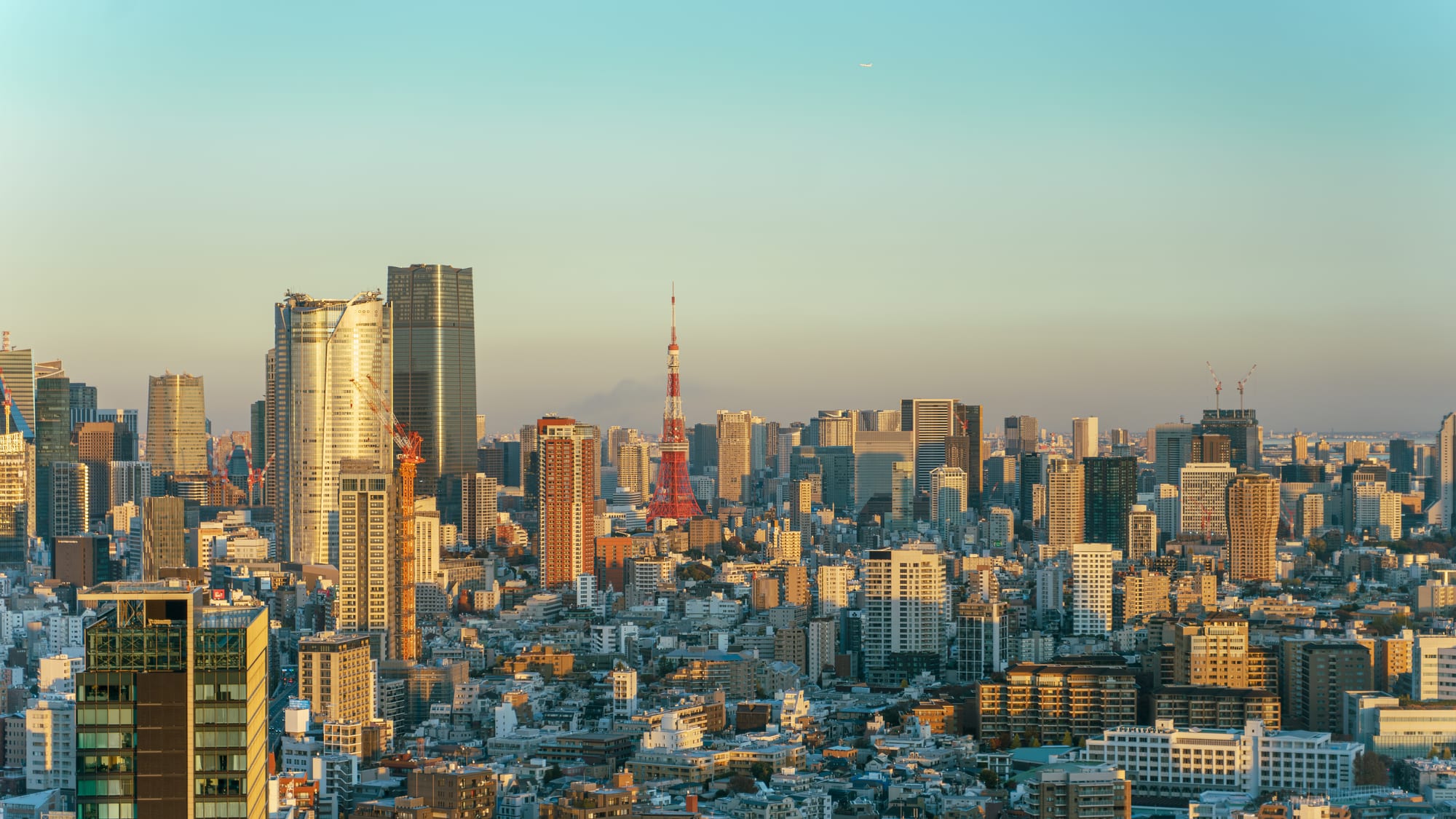
Dense city skyline at golden hour with skyscrapers and the red-and-white lattice of Tokyo Tower in the centre

Japan

Tokyo & Kanto

The skyline of Minato ward in central Tokyo at sunset, with Tokyo Tower rising among the high-rises. (David Kernan / Wikimedia Commons · CC BY 4.0)

The broad Kanto plain around Tokyo Bay and the mountains that ring it, spread across seven prefectures and home to about a third of Japan's people — the seat of the shoguns at Kamakura and Edo, the capital since 1868, and a region of shrines, hot springs and coast within reach of the city.

Explore Tokyo & Kanto

History

The Kanto plain has been settled since the Jomon era, whose shell mounds dot the old shores of Tokyo Bay, but it long lay far from the court at Nara and Kyoto. Its warriors made it the centre of power: in 1192 Minamoto no Yoritomo became shogun and ruled from Kamakura, where his regime and the Hojo regents lasted until 1333. In 1457 the warrior Ota Dokan built a castle at the fishing village of Edo.

In 1590 Tokugawa Ieyasu received the Kanto as his domain and made Edo his base; after he became shogun in 1603 it grew into one of the largest cities in the world, with around a million people by the 18th century. His grandson Iemitsu rebuilt the Toshogu at Nikko as Ieyasu's lavish mausoleum. In 1853 Commodore Perry's ships anchored off Uraga at the mouth of Edo Bay, and in 1859 Yokohama opened as a treaty port. In 1868 the emperor moved to Edo, which was renamed Tokyo, and in 1872 Japan's first railway linked the capital with Yokohama.

The 20th century twice levelled the city: the Great Kanto earthquake of 1923 and the fires that followed killed more than 100,000 people, and American firebombing in March 1945 killed about as many again in a single night. Tokyo rebuilt to host the 1964 Olympics, opening the first Shinkansen that year, and the metropolis spread across the plain in the decades of growth that followed. It hosted the Olympics again in 2021, a year late because of the pandemic.

Culture & Customs

Old Tokyo divides into the shitamachi, the low-lying eastern districts of merchants and craftsmen around Asakusa and Ueno, and the yamanote, the western hills once occupied by samurai estates. A true Edokko, a child of Edo, is said to be quick-tongued, generous and impatient, and the standard Japanese taught across the country grew from the speech of the capital.

The festival calendar is full. Asakusa's Sanja Matsuri in May sends portable shrines through the streets on the shoulders of shouting bearers, the Kanda Matsuri takes place in odd-numbered years, and summer brings fireworks on the Sumida River. Kawagoe's autumn festival parades tall carved floats, and Chichibu's night festival in December is famous for its lantern-lit wagons. Sumo tournaments are held three times a year at the Kokugikan in Ryogoku, and kabuki is staged at the Kabukiza in Ginza.

Contemporary culture draws as many visitors: the electronics and anime shops of Akihabara, the fashion of Harajuku and Shibuya, and the performance and nightlife districts of Shinjuku and Shimokitazawa. Outside the city, older crafts continue — Mashiko pottery in Tochigi, Yuki-tsumugi silk on the Ibaraki–Tochigi border and the round red daruma dolls of Takasaki in Gunma.

Daily Life

About 43 million people live in the seven Kanto prefectures. Tokyo itself has about 14 million, and around it lie Yokohama, with about 3.7 million, Kawasaki, Saitama and Chiba, all cities of a million or close to it. Together they form a single built-up region that commuters cross daily on some of the busiest trains in the world.

Tokyo is the national centre of government, finance, media and corporate headquarters. The bay is lined with ports, refineries and factories from Kawasaki to Chiba, and further out, Ibaraki hosts the research city of Tsukuba, Gunma and Tochigi build cars and machinery, and the plain grows vegetables for the capital.

Life is shaped by the commute: an hour or more each way is normal, and trains run to the minute from early morning until after midnight. Housing costs push families to the suburbs, the population is ageing even here, and Tokyo remains one of the few places in Japan still gaining residents. Preparing for a major earthquake is a constant background concern, with drills in schools and offices.

Food

Tokyo gave Japan several of its classic dishes. Nigiri sushi began as fast food in Edo, made with fish from the bay and known as Edomae, "in front of Edo"; tempura, soba and grilled eel, unagi, were also popular street and stall food in the shogun's city. Monjayaki, a runny batter of cabbage and seafood cooked on a griddle, is the speciality of Tsukishima, and chanko nabe, the hearty hotpot of sumo wrestlers, is served in Ryogoku. Tsukiji's outer market keeps its food stalls, while the wholesale fish market moved to Toyosu in 2018.

Yokohama has Japan's largest Chinatown and its own iekei ramen, a rich pork and soy broth with thick noodles. Utsunomiya in Tochigi is known across Japan for gyoza dumplings, Nikko for yuba, the skin that forms on heated soy milk, and Mito in Ibaraki for natto, fermented soybeans. Kamakura serves shirasu, tiny whitebait, on rice, and at Owakudani in Hakone eggs boiled in the sulphur springs turn black.

Chiba is a centre of soy sauce making, with large breweries at Noda and Choshi, and a major grower of peanuts. Kawagoe is famous for sweet potatoes, sold baked and as sweets along its old candy alley, and Gunma produces most of Japan's konnyaku, a firm jelly made from a root vegetable.

Attractions & Natural Wonders

Tokyo deserves days: Senso-ji and the old streets of Asakusa, the museums of Ueno Park, the Imperial Palace East Gardens, the Meiji Shrine, the crossing at Shibuya, the skyscrapers of Shinjuku with free views from the city government building, and Tokyo Skytree. Far out to sea, the Ogasawara Islands, a UNESCO World Heritage Site, also belong to Tokyo. Yokohama, south along the bay, has the Minato Mirai waterfront, Chinatown, the Cup Noodles Museum and the traditional garden of Sankeien.

Kamakura, an hour south, has the bronze Great Buddha of Kotoku-in, the shrine of Tsurugaoka Hachimangu, Hase-dera and Zen temples in its wooded valleys, with the island of Enoshima a short ride along the coast. Hakone, to the west, lies in the Fuji-Hakone-Izu National Park, whose Izu peninsula section belongs to neighbouring Shizuoka; its loop runs by mountain railway, cable car and ropeway past the Hakone Open-Air Museum and the sulphur vents of Owakudani to Lake Ashi.

North of Tokyo, Nikko's shrines and temples — the carved Yomeimon gate of the Toshogu, Rinno-ji and Futarasan — stand in cedar forest near the red Shinkyo bridge, and above them lie Lake Chuzenji and the Kegon Falls. Kawagoe, closer in, keeps its warehouse street and wooden bell tower. Gunma has the hot-spring town of Kusatsu and the Tomioka Silk Mill, a UNESCO World Heritage Site, and Ibaraki the plum garden of Kairakuen in Mito.

Chiba's coast wraps around the Boso peninsula: the long surfing beach of Kujukurihama, the rocky Pacific shore around Kamogawa, and Mount Nokogiri, with a large rock-carved Buddha at Nihon-ji, looking across the bay towards Kanagawa.

Cities in Tokyo & Kanto

Planning basics

Budget

Central Tokyo sets the price level for Japan, with the highest hotel rates, especially in spring and autumn, but it also has the widest choice of cheap food, from standing soba bars to convenience stores. Beyond the city, Hakone's ryokan and Nikko's lodges are the main expense, while Kawagoe, Kamakura and the Chiba coast are easy, inexpensive day trips.

Daily Budget Midrange
USD 130–250 (city hotel, restaurants, museum entry, a night in a Hakone or Nikko inn)
Daily Budget Shoestring
USD 55–90 (hostel or capsule hotel, noodles and konbini meals, metro and suburban trains)

Stay near a major line such as the JR Yamanote rather than in the centre itself, and look at the private railways' discount passes for Hakone and Nikko.

Safety

Tokyo and its region are very safe, even late at night. The main risks are earthquakes, which the capital prepares for constantly, summer heatstroke, overcrowding at stations and festivals, and touts steering visitors to bars in Shinjuku's Kabukicho and in Roppongi. Hakone's volcanic areas are occasionally closed when activity rises.

Know the nearest evacuation area of the hotel, drink water in summer, and follow closure notices at Owakudani. Check current official travel advice before travelling.

Climate

The plain has hot, humid summers and cool, dry, sunny winters with little snow. The inland cities of Saitama, Gunma and Tochigi are hotter still in summer — Kumagaya recorded 41.1°C in 2018 — and prone to afternoon thunderstorms, while the mountains of northern Gunma and Tochigi get heavy winter snow. Nikko and Hakone are several degrees cooler than Tokyo.

Summer
hot and humid, 30–35°C on the plain, hotter inland; cooler at Nikko and Hakone
Winter
dry and sunny, 2–10°C in Tokyo; snow in the northern mountains and at Nikko's higher lakes

Transportation

Tokyo has two airports — Narita, about an hour from the centre by express train, and Haneda, much closer — and a dense web of JR, subway and private lines. Kamakura and Yokohama are under an hour by JR from Tokyo station; private railways run from Asakusa to Nikko in about two hours, from Ikebukuro to Kawagoe in about 30–40 minutes, and from Shinjuku to Hakone in under two. Shinkansen lines fan out north and west from Tokyo and Ueno.

Avoid the morning rush between about 7:30 and 9:30 with luggage, and use an IC card on every railway company's lines.

Best Time to Visit

Late March to early April brings cherry blossom along Tokyo's rivers and parks, and May is warm and fresh. Nikko's autumn colour peaks from early October at the lakes to early November at the shrines, with Tokyo's ginkgo avenues turning gold in late November. Summer is hot and humid but full of festivals and fireworks; winter has the clearest views of distant Mount Fuji.