Small rocky islets topped with pine trees scattered across a calm blue bay under a cloudy evening sky

Japan

Tohoku

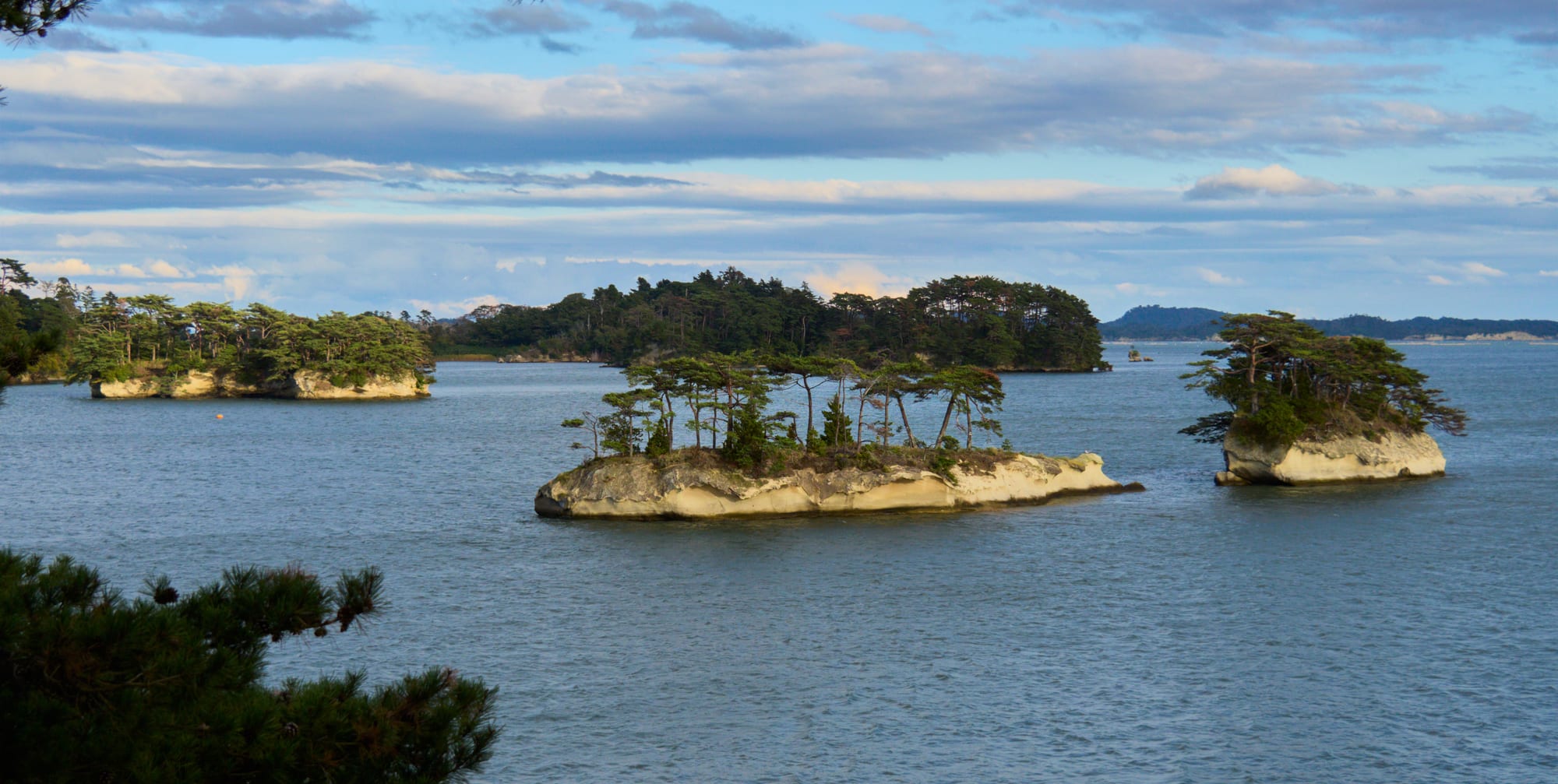
Pine-covered islets in Matsushima Bay, north-east of Sendai in Miyagi prefecture. (lumoplank / Wikimedia Commons · CC0)

The six prefectures of northern Honshu, a mountainous, snowy and thinly populated region of rice fields, castle towns and hot springs — once the frontier of the Japanese state, later the realm of the Date and Tsugaru lords, and in 2011 the coast struck by the great earthquake and tsunami.

Explore Tohoku

History

Tohoku was long the frontier. In the 8th and 9th centuries the court at Nara and then Kyoto sent armies north against the Emishi, peoples who resisted its rule, and campaigns under Sakanoue no Tamuramaro around 800 pushed the border northwards from the fortress of Taga near today's Sendai. In the 11th and 12th centuries the Northern Fujiwara ruled the north from Hiraizumi, growing rich on gold and horses and building Buddhist temples to rival Kyoto's, until Minamoto no Yoritomo destroyed them in 1189.

Under the Tokugawa the region was divided among powerful lords: the Date at Sendai, whose founder Date Masamune built the castle town from 1600 and sent an embassy to Rome, the Tsugaru at Hirosaki, the Nanbu at Morioka, the Satake in Akita, and the Matsudaira of Aizu. In 1689 the poet Basho walked through Tohoku on the journey he recorded in Oku no Hosomichi, "The Narrow Road to the Deep North".

In the Boshin War of 1868 most northern domains joined an alliance against the new Meiji government. Aizu fell after a month-long siege, and the region was later seen as a poor hinterland supplying rice, soldiers and labour to Tokyo. On 11 March 2011 a magnitude 9.0 earthquake off the coast sent a tsunami into the Sanriku coast and the Sendai plain, leaving more than 22,000 dead or missing and triggering the meltdowns at the Fukushima Daiichi nuclear plant. Rebuilding, with new sea walls and raised towns, has taken more than a decade.

Culture & Customs

Tohoku has a reputation within Japan for reserved, hard-working, patient people shaped by long winters and poor harvests. The Tohoku dialects are among the hardest for other Japanese to follow, and the Tsugaru speech of western Aomori is famously dense. The region's folk music includes the fast, percussive Tsugaru-jamisen, a style of shamisen playing born here.

Summer festivals are its great public events. Aomori's Nebuta Matsuri in early August parades giant illuminated paper figures of warriors and gods, Akita's Kanto Matsuri balances tall bamboo poles hung with dozens of lanterns on performers' hands, foreheads and hips, Sendai's Tanabata, the largest in Japan, hangs intricate paper decorations, and Yamagata's Hanagasa dancers carry flowered straw hats. On the Oga peninsula, men dressed as the Namahage — ogre-like visitors in straw capes — go from house to house on New Year's Eve warning children to behave, a custom listed as UNESCO intangible heritage.

Crafts are strong: kokeshi, the limbless painted wooden dolls of the hot-spring villages; Nanbu cast-iron kettles from Morioka; Aizu lacquerware; and the cherry-bark work of Kakunodate. In Yokote, children build kamakura snow huts in February, with an altar to the water god inside, and grill rice cakes in them.

Daily Life

About 8.5 million people live in Tohoku, and the population is falling. Sendai, with about 1.1 million, is the only large city — a university and commercial centre of tree-lined avenues rebuilt after wartime bombing. Koriyama and Iwaki in Fukushima, Akita, Morioka, Aomori and Yamagata are the prefectural and regional centres, each of roughly 200,000 to 350,000 people.

Farming defines the landscape: Tohoku is one of Japan's main rice bowls, and Aomori grows more apples than any other prefecture, while Yamagata is known for cherries and Fukushima for peaches. Fishing and oyster and seaweed farming sustain the Sanriku coast.

The pressures are depopulation and ageing, as young people leave for Sendai and Tokyo, and the long aftermath of 2011. Along the coast, towns have been rebuilt on higher ground behind new sea walls, while parts of Fukushima prefecture near the nuclear plant have reopened only gradually and have far fewer residents than before. Winter snow-clearing is a daily routine across the Sea of Japan side.

Food

Sendai's signature dish is gyutan, thick slices of grilled beef tongue served with barley rice and oxtail soup, and its sweet is zunda mochi, rice cakes coated in a bright green paste of mashed edamame. Akita has kiritanpo, pounded rice shaped around cedar sticks and toasted, then simmered in a chicken hotpot, along with thin, silky Inaniwa udon and iburi-gakko, smoked pickled daikon. Iwate is known for wanko soba, served in small bowls that are refilled until the diner stops them, and Morioka for chilled reimen noodles and jajamen.

In autumn Yamagata holds imoni gatherings on riverbanks, cooking a stew of taro, beef and leeks in the open air, and Yonezawa beef is one of Japan's prized wagyu brands. Kitakata in Fukushima has its own soy-based ramen with flat, wavy noodles, and Hachinohe makes senbei-jiru, a soup thickened with pieces of wheat cracker.

The coast supplies oysters from Matsushima and other seafood, and the tuna landed at Oma on the tip of the Shimokita peninsula are among the most expensive in Japan. Fruit is a point of pride — Aomori apples, Yamagata cherries, Fukushima peaches — and the region's cold winters and good rice make it one of Japan's leading sake areas, and Fukushima's breweries are among the most decorated in the country.

Attractions & Natural Wonders

Sendai is the gateway: the ornate Zuihoden mausoleum of Date Masamune, the site of Aoba Castle above the city and the zelkova-lined avenue of Jozenji-dori. Matsushima Bay, half an hour away, is scattered with pine-covered islets best seen by boat or from the hills around it, with the Zen temple of Zuiganji and the little Godaido hall on the shore. Inland in Iwate, Hiraizumi, a UNESCO World Heritage Site, keeps the temple of Chuson-ji and the gold-leaf Konjikido hall of the Northern Fujiwara.

In Akita, the samurai town of Kakunodate keeps its broad street of wooden residences and weeping cherries, and nearby Lake Tazawa is the deepest lake in Japan, with the old bathhouses of Nyuto Onsen in the hills above. Hirosaki Castle in Aomori is one of Japan's few surviving original keeps, ringed by moats and cherry trees; to its south-west lie the beech forests of Shirakami-Sanchi, a UNESCO World Heritage Site, and to its east Lake Towada and the Oirase stream, at their best in autumn.

Yamagata holds Yamadera, the cliffside temple of Risshakuji, and Ginzan Onsen, the lamp-lit hot spring village of wooden inns near Obanazawa, as well as the three sacred mountains of Dewa Sanzan and the ski slopes of Zao, where winter winds coat the fir trees in ice. In Fukushima, Aizu-Wakamatsu's Tsuruga Castle and the thatched post town of Ouchi-juku recall the Edo-era road north.

Cities in Tohoku

Planning basics

Budget

Tohoku is one of the cheapest parts of Japan to travel in. Business hotels and family-run onsen inns cost noticeably less than in Tokyo or Kyoto, and set meals are generous. The costs are transport — Shinkansen fares from Tokyo and the need for a car to reach mountain onsen and the coast — and the sought-after old inns of Ginzan and Nyuto, which book out early.

Daily Budget Midrange
USD 100–190 (onsen inn with dinner, Shinkansen legs, a hire car for the countryside)
Daily Budget Shoestring
USD 45–75 (business hotel or guesthouse, noodles and set lunches, local trains and buses)

Check the JR East regional passes, which can cover the Shinkansen across Tohoku for several days, and book onsen inns with dinner included.

Safety

Crime is very low. The hazards are natural: earthquakes and tsunami on the Pacific coast, heavy snow and whiteouts on mountain roads, and bears in the forests. Around the Fukushima Daiichi plant a small area remains closed; the towns and sights commonly visited in Fukushima prefecture are open and monitored.

Note tsunami evacuation signs on the coast, carry a bear bell on forest trails, and respect all signed restricted zones. Check current official travel advice before travelling.

Climate

Colder than central Japan, with a sharp divide down the spine of mountains. The Sea of Japan side — Akita, Yamagata and western Aomori — and the inland basins get some of the heaviest snowfall in Japan, while the Pacific side around Sendai is drier and sunnier in winter. Summers are warm and humid in the basins, and the rainy season is shorter and milder in the far north.

Summer
warm to hot, 25–32°C, with the inland basins of Yamagata and Fukushima the hottest
Winter
cold, about -5 to 5°C; deep snow on the Sea of Japan side and in the mountains, lighter around Sendai

Transportation

The Tohoku Shinkansen runs from Tokyo to Sendai and on to Shin-Aomori, which the fastest trains reach in about three hours, with branch lines to Akita and Yamagata. Local lines and buses reach the smaller towns, but services are infrequent, and the Sanriku coast, the mountain onsen and Lake Towada are much easier by car. Sendai has an airport with domestic and some international flights.

Build connections around the sparse local timetables, and plan winter driving only with snow tyres and experience of icy roads.

Best Time to Visit

Cherry blossom arrives in mid to late April, later than in Tokyo, and is the high point at Hirosaki and Kakunodate. Early August brings the great summer festivals of Aomori, Akita and Sendai, when hotels fill months ahead. October to early November is the season for autumn colour in the mountains, and January and February suit snow scenes at Ginzan and the frosted trees of Zao.