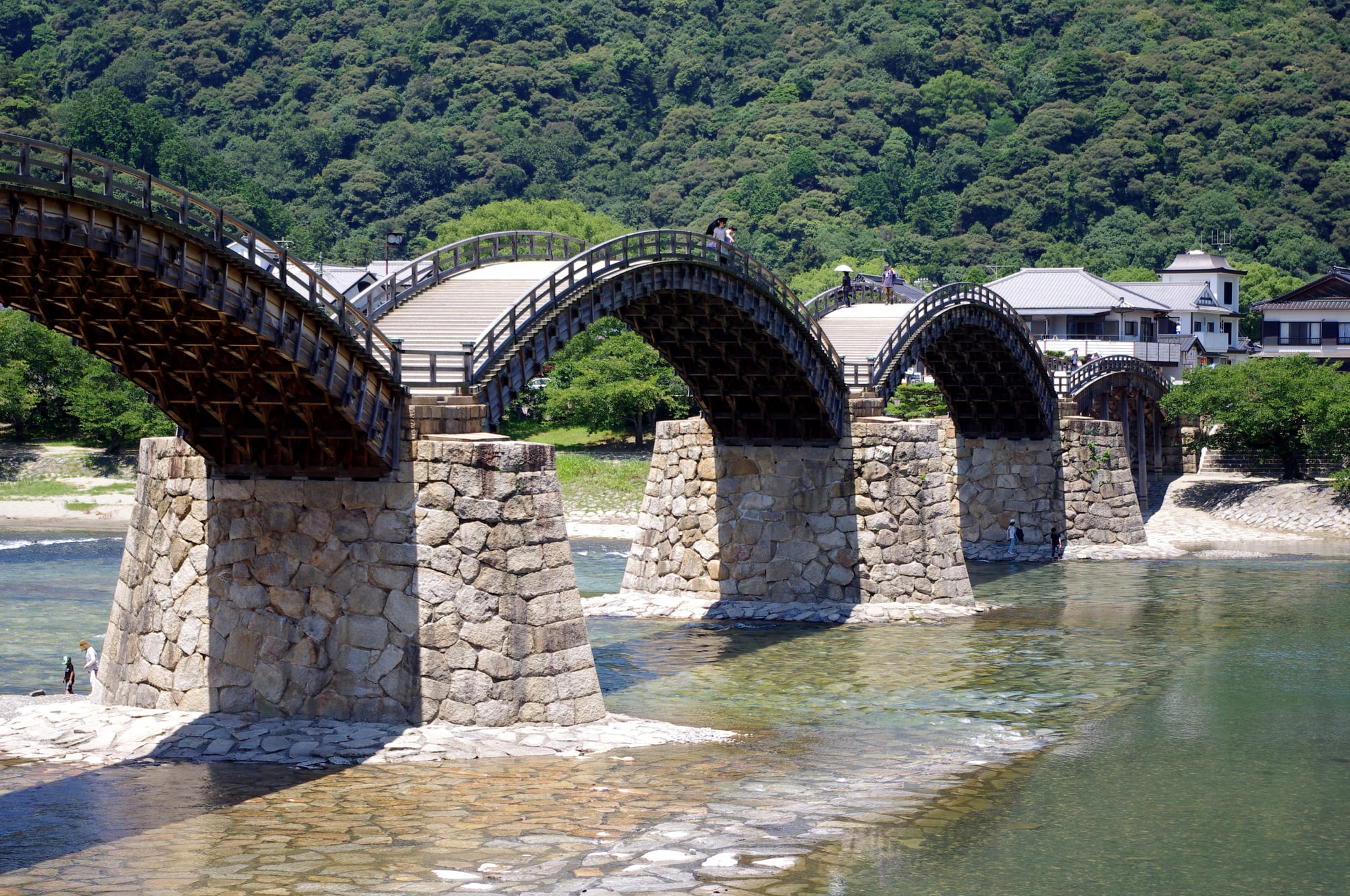
A wooden bridge of steep arches resting on stone piers across a clear, shallow river below wooded hills

Japan

Chugoku: Hiroshima & the San'in Coast

The arched wooden Kintai Bridge over the Nishiki River in Iwakuni, Yamaguchi Prefecture. (Jakub Hałun / Wikimedia Commons · CC BY-SA 4.0)

The western tip of Honshu, split by a spine of mountains into the sunny, industrial Inland Sea shore of Hiroshima and Okayama and the quiet, rural San'in coast of Tottori and Shimane — a region of the atomic-bomb memorial, Miyajima's shrine, ancient myth at Izumo and the old silver mine of Iwami.

Explore Chugoku: Hiroshima & the San'in Coast

History

Chugoku's oldest stories belong to Izumo, in today's Shimane. The 8th-century chronicles Kojiki and Nihon Shoki place a large share of their myths there, including the storm god Susanoo slaying an eight-headed serpent, and Izumo Taisha is counted among the country's oldest shrines. On the Inland Sea side, the ancient kingdom of Kibi around Okayama left huge burial mounds, and the sea itself was Japan's main trade highway to Kyushu and the continent.

The Taira clan built Itsukushima Shrine on Miyajima into its present form in the 12th century, and the clan's fleet was destroyed at Dan-no-ura, off Shimonoseki, in 1185. From the 16th century the Iwami silver mine in Shimane was one of the world's major silver sources. The Mori clan ruled most of the region from Hiroshima until defeat at Sekigahara in 1600, when they were pushed back to Hagi; their Choshu domain, in today's Yamaguchi, then became the powerhouse, with Satsuma, of the movement that overthrew the shogunate in 1868. Several early Meiji leaders and many later prime ministers came from Yamaguchi.

Modern Hiroshima grew as a military city, and on 6 August 1945 it became the first city destroyed by an atomic bomb, which killed tens of thousands instantly and many more by the end of the year. Rebuilt as a "city of peace", it is now the region's largest city, while the San'in coast has lost people steadily to the south and to the big cities.

Culture & Customs

The mountains divide the region in character as well as climate. The Sanyo side, along the Inland Sea, is urban, industrial and outward-looking; the San'in side is rural, conservative and proud of its myths. In Shimane the tenth lunar month, known elsewhere as the "month without gods", is called the "month with gods", because the gods are believed to gather at Izumo Taisha, and couples visit the shrine to pray for good matches. Matsue, where the writer Lafcadio Hearn lived and married, still trades on his ghost stories.

Hiroshima's identity is bound up with memory and baseball. The peace ceremony each 6 August, with lanterns floated on the river that evening, draws the world's attention, while the Hiroshima Toyo Carp inspire a fierce local loyalty. Okayama claims the folk hero Momotaro, the Peach Boy, whose statue greets arrivals at the station.

Crafts include Bizen ware, unglazed stoneware fired in wood kilns near Okayama for centuries, and the rice-paddle making and wood carving of Miyajima. Kagura, masked sacred dance, thrives in the Iwami area of Shimane and in northern Hiroshima, where local troupes perform it at shrine festivals with elaborate costumes and fast drumming. Local speech varies widely, and the Izumo dialect stands apart from the rest of the region's speech.

Daily Life

About seven million people live in Chugoku, heavily weighted towards the Inland Sea. Hiroshima has about 1.2 million people and Okayama about 700,000, with Kurashiki, Fukuyama and Shimonoseki the other large towns. Tottori and Shimane are the two least populous prefectures in Japan; their capitals, Tottori and Matsue, each have about 200,000 people.

The Sanyo coast is a manufacturing belt: Mazda is headquartered in the Hiroshima area, Kurashiki's Mizushima district has steelworks and refineries, Kure has shipyards and a naval base, and Kojima in Kurashiki is Japan's denim capital. San'in lives on farming, fishing, public-sector work and tourism, and in its villages the ageing and emptying of the countryside is starkly visible, with closed schools and empty houses. Hiroshima's recovery from heavy-rain disasters and the future of the Inland Sea islands' shrinking communities are live local issues.

Daily routines are unhurried outside Hiroshima's centre: commuters on the city's trams, market-town shops closing early, and evenings built around okonomiyaki counters and local izakaya.

Food

Hiroshima's okonomiyaki is layered rather than mixed: batter, a heap of cabbage, pork and yakisoba noodles are built up on the griddle and topped with a fried egg, a rival to the Osaka style. Hiroshima produces half or more of Japan's farmed oysters, eaten grilled, fried or in hot pots, and Miyajima sells momiji manju, maple-leaf-shaped cakes filled with sweet bean paste.

Okayama is fruit country, known for white peaches and Muscat grapes, and its kibi dango, soft rice-cake sweets, are tied to the Momotaro legend. Shimonoseki is Japan's fugu capital, serving the poisonous pufferfish by licensed chefs as paper-thin sashimi. On the San'in coast winter brings matsuba-gani, snow crab landed in Tottori; Tottori's nijisseiki pears are crisp and pale green; and Shimane's Lake Shinji yields shijimi clams for miso soup. Izumo soba is dark buckwheat noodles served in stacked round lacquer bowls.

Sake is brewed across the region, especially in Saijo, east of Hiroshima, where a cluster of breweries stands along one street, and in Yamaguchi, home of the widely exported Dassai.

Attractions & Natural Wonders

Hiroshima's Peace Memorial Park — the skeletal Atomic Bomb Dome, the cenotaph and the Peace Memorial Museum — is a sober first stop. Across the bay, Miyajima holds Itsukushima Shrine on stilts over the water and its great torii, both part of a UNESCO World Heritage Site, with deer in the streets and a ropeway up Mount Misen. The historic port of Tomonoura, Onomichi's hillside temples and the naval port of Kure lie along the same coast.

Okayama has Korakuen, one of Japan's celebrated landscape gardens, beside the black Okayama Castle, and nearby Kurashiki's Bikan quarter keeps white-walled warehouses along its willow-lined canal and the Ohara Museum of Art, Japan's first museum of Western art. In Yamaguchi, the five-arched Kintaikyo bridge spans the river at Iwakuni, Hagi keeps its castle-town lanes, Akiyoshidai is a grassy karst plateau above a huge limestone cave, and the Tsunoshima Bridge runs across turquoise water to an island.

On the San'in coast, the Tottori Sand Dunes rise high above the Sea of Japan, and Mount Daisen is the region's highest peak. Shimane has Izumo Taisha with its enormous straw rope, Matsue's original castle and Lake Shinji sunsets, the Adachi Museum of Art with its manicured gardens, and the Iwami Ginzan silver mine, where a tunnel and the old town of Omori can be walked.

Cities in Chugoku: Hiroshima & the San'in Coast

Planning basics

Budget

Chugoku is noticeably cheaper than Kansai or Tokyo. Hiroshima and Okayama have plenty of business hotels at reasonable prices, and the San'in towns of Matsue, Tottori and Izumo cost less again. A night in a ryokan on Miyajima is the main splurge, and the costs that add up are limited-express fares across the mountains to the San'in coast and a hire car for the countryside.

Daily Budget Midrange
USD 100–190 (business hotel or ryokan, restaurant dinners, Shinkansen and limited-express travel)
Daily Budget Shoestring
USD 45–70 (hostel or budget business hotel, okonomiyaki and noodle lunches, local trains)

Look at the JR West regional passes, which can undercut separate tickets for a Hiroshima–Okayama–San'in loop.

Safety

Chugoku is very safe. The main hazards are natural: heavy rain has caused deadly landslides around Hiroshima in recent years, typhoons reach the Inland Sea in late summer, and snow disrupts roads on the San'in side in winter. The Tottori dunes are hot and exposed in summer.

Take heavy-rain warnings seriously in the rainy season, carry water on the dunes, and allow for winter delays in San'in. Check current official travel advice before travelling.

Climate

The Inland Sea side — Okayama, Hiroshima and southern Yamaguchi — has a mild, relatively dry and sunny climate, sheltered by mountains to both north and south; Okayama calls itself the "land of sunshine". The San'in side facing the Sea of Japan is greyer and wetter, with snowy winters, heavy snow on Mount Daisen and the inland highlands, and more cloud all year.

Summer
hot and humid, 30–35°C on the Inland Sea; slightly cooler on the San'in coast
Winter
cool and dry on the Inland Sea, 2–10°C; cold, grey and snowy along the San'in coast and in the mountains

Transportation

The Sanyo Shinkansen runs along the Inland Sea through Okayama, Hiroshima and Shin-Yamaguchi to Shimonoseki, putting Hiroshima under two hours from Osaka. Crossing to the San'in coast is slower: limited expresses cut through the mountains from Okayama to Matsue and Izumo and to Tottori in roughly two to three hours. Miyajima is a short ferry ride from Miyajimaguchi. Buses and a hire car are useful for Iwami Ginzan, Akiyoshidai and the Yamaguchi coast.

Hiroshima's trams reach the Peace Park; rural San'in trains are infrequent, so check connections before setting out.

Best Time to Visit

Spring (late March to May) and autumn (October to November) are the best seasons, with cherry blossom at Okayama's Korakuen and autumn maples on Miyajima. Summer is hot but good for the Tottori coast and the Inland Sea islands; 6 August is Hiroshima's memorial day. Winter suits crab season and hot springs on the San'in coast.