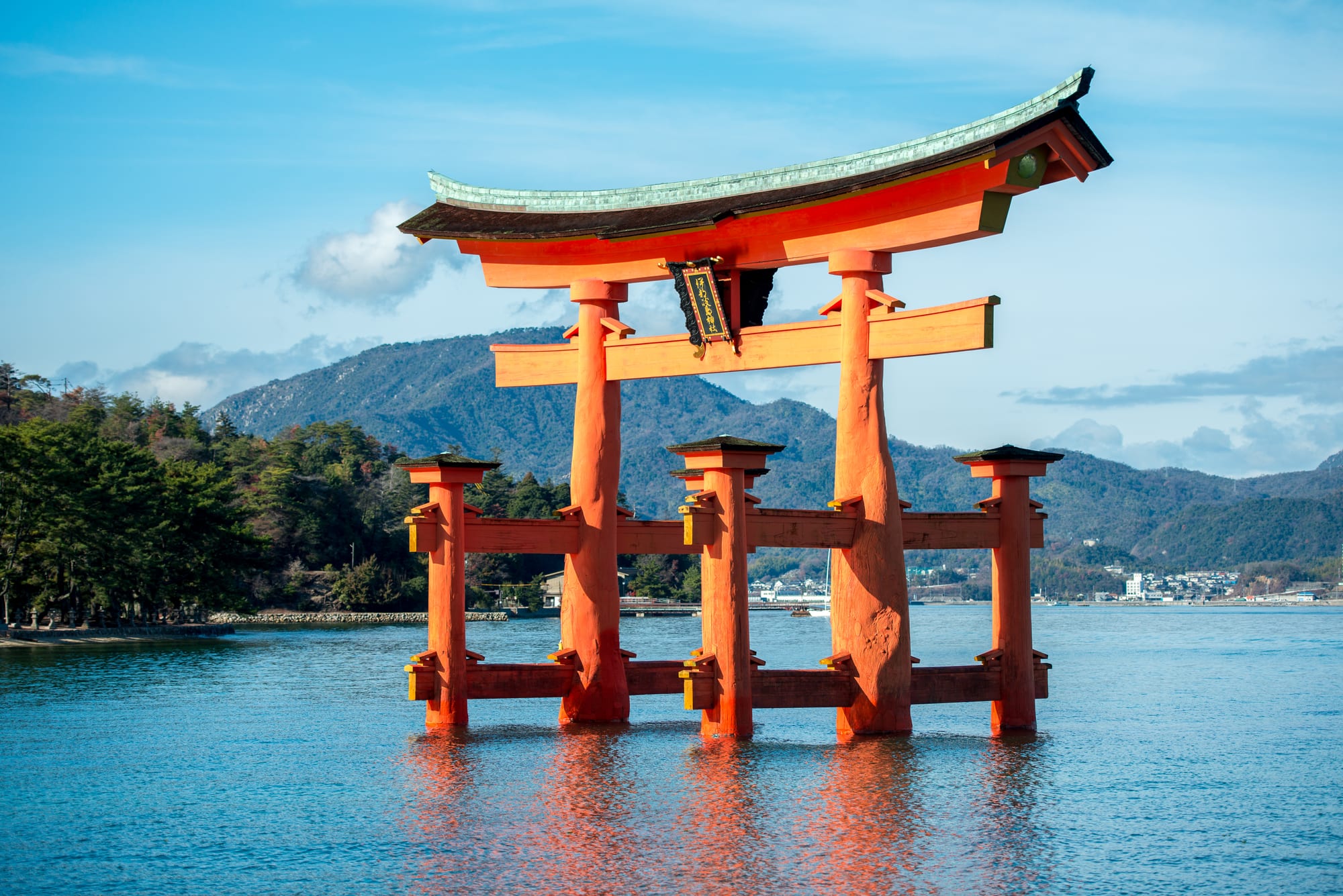
A large vermilion torii gate with a curved roof standing in shallow blue-green sea, with wooded hills and a distant shoreline behind it

Chugoku: Hiroshima & the San'in Coast, Japan

Miyajima

The great torii of Itsukushima Shrine standing in the water off Miyajima. (JordyMeow / Wikimedia Commons · CC BY-SA 3.0)

A small, steep, forested island in the Seto Inland Sea south-west of Hiroshima, officially called Itsukushima and part of the city of Hatsukaichi. Held sacred for centuries, it is known for the stilted halls of Itsukushima Shrine and the great torii standing in the shallows, for wild deer in its lanes and for the wooded summit of Mount Misen above.

Neighbourhoods

  • The shrine village and Omotesando
    • First-time visitors
    • Best for food
    • Shopping

    The flat strip between the ferry pier and the shrine, where almost everything on the island is concentrated. A covered arcade of shops selling grilled oysters, rice scoops and maple-leaf cakes runs parallel to the shore, and most inns and restaurants are within a few minutes' walk.

    Open in Maps
  • Machiya-dori and the back lanes
    • Quiet and residential
    • Historic district

    The older street one block inland from the arcade, lined with wooden merchant houses, small workshops and guest houses. It is where islanders live and where the crowds thin once the day boats have gone.

    Open in Maps
  • Mount Misen and the forest
    • Walks and viewpoints
    • Nature

    The island's wooded interior rises sharply behind the village to a summit of about 535 metres, reached by walking trails or by a ropeway from the Momijidani valley. Primeval forest, temple halls and boulder-strewn lookouts fill the slopes.

    Open in Maps
  • Tsutsumigaura and the eastern shore
    • Beaches
    • Quiet and residential

    A stretch of coast a few kilometres round from the village, with a beach and woodland behind it. It is a calm counterpoint to the shrine approach and is reached by road or coastal path.

    Open in Maps

Things to do

Shrines and temples

  • Itsukushima Shrinelandmark

    The shrine of stilted halls and covered walkways built over a tidal inlet, rebuilt in its present form under Taira no Kiyomori in the 12th century and listed as a UNESCO World Heritage Site.

    Open in Maps
  • Daisho-inlandmark

    A Shingon Buddhist temple on the slope below Mount Misen, with a stairway lined by spinning sutra wheels, ranks of small stone statues and a cave of lanterns.

    Open in Maps
  • Senjokakulandmark

    A vast unfinished wooden hall begun in the late 16th century on the hill above the shrine, open on all sides, standing beside a five-storeyed pagoda.

    Open in Maps

The mountain and the woods

  • Mount Misenviewpoint

    The island's highest point, with temple halls near the top, granite boulders to climb among and views across the Inland Sea and its islands.

    Open in Maps
  • Momijidani Parkpark

    A maple-filled valley behind the shrine at the foot of the mountain, crossed by a stream and bridges and at its most visited in November.

    Open in Maps
  • Miyajima Ropewayattraction

    A two-stage cable car climbing from Momijidani to a station below the summit, leaving about a 30-minute walk to the top.

    Open in Maps

The village

  • Miyajima Public Aquariumattraction

    A small aquarium west of the shrine focused on the sea life of the Seto Inland Sea.

    Open in Maps
  • Omotesando arcademarket

    The island's main shopping street, with oyster grills, sweet stalls, woodcarvers and a very large wooden rice scoop displayed along it.

    Open in Maps

Short trips from the island

  • Hiroshimaattraction

    The regional capital, reached by ferry across the bay or by train and tram from the mainland pier, with the Peace Memorial Park at its centre.

    Open in Maps
  • Kintai Bridgelandmark

    A five-arched wooden bridge over the Nishiki River at Iwakuni, west along the coast in Yamaguchi Prefecture.

    Open in Maps

Seasonal events

  • Kangensaisummer, on a lunar-calendar date that usually falls between late July and early August

    The shrine's best-known festival, in which decorated boats carry musicians playing court music across the water after dark.

  • Autumn maples in MomijidaniNovember

    The valley behind the shrine turns deep red and gold, drawing the year's heaviest day-trip crowds along with clear, cool weather.

  • New Year at the shrinelate December and early January

    Islanders and visitors come for the first shrine visit of the year, and a fire rite is held to mark the turn of the year.

  • Oyster seasonlate autumn to early spring

    The rafts in the surrounding bay are harvested through the colder months, when grills along the shopping street work all day.

Eat and drink

Long-standing places and food districts in Miyajima. Hours, ratings and directions come from your maps app, always current.

Miyajima classics

  • Anago-meshirestaurant

    Grilled saltwater conger eel, glazed and laid over rice cooked in its stock — the island's signature meal, sold in restaurants near the pier and as a boxed lunch.

    Open in Maps
  • Grilled oysters on Omotesandomarket

    Oysters farmed in the surrounding bay are opened and grilled in the shell at stalls along the shopping street, served with lemon or ponzu.

    Open in Maps
  • Momiji manjumarket

    Maple-leaf-shaped cakes filled with sweet bean paste, custard or chocolate, a speciality of the island and baked in view on the arcade; a deep-fried version is sold warm.

    Open in Maps

Streets to eat in

  • Omotesando and Machiya-dorineighborhood

    The two parallel village streets hold most of the island's kitchens, from noodle counters and oyster grills to guest houses serving Inland Sea fish; many close in the evening once the day visitors leave.

    Open in Maps

Experience Miyajima

History

The island has been treated as a god's dwelling for as long as records exist, and the shrine's own tradition dates its founding to 593. Because the whole island was sacred, ordinary people were long discouraged from living on it, and the halls of Itsukushima Shrine were built out over the water on piles so that worshippers approached without setting foot on holy ground. Its present layout dates from 1168, when Taira no Kiyomori, the most powerful man in Japan, rebuilt the shrine on a grand scale in the aristocratic style of the Heian court and made it his clan's tutelary place of worship.

The Taira were destroyed in 1185, but the shrine kept its prestige under later warrior houses. In 1555 the island was the site of the battle of Miyajima, in which Mori Motonari surprised and defeated a much larger force under Sue Harukata; the Mori then became the dominant power in western Japan and rebuilt parts of the shrine. Toyotomi Hideyoshi ordered the huge open hall now called Senjokaku in the late 16th century, and work stopped, unfinished, when he died in 1598.

A merchants' and pilgrims' village grew along the shore in the Edo period, trading on visitors to the shrine, and its craftsmen developed the wooden rice scoop that is still the island's souvenir. The current great torii dates from 1875. Itsukushima Shrine and its surrounding forest were inscribed as a UNESCO World Heritage Site, and in 2005 the town of Miyajima was merged into the mainland city of Hatsukaichi.

Culture & Customs

Shinto and Buddhism sit side by side here. The shrine's calendar of rites runs through the year, from the boat festival of Kangensai, when court music is played from vessels moving across the bay at night, to fire rites and archery ceremonies in winter. A Noh stage stands over the water within the shrine precinct, and performances are given on it at festival times. On Mount Misen, Daisho-in and its associated halls belong to the Shingon school. A flame said to have been lit there by the monk Kukai, and used to light the peace flame in Hiroshima, burned in the temple's Reikado Hall until the hall was destroyed by fire in May 2026; the temple says the flame itself was saved and the hall will be rebuilt.

The deer that wander the village are sika deer, traditionally regarded as messengers of the gods and left unharmed. Feeding them has been prohibited for years as the population grew too dependent on visitors, and residents keep paper and food out of their reach.

Crafts are the other strand. Miyajima woodwork is known for rice scoops, long made on the island, and for turned bowls and trays, and an outsized scoop is displayed on the main shopping street. The island has also kept old taboos in living memory: burials were not held on the island, and in earlier centuries births were moved to the mainland so that the sacred ground would not be polluted.

Daily Life

About 2,000 people live on the island, and several thousand visitors can arrive on a single fine day. Almost the entire resident population lives in the village on the north-western shore; the rest of the island is forest, most of it protected, with no through roads. Administratively it is part of Hatsukaichi, and islanders cross to the mainland for schools beyond the early years, hospitals and large shops.

The economy is tourism, more or less entirely: inns, restaurants, souvenir shops, the ferries and the ropeway, supported by oyster farming in the bay and a little fishing. Work follows the boats, with the streets busy from mid-morning to late afternoon and much of the village closing soon after the day trippers leave — which is why staying overnight feels like a different place.

Pressures are those of a small, famous island: an ageing population, young people moving away, the cost of maintaining historic buildings against salt and typhoons, and the sheer weight of visitors. Deer management, waste and the risk of fire in the wooden village are recurring local concerns, as is the state of the forest on the slopes after heavy rain.

Food

Anago-meshi is the dish to know: saltwater conger eel, grilled over charcoal with a sweet-savoury glaze and laid in strips over rice cooked in eel stock. It is sold in restaurants on the island and as a boxed lunch at the mainland ferry station. Oysters are the other staple, farmed on rafts in the surrounding bay and eaten grilled in the half shell at stalls along the shopping street, deep-fried as kaki-furai, or served in rice and hotpots in winter.

Momiji manju, small cakes shaped like maple leaves, are a speciality of the island and are baked in front of customers by machines in the arcade. The traditional filling is sweet red bean paste, but custard, chocolate, cheese and matcha versions are common, and age-momiji, the cake battered and deep-fried on a stick, is eaten warm. Other snacks along the street include grilled squid, savoury rice crackers and soft-serve ice cream flavoured with local citrus.

Beyond the stalls, the village restaurants serve the fish of the Inland Sea — sea bream, small whitefish and octopus — often as simple set meals at lunch. Ryokan dinners are more elaborate, built around oysters and seasonal seafood. Sake from the Saijo breweries east of Hiroshima is widely poured, and tea houses along the approach to the shrine serve matcha with island sweets.

Planning tools

Budget

A day trip costs little beyond the ferry, shrine admission and lunch. Staying over is the expensive choice: the island has a small number of ryokan, several of which serve elaborate seafood dinners, and prices rise sharply in the autumn-colour weeks and at New Year. Mainland Hatsukaichi and Hiroshima are much cheaper for a bed.

Daily Budget Midrange
USD 110–220 (island guest house or ryokan with dinner, restaurant meals, shrine and ropeway fares)
Daily Budget Shoestring
USD 45–75 (a bed on the mainland, ferry fares, oyster stalls and noodle lunches, walking up the mountain)

Walking one direction on the mountain and riding the ropeway the other keeps costs and effort down.

Best Time to Visit

Spring, for cherry blossom in the village and on the lower slopes, and November, for the maples in Momijidani, are the most beautiful and the most crowded. Oysters are best from late autumn to early spring. Summer is hot and humid, though evenings on the water are pleasant. Tide tables matter: the torii stands in water at high tide and can be walked out to at low tide.

Suggested Number of Days

Many people come for half a day from the mainland. A full day allows a walk into the hills as well, and an overnight stay is the way to see the village quiet in the early morning and evening. Add a further day or two for the coast nearby.

First Visit
Half a day to 1 day
With Surroundings
2–3 days

Transportation

The island is small and has almost no public transport. Everything in the village is reached on foot, the ropeway serves the mountain, and a road runs round to the eastern beaches. Ferries from Miyajimaguchi on the mainland take about ten minutes and run frequently through the day; a passenger boat also runs from central Hiroshima in season. Cars are discouraged and unnecessary.

Check the last ferry time before an evening meal on the island, and keep to the marked mountain trails, which are steep and rooty in places.

Airport & Station Connections

Most visitors take a JR train or the Hiroden tram from Hiroshima to Miyajimaguchi, which takes roughly half an hour by train and about an hour and a quarter by tram, then the short ferry crossing. A direct boat also runs from the pier beside the Peace Memorial Park in Hiroshima. Hiroshima Airport is about 70 kilometres to the east.

Walkability

The village is entirely walkable and flat, with the shrine about ten minutes from the pier along the shore. Beyond it the ground rises steeply: the paths up Mount Misen climb several hundred metres and take a couple of hours, and the summit involves steps and boulders. Deer wander the lanes and will investigate bags and paper.

Safety

Miyajima is very safe, and crime against visitors is rare. The practical hazards are the mountain trails, which are steep and slippery after rain, heat and humidity in summer, and the tide, which covers the flats around the torii quickly. Heavy rain and typhoons can suspend the ferries, and the deer, though used to people, are wild animals.

Do not feed the deer, keep food and paper out of reach, start mountain walks early in summer and carry water. Check current official travel advice before travelling.

Climate

The mild, relatively dry Inland Sea climate, with a rainy season through June into July and a typhoon risk from August to October. Snow is light and unusual, and the sheltered bay keeps the water calm for most of the year.

Summer
hot and humid, generally 28–34°C by day, with warm nights and heavy rain in the rainy season
Winter
cool, 3–11°C, with clear days and occasional light snow on the summit

Local Customs

The whole island has long been treated as sacred, and the shrine expects quiet, modest behaviour: visitors bow at torii, wash hands at the basin and avoid blocking the walkways for photographs. Shoes come off in ryokan and some restaurants. Feeding the deer is prohibited, and eating while walking is discouraged in the shopping streets.

Tipping is not practised; dress and speak modestly in the shrine and temple halls, and follow signs about photography inside them.

Common Payment Methods

The currency is the Japanese yen. Cards and IC transport cards are taken by the ferries, larger shops, the ropeway and many restaurants, but small stalls, the shrine and temple offices and some guest houses prefer cash. Cash machines on the island are few, so drawing money in Hiroshima is sensible.