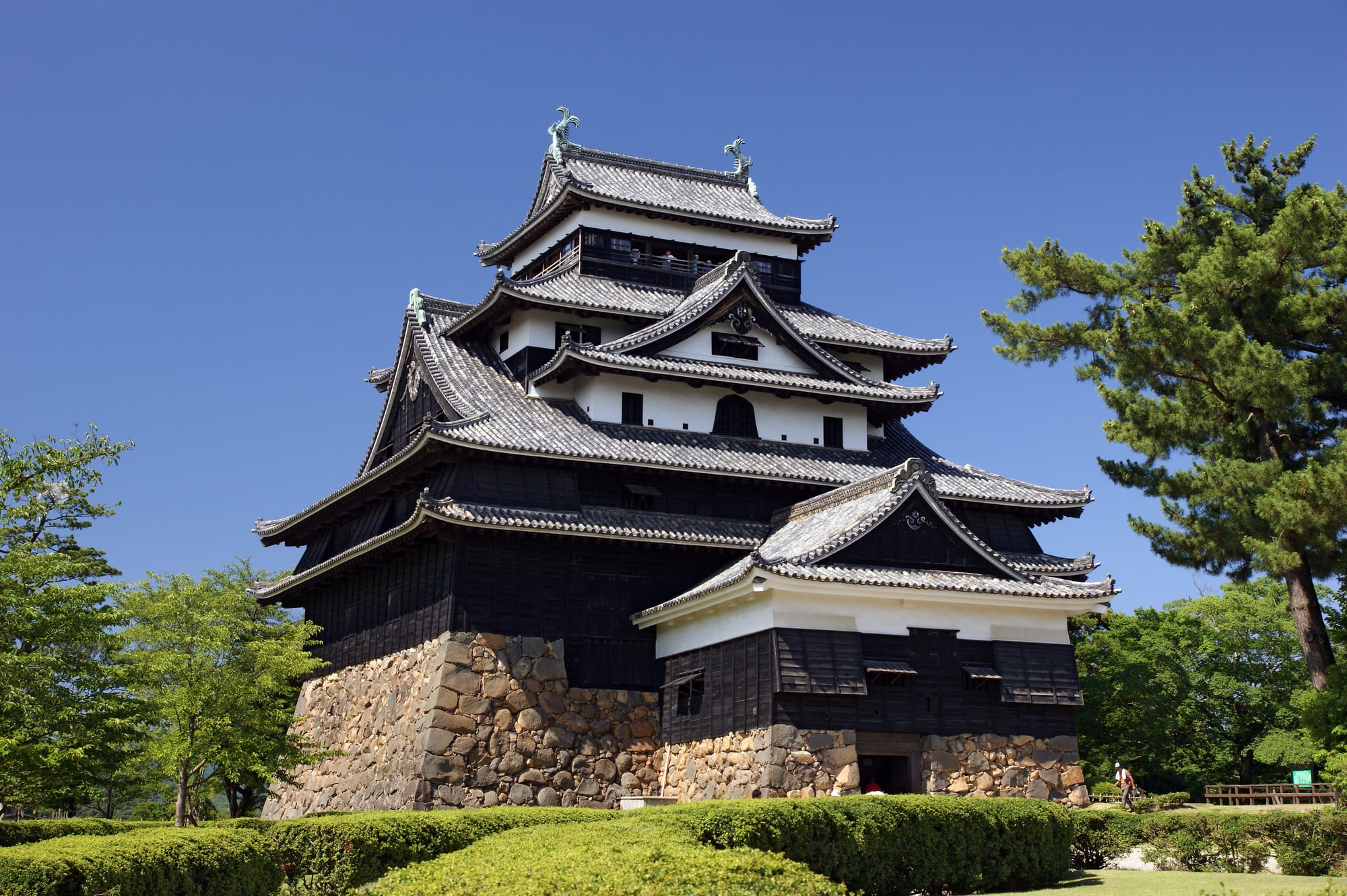
A black wooden castle keep with white plaster panels and grey tiled roofs standing on a rough stone base among pines

Chugoku: Hiroshima & the San'in Coast, Japan

Matsue

The 17th-century wooden keep of Matsue Castle, one of the few that survive in their original form. (663highland / Wikimedia Commons · CC BY 2.5)

The capital of Shimane Prefecture, on the narrow neck of land between Lake Shinji and the brackish lagoon of Nakaumi on the San'in coast. Built around a castle of 1611 whose wooden keep is one of only a dozen to survive, it keeps a quarter of samurai houses, a moat used by small boats, hot springs on the lake shore and the house where Lafcadio Hearn lived.

Neighbourhoods

  • The castle and Shiomi Nawate
    • First-time visitors
    • Historic district
    • Walks

    The moated hill north of the river, with the keep in its wooded park and, along the north moat, a street of earthen walls, pine trees and preserved samurai houses. Museums, tea rooms and Lafcadio Hearn's old residence stand along the same short stretch.

    Open in Maps
  • Around Matsue Station
    • Close to public transport
    • Shopping
    • First-time visitors

    South of the Ohashi River, where the JR station, the bus terminal and most of the business hotels are grouped. Department stores, chain restaurants and the city's late-night eating and drinking blocks are within a few streets.

    Open in Maps
  • Kyomise and the river bank
    • Best for food
    • Local life
    • Shopping

    The old merchant quarter on the north bank of the Ohashi River, laid out as the castle town's trading street. Confectioners, kimono shops, cafés and small restaurants occupy low buildings between the bridge and the moat.

    Open in Maps
  • Shinjiko Onsen
    • Hot springs
    • Quiet and residential
    • Sunset views

    A hot-spring district on the northern shore of Lake Shinji, a short tram-like train ride or walk from the castle, with ryokan, public baths and a lakeside promenade that fills at sunset.

    Open in Maps
  • Tamatsukuri Onsen
    • Hot springs
    • Quiet and residential

    An old spa village in a valley south-west of the centre, mentioned in eighth-century records and lined with inns along a small river, with cherry trees, footbaths and a shrine associated with jade working.

    Open in Maps

Things to do

The castle town

  • Matsue Castlelandmark

    Completed in 1611 for Horio Yoshiharu, one of only twelve castles in Japan whose wooden keep survives from the feudal era, designated a National Treasure, with a top-floor view over the lake.

    Open in Maps
  • Lafcadio Hearn Memorial Museummuseum

    A museum on Shiomi Nawate devoted to the writer, who came to teach in Matsue in 1890, married into a samurai family and took the name Koizumi Yakumo.

    Open in Maps
  • Buke Yashikimuseum

    A preserved middle-ranking samurai residence of the Edo period on the north moat, with its rooms, kitchen, storehouses and garden kept as they were.

    Open in Maps
  • Meimei-anlandmark

    A thatched tea house of 1779 built for Matsudaira Harusato, the lord and tea master known as Fumai, standing on a rise above the castle with a view of the keep.

    Open in Maps
  • Horikawa moat boatsattraction

    Small covered boats that circle the castle's inner and outer moats through willows and under low bridges, where the roof has to be lowered.

    Open in Maps
  • Matsue History Museummuseum

    The city's own collection in a wooden building on the moat, covering the castle, the Matsudaira lords and the craft traditions of the town, with a tea room attached.

    Open in Maps

Shrines and temples

  • Kamosu Shrinelandmark

    A shrine south of the centre whose main hall of 1583, in the ancient taisha style, is a National Treasure.

    Open in Maps
  • Yaegaki Shrinelandmark

    A shrine linked to the myth of Susanoo and the serpent, visited by people praying for marriage, with a pond in the grove behind it used for paper fortunes.

    Open in Maps
  • Gesshō-jilandmark

    The family temple of the Matsudaira lords of Matsue, rebuilt in 1664, with mossy gates, hydrangeas in June and a large stone turtle in the grounds.

    Open in Maps

Lakes, gardens and views

  • Lake Shinjipark

    The brackish lake on the city's western edge, known for its sunsets behind the small pine-covered island of Yomegashima and for the clams fished from it.

    Open in Maps
  • Nakaumipark

    The shallow lagoon east of the city, joined to the sea and to Lake Shinji, with bird reserves on its shores and islands reached by causeway.

    Open in Maps
  • Matsue Vogel Parkattraction

    Greenhouses of begonias and fuchsias above Lake Shinji, with birds of prey and waterfowl kept in large aviaries.

    Open in Maps

Short trips from the city

  • Adachi Museum of Artmuseum

    In Yasugi, about 16 kilometres east, a museum of modern Japanese painting opened in 1970, whose meticulously kept gardens are framed through windows as living pictures.

    Open in Maps
  • Izumo-taishalandmark

    One of the oldest and most revered shrines in Japan, about 35 kilometres west, where the gods are believed to gather in the tenth lunar month.

    Open in Maps
  • Yūshienpark

    A large stroll garden on the island of Daikonshima in Nakaumi, known for peonies and for the ginseng grown on the island.

    Open in Maps
  • Mihonosekineighborhood

    A small fishing port at the tip of the Shimane peninsula, with a stone-paved waterfront street, an old lighthouse on the headland and the shrine of Miho-jinja.

    Open in Maps
  • Sakaiminatoattraction

    A fishing port across the water in Tottori Prefecture, whose main street is lined with bronze statues of the yokai drawn by the manga artist Mizuki Shigeru, who grew up there.

    Open in Maps

Seasonal events

  • Cherry blossom at the castlelate March to early April

    Several hundred cherry trees flower in the castle park, which is lit in the evenings and counted among the better blossom sites in western Japan.

  • Matsue SuigosaiAugust

    The city's summer festival on the Ohashi River and Lake Shinji, with fireworks over the water.

  • Kamiari-saitenth lunar month, usually November

    The season when the gods are said to gather in Izumo, marked by rituals at shrines around Matsue as well as at Izumo-taisha.

Eat and drink

Long-standing places and food districts in Matsue. Hours, ratings and directions come from your maps app, always current.

Matsue classics

  • Shijimi clamsrestaurant

    The small dark clams fished from Lake Shinji, served in miso soup, steamed with sake or cooked with rice, and the best known of the lake's seven traditional foods.

    Open in Maps
  • Izumo sobarestaurant

    Dark buckwheat noodles made with the whole grain, served cold in stacked round lacquer bowls called warigo or hot in a broth poured over them.

    Open in Maps
  • Wagashi and matchacafe

    Matsue is one of Japan's main sweet-making towns, a legacy of the tea-loving lord Matsudaira Fumai, and its confectioners sell delicate seasonal sweets eaten with whisked green tea.

    Open in Maps
  • Winter crab and lake fishrestaurant

    Snow crab landed on the San'in coast from late autumn, alongside sea bass, whitebait and eel from the lakes, appear on set menus through the cold months.

    Open in Maps

Food districts

  • Kyomiseneighborhood

    The old merchant street north of the river, with long-established confectioners, tea rooms and small restaurants in low wooden buildings.

    Open in Maps
  • Isemiya and the station blocksneighborhood

    The dense grid of izakaya, sushi counters and bars south of the river, where most of the city's evening eating is done.

    Open in Maps

Experience Matsue

History

The land between the two lakes has been settled since antiquity: the eighth-century Izumo Fudoki describes villages, hot springs and shrines around the shores, and Kamosu and other shrines nearby preserve some of the oldest forms of Shinto architecture. The regional centre in the medieval period lay inland, and Matsue as a town did not exist until the beginning of the 17th century.

Horio Yoshiharu, granted the Izumo domain after the battle of Sekigahara, found his hilltop castle at Gassantoda inconvenient and moved to a low hill beside the Ohashi River, where he built Matsue Castle between 1607 and 1611 and laid out a grid of samurai and merchant quarters below it. The Horio line died out, and from the 1630s the Matsudaira family, relatives of the shogun, held the domain for more than two centuries. The seventh lord, Matsudaira Harusato, known as Fumai, was a celebrated tea master whose enthusiasm shaped the town's tea houses, gardens and confectionery.

The keep survived the demolition of the castle's other buildings in the early Meiji period, leaving it, an attached turret and the stone walls as the original structures. In 1890 the Greek-Irish writer Lafcadio Hearn arrived to teach English, lived here for little more than a year, married Koizumi Setsu of a samurai family and wrote about the town's ghost stories and customs, drawing outside attention that the city still trades on. Matsue became the prefectural capital, absorbed neighbouring towns, notably in a large merger in 2005, and now has about 200,000 residents. The castle keep was designated a National Treasure in 2015.

Culture & Customs

Matsue is a tea town. Fumai's patronage left it with a dense culture of tea houses, garden rooms and sweet makers, and it is often grouped with Kyoto and Kanazawa as one of the three great wagashi cities. Ordering matcha with a seasonal sweet is routine here rather than a tourist ritual, and tea is served in the castle grounds, in museum rooms and at Meimei-an.

The city also stands at the centre of Japan's oldest layer of myth. The Izumo region is where the chronicles place Susanoo, the serpent and the transfer of the land to the heavenly gods, and where the gods are believed to gather in the tenth lunar month — called elsewhere the month without gods and here the month with gods. Shrines around the city are visited for matchmaking, and marriage prayers at Yaegaki Shrine are part of the local economy as well as of belief.

Lafcadio Hearn's presence is a third strand. His essays on Matsue's temples, dances and ghost stories remain the best-known foreign account of the town, and the museum, his old house and a strong local line in supernatural tales all follow from them. Otherwise the tone is quiet and provincial: the Izumo dialect is distinctive and slow to outsiders' ears, shops close early, and the day ends with people gathered along the lake to watch the sun go down behind the small pine-covered island of Yomegashima.

Daily Life

About 200,000 people live in Matsue, which is the largest city in Shimane, one of the two least populous prefectures in Japan. The wider city takes in farming villages, fishing ports on the peninsula and the hot-spring valleys, and much of that area is ageing and losing residents while the centre holds steady.

The economy rests on government and services: the prefectural administration, schools and hospitals are the biggest employers, alongside retail, tourism and a small software sector that the city has promoted for years. Fishing on the lakes and the coast, rice farming, and the making of sweets, soba and crafts fill in the rest.

Daily life runs early and unhurried. Commuters drive or take short bus and train journeys, the central shopping streets are quiet on weekdays, and the evening crowd concentrates in a few blocks near the station. Depopulation is the overriding local issue, together with the future of rural rail and bus services, and the balance between tourism and the town's steady, ordinary character. Water quality in Lake Shinji, on which the clam fishery depends, is a continuing public concern.

Food

The lakes set the menu. Lake Shinji's seven traditional foods — shijimi clams, sea bass, whitebait, smelt, a small shrimp, carp and eel — are still served in the city, and shijimi soup is the everyday emblem, clouded, salty and eaten at breakfast as often as at dinner. Sea bass is baked in paper in a style said to have been favoured by the lords, and winter brings snow crab landed at the coastal ports along with firm, cold-water fish.

Izumo soba is the other staple: buckwheat ground with the husk, giving dark, strongly flavoured noodles, served cold in three stacked lacquer bowls with broth poured over each in turn, or hot as kamaage in the water they were boiled in. Simple soba shops are scattered through the castle district and the merchant streets.

Sweets are taken seriously. Matsue's confectioners make seasonal wagashi of bean paste, rice flour and sugar in forms tied to the tea calendar, several of them associated with Fumai's own preferences, and the city consumes green tea and sweets at a rate few places match. Botebote-cha, a frothy whisked tea mixed with rice and pickles in the bowl, is a local survival from the working past. Sake is brewed in the city and around Izumo, where brewing has deep ritual associations, and the region's rice and lake fish are its usual accompaniments.

Planning tools

Budget

Matsue is among the cheaper prefectural capitals. Business hotels near the station are inexpensive, entry to the castle, the samurai house and the museums costs little, and the moat boat is the main small extra. A night at a ryokan in one of the hot-spring districts, with dinner, is the usual splurge.

Daily Budget Midrange
USD 100–190 (business hotel or ryokan, restaurant dinners, Shinkansen and limited-express travel)
Daily Budget Shoestring
USD 40–70 (guesthouse or budget business hotel, soba and set-menu meals, buses and local trains)

A one-day pass on the loop bus around the castle district covers most of the sights and is cheaper than separate fares.

Best Time to Visit

Spring and autumn are the most comfortable, with blossom at the castle in early April and lantern evenings and clear skies in October and November. Summer is hot and humid but brings the river fireworks. Winter is grey, wet and sometimes snowy, and is the season for crab and hot springs.

Suggested Number of Days

The castle district and lake shore suit a day or two. Three or four days allow the shrines, gardens and ports around the two lakes and along the coast. Sparse rural transport is the main reason to allow extra time.

First Visit
1–2 days
With Surroundings
3–4 days

Transportation

A loop bus links the station with the castle, the samurai street and the museums, and ordinary city buses cover the rest. The private Ichibata railway runs from Matsuejinjiko-onsen station along the north shore of Lake Shinji towards Izumo, while JR lines follow the south shore. A hire car is useful for the peninsula and the outlying shrines.

Rural buses and trains can be an hour or more apart, so check return times before heading out of the centre.

Airport & Station Connections

Limited-express trains cross the mountains from Okayama in about two and a half hours, connecting there with the Shinkansen, and sleeper and express services run along the San'in coast. Izumo Airport lies to the west, about half an hour by road, and Yonago Airport to the east in Tottori Prefecture, both with flights from Tokyo and buses to the city. Long-distance coaches run overnight from Osaka and Tokyo.

Walkability

The centre is flat and compact, and the castle district is a pleasant walk of about two kilometres from the station across the Ohashi River. The moat path, Shiomi Nawate and the lake promenade are all level and quiet. Distances to the hot-spring districts and the outlying shrines are better covered by bus, train or bicycle.

Safety

Matsue is a very safe city with little crime. The hazards are natural: heavy rain and typhoons in late summer, snow and icy pavements in winter, and strong sun with little shade on the lake promenade in July and August.

Allow for winter weather delays on the San'in lines and roads, and take care on unfenced moat and lake edges. Check current official travel advice before travelling.

Climate

A Sea of Japan climate: cloudier and wetter than the Inland Sea side of the region, with rain spread through the year and cold, grey winters. Snow falls most winters and the surrounding mountains hold it for longer.

Summer
hot and humid, often 28–33°C, with heavy rain in the rainy season and typhoons possible in late summer
Winter
cold, grey and damp, usually 1–9°C, with several snowfalls a year

Local Customs

Manners are those of Japan generally, with a strong local shrine culture: visitors bow at torii gates, rinse hands and mouth at the basin, and keep quiet during rituals. Shoes come off at ryokan, tea houses and some museum rooms. In the hot-spring baths, washing thoroughly before entering the water is expected, and tattoos are refused at some establishments.

Do not photograph inside bathhouses, and ask before photographing ceremonies at shrines or the interiors of private samurai houses where indicated.

Common Payment Methods

The currency is the Japanese yen. Cards and IC transit cards work at the station, hotels and larger shops, but small restaurants, confectioners, shrine offices and the moat boats are often cash only. Convenience-store and post office machines accept foreign cards.