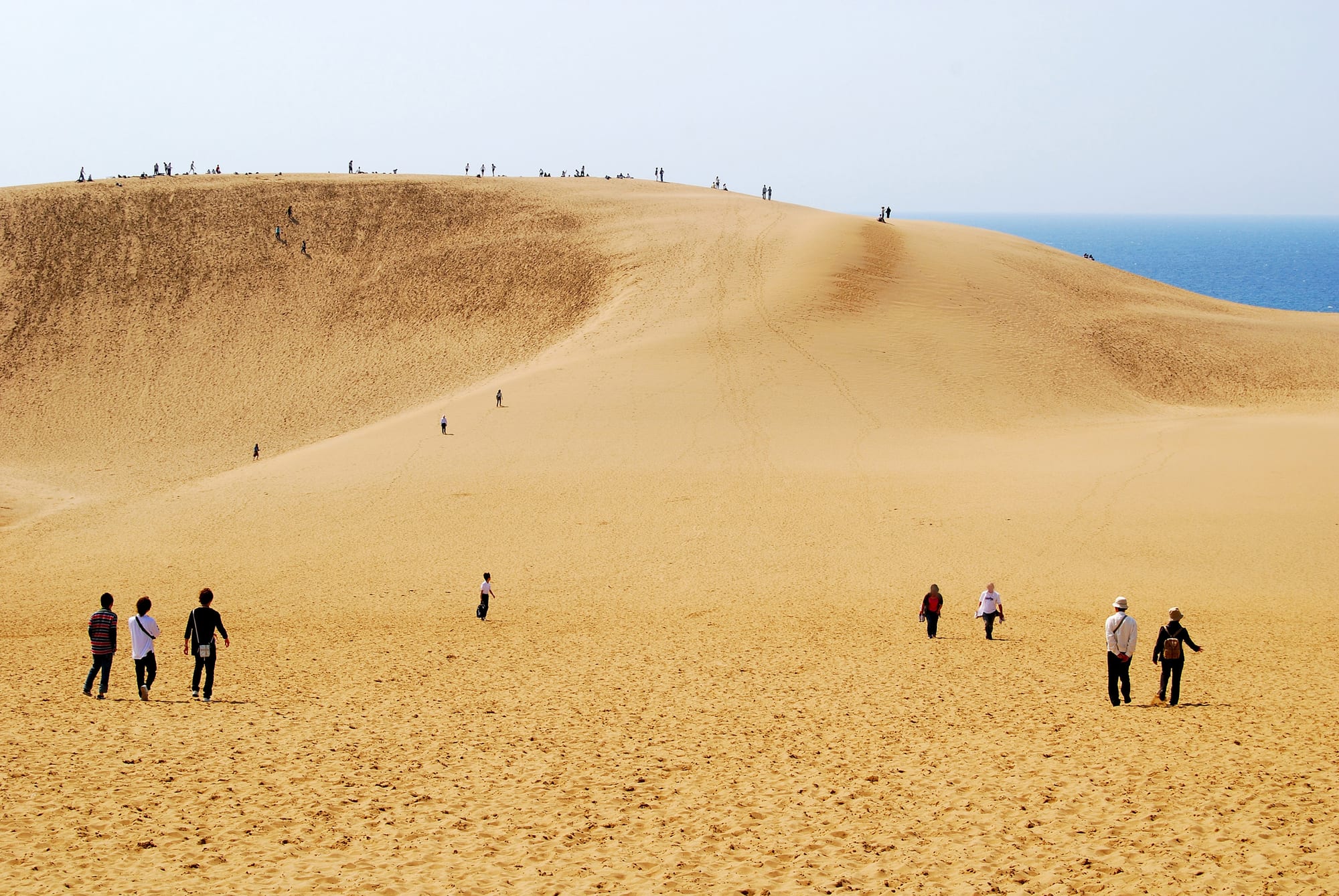
Walkers crossing a wide expanse of pale sand towards a high dune ridge, with the blue Sea of Japan beyond

Chugoku: Hiroshima & the San'in Coast, Japan

Tottori

The Tottori Sand Dunes above the Sea of Japan, north of the city centre. (Hashi photo / Wikimedia Commons · CC BY-SA 3.0)

The capital of Japan's least populous prefecture, on the San'in coast where the Sendai River meets the Sea of Japan. A castle town of the Ikeda lords rebuilt after an earthquake and a fire, it is known above all for the great sand dunes on its northern shore, for winter snow crab and for a quiet, small-city pace.

Neighbourhoods

  • Around Tottori Station
    • First-time visitors
    • Close to public transport
    • Best for food

    The commercial centre, rebuilt on a grid after the fire of 1952. Business hotels, department stores, covered shopping streets and most of the city's restaurants and izakaya stand within a few blocks of the station, and the buses to the dunes leave from outside it.

    Open in Maps
  • The castle district
    • Historic district
    • Museums
    • Walks and viewpoints

    About a kilometre north of the station at the foot of Mount Kyusho, where the castle's stone walls and moat survive below the wooded hill. The prefectural museum, a Western-style mansion of the Ikeda family and a cluster of temples and old residences are within walking distance.

    Open in Maps
  • The dunes and Fukube
    • Landscapes
    • Day trips

    The coastal strip north-east of the centre, reached in twenty minutes or so by bus. Beyond the pine windbreaks are the dunes themselves, a sand sculpture museum and a run of cafés and shops selling pear products, with the sea on the far side of the ridge.

    Open in Maps
  • Karo and the coast
    • Seafood
    • Local life

    The fishing port at the mouth of the river, north of the city centre, where much of the prefecture's crab and squid is landed. Seafood restaurants and fish shops cluster around the harbour, and a long sandy beach runs east towards the dunes.

    Open in Maps

Things to do

The dunes and the coast

  • Tottori Sand Duneslandmark

    A belt of wind-built dunes about 14 kilometres long on the Sea of Japan shore, the largest in the country, with ridges rising steeply above a hollow and the sea beyond.

    Open in Maps
  • Tottori Sand Museummuseum

    An indoor museum near the dunes showing large sand sculptures carved by international artists to a different theme each year.

    Open in Maps
  • Uradome Coastviewpoint

    A ria coast of sea cliffs, caves, tunnels and clear coves east of the dunes, designated a national Place of Scenic Beauty and Natural Monument.

    Open in Maps

The castle town

  • Tottori Castlelandmark

    The ruined hilltop and hillfoot castle of the Ikeda lords, famous for the siege of 1581, with stone walls, a moat and a climb up Mount Kyusho for a view over the city.

    Open in Maps
  • Jinpukakulandmark

    A white French Renaissance-style residence of the Ikeda clan below the castle, designed by the Meiji-period architect Katayama Tokuma and completed in 1907.

    Open in Maps
  • Tottori Folk Crafts Museummuseum

    A collection of Japanese and foreign folk craft, open since 1949, assembled by Yoshida Shoya, the local advocate of the mingei movement.

    Open in Maps
  • Kannon-inattraction

    A temple east of the centre whose Edo-period garden, laid out for the Ikeda lords, is a nationally designated scenic place.

    Open in Maps

Legends and local sights

  • Hakuto Shrinelandmark

    A coastal shrine west of the city tied to the myth of the White Hare of Inaba, which appears in the eighth-century chronicles and draws visitors praying for good matches.

    Open in Maps
  • Tottori Prefectural Museummuseum

    The prefecture's general museum below the castle hill, covering the natural history, archaeology and folk life of the San'in coast.

    Open in Maps

Short trips from the city

  • Mount Daisenviewpoint

    The highest peak in the Chugoku region, a volcano west of the city with walking routes, forest and the old mountain temple of Daisen-ji.

    Open in Maps
  • Misasa Onsenattraction

    A small riverside hot spring town south-west of Tottori, known for its radium-rich waters and old wooden inns.

    Open in Maps
  • Sanbutsu-jilandmark

    A mountain temple on Mount Mitoku whose Nageiredo hall is wedged into a cliff face, reached by a steep scramble through the forest.

    Open in Maps
  • Kurayoshineighborhood

    A city west of Tottori whose Utsubuki-Tamagawa quarter, a preservation district for groups of traditional buildings, keeps earthen-walled storehouses of the late Edo period beside a small waterway.

    Open in Maps

Seasonal events

  • Tottori Shan-Shan FestivalAugust

    The city's summer festival, in which thousands of dancers turn decorated umbrellas hung with bells through the central streets.

  • Sand sculpture exhibitionspring to early winter

    The Sand Museum's annual show, carved to a new country or theme each year and dismantled before the next is built.

  • Snow crab seasonNovember to March

    The months when matsuba-gani is landed at Karo and the other San'in ports, and the restaurants and inns build their menus around it.

  • Cherry blossom at the castleearly April

    Blossom along the moat and on the slopes of Mount Kyusho, when the castle park fills with picnics in the evenings.

Eat and drink

Long-standing places and food districts in Tottori. Hours, ratings and directions come from your maps app, always current.

Tottori classics

  • Karo Port seafoodmarket

    The city's main fishing harbour, where crab, squid and sweet shrimp are landed and sold, with seafood restaurants and fish shops around the quays.

    Open in Maps
  • Beef-bone ramen shopsneighborhood

    Tottori's own style of ramen uses a broth simmered from beef bones rather than pork, and small shops serving it are scattered across the city.

    Open in Maps

Food streets

  • Tottori Station streetsneighborhood

    The arcades and side streets around the station hold most of the city's izakaya, sushi counters, noodle shops and curry houses.

    Open in Maps
  • The dunes roadneighborhood

    Shops and cafés along the approach to the dunes sell pear juice, pear ice cream and other products of the prefecture's orchards.

    Open in Maps

Experience Tottori

History

The plain where the Sendai River reaches the sea was the heart of Inaba province, and the name Tottori, written with characters meaning bird-taking, appears in the eighth-century chronicles as the home of people who caught waterfowl in its marshes. A castle was built on Mount Kyusho in the mid-sixteenth century, and in 1581 Toyotomi Hideyoshi took it not by assault but by buying up the region's rice and cutting the garrison off until it starved — a siege remembered in Japan as one of the harshest of the period.

From 1616 the Ikeda family held Tottori as the castle town of a large domain covering Inaba and Hoki provinces, and the grid of merchant streets below the castle dates from that time. The castle's buildings were pulled down after the Meiji Restoration, leaving the walls and moat, and the prefecture that took the city's name was merged into Shimane in 1876 before being re-established a few years later.

Two disasters shaped the modern city. An earthquake in 1943 killed well over a thousand people and flattened much of the centre, and in 1952 a fire that began in a single house spread through the rebuilt wooden streets and destroyed thousands of buildings. The city that rose afterwards is low, wide and modern, with broad firebreak avenues. Mergers in 2004 brought in surrounding towns and villages, pushing the boundaries to the pear orchards and the coast, while the prefecture as a whole has continued to lose people to Osaka and Tokyo.

Culture & Customs

Tottori's best-known story is the White Hare of Inaba, in which a hare tricked sharks into forming a bridge across the sea, was skinned for the deception and was healed by a passing deity. The shrine at Hakuto, west of the city, marks the spot, and the tale has made it a place to pray for love and marriage. The myth also ties the area to the older mythology of Izumo, along the coast in Shimane.

The Inaba region has its own lion dance, kirin-jishi, performed at shrine festivals by two dancers under a long cloth with a single-horned head, to drums and flutes. The city's summer festival, Shan-Shan, takes its name from the sound of bells on the large decorated umbrellas that dancers spin through the streets in August — a dance traced to a legend of an old man who danced with an umbrella to pray for rain during a drought.

Craft matters here. Yoshida Shoya made Tottori a centre of the mingei folk craft movement in the twentieth century, founding a museum of everyday objects in 1949 and encouraging local potters, and kilns in the prefecture still work in that tradition. Tottori is also proud of its comic-book connections: the prefecture is the home ground of two celebrated manga artists, and the airport carries the name of a detective series whose creator grew up nearby. Manners are those of small-town Japan — quiet, formal with strangers and warm once introduced.

Daily Life

About 180,000 people live in Tottori, which has the lowest population of any prefectural capital in Japan, in the least populous prefecture of all. The city is spread thinly: a compact commercial core around the station, then suburbs, rice fields, orchards and fishing villages inside the same boundaries.

Government, education and health care employ a large share of the working population, since the prefectural offices, Tottori University and the main hospitals are all here. Farming and fishing remain central to the wider economy — pears, watermelons, scallions and rice on the plain, crab, squid and sweet shrimp landed at Karo — alongside electronics and food-processing plants and a tourist trade built on the dunes.

The rhythm is unhurried. Shops and offices empty by early evening, cars outnumber buses outside the centre, and life turns with the seasons: pear picking in late summer, crab from November, snow shovelling in January and February. Depopulation and ageing dominate local politics, along with the cost of keeping rural bus and rail lines running and the effort to draw visitors beyond the dunes.

Food

Winter belongs to crab. Matsuba-gani, the male snow crab landed on the San'in coast, is boiled, grilled or served as sashimi, and the smaller, cheaper beni-zuwai red snow crab appears on everyday menus. Karo port also lands pale squid, eaten raw in summer, and a sweet shrimp too delicate to travel far, which is one reason to eat it here.

The everyday dish is ramen made with a beef-bone broth, gyukotsu ramen, clear and lighter than the pork-bone soups of western Japan and a local speciality rather than a national one. Tofu chikuwa, a steamed roll of fish paste mixed with tofu, is made in the east of the prefecture, whose households eat more chikuwa than those of any other; it is served grilled with soy and ginger. Curry is popular here too, and curry houses are easy to find.

The land supplies the rest. Nijisseiki pears, crisp, pale green and juicy, are the prefecture's emblem, sold fresh in autumn and turned into juice, jelly and ice cream sold along the road to the dunes. Tottori beef is raised in the hills, the prefecture grows large quantities of scallions, yams and watermelons, and local sake breweries work with rice from the plain. Rakkyo, a shallot-like bulb grown in the sandy soil at the edge of the dunes, is pickled and eaten with curry — the dunes on a plate.

Planning tools

Budget

Tottori is one of the cheaper Japanese cities to visit. Business hotels near the station are inexpensive by national standards, noodle and set lunches cost little, and the dunes themselves are free to walk on. The costs that mount are limited-express fares across the mountains, a hire car for the coast and the villages, and crab, which is expensive everywhere in winter.

Daily Budget Midrange
USD 100–190 (business hotel or ryokan, restaurant dinners, limited-express trains or a hire car)
Daily Budget Shoestring
USD 45–70 (budget business hotel or guesthouse, ramen and set lunches, local buses)

A crab dinner can cost more than the room; a set lunch at the same restaurant is the cheaper way to try it.

Best Time to Visit

Spring and autumn are the most comfortable seasons, with blossom around the castle in early April and clear light on the dunes in October and November. Summer is hot and the sand can be punishing at midday, though the coast and its coves are at their best. Winter is grey and snowy, and it is the season for crab.

Suggested Number of Days

One full day is enough for the city and its coast. A second allows the shore east or west of the centre at a slower pace. Three or four suit a wider San'in trip by car, taking in the mountains, the hot spring villages and neighbouring towns.

First Visit
1–2 days
With Surroundings
3–4 days

Transportation

The centre is small enough to walk, and buses from Tottori Station serve the dunes, the port and the outer districts, though they are not frequent. A loop bus links the main sights on some days. Taxis are easy to find at the station. A hire car is the practical way to reach the Uradome coast, Hakuto, Mount Mitoku and the hot spring villages.

Rural bus and train services can be an hour or more apart, so check the return times before setting out.

Airport & Station Connections

Limited-express trains link Tottori with Osaka in about two and a half hours and with Okayama, on the Shinkansen line, in roughly two. Local trains run west along the San'in coast towards Kurayoshi and Matsue. Tottori Airport, on the coast a few kilometres north of the centre, has flights to Tokyo and is nicknamed Tottori Sand Dunes Conan Airport, after the dunes and the detective manga whose author was born in the prefecture. Express buses run from Osaka, Kobe and Tokyo.

Walkability

The station area, the shopping arcades and the castle district are an easy walk apart, a little over a kilometre end to end, on flat ground with wide pavements. The dunes, the port and the shrines are too far to walk and need a bus or a car. On the dunes themselves, soft sand and a steep ridge make short distances hard work.

Safety

Tottori is a very safe city with little street crime. The real hazards are natural: heat and lack of shade on the dunes in summer, strong currents and sudden high waves on the Sea of Japan coast, and snow and ice that disrupt roads and trains in winter. Typhoons and heavy rain can reach the region in late summer.

Carry water on the dunes, take beach and cliff-path warnings seriously, and allow for winter delays on San'in roads and railways. Check current official travel advice before travelling.

Climate

A Sea of Japan climate: cloudier and wetter than the Inland Sea side of the mountains, with a long grey winter and a humid summer. Rain is spread through the year, with a June rainy season and a second peak in autumn.

Summer
hot and humid, generally 28–33°C, with sand surfaces far hotter than the air
Winter
cold and grey, generally 2–9°C, with repeated snowfalls and occasional heavy accumulations

Local Customs

Tipping is not practised anywhere in Japan and can cause confusion. Shoes come off at the entrance to inns, temples and many restaurants, and tattoos may be refused at public baths. Queuing is orderly, eating while walking is avoided, and rubbish bins are rare, so litter is usually carried away. On the dunes, visitors keep to the open sand and away from the fenced plant colonies.

Speak quietly on trains and buses, ask before photographing people at work in the port or the markets, and carry a small bag for rubbish.

Common Payment Methods

The currency is the Japanese yen. Cards and code payments are accepted at hotels, chain shops and most station-area restaurants, but small family-run places, buses and rural shops often want cash. Post office and convenience store cash machines accept foreign cards; many bank machines do not.