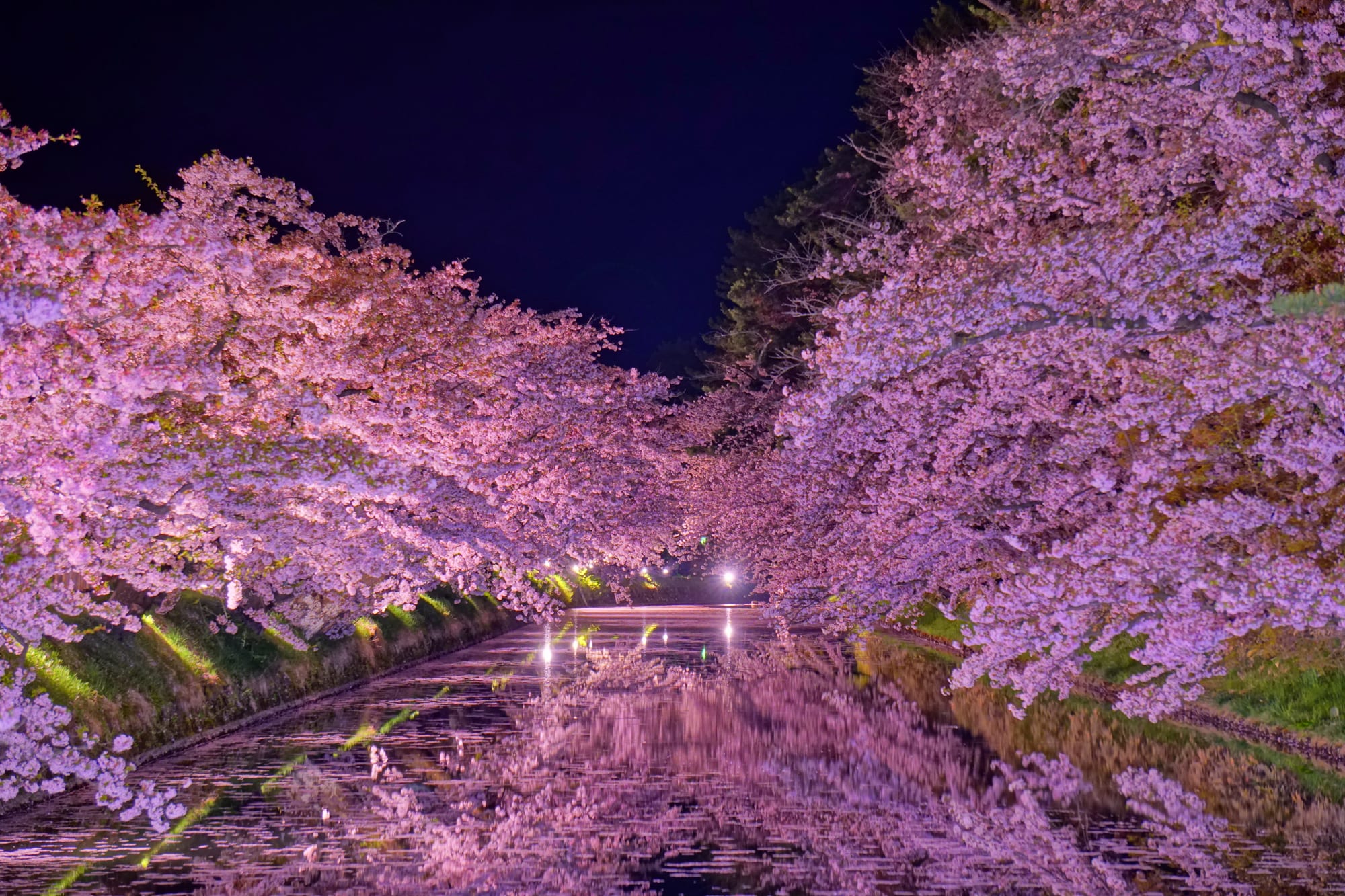
A narrow castle moat lit at night between banks of cherry trees in full pink blossom, their branches meeting above the water

Tohoku, Japan

Hirosaki

Cherry trees in blossom along a moat of Hirosaki Castle, lit for the spring festival. (掬茶 / Wikimedia Commons · CC BY-SA 4.0)

A castle town in western Aomori prefecture, seat of the Tsugaru lords from the early seventeenth century and still centred on one of Japan's few surviving original keeps. Apple orchards cover the plain around it beneath the volcano of Mount Iwaki, Meiji and Taisho brick and timber buildings line the streets, and the cherry trees of its castle park draw crowds every spring.

Neighbourhoods

  • The castle park
    • First-time visitors
    • Historic district
    • Cherry blossom

    The walled and moated grounds of the Tsugaru castle at the centre of town, with earthworks, gates, bridges and some 2,600 cherry trees. Museums, the concert hall and the city's Western-era buildings stand around its edges.

    Open in Maps
  • Dotemachi and the central streets
    • Shopping
    • Best for food
    • Cafés

    The old main shopping street between the station and the park, with department stores, coffee houses, bakeries and bars in a mixture of post-war blocks and pre-war brick. It is the heart of the town's evening life.

    Open in Maps
  • Around Hirosaki Station
    • Close to public transport
    • Hotels

    The east side of the centre, where the JR line and the private Konan railway meet. Business hotels, chain restaurants and bus stands cluster here, about half an hour on foot or a short bus ride from the castle.

    Open in Maps
  • Zenringai, the temple street
    • Historic district
    • Quiet
    • Walks

    A long avenue in the south-west lined with rows of Soto Zen temples, laid out by the Tsugaru lords as a defensive belt around the castle town, ending at the great gate of their family temple.

    Open in Maps
  • The orchards and the Iwaki road
    • Nature
    • Quiet and residential
    • Autumn colour

    Apple country on the plain west of the town, where the orchards run towards the cone of Mount Iwaki. Farm roads, a hot spring or two and the long approach to the mountain shrine cross a landscape that turns red and gold in autumn.

    Open in Maps

Things to do

The castle and its park

  • Hirosaki Castlelandmark

    The seat of the Tsugaru clan, whose small three-storey keep of 1811 is one of the few original castle keeps left in Japan, set among gates, turrets and wide moats.

    Open in Maps
  • Hirosaki Parkpark

    The castle grounds, planted with some 2,600 cherry trees whose blossom in late April is among the best known in the country, and a place of maples and chrysanthemums in autumn.

    Open in Maps
  • Fujita Memorial Gardenpark

    A Japanese garden in the centre of town beside a Western-style villa, a Japanese house and brick storehouses of the Taisho era, all registered cultural properties.

    Open in Maps

Temples, shrines and old streets

  • Choshojilandmark

    The Zen family temple of the Tsugaru lords at the end of the temple street, entered through a tall two-storey gate, with the mausolea of the domain's rulers behind it.

    Open in Maps
  • Saishoin Five-storey Pagodalandmark

    The five-storey pagoda of Saishoin, a Shingon temple east of the castle, and the northernmost of Japan's five-storey pagodas designated an Important Cultural Property.

    Open in Maps
  • Zenringai temple streetneighborhood

    An avenue of Soto Zen temples with earthen walls and old cemeteries, laid out in the seventeenth century and quiet to walk at any season.

    Open in Maps

Museums and Western-era architecture

  • Hirosaki Museum of Contemporary Artmuseum

    A gallery opened in 2020 inside a Meiji and Taisho brick warehouse near the station, its conversion designed by the architect Tsuyoshi Tane.

    Open in Maps
  • Hirosaki City Museummuseum

    The municipal history museum inside Hirosaki Park, opened in 1977, with some eighteen thousand items covering the Tsugaru domain and prehistoric finds from the Sunazawa site.

    Open in Maps
  • The former city library and Western-style buildingslandmark

    A cluster of Meiji and Taisho buildings near the park, including the old city library of 1906, from the decades when local carpenters copied Western styles.

    Open in Maps
  • Tsugaru-han Neputa Muraattraction

    An exhibition hall by the park keeping Neputa floats on show all year, with demonstrations of Tsugaru-jamisen playing and local crafts.

    Open in Maps

Short trips from the city

  • Mount Iwakiviewpoint

    The 1,625-metre volcano west of the town, climbed on foot or reached by a toll road and chairlift near the summit, with wide views over the Tsugaru plain.

    Open in Maps
  • Iwakiyama Shrinelandmark

    The shrine at the foot of Mount Iwaki, with ornate seventeenth-century buildings paid for by the Tsugaru lords and the goal of an autumn pilgrimage.

    Open in Maps
  • Kuroishiattraction

    A small town east of Hirosaki whose Komise street keeps a run of Edo-period merchant houses with covered wooden arcades against the snow.

    Open in Maps
  • Shirakami-Sanchipark

    A UNESCO World Heritage Site of old beech forest in the mountains south-west of the city, with waterfalls, gorges and the twelve lakes of Juniko on its western side.

    Open in Maps

Seasonal events

  • Hirosaki Cherry Blossom Festivallate April to early May

    Weeks of crowds, food stalls, boats on the moat and night illumination in the castle park when the trees flower, later than in most of Japan.

  • Hirosaki Neputa Matsuriearly August

    Parades of huge fan-shaped illuminated floats painted with warriors on one face and ghostly figures on the other, accompanied by drums and flutes.

  • Chrysanthemum and Autumn Foliage FestivalOctober to November

    Chrysanthemum displays and figures made of flowers in the castle park, held as the maples turn.

  • Hirosaki Castle Snow Lantern Festivallate winter

    Snow lanterns, sculptures and small igloos lit through the park in the depths of the Tsugaru winter.

Eat and drink

Long-standing places and food districts in Hirosaki. Hours, ratings and directions come from your maps app, always current.

Hirosaki classics

  • The apple pie shops of the centreneighborhood

    Cafés, bakeries and hotels across the town bake their own versions of apple pie from the surrounding orchards; the tourist office keeps a map of them.

    Open in Maps
  • Dotemachi and the centre's restaurantsneighborhood

    Izakaya, French and Western restaurants and coffee houses fill the streets between the station and the park, a legacy of a town that took to Western cooking early.

    Open in Maps
  • Tsugaru soba and niboshi ramen shopsneighborhood

    Local noodle shops serve soba bound with soya flour in the Tsugaru manner and ramen in a strong broth of dried sardines, the northern Aomori style.

    Open in Maps

Markets and produce

  • Hirosaki Apple Parkmarket

    An orchard park on the road towards Mount Iwaki with orchards of many apple varieties, picking in autumn, a harvest festival in late September and a shop of cider, juice and sweets.

    Open in Maps

Experience Hirosaki

History

Hirosaki was created by a single family in a single generation. The Tsugaru clan broke away from their overlords the Nanbu at the end of the sixteenth century, were confirmed in their own domain in western Aomori, and in 1603 began laying out a castle town on the plain below Mount Iwaki. Tsugaru Nobuhira completed the castle in 1611, with a five-storey keep that burned after a lightning strike in 1627; the small three-storey keep that stands today was built in 1811 and is one of the few original ones left in Japan. Temples were arranged in belts around the town for defence, and samurai, merchant and craft quarters were set out on a grid that still shapes the streets.

The domain was rich in rice but exposed to the cold summers of the north, and the famines of the eighteenth and nineteenth centuries killed thousands. In the Boshin War of 1868 the Tsugaru changed sides to the imperial government and kept their position. After the domains were abolished, Hirosaki became the home garrison of the army's 8th Division from 1898 and a centre of education with a strong Protestant mission presence; local carpenters built churches, schools and banks in imitation of Western models, several of which survive.

Apples changed the countryside. Introduced to Aomori in the 1870s, they took to the volcanic soil of the Tsugaru plain, and Hirosaki became the leading apple-growing city in Japan. The Second World War left the town undamaged, so its castle, temples and pre-war buildings remained, and in the post-war decades it turned to tourism, fruit and its university. Aomori prefecture's administration went to the port city of Aomori, leaving Hirosaki the historic capital rather than the political one.

Culture & Customs

The town's great public art is Neputa. In the first week of August, teams drag huge illuminated floats through the streets, the fan-shaped frames painted with warriors from Chinese and Japanese legend on the front and pale, unsettling figures on the back, to drums, flutes and a shout that differs from the one used in Aomori city's Nebuta. Preparation of the paintings and frames occupies craft workshops for much of the year.

Tsugaru has its own voice as well. Tsugaru-jamisen, a fast, percussive style of shamisen playing, developed among itinerant musicians in this district and is still performed in halls and restaurants here. The region's crafts include Tsugaru-nuri lacquerware, built up in many coloured layers and polished to a speckled finish, and kogin-zashi, a white geometric embroidery once used to strengthen hemp clothing against the cold.

Hirosaki also keeps an unusually strong Western thread. Missionary schools, apple orchards brought in by foreign advisers and the architecture of the Meiji era left a town of churches, brick warehouses, old coffee houses and French restaurants, a combination rare in northern Japan. Cherry blossom is managed here like an inheritance: the park's trees are pruned using methods borrowed from apple growing, which is why they flower so densely. Local manners are reserved and the dialect is thick, but hospitality towards visitors in blossom season is practised and warm.

Daily Life

About 157,000 people live in Hirosaki, and the number is falling as young people move to Sendai and Tokyo; the city has one of the older populations in a region that is ageing fast. Hirosaki University, with its medical school and hospital, is a major employer and keeps several thousand students in the centre.

Apples underpin the rural economy. The orchards on the plain are worked by family growers, many of them elderly, with picking from September to November and pruning through the snow in late winter; the fruit is graded, stored and shipped from the town, and processed into juice, cider and confectionery. Rice, vegetables and food processing fill out the farming year, alongside retail, local government and tourism, which concentrates into a few intense weeks.

Snow organises winter life: roofs are cleared, streets are dug out by municipal ploughs before dawn, and covered arcades and heated pavements keep the shopping streets usable. People live mostly in houses with steep roofs and in low blocks of flats, and almost every household has a car, though the town's flat centre suits bicycles for half the year. The pressures are familiar across Tohoku: depopulation, shops closing on the old main street as shopping moves to roadside stores, and orchards without successors.

Food

Apples run through everything. Aomori grows about three-fifths of Japan's crop and Hirosaki more than any other city, so the fruit appears fresh and dried, as juice and cider, in curries and, above all, in apple pie: dozens of cafés, bakeries and hotels bake their own, and the town promotes a map of them. Autumn brings orchards open to visitors for picking and stalls of unfamiliar varieties.

Tsugaru cooking is plain and suited to long winters. Kenoshiru is a soup of finely chopped root vegetables, mountain plants and soya, simmered in miso and eaten in the new year, and kayaki cooks scallops, egg and miso in the shell over a flame. Tsugaru soba is bound with soya flour rather than wheat, giving a soft, dark noodle, and the local ramen is a broth of dried sardines, niboshi, that is stronger and saltier than the southern styles.

Vegetables are preserved as pickles against the snow, and the rice of the plain supports a number of small sake breweries. The Sea of Japan and Mutsu Bay supply squid, scallops and flatfish to the town's izakaya. The Western legacy is edible too, in old coffee houses, French restaurants and a locally made cider sold across the district.

Planning tools

Budget

Hirosaki is inexpensive outside blossom season. Business hotels near the station are the usual choice, set lunches and noodle shops are cheap, and most of the town can be seen on foot for the price of the castle park ticket. Prices and availability change sharply for the last week of April and the first days of May, when rooms are scarce across the whole area.

Daily Budget Midrange
USD 100–185 (mid-range hotel or onsen inn, restaurant dinners, entry fees, a hire car for the orchards)
Daily Budget Shoestring
USD 45–75 (business hotel or guesthouse, noodles and set lunches, local buses)

Book blossom-season rooms many months ahead or stay in Aomori and travel in; a day bus ticket covers the town loop.

Best Time to Visit

Late April and early May for the cherry blossom, the town's busiest and most celebrated season. Early August for the Neputa floats, and late October for apples, chrysanthemums and maples. Winter is long, grey and deep in snow, which suits the lantern festival and the hot springs but makes country roads hard going.

Suggested Number of Days

A day covers the castle park and the central streets; two allow the temple street and the museums without hurrying. Three or four suit a visitor taking in the mountain, the orchards and the wider Tsugaru district, and festival weeks need more time for crowds.

First Visit
1–2 days
With Surroundings
3–4 days

Transportation

The town is small and mostly flat, and a loop bus links the station, the centre and the castle park; ordinary city buses cover the outskirts and the Iwaki road. Bicycles can be hired in season. The JR Ou Main Line runs to Aomori and Akita and the private Konan railway to Kuroishi, but the orchards, the mountain and Shirakami are much easier by car.

Bus services thin out early in the evening and in winter; check the last departure before heading out to the orchards or the mountain.

Airport & Station Connections

Shinkansen trains from Tokyo run to Shin-Aomori in about three hours, with a connection of roughly half an hour on to Hirosaki. Aomori Airport, linked to the town by bus, has flights from Tokyo, Osaka and Sapporo and a few international routes. Overnight and daytime buses run from Tokyo and Sendai, and local trains connect with Akita down the Sea of Japan side.

Walkability

Easy on foot in the centre: the castle park, the museums, the temple street and the shopping streets lie within about two kilometres of each other on level ground. The station is a walk of twenty-five minutes or so from the park, and the orchards and mountain need wheels. Snow and ice cover the pavements from December to March, and banks of cleared snow narrow them.

Safety

Crime is very low and the town is calm at night. The hazards are winter weather — deep snow, ice underfoot, snow sliding from roofs and whiteouts on country roads — along with bears in the forests around Mount Iwaki and Shirakami, and the earthquakes common to northern Japan.

Wear boots with grip in winter and watch for snow falling from eaves, carry a bear bell and check local warnings before walking forest trails, and follow signed routes on Mount Iwaki. Check current official travel advice before travelling.

Climate

Among the snowiest towns in Japan, in a basin that traps cold air in winter and heat in summer. Snow lies from December to March and can reach well over a metre in town, spring comes late, and the blossom arrives about a month after Tokyo's.

Summer
warm and humid, generally 25–31°C by day, with cooler nights than central Japan
Winter
cold and very snowy, about -5 to 2°C, with frequent grey skies and heavy snowfall

Local Customs

Standard Japanese etiquette holds: shoes off indoors, no tipping, quiet on buses and trains. The Tsugaru dialect is famously hard even for other Japanese to follow, and older residents may switch to it among themselves. At the Zen temples of Zenringai and at Iwakiyama Shrine, visitors keep to paths, avoid photographing services and graves, and bow at the gate.

Ask an orchard's permission before walking among the apple trees, do not photograph people in their gardens or fields, and wash thoroughly before entering a hot-spring bath.

Common Payment Methods

The currency is the Japanese yen. Hotels, supermarkets, convenience stores and the larger attractions take cards, and IC cards work on buses and in chain shops, but small restaurants, orchards, market stalls and temple offices are often cash only. Convenience-store and post office machines accept foreign cards.