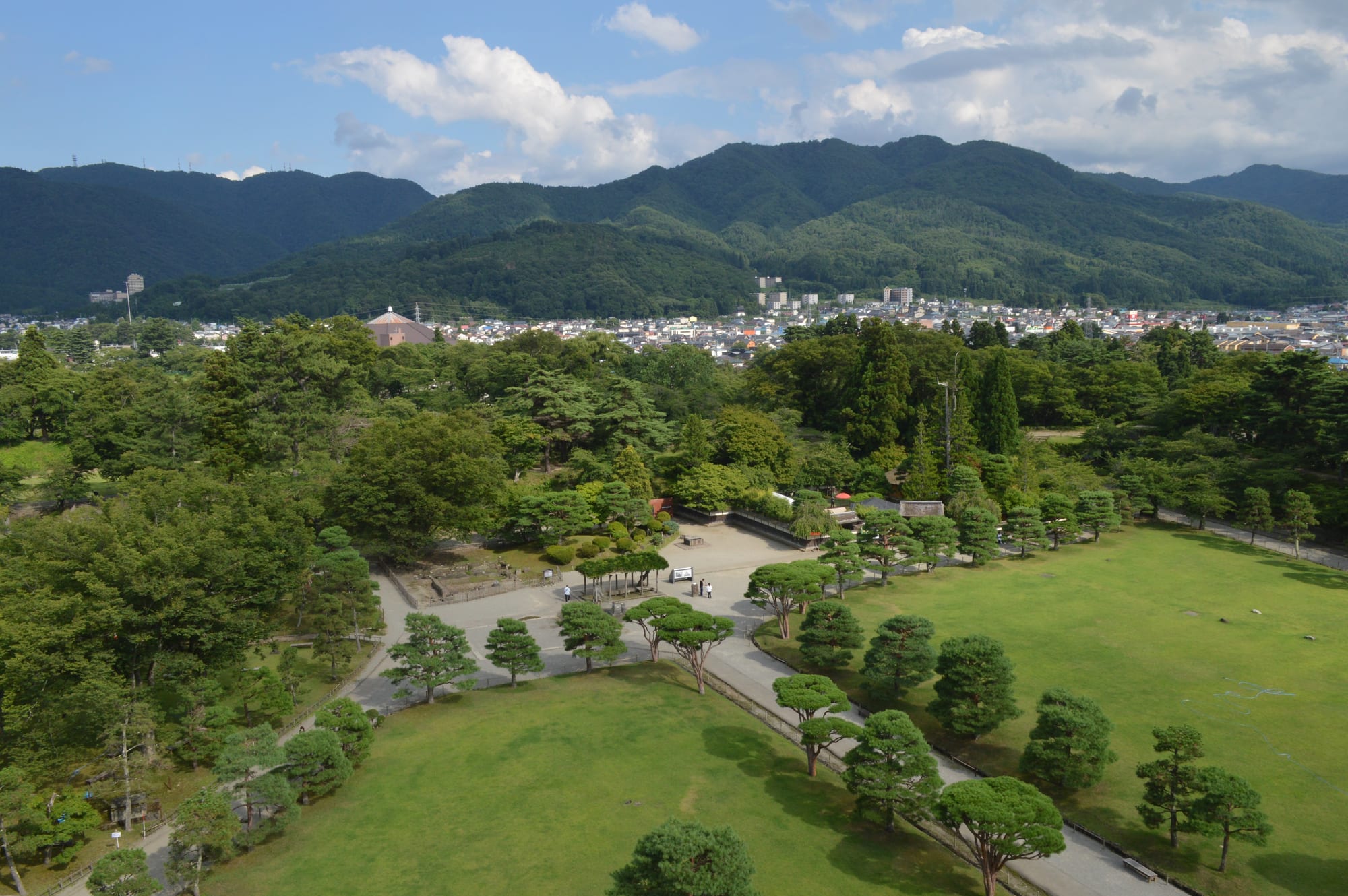
Green castle grounds with clipped pines and lawns in the foreground, the low roofs of a town beyond and forested mountains on the horizon

Tohoku, Japan

Aizuwakamatsu

The grounds of Tsuruga Castle and the town of Aizuwakamatsu, ringed by the mountains of the Aizu basin. (Asturio Cantabrio / Wikimedia Commons · CC BY-SA 4.0)

A castle town in a mountain basin in western Fukushima prefecture, seat of the Aizu domain and of the samurai who fought on the losing side of the Boshin War of 1868. Its rebuilt keep, the graves of the Byakkotai on Mount Iimori, lacquer workshops and sake breweries make it the centre of the Aizu region.

Neighbourhoods

  • The castle quarter
    • First-time visitors
    • Historic district

    The moats, stone walls and park around the rebuilt keep of Tsuruga Castle sit south of the centre, with the Oyakuen garden and a scatter of museums and craft shops a short walk away. It is quiet, green and the part of town most visitors see first.

    Open in Maps
  • Nanokamachi
    • Best for food
    • Shopping
    • Historic district

    The old merchant street running through the centre, lined with early 20th-century shopfronts and storehouses now holding lacquer shops, cafés and restaurants. It is the most walkable stretch of the town and the easiest place to buy Aizu crafts.

    Open in Maps
  • Around Aizu-Wakamatsu Station
    • Close to public transport
    • Budget stays

    The northern end of the centre, where the JR lines and the Aizu Railway meet. Business hotels, chain restaurants and the loop buses for the sights are all here, though the streets themselves are plain.

    Open in Maps
  • Higashiyama Onsen
    • Hot springs
    • Quiet and residential

    A hot-spring quarter in a wooded valley a few kilometres east of the centre, where inns line a narrow river. It has been used for bathing since long before the Meiji era and is where many visitors stay the night.

    Open in Maps
  • Mount Iimori
    • History
    • Walks and viewpoints

    The hill north-east of the centre where the teenage Byakkotai fighters died in 1868, now reached by steps or a slope conveyor. The graves, the spiral Sazaedo hall and a view over the basin are all on its slopes.

    Open in Maps

Things to do

Castle and samurai sites

  • Tsuruga Castlelandmark

    The domain's castle, dismantled in 1874 and rebuilt in concrete in 1965, with a museum inside and red roof tiles restored in 2011 to match the Edo-period originals.

    Open in Maps
  • Mount Iimoriviewpoint

    The hill holding the graves of the Byakkotai, the young Aizu fighters who took their own lives in 1868 on seeing smoke rising over the town.

    Open in Maps
  • Sazaedolandmark

    An unusual wooden hall of 1796 on Mount Iimori, built with a double-helix ramp so that visitors climbing and descending never meet.

    Open in Maps
  • Aizu Bukeyashikimuseum

    A large reconstructed samurai residence on the road to Higashiyama Onsen, furnished to show how a senior retainer's household lived.

    Open in Maps
  • Nisshinkanmuseum

    A reconstruction of the Aizu domain school, where the sons of samurai learned Confucian texts, archery and swimming.

    Open in Maps

Gardens, museums and crafts

  • Oyakuenpark

    A domain garden of the Aizu lords laid out around a pond, once used to grow medicinal herbs, which are still cultivated in its beds.

    Open in Maps
  • Fukushima Museummuseum

    The prefectural museum, beside the castle park, covering the archaeology, folk crafts and history of the Aizu region and Fukushima as a whole.

    Open in Maps
  • Nanokamachi Streetneighborhood

    The old commercial street of storehouses and Taisho-era shopfronts, now the town's main row of lacquerware shops, cafés and small galleries.

    Open in Maps

Hot springs and walks

  • Higashiyama Onsenattraction

    A hot-spring quarter of riverside inns in a valley east of the town, with baths open to day visitors.

    Open in Maps
  • Mount Seaburitrail

    The wooded ridge above Higashiyama, crossed by walking paths that climb from the hot-spring valley to viewpoints over the Aizu basin.

    Open in Maps

Short trips from the town

  • Ouchi-jukuattraction

    A preserved post town on the old road south, where thatched houses line a single unpaved street and soba is eaten with a leek instead of chopsticks.

    Open in Maps
  • Lake Inawashiroattraction

    One of Japan's largest lakes, east of the town beneath Mount Bandai, with swans wintering on its shore and the birthplace of the bacteriologist Hideyo Noguchi nearby.

    Open in Maps
  • Mount Bandaiviewpoint

    The volcano north-east of the lake whose 1888 eruption dammed streams and created the ponds and marshes of the Urabandai plateau.

    Open in Maps
  • Kitakataattraction

    A small city of brick and clay storehouses about twenty kilometres north, known across Japan for its flat, wavy-noodled ramen.

    Open in Maps

Seasonal events

  • Tsuruga Castle cherry blossommid to late April

    Cherry trees flower in their hundreds around the moats and walls of the castle park, with evening illumination.

  • Aizu FestivalSeptember

    The town's main festival, whose procession dresses hundreds of participants as the lords and retainers of the Aizu domain.

  • Aizu Painted Candle FestivalFebruary

    Thousands of the region's hand-painted candles are lit in the snow around the castle and the Oyakuen garden.

Eat and drink

Long-standing places and food districts in Aizuwakamatsu. Hours, ratings and directions come from your maps app, always current.

Aizu classics

  • Kozuyurestaurant

    The region's celebration soup, a clear broth made from dried scallop with taro, carrot, mushroom and beads of wheat gluten, served in small lacquer bowls.

    Open in Maps
  • Sauce katsudonrestaurant

    A breaded pork cutlet dipped in a sweet-savoury sauce and laid on rice with shredded cabbage — the town's everyday dish, served in restaurants across the centre.

    Open in Maps
  • Wappa-meshirestaurant

    Rice steamed in a round bentwood cedar box under salmon, mushrooms or mountain vegetables, a speciality of Fukushima and neighbouring Niigata.

    Open in Maps

Streets and breweries

  • Nanokamachi Streetneighborhood

    The old merchant street, where lacquer shops sit beside cafés, soba restaurants and sweet shops in converted storehouses.

    Open in Maps
  • Aizu sake breweriesneighborhood

    Several long-established breweries work in the town, using rice from the basin and snowmelt water; a number keep shops and tasting counters open to visitors.

    Open in Maps
  • Kitakata ramenrestaurant

    The thick, flat, wavy noodles and light soy broth of the small city to the north, one of Japan's best-known regional ramen styles.

    Open in Maps

Experience Aizuwakamatsu

History

The Aizu basin was fortified in 1384, when the Ashina clan built Kurokawa Castle on the site of the present keep and grew into one of the strongest houses of the northern interior. Date Masamune defeated them in 1589 but held the basin only briefly: Toyotomi Hideyoshi took it from him the following year and gave it to Gamo Ujisato, who rebuilt it in stone in 1592 and renamed it Tsuruga, developed the castle town whose grid still orders the streets, and brought in lacquer workers and brewers whose trades the town lives by to this day.

From 1643 the domain belonged to the Hoshina family, later the Matsudaira, a branch of the Tokugawa house that owed the shogunate a debt of loyalty and made it a matter of principle. Its schooling was famously strict, centred on the Nisshinkan academy, and by the 1860s the lord Matsudaira Katamori was serving as military commissioner in Kyoto for the shogun.

That loyalty destroyed the town. In the Boshin War of 1868, Aizu led the northern alliance against the new imperial government; after defeat in the passes, the castle endured a month-long siege before surrendering. Among the dead were the Byakkotai, a reserve unit of teenage sons of samurai, nineteen of whom took their own lives on Mount Iimori when they saw smoke over the town and believed the castle had fallen. The domain was abolished, many families were exiled to the far north, and the castle was pulled down in 1874. The keep was rebuilt in concrete in 1965, and in 2011 its roof was retiled in the red tiles it had carried in the Edo period.

Culture & Customs

Aizu keeps its defeat as a living identity. The Aizu Festival each September parades hundreds of townspeople dressed as the lords, retainers and boy soldiers of the domain, and schoolchildren still learn the domain's code of conduct, whose closing line — "what must not be done must not be done" — is repeated as a local motto. The Byakkotai graves draw visitors and mourners all year.

The town is also a craft centre. Aizu lacquerware, worked here since the 16th century, is decorated with pine, bamboo and plum and with a gold-flecked technique associated with the region; the akabeko, a nodding papier-mache red cow, is a charm against illness made in the Aizu villages and now a mascot found across Fukushima; and painted candles, decorated with flowers because fresh ones were scarce in the snow, are the subject of the February festival. Martial arts, archery and shrine rituals carried on by old families remain part of local life.

Sake matters as much. The basin's rice, soft snowmelt water and cold winters have made Aizu one of Japan's leading brewing districts, and several breweries in the town open their halls to visitors. Higashiyama Onsen, with its riverside inns and geisha tradition, is where much of the town's hospitality is concentrated, and its dances appear at civic occasions.

Daily Life

About 118,000 people live in Aizuwakamatsu, the main city of western Fukushima and the service centre for a basin of farming villages. The population has been falling for decades as young people leave for Koriyama, Sendai and Tokyo, and the city has responded by courting technology work: the University of Aizu, founded in 1993, specialises in computer science and has spun off software firms that give the town an unusual profile for its size.

The older economy continues alongside it — rice farming in the basin, lacquer workshops, sake breweries, textiles and the tourism built on the castle and the hot springs. Most residents live in low houses and flats spread across the grid north and west of the castle, drive to out-of-town supermarkets, and shop in the centre mainly for crafts and meals out.

Winter shapes the year. Snow falls from December to March, roofs and roads are cleared as a matter of routine, and pavement heating or sprinklers keep the main streets passable. The 2011 earthquake and nuclear accident happened on the far side of the prefecture, but the damage to Fukushima's name cut visitor numbers here for years, and rebuilding that trade has been a long civic project.

Food

Kozuyu is the dish Aizu is known for: a clear soup of dried scallop broth with taro, carrot, mushroom, shirataki and small beads of dried wheat gluten, served in shallow lacquer bowls at New Year, weddings and funerals, and now on restaurant menus all year. Wappa-meshi, rice steamed in a round bentwood cedar box beneath salmon, mushrooms or mountain vegetables, is the other formal local plate.

Everyday eating is led by sauce katsudon, a breaded pork cutlet dipped in a sweet-savoury sauce and set on rice with shredded cabbage, a version of the dish particular to the town. Nishin no sansho-zuke, dried herring pickled with the leaves of the sansho pepper tree in lidded stone boxes, is an old preserve from the days when the basin was far from the sea. Mountain vegetables, buckwheat and freshwater fish fill out the rest of the local repertoire, and at Ouchi-juku to the south soba is eaten with a spring onion used in place of chopsticks.

Aizu is one of Japan's leading sake districts, and the town's breweries sell directly from their halls. Locally the drink goes with grilled Aizu-jidori chicken and pickles; the sweet counterpart is awa-manju, steamed millet buns from nearby Yanaizu, and lacquer-wrapped sweets sold along Nanokamachi. Kitakata's ramen, twenty kilometres north, is close enough to be part of the local diet.

Planning tools

Budget

Aizuwakamatsu is inexpensive by Japanese standards. Business hotels near the station cost little, set lunches are generous, and the main sights charge modest entry fees. The two things that raise a budget are a night in a Higashiyama Onsen inn with dinner and breakfast, and the Shinkansen fare from Tokyo as far as Koriyama.

Daily Budget Midrange
USD 100–190 (onsen inn with dinner, Shinkansen and local train legs, a hire car for Ouchi-juku and the lake)
Daily Budget Shoestring
USD 45–75 (business hotel or guesthouse, noodles and set lunches, local trains and the loop buses)

Onsen inns quote a price per person including two meals, so compare that figure rather than a room rate, and check the local sightseeing bus day tickets.

Best Time to Visit

Late April, when the cherry trees around the castle flower two or three weeks after Tokyo's, and late October to early November, when the basin and the mountains around it turn colour. Summer is hot and humid but brings the September festival season closer; February is deep winter, with snow on the castle walls and the candle festival.

Suggested Number of Days

One full day is enough for the main sights in the town, and a second allows a slower pace and a night at the hot springs. Three or four days suit anyone adding the surrounding villages, lake and mountains, which are much easier with a car.

First Visit
1–2 days
With Surroundings
3–4 days

Transportation

The town is spread out and the sights sit on opposite sides of it. Two sightseeing loop buses run in opposite directions between the station, the castle, Mount Iimori and the road to Higashiyama Onsen, and ordinary city buses cover the rest. Taxis are easy to find at the station, and bicycles can be hired in the centre.

Buses are timed for sightseeing rather than commuting, so check the last departure of the afternoon before setting off for the hot springs or the hill.

Airport & Station Connections

Most visitors come by rail from Tokyo: the Tohoku Shinkansen to Koriyama in about eighty minutes, then the JR Ban'etsu West Line across the mountains to Aizu-Wakamatsu in a little over an hour. Express buses also run from Tokyo, Sendai and Niigata. The Aizu Railway and the Tadami Line, a scenic single track through the mountains, also run from the town.

Walkability

The centre around Nanokamachi is flat and pleasant on foot, but the town covers a wide grid and the castle, the station and Mount Iimori stand a couple of kilometres apart, so most days mix walking with a bus or a bike. Pavements are cleared in winter but can be slushy from December to March.

Safety

Crime is very low and the town is comfortable to walk at night. The practical hazards are snow and ice in winter, heat and humidity in midsummer, and bears in the forested hills. Around the Fukushima Daiichi plant, far to the east on the coast, a small area remains closed; the towns and sights commonly visited in Fukushima prefecture are open and monitored.

Wear shoes with grip in winter, carry a bear bell on forest trails above the town, and drink water in the humid summer. Check current official travel advice before travelling.

Climate

An inland basin climate with a wide annual range. Winters are long and snowy, with cold air spilling over from the Sea of Japan side, while summers are hot and close because the surrounding mountains trap the air. Spring and autumn are short, clear and the most comfortable seasons.

Summer
hot and humid, typically 28–33°C in the afternoon, with warm nights and thunderstorms
Winter
cold and snowy, about -3 to 4°C, with snow lying in the town for weeks and deeper drifts in the hills

Local Customs

Aizu people have a reputation in Japan for formality and stubborn pride in their history, and the domain's old code for children, ending with the phrase 'what must not be done must not be done', is still quoted locally. Shoes come off at the entrance to inns, temples and many restaurants, tattoos may bar entry to some public baths, and bathers wash thoroughly before entering an onsen pool.

Tipping is not practised anywhere in Japan. Keep voices low on trains and buses, and ask before photographing people at the graves on Mount Iimori, which is a place of mourning.

Common Payment Methods

The currency is the Japanese yen. Cards and IC cards are accepted at hotels, chain shops and larger restaurants, but small family-run places, temple entry desks and rural buses often take cash only. Post office and convenience store cash machines accept foreign cards.