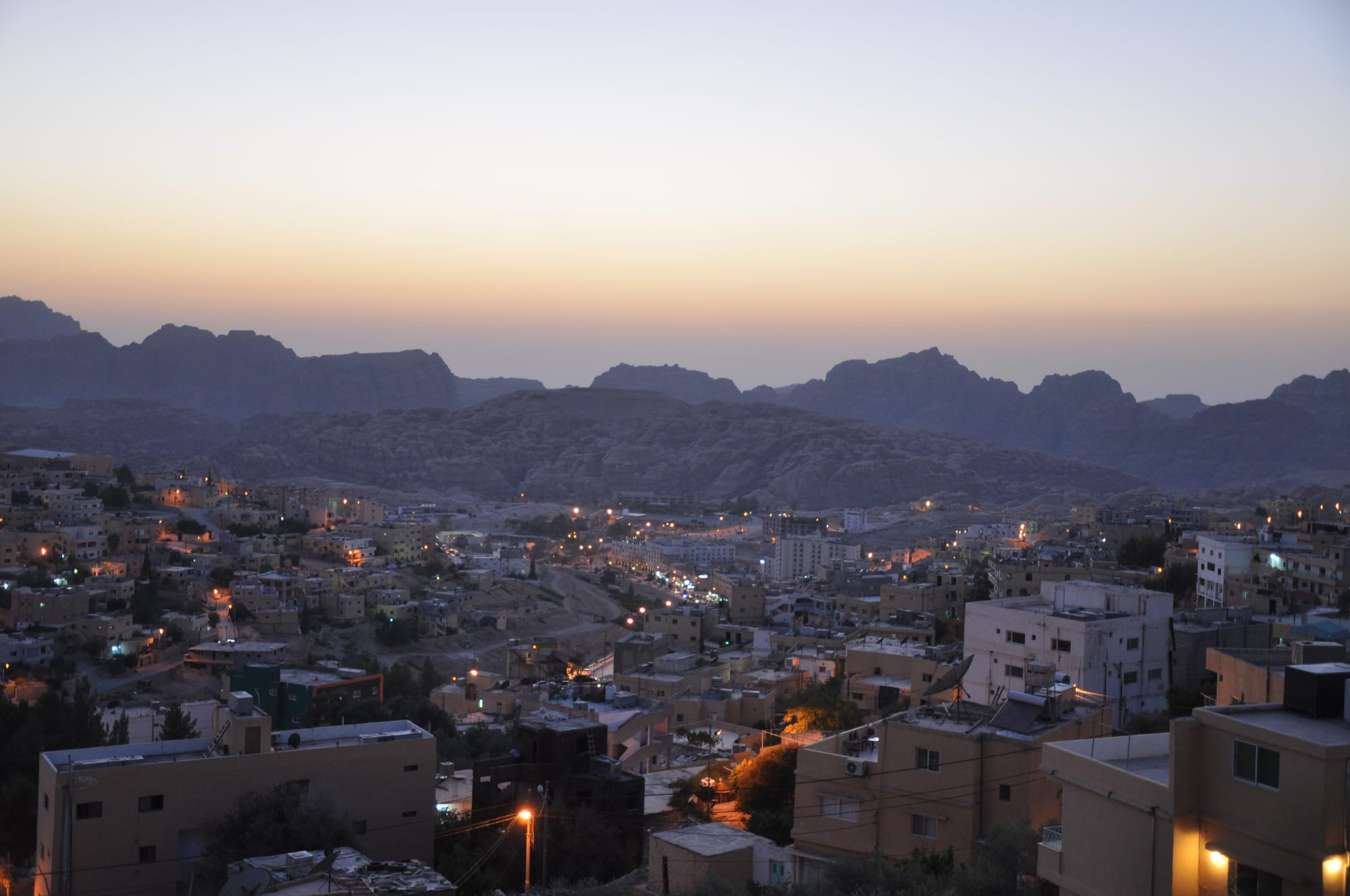
Pale stone houses covering a hillside at dusk, with street lights coming on and layered sandstone mountains behind

Petra, Wadi Rum & the South, Jordan

Wadi Musa

Wadi Musa at dusk, with the sandstone mountains of Petra behind the town. (Jorge Láscar from Australia / Wikimedia Commons · CC BY 2.0)

The town at the gate of Petra, in the Ma'an Governorate of southern Jordan. Its name means 'valley of Moses', after the spring where tradition says Moses struck the rock. Stone and concrete houses climb a long ridge above the Siq entrance, and almost the whole town — hotels, restaurants, guides, drivers and souvenir shops — lives from the Nabataean city below it.

Neighbourhoods

  • The Petra gate and lower town
    • First-time visitors
    • Close to the site
    • Best for food

    The bottom of the valley, where the road ends at the visitor centre and the path into the Siq. Hotels, restaurants, souvenir shops and the taxi and minibus stands are packed into a few hundred metres, and everything is within walking distance of the entrance.

    Open in Maps
  • The ridge and upper town
    • Views
    • Quiet and residential
    • Budget stays

    The long climb of houses, small shops and family hotels up the hillside above the site, strung along the main road. Rooms here are cheaper and the views over the valley and the mountains are wide, but the walk back up from the gate is steep.

    Open in Maps
  • Ain Musa
    • Local life
    • History

    The upper end of the town on the road in from the King's Highway, named after the spring associated with Moses, which is covered by a small domed building beside the road. It is a residential quarter with a scattering of hotels and viewpoints over the valley.

    Open in Maps
  • Umm Sayhoun
    • Local life
    • Back route into Petra

    A village on the far side of the ridge, built in the 1980s for the Bdul, the Bedouin community who until then lived in Petra's caves and tombs. A back road from here reaches the site near the Monastery trail.

    Open in Maps

Things to do

The Petra archaeological site

  • Petralandmark

    The rock-cut Nabataean capital and a UNESCO World Heritage Site, a valley of carved tombs, temples, tracks and stairways beginning a short walk below the town.

    Open in Maps
  • The Siqlandmark

    The narrow, winding gorge, in places only a few metres wide, that forms the main entrance to Petra and ends at the Treasury.

    Open in Maps
  • Al-Khaznehlandmark

    The Treasury, a temple or tomb facade carved into the rose sandstone cliff at the end of the Siq and the best-known image of Jordan.

    Open in Maps
  • Ad Deirlandmark

    The Monastery, a vast carved facade reached by a long rock-cut stairway from the valley floor, with a plateau and viewpoints above it.

    Open in Maps
  • Qasr al-Bintlandmark

    One of the few free-standing buildings left in Petra, a Nabataean temple at the end of the colonnaded street.

    Open in Maps
  • Great Templelandmark

    A large excavated complex beside the colonnaded street, with columns, a theatre-like structure and long flights of steps.

    Open in Maps

Around the town

  • Little Petralandmark

    Siq al-Barid, a small Nabataean settlement of carved facades, dining halls and cisterns in a short gorge north of the town.

    Open in Maps
  • Beidhaattraction

    A Neolithic village site excavated beside Little Petra, one of the earliest known settlements in the region.

    Open in Maps
  • Jabal Haruntrail

    The mountain south-west of Petra identified in tradition as the burial place of Aaron, with a Mamluk-era shrine on its summit marking the traditional tomb of Aaron, and a long walking route to it.

    Open in Maps

Short trips from the town

  • Shobak Castlelandmark

    The crusader fortress of Montréal, founded in 1115, standing on a bare hill north of Wadi Musa on the King's Highway.

    Open in Maps
  • Dana Biosphere Reservepark

    Jordan's largest nature reserve, dropping from highland cliffs through canyons to the desert, about an hour and a half north by road.

    Open in Maps

Eat and drink

Long-standing places and food districts in Wadi Musa. Hours, ratings and directions come from your maps app, always current.

Food streets

  • The Petra gate restaurantsneighborhood

    The cluster of restaurants and hotel dining rooms at the bottom of the valley, serving buffets of maqluba, grilled meats, mezze and salads to visitors coming off the site.

    Open in Maps
  • The main street shawarma and falafel shopsneighborhood

    Small grills, falafel counters and juice shops along the road climbing the ridge, where guides, drivers and residents eat, and bakeries sell flatbread and date-filled ma'amoul.

    Open in Maps

Experience Wadi Musa

History

The valley below the modern town was settled long before Petra: the Neolithic village at Beidha, a few kilometres north, is one of the oldest known settlements in the region, and the spring at Ain Musa has drawn people to the ridge for millennia. From around the fourth century BC the Nabataeans, Arab traders who controlled the incense routes out of Arabia, built their capital in the sandstone basin beyond the gorge and engineered dams, channels and cisterns to carry the valley's water into it. Rome annexed the kingdom in 106 AD, an earthquake in 363 did great damage, and the city faded from outside knowledge for centuries.

Through the Middle Ages and the Ottoman period the settlement above the ruins was a farming village whose terraces of figs, grapes and pomegranates were watered by the spring, while the Bdul lived among the tombs and caves below. The Swiss traveller Johann Ludwig Burckhardt, disguised as a pilgrim, reached the ruins in 1812 and brought them back to European attention, and a slow trickle of scholars and travellers followed.

The town that now carries the name Wadi Musa grew with that traffic. Excavation and study intensified through the twentieth century; in 1985 the Bdul were resettled in the new village of Umm Sayhoun on the ridge, and in December of that year Petra was inscribed as a UNESCO World Heritage Site. Hotels spread down the hillside, the site's entrance and visitor centre were rebuilt, and a village of farmers became a town whose fortunes rise and fall with regional crises and the number of visitors who reach the Siq.

Culture & Customs

Wadi Musa's identity is bound to the site below it. Tribal belonging still orders much of local life: the Liyathnah are long established in the town itself, while the Bdul of Umm Sayhoun keep a distinct identity and a close relationship with Petra, where families have worked as guides, drivers and stallholders for generations. Hospitality follows Bedouin form — small glasses of sweet tea, cardamom coffee poured from a long-spouted pot, an insistence that a guest eat before talking business.

Manners are conservative. Dress covers shoulders and knees for both men and women away from the site, couples are discreet in public, and Friday prayers empty the streets for part of the day. Ramadan reshapes the year: restaurants that serve visitors stay open, but the town turns nocturnal, with families gathering after sunset and the site quieter by day.

Alongside this runs a fluent, multilingual tourist culture unusual in a town of this size. Guides licensed by the Petra authority speak several languages, and schoolchildren practise their English and other languages on visitors. The traditions of Bedouin music — the single-stringed rababa, sung poetry, drumming around a fire — are performed for guests at camps and hotels and still belong to family occasions.

Daily Life

Around 17,000 people live in Wadi Musa, with several thousand more in Umm Sayhoun and the surrounding villages of the Petra district. The town is the administrative centre of its area, with schools, a hospital and government offices, but nearly every household depends in some way on the archaeological site: hotel work, restaurants, taxis, horses and camels, souvenir stalls, guiding and the construction that follows good seasons.

That dependence makes life volatile. Regional conflict, pandemic closures and shifts in air links have each emptied the town's hotels within weeks, and underemployment among young people is a constant concern; families also keep goats, olive terraces and small plots as a hedge. Older residents remember when the valley below was farmland and grazing rather than a ticketed site.

The daily rhythm follows the visitors. Minibuses and taxis take workers down to the gate before the site opens, the main road is busy through the morning, the afternoon heat quietens everything, and the evening brings families out to shops and cafés along the ridge. Water is scarce and supplied on a rota, as in much of Jordan; building continues up the hillside, and the road between the ridge and the gate is the town's spine, its shops and hotels arranged along a climb of several hundred metres.

Food

Eating in Wadi Musa mixes Jordanian home cooking with what the hotels have built for visitors. Maqluba — 'upside down' — appears everywhere: rice layered with chicken or lamb and fried aubergine and cauliflower, cooked in one pot and turned out onto a tray. Mansaf, lamb cooked in a sauce of fermented dried yoghurt called jameed and served over rice and thin shrak bread, remains the dish of weddings, funerals and honoured guests, eaten by hand from a shared platter in the proper form. Grills of chicken, kofta and lamb come with hummus, mutabbal, tabbouleh and pickles.

Bedouin cooking is the other strand. Zarb is meat and vegetables cooked slowly in a covered pit in the ground, usually served at camps and at some hotels on the ridge; shrak, the paper-thin flatbread baked on a domed metal griddle, is folded around everything. Tea is black, very sweet and often flavoured with sage or mint, and coffee is Arabic-style, pale with cardamom and poured in small quantities.

Cheap eating is along the main road: falafel fried to order, shawarma turning in the doorways, foul and hummus for breakfast, and fresh juice. Bakeries sell ma'amoul, the date- or nut-filled semolina biscuits made for feasts, along with knafeh, the shredded pastry and cheese dessert soaked in syrup that Jordanians eat at any hour. Alcohol is confined to hotels and a small number of licensed bars.

Planning tools

Budget

Petra's entry ticket is the single largest cost of a visit to Jordan and is cheaper per day the longer the ticket, or free for holders of the Jordan Pass bought before arrival. Hotel prices in the town rise steeply in spring and autumn and fall in summer and midwinter. Food ranges from cheap falafel and shawarma on the main road to hotel buffets near the gate.

Daily Budget Midrange
USD 130–250 (mid-range hotel, restaurant meals, taxis, guided walks inside the site)
Daily Budget Shoestring
USD 45–80 (hostel or simple guesthouse, falafel and shawarma, shared minibus, Petra ticket spread over several days)

A Jordan Pass covering two or three Petra days usually costs less than a visa plus single-day entry, and must be bought before arriving in the country.

Best Time to Visit

March to May and October to November, when days are warm enough for the long climbs and nights are cool. Spring is the busiest season. Summer makes the stairways to the Monastery and the High Place hard work, and winter brings cold nights, rain and the risk of flash floods in the Siq. The war that began in February 2026 has disrupted aviation and tourism across the region.

Suggested Number of Days

Two days allow the main valley and one of the long climbs without rushing. Three or four suit walkers, or anyone adding the sites north of the town and a slow drive along the King's Highway. Heat, fitness and the number of stairways change the figure more than anything else.

First Visit
2 days
With Surroundings
3–4 days

Transportation

The town is small enough that most travel is between the ridge and the gate, done on foot downhill and by taxi uphill; fares are short and usually agreed before setting off. Taxis and minibuses run to Wadi Rum, Aqaba and Amman, and JETT coaches connect with the capital. Inside Petra there are no vehicles beyond horses, carriages, donkeys and camels offered by the Bdul.

Agree a price before any taxi, horse or carriage ride, and arrange onward transport a day ahead, as departures are few and early.

Airport & Station Connections

Most visitors arrive by road: about three hours from Amman on the Desert Highway, longer and more scenic on the King's Highway, and roughly two hours from Aqaba or from Wadi Rum. JETT runs coach services from Amman and Aqaba, and minibuses serve Ma'an and the nearby towns. The closest airport is King Hussein International at Aqaba; Amman's Queen Alia International is the main gateway to the country.

Walkability

Walkable in the sense that everything lies along one road, but that road climbs several hundred metres from the Petra gate to the top of the town, so walking up is a real effort in the heat. Inside the site, distances are long: the gate to the far end of the colonnaded street is several kilometres on uneven ground, with hundreds of rock-cut steps beyond it. Sturdy shoes matter more here than anywhere else in Jordan.

Safety

The town is used to visitors and generally safe, with a police presence at the site. The real hazards are heat and dehydration, falls on worn rock-cut stairways, and flash floods in the Siq and side wadis after winter rain, when the site can be closed. Souvenir sellers and ride touts inside Petra can be persistent. Since 27 February 2026 the United States and Israel have been at war with Iran and its allies; missiles and drones have been launched at targets in Jordan, and Jordan has reported that its air defences, helped by allied forces, intercepted most of them and that those that were not fell on open or uninhabited ground.

Start walks early with plenty of water, heed flood warnings and site closures, and take a guide for the less-used trails. Check current official travel advice before travelling.

Climate

A highland climate at around 1,000 metres, dry for most of the year, with hot days and cool nights in summer and cold nights in winter. Rain falls mainly between November and March, sometimes heavily enough to flood the gorges.

Summer
hot and dry, typically 30–35°C by day, with strong sun in the open parts of the valley and much cooler nights
Winter
cool to mild days around 10–15°C, cold nights near freezing, occasional rain and rare snow

Local Customs

This is a conservative, tribal town where modest dress — covered shoulders and knees — is expected off the archaeological site as well as on it. Tea and cardamom coffee are offered constantly and refusing outright is unusual; accepting a small glass is the polite response. Bargaining is normal in souvenir shops. Many of the guides, drivers and stallholders in the valley belong to the Bdul, and asking before photographing people is expected.

Tips of a few dinars are usual for guides and drivers; alcohol is limited to hotels and a few licensed bars, and drinking is not public. Friday is the main day of prayer and rest.

Common Payment Methods

The currency is the Jordanian dinar, pegged to the US dollar. Hotels and the larger restaurants take cards, but small shops, taxis, tips and rides inside the site are cash. ATMs are on the main road and near the gate; there are none inside Petra itself, so it is worth carrying the day's cash down to the gate.