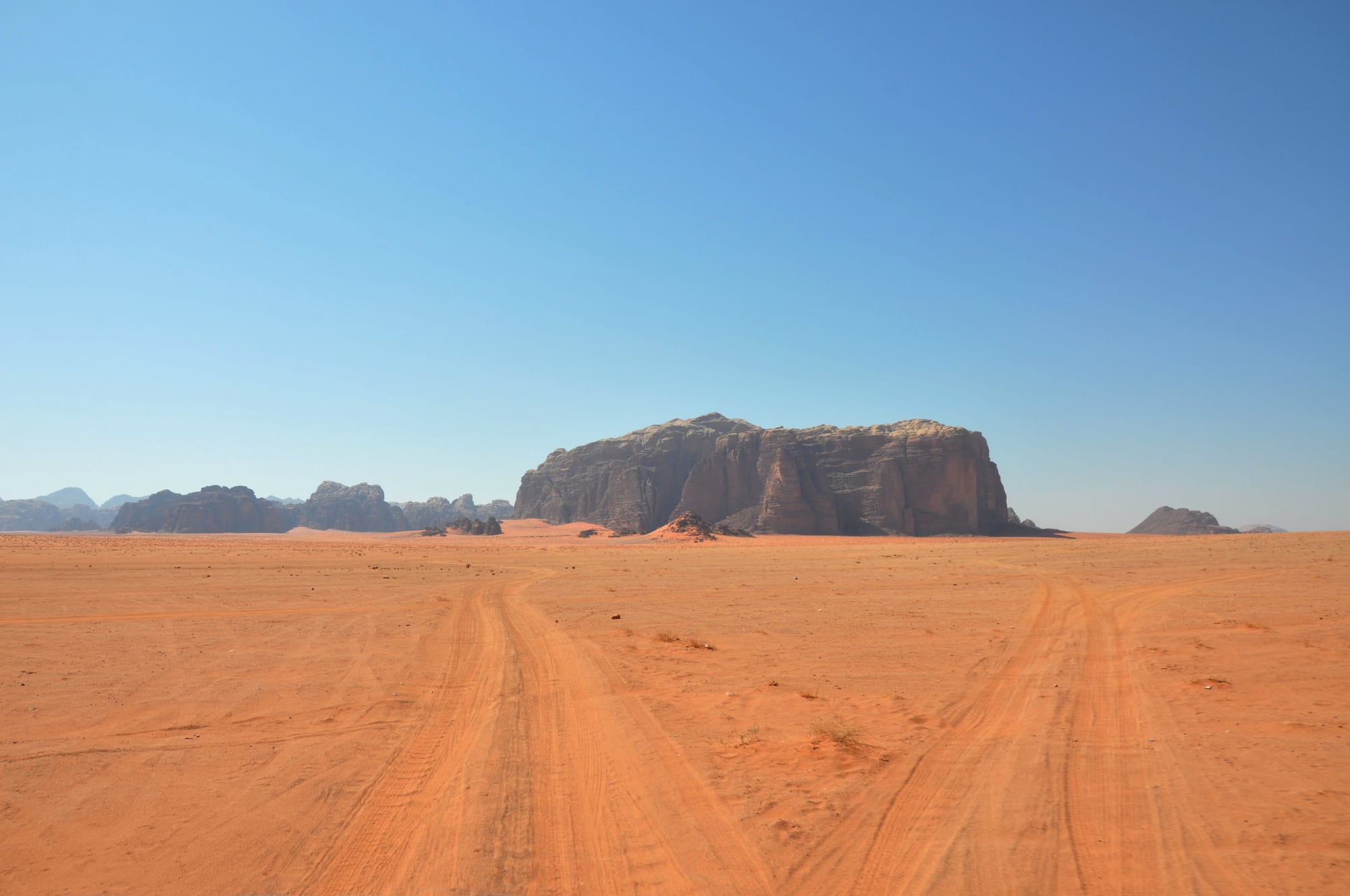
Tyre tracks crossing flat orange sand towards a massive sandstone outcrop under a clear blue sky

Jordan

Petra, Wadi Rum & the South

Orange sand and sandstone massifs in the Wadi Rum desert, east of Aqaba. (Jorge Láscar / Wikimedia Commons · CC BY 2.0)

Jordan's thinly populated south, from the highland villages of Tafilah and the cliffs of the Dana Biosphere Reserve through the Nabataean city of Petra and the crusader castle of Shobak to the red sands of Wadi Rum and the country's only seaport at Aqaba — the region most visitors come to Jordan to see.

Explore Petra, Wadi Rum & the South

History

The south was the land of Edom in the Iron Age, with towns such as Busayra in the Tafilah highlands, and copper was mined and smelted at Wadi Feynan from very early times. From around the fourth century BC the Nabataeans, Arab traders who controlled the incense routes from Arabia, settled Petra and later made it their capital, carving tombs and temples into its sandstone and engineering dams and channels to store rainwater. Rome annexed the kingdom in 106 AD, and Petra continued as a provincial city until trade shifted and an earthquake in 363 damaged it badly; by the Middle Ages it was largely forgotten outside the region. The Swiss traveller Johann Ludwig Burckhardt reached it in disguise in 1812 and made it known in Europe.

Aqaba, ancient Aila, was a Red Sea port under Rome and grew into the early Islamic town of Ayla. The Crusaders pushed into the region in the 12th century, building Shobak Castle in 1115 and a post on the Wadi Musa, until Saladin took Shobak in 1189. The Mamluks refortified Aqaba, and pilgrims to Mecca passed through Ma'an for centuries.

The region's modern story begins with the Arab Revolt: Arab forces with T. E. Lawrence took Aqaba from the Ottomans in 1917 and fought at Tafilah in 1918, and in 1920 Emir Abdullah arrived at Ma'an before moving north to Amman. Aqaba became Jordan's outlet to the sea, extended by a 1965 border exchange with Saudi Arabia, and the Petra and Wadi Rum tourist economy grew after Petra's UNESCO listing in 1985.

Culture & Customs

This is Bedouin country more than anywhere else in Jordan. The Bdul, who once lived in Petra's caves, were moved to the village of Umm Sayhoun in the 1980s and still run much of the site's trade in donkeys, camels and souvenirs, while the Zalabia and other tribes of Wadi Rum guide visitors, drive the jeeps and host the camps. Tribal belonging, hospitality to guests and the shared pot of cardamom coffee remain central, and camp evenings often end with the rababa, the Bedouin fiddle, and songs around the fire.

The highland towns of Tafilah, Shobak and Ma'an are farming and tribal communities, conservative in dress and manners, where visitors are expected to dress modestly and couples to be discreet. Ma'an has a reputation for independence and has at times clashed with the authorities.

Aqaba is more mixed and relaxed, a port and resort city with workers from across Jordan and Egypt, beach clubs and a seafront where families picnic late into the evening. Across the south, the hajj season and Ramadan still shape the year, and the Bedouin keep a detailed knowledge of the desert's plants, wells and paths.

Daily Life

Aqaba, with roughly 150,000 people, is the south's only large city, a special economic zone with the country's port and phosphate exports and a growing resort strip towards the Saudi border. Ma'an is the largest inland town; Wadi Musa, beside Petra, lives almost entirely from tourism, and Tafilah, Shobak and Rum village are small.

Outside tourism, the economy rests on phosphate mining around Shidiya, the port, government jobs and the army, and herding and farming in the highlands, where Shobak is known for apples and Tafilah for olives and figs. Unemployment is high, and tourism's ups and downs with regional crises hit Wadi Musa and Wadi Rum hard.

Days in the desert start before sunrise and pause in the midday heat; guides and camp workers often live in Rum village or Wadi Musa and head out with the visitors. In Aqaba, the evening walk on the corniche is the social hour.

Food

The desert's signature is zarb, meat cooked slowly in a pit in the ground in the Bedouin way. Bedouin cooks also bake shrak, thin flatbread on a metal griddle, and brew sweet black tea with desert sage. Mansaf remains the dish of weddings and guests here as everywhere in Jordan.

Aqaba cooks from the Red Sea. Sayadieh, fish and rice spiced with cumin and fried onions, is served alongside grilled fish and prawns chosen from the counter in harbour restaurants. The highlands produce apples and stone fruit around Shobak, and olives, figs and grapes around Tafilah.

In Wadi Musa, restaurants and hotel buffets serve maqluba and grills to visitors, and bakeries sell the date-filled ma'amoul biscuits. Alcohol is available in tourist hotels and cheaply in Aqaba's shops, but the local drinks are cardamom coffee and tea.

Attractions & Natural Wonders

Petra is the centrepiece: the Siq to the Treasury, then the Roman-style theatre, the Royal Tombs, the colonnaded street and the Great Temple, with a long stairway climb to the Monastery, the High Place of Sacrifice and viewpoints over Wadi Araba. Little Petra, Siq al-Barid, lies a few kilometres north. Shobak Castle stands on its hill further north on the King's Highway, and beyond it the Dana Biosphere Reserve, run by the Royal Society for the Conservation of Nature, drops from Dana village through the Wadi Dana canyon to the Feynan ecolodge in the desert below.

Wadi Rum, a UNESCO World Heritage Site rich in ancient rock art, is a desert of sand valleys and massifs such as Jebel Rum and the Seven Pillars of Wisdom, with the inscriptions of Khazali canyon, natural rock bridges, dunes and Jebel Umm ad Dami, Jordan's highest peak, near the Saudi border. Films including Lawrence of Arabia and The Martian were shot here.

Aqaba's Red Sea coast has coral reefs close to the shore in the Aqaba Marine Reserve and more than thirty dive sites, as well as the Mamluk fort and the ruins of early Islamic Ayla in town.

Cities in Petra, Wadi Rum & the South

Planning basics

Budget

The south concentrates Jordan's biggest tourist costs: Petra's entry fee is high unless covered by the Jordan Pass, and Wadi Musa's hotels rise in price in spring and autumn. Wadi Rum camps range from simple tents with dinner included to costly domed "Martian" camps, and jeep tours are priced per vehicle. Aqaba is a special economic zone with lower taxes, which makes shopping and alcohol cheaper than elsewhere.

Daily Budget Midrange
USD 130–250 (mid-range hotel or comfortable camp, restaurant meals, private jeep or diving)
Daily Budget Shoestring
USD 50–80 (Wadi Musa hostel or simple Rum camp with meals, buses, shared jeeps)

Buy a Jordan Pass with two or three Petra days; one day is not enough for the Monastery and the high trails.

Safety

The south is generally safe and used to visitors, with a strong police presence at Petra and Aqaba. The real hazards are heat, dehydration and falls on Petra's long rock-cut stairways, flash floods in the Siq and the desert wadis after winter rain, and getting lost in Wadi Rum without a guide. Touts at Petra can be persistent, and Ma'an has seen occasional local unrest.

Start Petra walks early with plenty of water, heed flood warnings and closures, and explore Wadi Rum only with a licensed local guide. Check current official travel advice before travelling.

Climate

The south is the most varied part of Jordan. Shobak, Tafilah and Dana's upper village sit well over 1,000 metres up and have cold winters with occasional snow; Petra, a little lower, is warm by day and chilly at night outside summer. Wadi Rum is desert, hot by day and cold after dark, and Aqaba on the Red Sea is hot for much of the year and warm and sunny in winter.

Summer
hot and dry, 30–35°C at Petra and Wadi Rum; often above 40°C in Aqaba
Winter
cold nights and sometimes snow in the highlands; mild days at Petra and Wadi Rum; around 20–24°C in Aqaba

Transportation

The fast Desert Highway runs from Amman to Aqaba in about four hours, and the slower King's Highway passes Tafilah, Dana and Shobak on the way to Wadi Musa. JETT coaches and minibuses link Amman, Petra and Aqaba, and Petra to Wadi Rum or Aqaba takes roughly two hours by road. Aqaba has an international airport and a land crossing to Eilat. Inside Wadi Rum, travel is by Bedouin-driven 4x4.

Arrange Wadi Rum transport through the camp in advance, and allow a full day to drive the King's Highway via Dana and Shobak.

Best Time to Visit

March to May and October to November are best for Petra, Dana and Wadi Rum, with comfortable hiking temperatures and clear skies; spring is the busiest season at Petra. Winter suits Aqaba and daytime desert trips but brings cold nights at camps and in Wadi Musa. Summer makes the Petra climbs hard work and is quieter as a result.