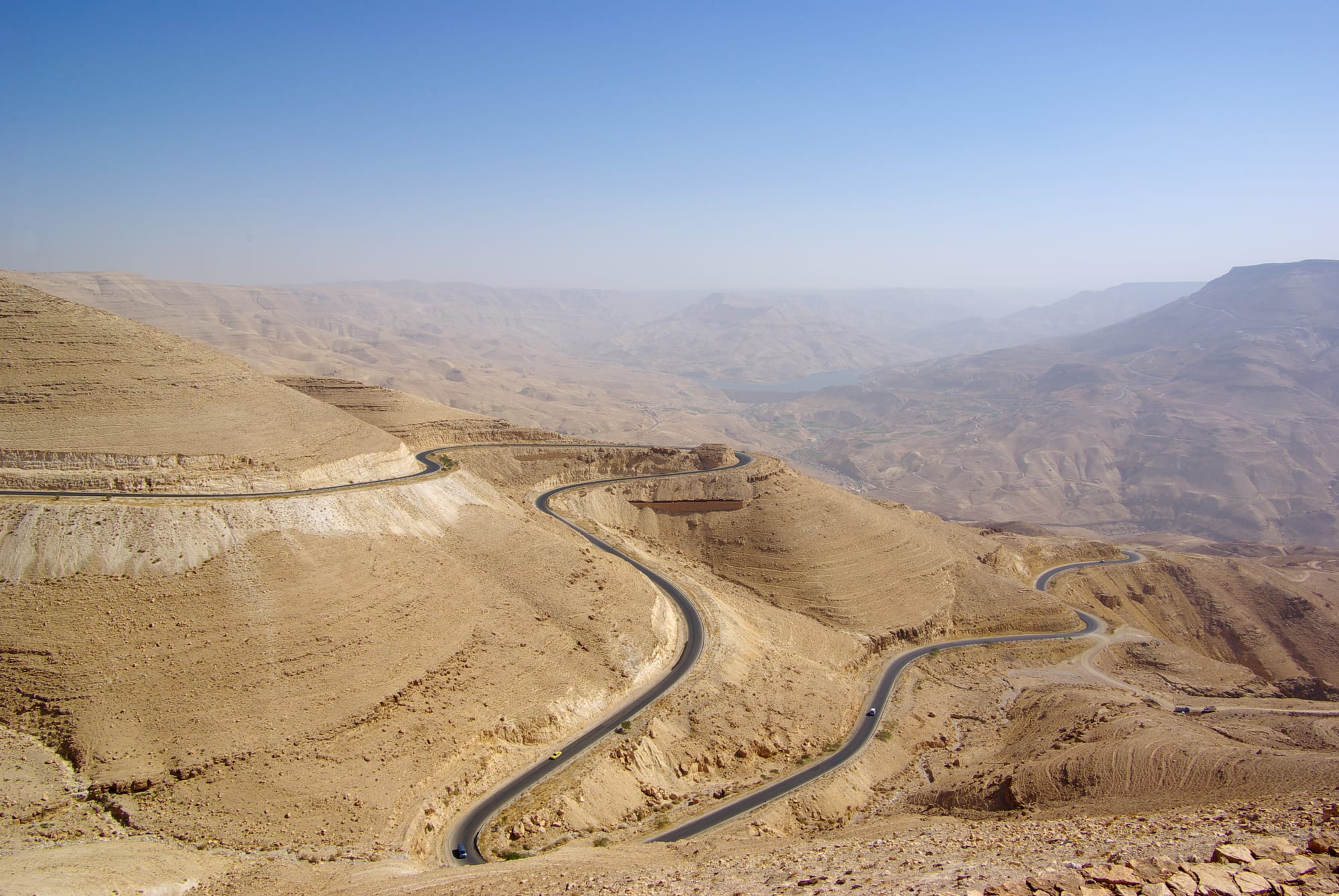
A road winding in hairpin bends down the bare, pale slopes of a wide desert canyon, with a reservoir in the haze below

Jordan

Amman, the Dead Sea & the North

The King's Highway descending into Wadi Mujib, the great canyon between Madaba and Karak. (Berthold Werner / Wikimedia Commons · CC BY 3.0)

Jordan's populated heartland, running from the capital Amman north through the olive hills of Jerash, Ajloun and Irbid to the Syrian border, east to the basalt desert and its Umayyad castles, and south-west down to the Dead Sea, Madaba and the crusader stronghold of Karak — home to the great majority of Jordanians.

Explore Amman, the Dead Sea & the North

History

The north was settled long before the Romans. Amman was Rabbath Ammon, capital of the Ammonites, and the plateau around Karak and Dhiban was the kingdom of Moab, whose King Mesha recorded his victories on the Mesha Stele found at Dhiban in 1868. Under the Hellenistic and Roman empires, Amman became Philadelphia, and Gerasa (Jerash), Gadara (Umm Qais) and Pella joined the Decapolis, a league of Greek-speaking cities; Jerash grew rich on the trade that Rome's annexation of Nabataea in 106 AD brought through the region. Byzantine Christianity then covered Madaba and Mount Nebo with mosaic-floored churches.

After the Muslim victory over Byzantium at the Yarmouk River in 636, the Umayyad caliphs of Damascus built bathhouses, hunting lodges and caravan halts in the eastern desert, among them Qusayr Amra and Qasr Kharana. The Crusaders built Karak Castle in the 1140s to control the road from Damascus to Egypt; Saladin's forces took it in 1188, while his general had raised Ajloun Castle a few years earlier.

Under the Ottomans the area was a thinly held frontier until Circassian refugees resettled the ruins of Amman from 1878 and the Hejaz Railway arrived in the 1900s. Salt was the Ottoman administrative centre until Emir Abdullah made Amman the capital of Transjordan in 1921. Palestinian refugees in 1948 and 1967, fighting between the army and Palestinian armed groups in 1970, and later the arrival of Iraqis and Syrians, turned Amman into a large city.

Culture & Customs

The north is where Jordan's many strands meet. Amman's population includes many families of Palestinian origin, alongside East Bank families, Circassians and Chechens whose ancestors settled Amman and Zarqa from the 1870s and the 1900s, and newer Iraqi and Syrian communities. The large refugee camps founded after 1948 and 1967, such as Baqa'a north of Amman, have long since become crowded urban districts.

Christian communities are rooted here: in Madaba, Fuheis and Salt, and among old Karak families, church bells and mosques share the same streets, and Christmas is a public celebration. Salt's golden limestone merchant houses and its tradition of hospitality between faiths earned it a UNESCO World Heritage listing in 2021. The tribes of Karak and Balqa keep a strong sense of lineage and honour, and tribal elders still mediate disputes.

Amman is conservative in its eastern districts and relaxed in its western ones, where cafés on Rainbow Street and in Jabal al-Weibdeh stay busy late, especially on Ramadan nights. The Jerash Festival brings music and dance into the Roman theatres every year, and weddings bring out the dabke line dance and the red and white shemagh headscarf.

Daily Life

Greater Amman holds around five million people, spread over hills that divide the poorer, older east from the richer west. Zarqa, the industrial city to the north-east, and Irbid, a university city near the Syrian border, each have several hundred thousand people; Salt, Madaba, Mafraq, Jerash, Ajloun and Karak are smaller.

Amman runs the country's government, banking, IT and services; Zarqa has the oil refinery and much of its industry; the Jordan Valley grows vegetables and bananas for the whole country; and the northern hills are olive country. Mafraq governorate hosts the Za'atari camp, home to tens of thousands of Syrian refugees, and many more live in the cities, adding pressure on rents, jobs and schools. Water is rationed and delivered to rooftop tanks, and traffic in Amman is a constant complaint.

The week ends on Friday, with family lunches after noon prayers. Evenings bring families to the malls, the Citadel and, in summer, to picnics in the Ajloun and Dibeen forests.

Food

Karak claims mansaf, the national dish of lamb cooked in jameed — dried, fermented yoghurt — over rice and bread, and its hard white balls of jameed are prized across the country. In Amman, downtown restaurants serve falafel, hummus and foul (stewed fava beans) from early morning, and the old sweet shops sell knafeh, warm cheese pastry soaked in syrup, by the tray. Maqluba, musakhan (roast chicken on onion-heaped flatbread) and mulukhiyah stew reflect the city's Palestinian heritage, and Circassian families keep their own dishes and cheeses.

The hills of Ajloun, Jerash and Irbid produce much of Jordan's olive oil, pressed each November, and the north is known for fresh labneh, za'atar and dried figs. The Jordan Valley supplies tomatoes, aubergines and bananas; galayet bandora, tomatoes fried with onion and chilli, is the simplest of everyday meals.

Tea with mint or sage and cardamom coffee are the daily drinks. Jordan's two wineries, Zumot and Haddad, grow their grapes on the high basalt plateau of Mafraq, and arak is sold in Amman's liquor shops and hotels.

Attractions & Natural Wonders

Amman's sights start at the Citadel, with the Temple of Hercules, the Umayyad palace, with the Jordan Museum lower in the city, then drop to the Roman theatre, the downtown souks and the Grand Husseini Mosque. North of the capital, Jerash has Hadrian's Arch, the Oval Plaza, the Cardo, the Temple of Artemis and two theatres. Ajloun Castle surveys the Jordan Valley from its hilltop beside the Ajloun Forest Reserve, and Umm Qais, ancient Gadara, looks from its ridge across to the Sea of Galilee and the Golan, with Pella lower down in the valley.

East of Amman, the desert castles — Qasr Kharana, the frescoed Qusayr Amra, Qasr al-Hallabat and the black basalt fort at Azraq, where T. E. Lawrence wintered in 1917–18 — lie on a loop with the Azraq wetland; the basalt ruins of Umm el-Jimal stand near Mafraq.

South-west, Madaba's Church of St George holds the mosaic map of the Holy Land, and Mount Nebo's Franciscan church looks towards Jericho. The Dead Sea resorts at Sweimeh sit near the baptism site of Bethany beyond the Jordan, with the hot springs of Ma'in and Herod's hilltop fortress of Machaerus in the hills above. Wadi Mujib's canyon, protected as a nature reserve, offers wading trails up its sandstone siq, and the crusader castle at Karak crowns the King's Highway beyond.

Cities in Amman, the Dead Sea & the North

Planning basics

Budget

Amman is the most expensive city in Jordan, especially in the western districts of Abdoun and Sweifieh, but downtown's falafel and hummus restaurants, cheap hotels and shared taxis keep costs low. The Dead Sea resorts are the priciest stays in the region; Madaba, Jerash and Ajloun have good-value guesthouses. Most sites, including Jerash, Karak and the Amman Citadel, are covered by the Jordan Pass.

Daily Budget Midrange
USD 110–240 (mid-range hotel or a Dead Sea resort night, restaurant meals, car hire or driver)
Daily Budget Shoestring
USD 40–70 (Amman or Madaba guesthouse, downtown food, minibuses and shared taxis)

Base in Madaba rather than Amman to be close to the airport, the Dead Sea and the King's Highway at lower prices.

Safety

The region is generally calm and welcoming, with low crime and visible security at hotels and sites. The northern and north-eastern border with Syria, in Irbid and Mafraq governorates, is a sensitive military area, and the far eastern desert is sensitive. Flash floods in the wadis around the Dead Sea can be dangerous, and the Dead Sea itself demands care.

Keep away from the Syrian border area, avoid wadis in rain and follow closures at Wadi Mujib, and keep the head above the Dead Sea water. Check current official travel advice before travelling.

Climate

Height makes the difference. Amman and the northern hills of Jerash, Ajloun and Irbid have warm dry summers and cool, wet winters, with snow some years, and Ajloun is the greenest corner of the country. The Jordan Valley and the Dead Sea, about 430 metres below sea level, are hot most of the year, and the eastern desert around Azraq swings from very hot days to cold nights.

Summer
warm and dry, 28–33°C in Amman and the hills; above 40°C common at the Dead Sea
Winter
cool and wet in Amman and the north, 5–13°C, with occasional snow; mild, 20–24°C, at the Dead Sea

Transportation

Queen Alia International Airport lies south of Amman. Minibuses from Amman's northern bus station reach Jerash, Ajloun and Irbid, and Madaba is close to the airport; JETT coaches serve the main routes. The Dead Sea, the desert castles, Wadi Mujib and Karak are much easier by hired car or driver, taking the scenic King's Highway or the faster Dead Sea road south. Amman's traffic is heavy and its hills steep.

Hire a car or driver for a day loop of the desert castles, which have no public transport.

Best Time to Visit

March to May and October to November for the Roman sites, the hills and walking; spring brings wildflowers to Ajloun and Umm Qais. The Dead Sea is best from October to April, when summer's heat has gone. The Wadi Mujib water trails suit the warm, dry months, and Jerash's annual festival fills the ruins.