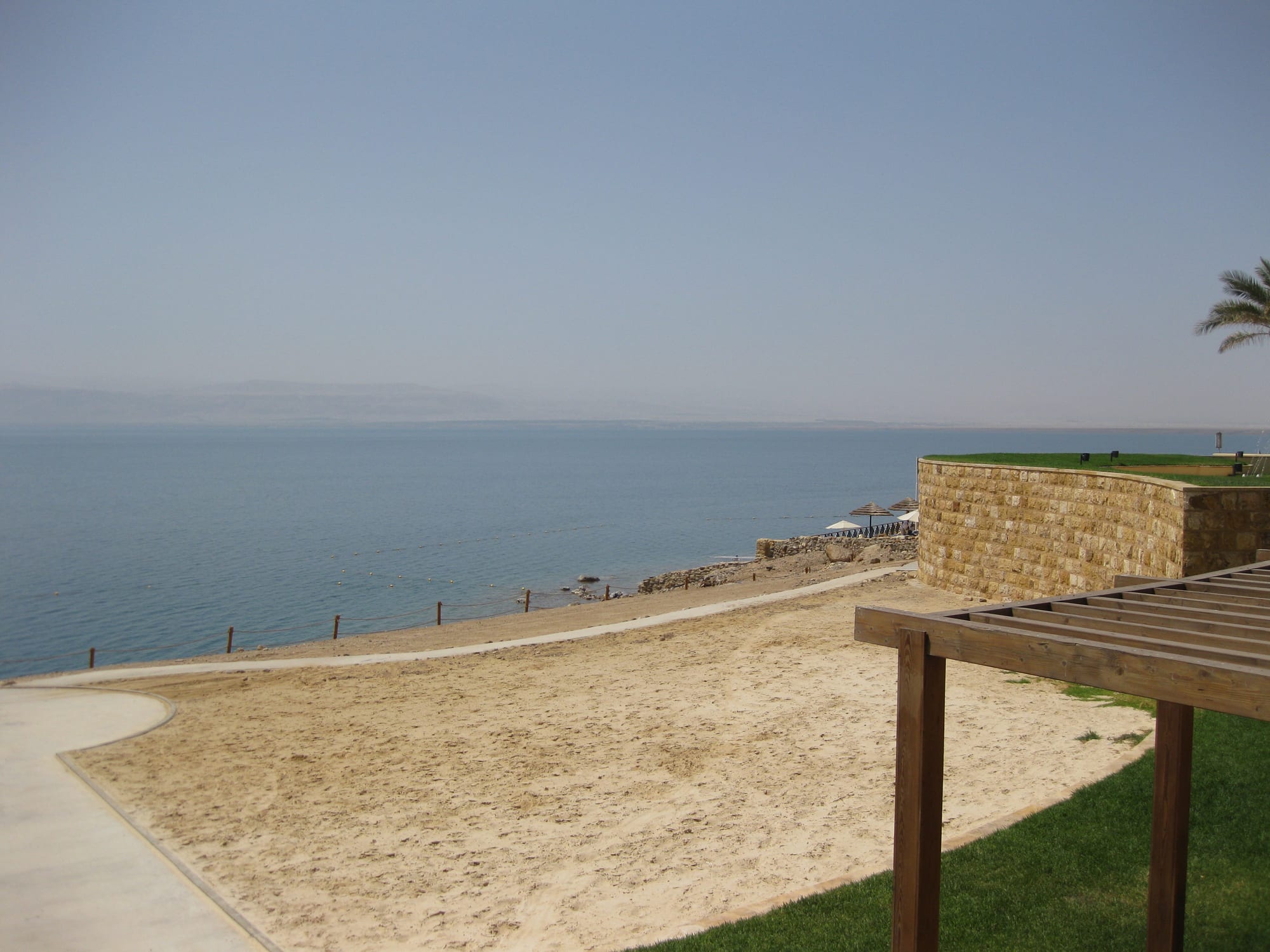
A sandy resort beach on the Dead Sea with pale blue water, a stone terrace and lawn in front and hazy hills across the lake

Amman, the Dead Sea & the North, Jordan

Sweimeh

The Dead Sea shore at the resort strip on the Jordanian side. (Producer (talk) / Wikimedia Commons · CC BY 2.5)

A village and resort strip on the north-eastern shore of the Dead Sea, more than 430 metres below sea level at the foot of the Moab hills. Once a farming village on the Jordan Valley floor, it became Jordan's main Dead Sea destination from the 1990s, with spa hotels, public beaches and salt flats along a short stretch of shoreline.

Neighbourhoods

  • The hotel strip
    • First-time visitors
    • Spas and pools
    • Beaches

    A few kilometres of large resorts set in gardens along the shore, each with private beach access, freshwater pools and spa treatments using Dead Sea mud and salt. Almost all overnight visitors stay here, and the hotels are largely self-contained.

    Open in Maps
  • The public beach area
    • Day trips
    • Families
    • Budget

    Managed public beaches near the resorts, with changing rooms, showers and shaded seating, used by Jordanian families on Fridays and by day visitors from Amman. Simpler than the hotels and much cheaper.

    Open in Maps
  • Sweimeh village
    • Local life
    • Quiet and residential

    The settlement inland from the shore, where most of the area's residents live and work, with small shops, a mosque and houses among irrigated fields. Few visitors go there, but it is the reason the place has a name.

    Open in Maps
  • The Dead Sea highway
    • Views
    • Drives

    The road running south along the shore below the escarpment, passing salt flats, potash works, wadi mouths and lay-bys with views across the lake towards the hills of the West Bank.

    Open in Maps

Things to do

The shore

  • The Dead Seabeach

    A hypersaline lake whose shores are the lowest land on Earth, about nine times as salty as the ocean and so dense that bathers float; the mud along the shore is used for skin treatments.

    Open in Maps
  • Dead Sea beachesbeach

    Public and hotel beaches with freshwater showers, essential after bathing because the brine dries to a crust and stings any cut or graze.

    Open in Maps
  • The salt flats and shorelineviewpoint

    White salt crusts, crystallised formations and abandoned jetties mark a shoreline that has retreated a long way as the lake level falls.

    Open in Maps

Short trips from the shore

  • Bethany Beyond the Jordanlandmark

    The baptism site on the east bank of the Jordan River north of the resorts, a UNESCO World Heritage Site with churches, pools and pilgrim chapels.

    Open in Maps
  • Mount Nebolandmark

    The ridge above the valley where Moses is said to have seen the Promised Land, with a Franciscan memorial church over Byzantine mosaic floors.

    Open in Maps
  • Ma'in Hot Springsattraction

    Thermal waterfalls in a gorge in the hills above the lake, where hot mineral springs fall over dark rock into bathing pools.

    Open in Maps
  • Wadi Mujibpark

    A deep canyon entering the Dead Sea to the south, protected as the Mujib Biosphere Reserve, with water trails up its narrow sandstone siq in the warm months.

    Open in Maps
  • Madabaattraction

    The mosaic town on the plateau above, known for the sixth-century map of the Holy Land in its Greek Orthodox church.

    Open in Maps
  • Machaeruslandmark

    A hilltop fortress palace overlooking the Dead Sea, linked by Josephus to the imprisonment and death of John the Baptist.

    Open in Maps

Eat and drink

Long-standing places and food districts in Sweimeh. Hours, ratings and directions come from your maps app, always current.

Eating on the shore

  • Resort restaurants and buffetsneighborhood

    The hotels run buffet and à la carte restaurants serving mezze, grills and international dishes, and are licensed, which makes them the main places to eat and drink on this stretch of shore.

    Open in Maps
  • Roadside cafés on the Dead Sea highwayneighborhood

    Simple cafés and snack stands near the public beaches sell tea, coffee, sandwiches and grilled chicken to day visitors from Amman.

    Open in Maps

What is eaten here

  • Mezze and grilled fishrestaurant

    Hummus, mutabbal, tabbouleh and fattoush precede grilled lamb and chicken; farmed tilapia from the Jordan Valley appears on some menus, as the Dead Sea itself holds no fish.

    Open in Maps
  • Jordan Valley fruit and vegetablesmarket

    The irrigated valley behind the shore grows tomatoes, cucumbers, aubergines, citrus and bananas, sold from roadside stalls in winter and spring.

    Open in Maps

Experience Sweimeh

History

The northern end of the Dead Sea has been inhabited far longer than the resorts suggest. The plain around Sweimeh sits at the mouth of the Jordan River, in a valley that carried traffic between Jerusalem, the Moabite plateau and the desert, and the area has been identified with several biblical episodes: the village itself is commonly identified with Beth-jeshimoth, and the crossing of the Jordan and the baptism of Jesus are placed a short distance north, at the excavated site known as Bethany beyond the Jordan. Byzantine hermits and pilgrims lived along this shore, leaving churches and cave monasteries behind them.

For most of the Ottoman period the settlement was small: a farming village on the valley floor, dependent on springs and on the irrigated land behind the beach, in a place too hot and too salty to attract many people. After 1948 and again after 1967 the Jordan Valley became a militarised frontier, and the shore was largely closed to ordinary travel for years, with farming disrupted and villages emptied.

The modern resort strip dates from the 1990s, when peace agreements and government investment opened the shore to tourism. Large hotels were built along a short stretch of beach, a spa industry grew around Dead Sea mud and mineral salts, and Sweimeh became the address for conferences and summits, with the King Hussein Bin Talal Convention Centre built beside the hotels. Since then the lake itself has become the story: its level has fallen by more than a metre a year as the Jordan's water is diverted and minerals are extracted, so hotels that once stood on the beach now look down at a shoreline some way below them.

Culture & Customs

Sweimeh has two overlapping cultures. Inside the hotel gates it is international: staff from across Jordan and beyond, spa treatments, poolside service, buffet dining, conferences and weddings, with swimwear and alcohol taken for granted. Outside, it is a Jordan Valley village, Muslim and conservative, where families farm, work in the hotels and follow the rhythms of prayer, Ramadan and Friday rest like the rest of the country.

The public beaches are where the two meet. On Fridays and holidays Jordanian families arrive from Amman for the day, spreading mats, cooking, smoking shisha and floating in the water fully dressed; the atmosphere is sociable and noisy, and quite different from the quiet of the hotel beaches a few hundred metres away. Mud is applied communally, left to dry to a grey crust and washed off with a great deal of laughing, a ritual that everyone performs regardless of background.

Pilgrimage runs alongside tourism. Groups visiting the baptism site, Mount Nebo and Machaerus often stay on this shore, and coaches of Christian pilgrims are a common sight on a road that also carries potash lorries. The usual Jordanian courtesies apply everywhere: greetings before business, insistent hospitality, the right hand used for eating, and modest dress once away from the beach. Bargaining is not expected in the hotels but is normal with beach vendors selling mud, salt scrubs and souvenirs.

Daily Life

Sweimeh itself is a village of about 5,000 people in the Balqa Governorate, and the resident population is far smaller than the number of visitors on a busy weekend. Most working residents are employed by the hotels, the beaches and the businesses that supply them, or farm the irrigated land behind the shore, where the warmth of the valley brings tomatoes, cucumbers, aubergines, citrus and bananas to market in winter, months before the plateau.

The working day starts very early and pauses in the afternoon heat, which for much of the year makes outdoor work impossible between late morning and mid-afternoon. Many hotel staff commute from Madaba, Amman or valley towns on shift buses rather than living on the shore. Potash and bromine extraction at the southern end of the lake is the other major regional employer, and heavy lorries use the shore road throughout the day.

The falling level of the lake shapes everything here. Jetties and steps built for bathers have been left high above the water, hotels have extended paths and shuttle buggies down to the new shoreline, and sinkholes have opened around the basin where fresh water dissolves underground salt layers. Water supply is a constant concern in a place with almost no rainfall, and the future of the shore depends on schemes to bring water to the basin that have been discussed for decades without resolution.

Food

Eating at Sweimeh means, for most visitors, eating in a hotel, and the kitchens cook a mixture of Jordanian and international food. The Jordanian half is mezze: hummus, mutabbal of smoked aubergine, tabbouleh and fattoush, labneh with olive oil, stuffed vine leaves, and warm flat bread, followed by mixed grills of lamb kofta and shish taouk, or maqluba, the pot of rice, aubergine and meat turned upside down onto a tray.

Mansaf, the national dish of lamb cooked in jameed — dried fermented sheep's yoghurt — over rice and shrak bread, appears at Friday lunches and celebrations, often as a buffet centrepiece. Musakhan, chicken roasted on bread with onions and sumac, and galayet bandora, tomatoes fried with onion and chilli, are the other familiar dishes. Farmed tilapia from the Jordan Valley is the fish most likely to be served, since the lake's salinity keeps fish out of it altogether.

The valley's own produce is the pleasure of the place: tomatoes, cucumbers and herbs picked nearby, citrus and bananas from the plantations north of the shore, and dates from the palms grown along the valley floor. Roadside stalls sell them by the crate in winter and spring. Tea comes strong with mint or sage and coffee in small cups with cardamom, while the resorts serve arak, the aniseed spirit drunk with water and ice, alongside Jordanian wine and imported drinks — a licensed island on an otherwise dry stretch of coast.

Planning tools

Budget

This is the most expensive stretch of coast in Jordan. Resort rooms and spa treatments carry international prices, and because the hotels are isolated, most meals are eaten on site at hotel rates. Day visitors pay far less by using a public beach and returning to Amman or Madaba to sleep. There is very little in the way of budget accommodation.

Daily Budget Midrange
USD 110–240 (mid-range hotel or a Dead Sea resort night, restaurant meals, car hire or driver)
Daily Budget Shoestring
USD 45–80 (public beach entry, food brought or bought at a café, a bus from Amman and a bed in Madaba)

A day-use pass at a resort or public beach buys showers, pools and loungers without the cost of a room.

Best Time to Visit

October to April, when the shore is warm rather than punishing and the water is pleasant; midwinter days are mild and sunny while Amman is cold and wet. From June to September temperatures on the shore regularly pass 40°C and midday bathing is uncomfortable. The war that began in February 2026 has disrupted aviation and tourism across the region.

Suggested Number of Days

One night is enough for the shore itself, and many people come only for the day. Two or three nights suit those combining the lake with the valley, the hot springs and the plateau above. Heat and the strength of the brine limit how long anyone spends in the water.

First Visit
1 night
With Surroundings
2–3 days

Transportation

There is no useful public transport along the shore, and the resorts are spread over several kilometres with no pavements between them. Most visitors arrive by hire car, taxi or hotel shuttle from Amman or the airport, or on an organised trip. Minibuses run from Amman's southern terminal to the Dead Sea area, but they are infrequent and awkward for returning in the evening.

Arranging return transport in advance avoids being stranded, as taxis do not wait along this road.

Airport & Station Connections

The shore lies about 55 kilometres from Amman, roughly an hour by the descending Dead Sea road, and around 35 kilometres from Madaba. Queen Alia International Airport is about an hour and a quarter away. The descent is steep and drops from the plateau to more than 430 metres below sea level. Aviation across the region has been disrupted by the war that began in February 2026.

Walkability

Only the hotel grounds and the beaches are walkable. The highway between the resorts has no pavement, heavy traffic and fierce sun, so walking from one to another is not practical. Beach paths are hot underfoot and the salt-crusted rocks at the water's edge are slippery and sharp; sandals are usual for getting into the water.

Safety

The area is calm and heavily oriented to visitors, with low crime. The real risks come from the environment: extreme heat, dehydration, and the brine itself, which burns the eyes, cuts and shaved skin and is dangerous to swallow. Flash floods can sweep the wadis after rain on the hills, and sinkholes have appeared along the retreating shoreline in the wider Dead Sea basin. Since February 2026 the wider region has been at war.

Keep the head above water and never dive or swim face down, rinse in fresh water afterwards, drink far more than usual in summer, and avoid wadis when rain is forecast. Check current official travel advice before travelling.

Climate

A hot desert climate made more extreme by the depth of the basin, where the air is dense and hazy and the sun is filtered slightly by the extra atmosphere. Rain is rare and falls only in winter; evaporation is constant.

Summer
very hot, frequently above 40°C by day and staying warm at night, with low humidity
Winter
mild and sunny, usually 20–24°C by day, with occasional rain and cool nights

Local Customs

The resorts are relaxed: swimwear is normal on hotel beaches and around pools, and alcohol is served. Away from them, and on public beaches used by Jordanian families, dress is conservative and many women bathe fully clothed, so covering up between the beach and the road is courteous. Ramadan daylight hours are observed outside the hotels, and Friday is the busiest day for local visitors.

Ask before photographing other bathers, and keep swimwear for the beach rather than the roadside cafés and shops.

Common Payment Methods

The currency is the Jordanian dinar. Resorts, restaurants and beach entrances take cards, but small cafés, roadside stalls and minibuses expect cash, and there are few cash machines along the shore, so it is best to arrive with dinars in hand.