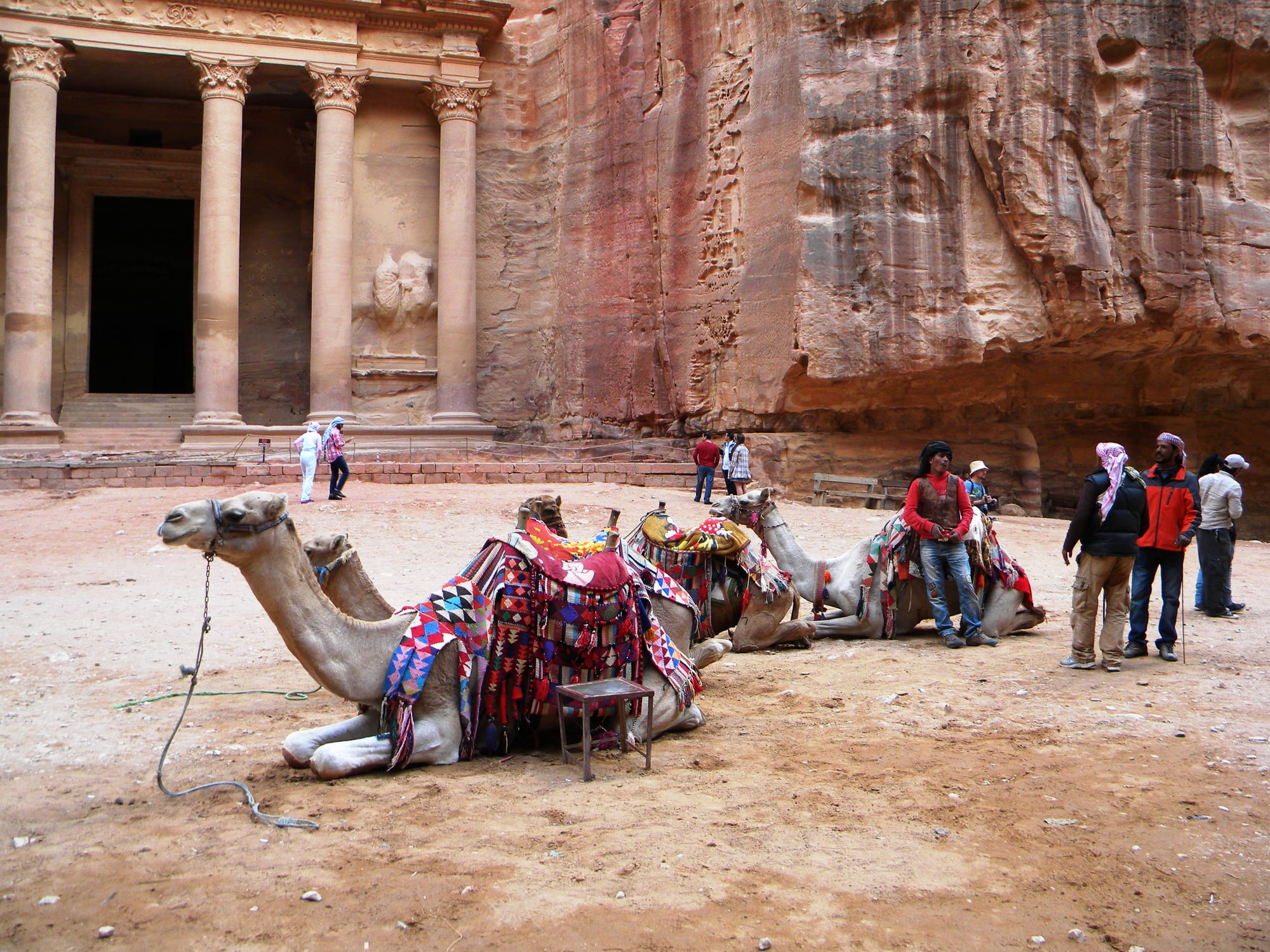
An ornate classical facade carved into a towering pink sandstone cliff, with camels resting on the sand in front

Jordan

Al-Khazneh, the "Treasury," carved into the rock at Petra by the Nabataeans in the early 1st century AD. (Britchi Mirela / Wikimedia Commons · CC BY-SA 4.0)

A small, resource-poor kingdom that has stayed stable in a turbulent region — a land of desert, the Dead Sea, and the rock-cut Nabataean city of Petra, and a refuge for waves of people fleeing neighbouring wars.

Explore Jordan

History

The land east of the Jordan River has been a corridor between Arabia, the Levant, and Mesopotamia for millennia. Its most famous inhabitants were the Nabataeans, an Arab trading people who from around the fourth century BC grew rich controlling the incense routes and carved the temples and tombs of Petra into the rose-coloured sandstone. Rome absorbed the Nabataean kingdom in 106 AD and left the colonnaded streets of Jerash and other cities of the Decapolis.

For the next 1,500 years the region passed through Byzantine, early Islamic, Crusader, and Ottoman hands, its fortunes rising and falling as the trade routes shifted. Modern Jordan was created after the First World War, when Britain carved the Emirate of Transjordan out of Ottoman territory and installed Abdullah, a prince of the Hashemite family that had led the Arab Revolt against the Ottomans. Independence came in 1946.

Jordan absorbed hundreds of thousands of Palestinian refugees after the 1948 and 1967 wars, annexed and then lost the West Bank and East Jerusalem to Israel, and signed a peace treaty with Israel in 1994. King Hussein reigned from 1952 to 1999, steering the country through repeated regional crises; his son Abdullah II has continued a careful balancing act while Jordan has taken in further waves of Iraqi and Syrian refugees.

  • Jordan: The Hashemite Kingdom — Nabataean Petra and Roman Jerash on an ancient caravan land — a country drawn by Britain in 1921, ruled by a dynasty from Mecca, and shaped ever since by war next door and the refugees it sends

Culture & Customs

Jordanian identity blends a Bedouin heritage — hospitality, tribal loyalty, the desert, coffee poured for guests — with the settled life of the highland towns and a large population of Palestinian origin. Most Jordanians are Sunni Muslim, with a long-established Christian minority, and religious observance is widespread but generally relaxed toward visitors.

Hospitality is a genuine obligation: guests are pressed to eat and to stay, and refusing tea or coffee outright can cause offence. Family and the extended clan are central, and respect for elders and for the monarchy runs deep.

The east-bank tribes and the large population of Palestinian origin sit in a careful social and political balance that shapes everything from parliament to the civil service. Away from Amman's cosmopolitan neighbourhoods, dress and behaviour are more conservative, and modest clothing is appreciated at religious sites and in villages.

  • Jordan: Hand on the Heart — A Muslim kingdom with an ancient Christian minority, where coffee is poured as a pledge of generosity, a refusal is softened with a hand on the heart, and no one misses a neighbour's days of mourning

Daily Life

About five million people — a large share of the country — live in Greater Amman, a city built across a series of hills, its older downtown of markets and Roman ruins overlooked by newer districts of malls and cafés. Irbid and Zarqa in the north, and Aqaba on the Red Sea, are the other main centres; the eastern three-quarters of the country is near-empty desert.

Jordan has almost no oil and very little water — it is among the most water-scarce countries in the world — and the economy leans on services, tourism, phosphates, remittances, and foreign aid from the United States and the Gulf. Youth unemployment is high, and the strain of hosting so many refugees on schools, hospitals, and jobs is a constant public concern.

Daily life runs on the shared taxi and the family gathering, the mosque or church, and a week whose rhythm turns on Friday prayers. The influx of Iraqis and Syrians has reshaped whole neighbourhoods of Amman, adding restaurants, businesses, and accents from across the region.

  • Jordan: When the Water Comes — Extended families sharing one roof, a working week that ends on Friday, and a country where almost every home plans its washing, cooking and cleaning around the one or two days a week the taps actually run

Food

Jordanian cooking is Levantine, built on bread, olive oil, yoghurt, pulses, and grilled meat. The national dish is mansaf — lamb slow-cooked in a sauce of fermented dried yoghurt (jameed), served over rice and flatbread and eaten communally, traditionally with the right hand, at weddings and feasts.

Meze fills the table: hummus, mutabbal, tabbouleh, fattoush, foul, and makdous, with fresh bread from the bakery. Maqluba ("upside down"), a pot of rice, meat, and fried vegetables inverted onto a platter, and grilled kebab and shish tawook are everyday mains, and knafeh — a warm cheese pastry soaked in syrup, best from Nablus-style shops — is the sweet everyone argues about.

Coffee, cardamom-scented and served in tiny cups, and sweet mint tea are the drinks of welcome. Alcohol is available in hotels, restaurants, and shops in Amman and the resorts but is not part of most people's lives.

  • Jordan: Food and the National Dish — Lamb simmered in a tangy dried yoghurt sauce, served over rice at gatherings large enough for the whole extended family, and eaten by hand according to genuine tradition

Attractions & Natural Wonders

Petra is the reason most people come: a walk through the narrow Siq gorge opens suddenly onto the Treasury facade, and beyond it lie a whole city of rock-cut tombs, a great rock-cut theatre, a colonnaded street, and the long climb to the Monastery. It rewards at least a full day, and a second for the quieter high trails.

Wadi Rum, south of Petra, is a desert of red sand and towering sandstone "jebels," crossed by 4x4 or on camel and slept in at Bedouin camps under enormous skies; it stood in for Mars and other worlds in a string of films. The Dead Sea, the lowest land elevation on Earth, lets you float on mineral-heavy water and coat yourself in black mud, with resorts and public beaches along the shore.

Elsewhere: Jerash, one of the best-preserved Roman provincial cities anywhere; Amman's citadel and Roman theatre; Madaba's sixth-century mosaic map of the Holy Land and nearby Mount Nebo; the Crusader castles of Karak and Shobak on the King's Highway; the Dana Biosphere Reserve for hiking; the baptism site of Bethany-beyond-the-Jordan; and Aqaba on the Red Sea for coral reefs and diving.

Jordan's story now runs alongside a war. Since 28 February 2026 the United States and Israel have been at war with Iran and its allies, a conflict that grew out of the wider Middle Eastern crisis sparked by the Gaza war. Iranian missiles and drones have been launched at targets in Jordan, chiefly United States military sites, and Jordan has said it intercepted most of them. Israel has been occupying southern Lebanon since March, the Strait of Hormuz has been blocked, and a crisis in the Strait of Bab al-Mandab began in September. Aviation, tourism, shipping and fuel prices across the region have been disrupted. Jordan itself remains a working country with its sites open, but anyone planning a trip should check flights, airspace and official travel advice close to the date.

Planning basics

Budget

Jordan is more expensive than most of its neighbours, and Petra's entry fee is high. The Jordan Pass, bought online before travel, bundles the tourist visa with entry to Petra and many other sites and pays for itself quickly. Cards are widely accepted in cities and hotels.

Daily Budget Midrange
JOD 80–160 (mid-range hotel, restaurants, a rental car or driver, site entries)
Daily Budget Shoestring
JOD 35–55 (guesthouse, local food, buses)

Buy the Jordan Pass before you fly; it covers the tourist visa fee as well as entry to Petra, and, like an e-Visa or a visa arranged in advance, it lets you arrive visa-ready at the King Hussein / Allenby Bridge. Check the current terms when you buy.

Visa Requirements

Most nationalities can get either a visa on arrival at Amman airport and the main land borders or an e-Visa applied for beforehand, or have the fee covered by the Jordan Pass. Passports must be valid for at least six months with two blank pages, and a return or onward ticket may be asked for. In January 2026 the standard stay was extended from 30 days to 90.

Typical Validity
90 days (visa on arrival or e-Visa; Jordan extended the standard stay from 30 to 90 days in January 2026)

Overland entry via the King Hussein / Allenby Bridge from the West Bank does not grant a visa on arrival — arrange it in advance.

Safety

Jordan has long been one of the safest countries in the region for visitors, with low levels of crime and a strong security presence at tourist sites, but it now sits beside a war. Since 28 February 2026 the United States and Israel have been at war with Iran and its allies, and Jordan has been on the flight path: Iranian missiles and drones have been launched at targets on Jordanian soil, mostly United States military sites, and the Jordanian authorities have reported intercepting most of them, with others falling on open ground. Air defence of Jordanian airspace has involved allied forces, including United Kingdom bases on Cyprus. Aviation and tourism across the Middle East have been disrupted. The long-standing sensitive areas are the borders with Syria and Iraq and the eastern desert near them, which most governments advise against visiting, and protests over the wider regional conflict are common.

Source
US Department of State and UK FCDO travel advisories — check for the latest wording.

Stay away from the Syrian and Iraqi border zones, avoid demonstrations, check whether flights and airspace are running before you travel, and keep an eye on regional developments. Women travellers report staring and some harassment but generally find Jordan manageable.

Source: US Department of State and UK FCDO travel advisories — check for the latest wording.

Climate

Mostly hot and dry. The highlands, including Amman, have a Mediterranean climate — warm dry summers and cool, sometimes snowy winters. The Jordan Valley, the Dead Sea, and Aqaba are hot year-round, and the eastern desert swings between scorching days and cold nights.

Amman
warm summers (28–33°C), cool wet winters, occasional snow
Dead Sea And Aqaba
hot; over 40°C common in summer, pleasant in winter

Transportation

Queen Alia International Airport near Amman is the main gateway, with Aqaba a second option in the south. The country is compact: a rental car is the easiest way to link Amman, the Dead Sea, Petra, Wadi Rum, and Aqaba, and coaches and minibuses cover the main routes. There is no passenger rail of use to visitors.

Driving
On the right; the Desert Highway and the scenic King's Highway both run north–south

The King's Highway past the crusader castles and Wadi Mujib is the memorable route between Amman and Petra.

Best Time to Visit

March to May and September to November for comfortable temperatures at Petra, Wadi Rum, and the Roman sites. Summer is very hot for hiking and the desert; winter is mild by day in the south but cold, wet, and occasionally snowy in Amman and Petra.

Ramadan Note
During Ramadan, daytime eating is limited and hours shift, though tourist restaurants and hotels stay open.

Currency

The currency is the Jordanian dinar (JOD), pegged to the US dollar and relatively high in value; it divides into 1,000 fils. Carry small notes for taxis, tips, and rural areas.

Cards
Accepted in cities and hotels; cash needed in villages and for site guides
Symbol
د.ا / JD
Currency Code
JOD — Jordanian dinar

Language

Arabic is the official language, spoken locally in a Levantine dialect. English is very widely used in business, education, and tourism, and most people in Amman and at the main sites speak it well.

English
Widely spoken in tourism, business, and among younger people
Official Language
Arabic