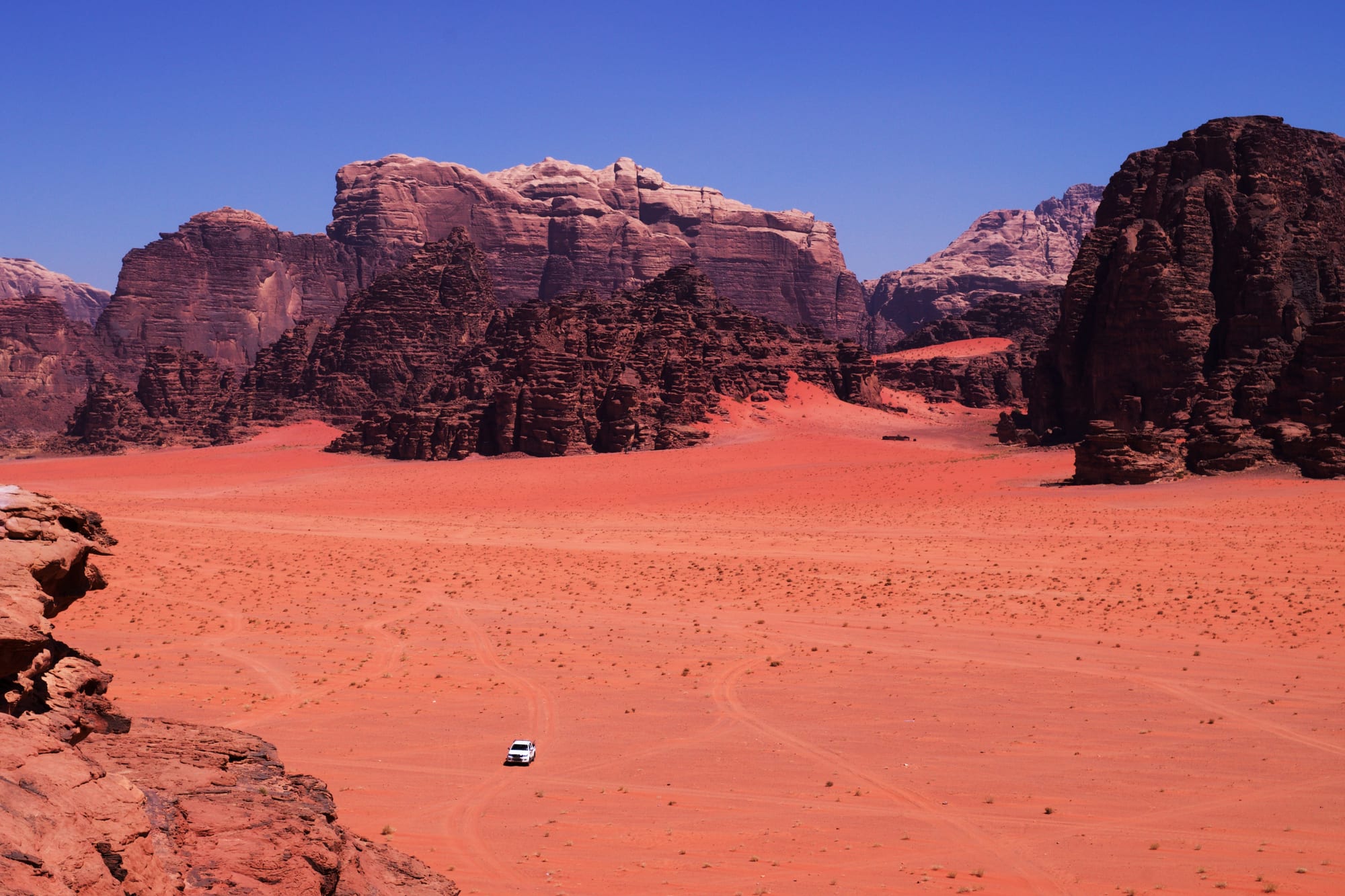
A single white vehicle crossing a wide plain of red sand beneath layered sandstone massifs under a deep blue sky

Petra, Wadi Rum & the South, Jordan

Wadi Rum

Red sand and sandstone massifs in the Wadi Rum Protected Area, southern Jordan. (Evan Qu wenhong / Wikimedia Commons · CC0)

A desert valley in southern Jordan where sandstone and granite mountains rise straight out of red sand. Inhabited since prehistory and long held by Bedouin tribes, it is a protected area and a UNESCO World Heritage Site, visited from Rum village by 4x4, camel and on foot, and slept in at Bedouin camps scattered across the sand.

Neighbourhoods

  • Rum village
    • First-time visitors
    • Local life
    • Transport and guides

    The settlement at the centre of the valley, a grid of low concrete houses, shops, a school and the rest house, below the cliffs of Jabal Rum. Jeeps, guides and camels are arranged here, and the Desert Patrol fort stands at its edge.

    Open in Maps
  • The camps in the protected area
    • Stargazing
    • Quiet
    • Desert scenery

    Bedouin-run camps spread through the sand valleys beyond the village, from goat-hair tents with shared washrooms to permanent cabins and transparent domes. They are reached only by 4x4, have no shops nearby, and are the reason most visitors stay overnight.

    Open in Maps
  • Diseh
    • Quiet
    • Alternative base
    • Close to the main road

    A village to the north of the protected area, outside the main gate, with its own camps and jeep operators and a shorter drive from the Desert Highway. The rock scenery around it is gentler than the valleys further south.

    Open in Maps

Things to do

The desert

  • Wadi Rum Protected Areapark

    The protected desert itself, a UNESCO World Heritage Site of sand valleys, sandstone and granite massifs, rock bridges, canyons and thousands of ancient inscriptions and petroglyphs.

    Open in Maps
  • Jabal Ramtrail

    The mountain standing over Rum village, among the highest in Jordan, with scrambling and climbing routes that need a local guide.

    Open in Maps
  • Jabal Umm ad Damitrail

    Jordan's highest peak, near the Saudi border in the south of the protected area, climbed on a half-day walk from the end of a long jeep drive.

    Open in Maps

Short trips from the desert

  • Aqabaneighborhood

    Jordan's Red Sea port and resort city, about an hour south-west by road, with reefs, diving and the country's only coastline.

    Open in Maps
  • Petralandmark

    The rock-cut Nabataean capital roughly two hours north, the usual companion to a desert stay.

    Open in Maps

Eat and drink

Long-standing places and food districts in Wadi Rum. Hours, ratings and directions come from your maps app, always current.

Eating in the desert

  • Camp dinnersrestaurant

    Most meals are eaten at the camps: zarb, meat and vegetables cooked slowly in a covered pit in the sand, served with rice, flatbread, salads and dips, and followed by sweet tea around a fire.

    Open in Maps
  • Rum village shops and rest houseneighborhood

    The only place in the valley to buy food independently — small grocery shops, tea stalls and a rest house serving simple Jordanian dishes near the visitor centre.

    Open in Maps

Experience Wadi Rum

History

People have lived in this valley for far longer than the stone shelters and camps suggest. Flint tools, rock shelters and thousands of petroglyphs and inscriptions cut into the sandstone record hunting, herding and caravan traffic over some twelve thousand years, and the Thamudic, Nabataean, Greek and Arabic scripts on the walls of canyons such as Khazali are among the fullest sequences of desert writing anywhere. A Nabataean temple stands at the foot of the cliffs near Rum village, built beside a spring in a place that already mattered as a water source on the routes between Arabia and the Levant.

The valley's modern fame comes from the Arab Revolt. T. E. Lawrence passed through repeatedly during the campaign that took Aqaba from the Ottomans in 1917, and his account of the campaign in Seven Pillars of Wisdom made the valley famous in Europe; in the 1980s a rock formation near the entrance was renamed after the book. The Huwaytat hold land around the valley, and the Zalabia of Rum village have grazed and travelled here for generations; the village itself grew around a well and a post of the Desert Patrol.

Filming brought a second kind of attention. David Lean shot Lawrence of Arabia here in the early 1960s, and later productions used the valley as an alien planet in several science-fiction films. The valley is managed as a protected area with the local Bedouin communities, and in 2011 it was inscribed as a UNESCO World Heritage Site for both its landscape and its rock art. Camps and jeep tourism have grown steadily since.

Culture & Customs

The culture of Wadi Rum is Bedouin and tribal. The Zalabia, based around Rum village, and the Bedouin families of Diseh run almost everything a visitor encounters: the jeeps, the camels, the camps and the guiding. Vehicles and mobile phones have replaced tents and camels for daily life, but herding continues, and many families keep goats and a connection to grazing land alongside tourism work.

Hospitality is the strongest custom. Tea, black and heavily sweetened, is made on a fire and refilled without asking; coffee is Arabic-style, pale, bitter with cardamom and served in small quantities from a long-spouted pot. Refusing outright is awkward, and food is shared from a common tray. Evenings at camps follow a pattern of the zarb pit being opened, then music — the single-stringed rababa, hand drums, sung poetry — and the fire.

Manners are conservative and the desert is a public place: modest dress, discretion between couples, and asking before photographing people are all expected. Knowledge of the terrain is itself a cultural inheritance, with drivers navigating by rock shapes and the names of wells and passes rather than signs. Guides are licensed through the protected area authority, and the right to bring visitors into the valley is tied to local tribal membership, which keeps the income within the communities who live there.

Daily Life

Rum village has several hundred residents and is the only settlement inside the protected area, some 720 square kilometres of desert; Diseh lies just outside it to the north. Houses are low concrete blocks with courtyards, and the village has a school, a clinic, a mosque, small grocery shops and the headquarters of the Desert Patrol Corps. Almost every household is involved in tourism in some way — driving, guiding, cooking, running a camp or hiring out camels.

The working day is shaped by the visitors and the heat. Drivers collect guests at the visitor centre through the morning, tours run until the light softens in the late afternoon, and camp staff prepare dinner for the evening arrival. Midday in summer is spent in shade. Water is trucked or piped in from the Disi aquifer nearby, the same groundwater that supplies Amman, and electricity at remote camps often comes from generators and solar panels.

The chief current concerns are the volatility of tourism, which falls sharply with each regional crisis and takes the valley's whole income with it, and the pressure of camp building on the landscape. Employment is heavily male and seasonal, and younger residents often work between the desert and Aqaba. Goats and camels still move across the sand each morning, and families keep grazing rights that predate any tourist camp.

Food

Cooking in Wadi Rum is Bedouin in style and built around what can be prepared with fire, sand and a single pot. The best-known dish is zarb: chicken, lamb and vegetables set in a metal rack, lowered into a pit dug in the sand, covered with a lid, a blanket and sand itself, and left to bake for hours until the meat falls apart. Lifting the rack out in front of guests is the centrepiece of most camp evenings.

Around it come the staples of Jordanian eating: rice, often with almonds and fried onions, hummus, mutabbal of smoked aubergine, tabbouleh, olives and pickles. Shrak, the thin flatbread cooked on a domed metal griddle over embers, is torn and used instead of cutlery, and galayet bandora, tomatoes fried with olive oil, onion and chilli, is a common simple hot dish. Mansaf, lamb in a sauce of fermented dried yoghurt called jameed served over rice and bread, appears for weddings and larger groups.

Drink is tea and coffee. The tea is black, very sweet and flavoured with sage or mint gathered in the hills; the coffee is cardamom-heavy and poured in a few mouthfuls at a time as a gesture of welcome. Breakfast at camps is bread, olive oil, za'atar, labneh, eggs, jam and more tea. Fresh produce arrives from Aqaba or Ma'an, and alcohol is generally absent from the desert.

Planning tools

Budget

Costs here are bundled: a camp's price usually covers dinner, breakfast and a bed, while jeep tours are priced per vehicle for a set number of hours, so sharing a vehicle makes a large difference. Entry to the protected area is charged separately unless covered by a Jordan Pass. There is almost nothing else to spend money on once inside the desert.

Daily Budget Midrange
USD 130–250 (comfortable camp or dome, private jeep with a Bedouin driver, camel ride, transfers)
Daily Budget Shoestring
USD 45–80 (simple tent in a shared camp with meals, a shared half-day jeep tour, minibus transport)

Book a camp directly and confirm what the price includes — transfer from the visitor centre, meals and the length of any jeep tour are the usual points of confusion.

Best Time to Visit

March to May and October to November, when days are warm rather than fierce and nights are merely cool. Winter days can be pleasant for jeep trips but nights at camps drop close to freezing and rain can flood the wadis. Midsummer is very hot, with shade only in the canyons. The war that began in February 2026 has disrupted aviation and tourism across the region.

Suggested Number of Days

One night in a camp with a jeep tour either side of it is the common pattern; a second night allows longer routes, a climb or a walking traverse instead of driving. Heat, the length of the tours booked and the drive in from the nearest towns are what change the figure.

First Visit
1–2 days
With Surroundings
2–3 days

Transportation

Inside the protected area there is no public transport: travel beyond the village is by Bedouin-driven 4x4, by camel or on foot, all arranged through a camp or at the visitor centre. Outside, a minibus links the village with Aqaba and Petra, taxis serve the Desert Highway junction, and most visitors arrive by pre-booked transfer.

Arrange the transfer from the visitor centre to a camp in advance, and expect no mobile signal across much of the desert.

Airport & Station Connections

The turning off the Desert Highway is about an hour north of Aqaba and two hours south of Wadi Musa, with a further drive of roughly half an hour to the visitor centre, where entry is paid and camps collect their guests. Minibuses run from Aqaba and Petra, usually once or twice a day and early. The nearest airport is King Hussein International at Aqaba.

Walkability

Rum village is small enough to cross on foot in a few minutes, but the desert is not walkable in any ordinary sense: distances between the well-known rock formations run to many kilometres over soft sand, with no shade, no water and few landmarks for anyone who does not know the ground. Walking routes, canyon scrambles and the climb of Jordan's highest peak are done with local guides, who carry water and know the paths.

Safety

The desert is calm and the Bedouin communities who run it are experienced with visitors, but the hazards are real: heat and dehydration, exposure at night, getting lost without a guide, flash floods in the canyons after rain, and injuries on unroped scrambles far from help. Since 27 February 2026 the United States and Israel have been at war with Iran and its allies; missiles and drones have been launched at targets in Jordan, and Jordan has reported that its air defences, helped by allied forces, intercepted most of them and that those that were not fell on open or uninhabited ground.

Explore only with a licensed local guide, carry far more water than seems necessary, and take warm clothing for the night even in summer. Check current official travel advice before travelling.

Climate

Desert climate with a very wide daily range: strong sun and dry air by day, sharp cooling after sunset. Rain is rare and falls mostly between November and March, sometimes as short violent storms that flood the wadis. Sandstorms and dusty winds can blow in spring.

Summer
hot and dry, commonly 35–40°C by day, with nights around 20°C and no shade in the open valleys
Winter
mild days around 15–20°C, nights close to freezing in the camps, and occasional rain

Local Customs

Wadi Rum is Bedouin country and the camps are family businesses. Hospitality follows form: cardamom coffee and sweet tea are offered on arrival and accepting a glass matters. Dress is modest — covered shoulders and knees for men and women alike, and swimwear has no place here. Alcohol is not part of camp life and many camps do not allow it. Ask before photographing people, and expect a quiet, early night.

Tips for drivers, guides and camp staff are customary; leave no litter, and do not touch or climb on the rock inscriptions.

Common Payment Methods

The currency is the Jordanian dinar. Camps often take card or bank transfer for the booking, but everything inside the desert — tips, extra tours, camel rides, shop purchases in the village — is cash. There is no reliable cash machine in the valley, so money is best drawn in Aqaba or Wadi Musa beforehand.