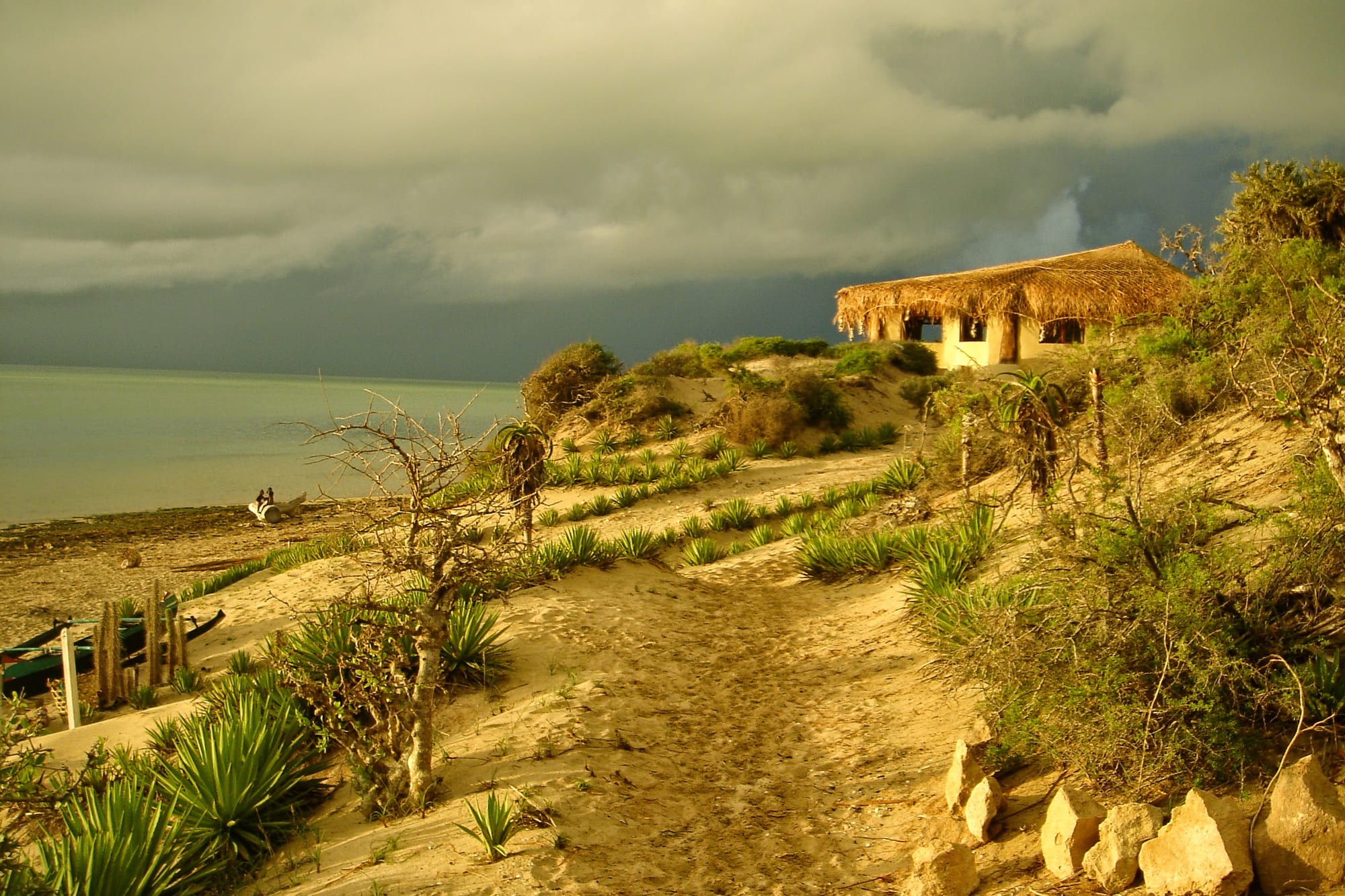
A sandy path over a low dune planted with sisal, a thatched building above the shore, and fishing canoes drawn up beside a calm sea under heavy cloud

Isalo, Toliara & the South, Madagascar

Anakao

The dune and shoreline at Anakao, on the south-western coast of Madagascar. (krishna naudin / Wikimedia Commons · CC BY-SA 2.0)

A Vezo fishing village on Madagascar's dry south-western coast, south of Toliara and reached most easily by boat across the mouth of the Onilahy. Sailing pirogues are drawn up along a long sand beach, a barrier reef lies offshore, and the small island of Nosy Ve sits a short crossing away, with humpback whales passing in the southern winter.

Neighbourhoods

  • The village
    • Local life
    • Beaches
    • Boats

    A long line of timber and thatch houses set back from the sand, with pirogues pulled up in front, nets drying and boat repairs going on along the shore. It is a working fishing settlement rather than a resort, and the daily rhythm belongs to the sea.

    Open in Maps
  • The lodge strip
    • Beaches
    • Quiet stays
    • Snorkelling and diving

    A scatter of beach bungalows and small lodges along the dunes at either end of the village, set apart from the houses and facing the reef. There is no through road and almost no traffic, so the strip is quiet and lit mainly by generators and solar panels.

    Open in Maps

Things to do

The beach and the reef

  • Anakao beachbeach

    A long, pale, wind-swept beach running the length of the village, where sailing pirogues are launched and landed through the day.

    Open in Maps
  • The barrier reefattraction

    A reef line offshore shelters the lagoon and is the main snorkelling and diving ground, reached in a few minutes by pirogue or motor boat.

    Open in Maps

Islands and the coast

  • Nosy Veattraction

    A small island a short boat crossing offshore, facing the village, where red-tailed tropicbirds nest and where the French administration of the south-west was based before Toliara grew in the colonial period.

    Open in Maps
  • Nosy Satranaattraction

    A second island, of about 50 hectares, a few kilometres from the village, uninhabited, its Malagasy name translating as 'palm island'.

    Open in Maps
  • Bay of Saint-Augustinattraction

    The bay at the mouth of the Onilahy river north of Anakao, long a stopping point for European ships, where English settlers tried to found a colony in 1645 and were expelled by the Malagasy.

    Open in Maps

Short trips from the village

  • Tsimanampetsotsa National Parkpark

    A park around a shallow, mildly alkaline lake behind the coast to the south, a Ramsar wetland, with blind fish in the Mitoho cave, baobabs and spiny forest.

    Open in Maps

Eat and drink

Long-standing places and food districts in Anakao. Hours, ratings and directions come from your maps app, always current.

Anakao classics

  • Grilled fish and seafood on the beachneighborhood

    The day's catch — fish, octopus, squid, crab and lobster — grilled over charcoal or cooked with coconut and tomato, served with rice at the bungalows and village eating places.

    Open in Maps
  • Vezo village kitchensneighborhood

    Everyday food in the village is simpler — dried and salted fish, cassava, maize and rice, with what the sea and the small gardens provide.

    Open in Maps

Markets

  • The fish landingmarket

    Fish, octopus and squid are sold on the sand as the pirogues come in, the closest thing the village has to a market.

    Open in Maps

Experience Anakao

History

Anakao belongs to the Vezo, the fishing people of Madagascar's south-west coast, whose settlements have moved along this shore for centuries as fish, wind and water dictated. Vezo identity is defined by the sea rather than by descent: people become Vezo by living from fishing and sailing. The village lies on a long beach facing the island of Nosy Ve, with the great mouth of the Onilahy river to the north.

The bay north of here has a longer written history than the village itself. In the seventeenth century English settlers attempted a colony at St Augustine's Bay and were expelled by the Malagasy; European ships nonetheless continued to call at the bay to trade, and Toliara was later founded to the north to keep up that trade. Anakao stayed a fishing settlement outside that story.

In the twentieth century the coast was drawn into the wider economy through the fish trade, and in recent decades a small number of beach bungalows and lodges opened, bringing divers, birdwatchers and, in the southern winter, whale watchers. Tourism now sits alongside fishing rather than replacing it, and the village has kept its shape: no road runs through it, and most arrivals still come off a boat onto the sand.

Culture & Customs

The Vezo way of life shapes everything here. Men fish from lakana, the pirogues hollowed from a single log and driven by sail and paddle, going out before dawn and returning through the day; women glean the reef flats at low tide for octopus, shellfish and sea cucumbers, and dry and trade the catch. Boat building and repair happen on the beach in full view, with hand tools and local timber.

Ancestral custom is taken seriously. Tombs stand near the point of the village, apart from the houses, and are not approached casually: the living go to them only for burials and the work of building tombs. Fady differ from family to family and from village to village, so the safe course is to ask and to follow what a local guide says. Christianity is practised alongside these observances.

Music and dance belong to celebrations, funerals and the end of good fishing seasons, and the fast guitar-led tsapiky of the Toliara coast is the sound of them. The village is small and social life is public: conversation on the sand, football on flat ground at low tide, and long greetings before any business is done.

Daily Life

Anakao is a village strung along the shore in timber, reed and thatch houses with a handful of concrete buildings, a school and small shops. There is no mains electricity network of the kind found in the towns; lodges and some houses run on solar panels and generators, and fresh water is scarce enough that it is carried, stored and used carefully.

Almost everyone lives from the sea, directly or through the trade in dried and salted fish that moves inland to Toliara and beyond. As fish stocks have come under pressure, some Vezo fishers have gone far offshore for months at a time in search of sharks and sea cucumbers, and a minority of households keep small gardens and goats in the sandy ground behind the village. Tourism provides boat work, guiding and lodge jobs for part of the year.

The day follows the tide and the wind: boats out early, the catch sold and dried through the morning, repairs and rest in the heat of the afternoon, and the beach busy again in the evening light. Distance is the constant problem — the nearest hospital, bank and market of any size are across the water in Toliara — and drought, overfishing and cyclones are the recurring threats.

Food

Anakao eats what the reef and the channel give up. Fish of many kinds, octopus, squid, crab, lobster and sea urchins are grilled over charcoal, fried, or cooked with tomato, ginger and coconut milk, and are eaten with rice where it can be had. Octopus, much of it gleaned from the reef flats, is stewed slowly, and small fish are salted and dried on racks along the beach for trade inland.

Away from the visitor kitchens, everyday food is the food of the dry south rather than of rice-growing Madagascar: cassava, maize and sweet potato, boiled or pounded, with dried fish and greens. Sakay, the fiery chilli paste, is the usual seasoning, and coconut and tamarind add sweetness and sourness to sauces.

Drinks are simple. Ranon'ampango, the water boiled in the rice pot, is drunk with meals, alongside sweetened coffee and tea; Three Horses Beer and rum made from Malagasy cane are the alcohol, and fresh coconut and fruit juices appear when supplies come across from Toliara. Meals in the lodges are usually fixed by what the boats brought in that morning.

Planning tools

Budget

There is little to spend money on in Anakao beyond a bed, meals and boats, and village prices are low. The costs are the transfer from Toliara, the hire of a pirogue or motor boat for the reef, Nosy Ve and whale watching, and any onward trip south to the park. Bungalow rates cover most meals in practice, since alternatives are few.

Daily Budget Midrange
USD 80–210 (beach lodge, boat transfers and excursions, guides and park fees)
Daily Budget Shoestring
USD 25–45 (simple bungalow, village meals, shared boat)

Agree the price and the return arrangement for any boat before leaving the beach, and bring enough cash for the whole stay.

Best Time to Visit

April to November, the dry season, when the sea is calmest for the crossing and the days are hot and clear. Humpback whales pass this coast in the southern winter, which is the busiest period. The hot months from December to March bring heavier seas, more wind and a cyclone risk in the channel.

Suggested Number of Days

Two or three days suit the village, the beach and the water. Four or five allow the island, the reef and the country south of the village to be added. Boat crossings depend on the sea and the wind, so building in a spare day is sensible.

First Visit
2–3 days
With Surroundings
4–5 days

Transportation

There are no roads through the village and no vehicles to speak of. Everything is done on foot along the sand, or by pirogue and small motor boat, which are also how people reach the reef, the islands and the neighbouring settlements along the coast. Sand tracks inland are usable only with a 4x4.

Boats run to the sea rather than the clock, and crossings are cancelled in strong wind; treat departure times as approximate.

Airport & Station Connections

Anakao is usually reached from Toliara by motor boat across the bay and the mouth of the Onilahy, a crossing of about an hour that can be wet and rough. The alternative is a long, slow 4x4 track overland. Toliara itself has an airport with flights to Antananarivo and is the end of the RN7 from the highlands.

Walkability

The whole village and its beach can be walked in an hour or so, on sand rather than pavement, and there is no traffic to avoid. Shade is scarce and the sun is strong, so walking is easiest early and late. Anything beyond the village means a boat or a 4x4.

Safety

Anakao itself is quiet, but the wider south and south-west have the most serious security problems in Madagascar for travellers, with dahalo cattle-raiding gangs active in rural areas and robbery reported on southern roads. Local risks are of the sea and the climate: currents and surf outside the reef, small boats in wind, sunburn and dehydration, and malaria. Medical facilities are in Toliara, not here.

Travel only in daylight with a reputable driver or guide, avoid remote tracks without local advice, and carry plenty of water. Check current official travel advice before travelling.

Climate

Hot and very dry, in the driest corner of Madagascar, with the sea breeze making the heat bearable. Rain is scarce in any month and falls mainly in short bursts in the hot season. Seasons are those of the southern hemisphere: summer runs from December to February, winter from June to August.

Summer
very hot, about 28–35°C by day, with occasional heavy showers and a cyclone risk from December to March
Winter
warm and dry, about 24–28°C by day with cooler, breezy nights, and whales offshore

Local Customs

Anakao is a Vezo village, where life is organised around fishing from sailing pirogues, and ancestral custom is strong. Certain places, above all the tombs near the point of the village, are sacred, and fady — prohibitions that differ between families and villages — cover foods, days and places. Tombs should not be approached casually.

Ask before photographing people, boats or houses, dress modestly in the village, and follow local guidance on which places are sacred and which paths may not be used.

Common Payment Methods

The currency is the Malagasy ariary, and the village runs on cash. There are no cash machines and card payment is unreliable even where it is offered, so money for the whole stay, including boats and guides, should be changed and drawn in Toliara beforehand, in small notes.