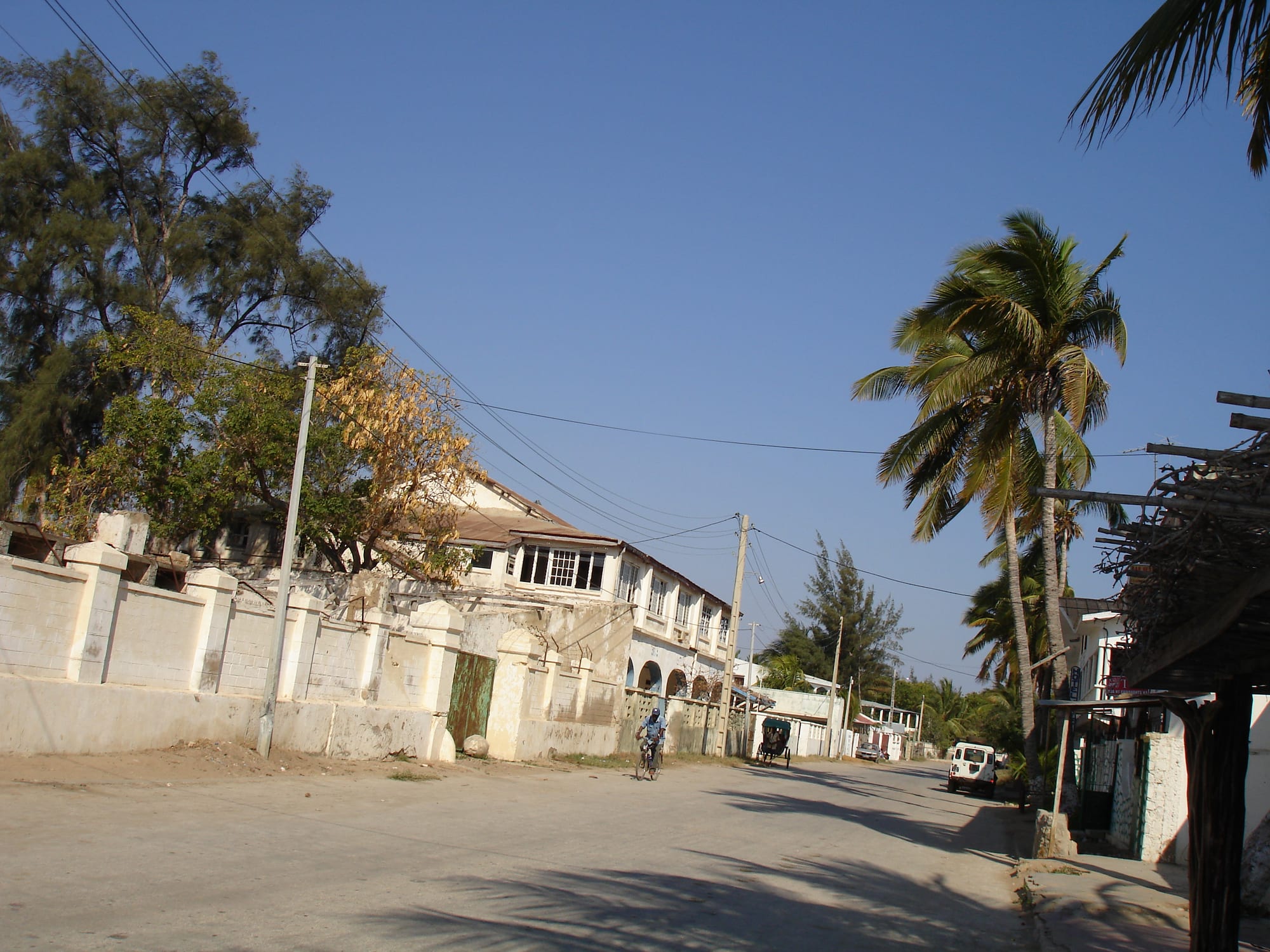
A wide sandy street with a long white colonial building, palms and casuarina trees, a cyclist and a rickshaw under a clear sky

Isalo, Toliara & the South, Madagascar

Toliara

A broad sandy street in Toliara, with a colonial-era building and pousse-pousse rickshaws. (Mauro Didier / Wikimedia Commons · CC0)

The main city of south-western Madagascar, formerly known by its French name Tuléar, standing on a wide shallow bay at the end of the long highway from the capital. Hot, low and dusty, it is a port and market town of Vezo fishers and Masikoro farmers, with a coral reef offshore and spiny forest of octopus trees and baobabs inland.

Neighbourhoods

  • The centre and the market
    • First-time visitors
    • Markets
    • Close to transport

    A grid of broad, sandy streets around the main market, the banks and the shops, with pousse-pousse rickshaws and cycle-rickshaws working every corner. Most of the hotels, offices and bus yards are within a few blocks, and the whole quarter empties into the shade in the middle of the day.

    Open in Maps
  • The seafront
    • Walks and viewpoints
    • Sunsets

    A long boulevard runs along the shallow bay past the port, jetties and pirogue landings, with trees, benches and stalls. The tide goes a long way out over sand flats, and the promenade is where the town gathers in the cool of the evening.

    Open in Maps
  • The fishing quarters
    • Local life
    • Boats

    Vezo fishing villages on the edge of the bay, with sailing pirogues drawn up on the sand, nets drying and fish sold straight off the beach. They are the working waterfront of a city that lives from the sea.

    Open in Maps
  • The university quarter
    • Students
    • Quiet and residential

    Inland and east of the centre, low residential districts spread towards the spiny scrub, with the university campus at Maninday, schools and local markets. These are the neighbourhoods where most of the city actually lives.

    Open in Maps

Things to do

In the city

  • The central marketmarket

    The city's main market, selling fish, octopus and dried fish alongside vegetables, tamarind, mats, baskets and the cotton lambahoany cloths worn across the south.

    Open in Maps
  • The seafront boulevardattraction

    The waterfront promenade along the bay, lined with trees and stalls, where pirogues come and go, a small shell and craft market sets up behind the Alliance Française, and the town walks in the evening.

    Open in Maps
  • The Museum of the Seamuseum

    The oceanographic institute's museum of the marine life of the south-west coast, whose exhibits include a coelacanth caught near Anakao in 1995.

    Open in Maps
  • The Regional Museum of the University of Toliaramuseum

    A small ethnological collection covering the peoples and crafts of the south, with an elephant-bird egg among its exhibits.

    Open in Maps

The reef and the beaches

  • Ifatybeach

    A group of small Vezo and Masikoro fishing and beach villages on the bay of Ranobe, about 30 kilometres north of the city on the RN9, known for its sand and its water.

    Open in Maps
  • Anakaobeach

    A fishing village on the coast south of the bay, reached by boat, with a long beach, sailing pirogues and reef diving.

    Open in Maps
  • Nosy Veattraction

    A low sand island off Anakao on a reef, one of the few breeding sites of the red-tailed tropicbird and the seat of the first French administration on this coast.

    Open in Maps
  • Saint Augustinattraction

    A village at the mouth of the Onilahy river south of the city, on the bay where an English association attempted a colony in 1645 that was abandoned the following year.

    Open in Maps

Forests and lakes

  • Arboretum d'Antsokaypark

    A botanical garden about 12 kilometres out on the RN7, established in 1980, with more than 900 plant species of the region's spiny forest — succulents, euphorbias and baobabs — most of them found nowhere outside Madagascar.

    Open in Maps

Short trips from the city

  • Tsimanampetsotsa National Parkpark

    A shallow alkaline lake below a limestone plateau, with flamingos, blind cave fish, baobabs and spiny forest.

    Open in Maps

Eat and drink

Long-standing places and food districts in Toliara. Hours, ratings and directions come from your maps app, always current.

Seafood and markets

  • The central marketmarket

    Fish, octopus, squid, crab and dried shark come in from the bay each morning, sold beside tamarind, mangoes, cassava and sacks of rice.

    Open in Maps
  • The seafront eating placesneighborhood

    Simple restaurants and bars along the boulevard grill fish and prawns and serve cold beer as the sun goes down over the bay.

    Open in Maps
  • The hotely of the centreneighborhood

    Small family eating houses around the market serve rice or cassava with fish, zebu or beans, the everyday meal of the south-west.

    Open in Maps

Beach villages

  • Ifatyneighborhood

    The beach hotels and small restaurants north of the city cook what the pirogues bring in — grilled fish, lobster, octopus salad — often with coconut and tamarind.

    Open in Maps

Experience Toliara

History

The bay that Toliara stands on was known to sailors long before the town existed. St Augustine's Bay, just south at the mouth of the Onilahy river, was a watering place for European ships crossing the Indian Ocean, and in 1645 an English association attempted a colony there that failed within a year, driven out by famine, disease and conflict with the Malagasy. Trade continued all the same: pirates and traders frequented the bay, and a trading post at Saint Augustin resupplied passing ships and dealt in slaves from 1686 to 1719.

The town itself grew late. French traders and a French resident first settled on the islet of Nosy Ve offshore, and in 1895 that community moved to Tuléar; it was under the French, after 1897, that the town grew into the regional capital, laid out on the broad grid of sandy streets it still has. Its former French name was Tuléar; the present Malagasy spelling was adopted in the 1970s. A harbour, a cathedral, schools and warehouses followed, and the town became the outlet for the sisal, cotton, rice and peanuts of the south-west.

The completion of the Route Nationale 7 tied Toliara to Antananarivo, nearly a thousand kilometres away, and made the city the end point of the long road south-west from the capital. The University of Toliara was founded in 1971, and it includes a fisheries and marine sciences institute. Since independence the city has grown quickly and unevenly, pressed by the recurring drought and famine of the far south, which pushes people into its outer districts.

Culture & Customs

Toliara is the meeting point of the Vezo, who live from the sea, and the Masikoro, who farm and herd inland. Vezo identity is defined by what people do rather than where they were born: to sail a pirogue, to read the reef and to fish is to be Vezo, and the sailing canoes drawn up on the sand around the bay are the emblem of the city. Ancestors are honoured in both communities, and the tombs of the south, decorated by the Mahafaly with aloalo, tall carved wooden posts, are renowned across the island.

Music belongs to the city as much as to the coast. Tsapiky, a fast, hard-driving guitar style created in the south-west in the 1970s out of South African pop and Malagasy tradition, is played through the night at celebrations and funerals, amplified and relentless, and festivals of it run for days in the city. Ancestral ceremonies remain part of religious life alongside Christianity.

Everyday manners are shaped by the heat and by the pousse-pousse economy: greetings first, bargaining without hurry, and life outdoors in the early morning and the evening. French is widely used in business, the Malagasy spoken here is a distinct southern dialect, and the city's university and marine research institute give it a student population from across the country.

Daily Life

About 170,000 people live in Toliara, the capital of the Atsimo-Andrefana region, and the population has grown quickly as drought and famine in the far south push families towards the city. Most live in low houses of wood, reed and cement in districts spreading inland from the centre, where services are thin and water supply intermittent.

The economy rests on fishing — from the reef, the bay and the deeper water, with much of the catch dried, salted or sent north — along with the port, trade in cattle and cotton from the interior, the university and hospital, and a tourist business based on the reef villages and the RN7 traffic. Sisal, salt pans and mineral prospecting employ others in the wider region.

Days run early and late around a long, hot middle: pirogues leave before dawn, the market is busiest in the morning, the streets empty into the shade after midday, and the seafront fills again at sunset. Power cuts, water shortages and poverty are constant, and the hunger of the far south, only a few hours away by road, is never distant from the city's concerns.

Food

Toliara eats from the sea. Fish, octopus, squid, crab, lobster and sea urchins come in daily from the reef and are grilled over charcoal or cooked with tomato, ginger and coconut; dried and salted fish, laid out in the market, is the trade good that travels inland. Rice is less dominant here than in the highlands, and cassava, maize and sweet potato carry many meals, boiled, pounded or grilled.

Zebu is ceremonial food more than everyday food, eaten in quantity at funerals and celebrations, though grilled beef brochettes are sold on the street. Tamarind flavours drinks and sweets, baobab fruit is eaten in its short season, and mangoes, coconut and cassava cakes fill the stalls. The standard hotely plate is rice or cassava with a laoka of fish or beans and a spoonful of sakay, the chilli paste, alongside.

Drinks are cold beer, sweet coffee, coconut water sold from a handcart, ranovola — one of Madagascar's most common traditional drinks — and toaka gasy, the home-distilled rum of the countryside. The beach hotels at Ifaty and Anakao cook a French-influenced version of the same seafood, and wine from the highlands around Fianarantsoa reaches the better restaurants in the city.

Planning tools

Budget

Toliara itself is cheap: guesthouses, market food and hotely meals cost little, and the pousse-pousse fares are small. What raises the daily figure is the coast — beach hotels at Ifaty, the boat transfer to Anakao, a 4x4 with driver for the tracks south — along with park fees and guides. Cash machines are available in the city, which they are not in the villages.

Daily Budget Midrange
USD 80–210 (beach hotel or lodge, 4x4 with driver, park fees and guides, boat transfers)
Daily Budget Shoestring
USD 25–40 (guesthouse or beach bungalow, hotely meals, taxi-brousse)

Agree the price of a boat transfer or a vehicle for the southern tracks before setting out, and draw cash here rather than in the coastal villages.

Best Time to Visit

April to November, when the heat is bearable and the tracks are open, is the main season; the winter months from June to August are warm by day and cool at night. December to March is very hot with short heavy rains and occasional storms, though the spiny forest is at its greenest.

Suggested Number of Days

The city is generally a base rather than the object of a visit, and a day or two covers its market, seafront and museum. Four to seven days suit a stay that takes in the reef villages, the spiny forest and the coast to the south, where the journeys are slow.

First Visit
1–2 days
With Surroundings
4–7 days

Transportation

Pousse-pousse rickshaws, pulled or pedalled, are the everyday transport in the flat sandy streets, along with shared taxis and minibuses. Bush taxis leave from yards in the city for Ifaty, Sakaraha, Ihosy and the north, and for the southern tracks a 4x4 is needed. Anakao is reached by boat across the bay, weather permitting.

Settle the pousse-pousse fare before getting in, and treat the sea crossing to Anakao as weather-dependent, since it can be rough and wet in the afternoon wind.

Airport & Station Connections

Toliara stands at the end of the RN7, about 950 kilometres from Antananarivo — two or three days of driving, or a long sequence of bush taxis. Toliara Airport, in the city itself, has flights to the capital, though schedules change often, and many visitors fly one leg and drive the other. The port ships the region's sisal, cotton, rice and peanuts.

Walkability

The centre is flat and laid out on a grid, so walking is easy in principle, but the streets are wide, sandy and shadeless and the heat is serious from mid-morning until late afternoon. Most people cover even short distances by pousse-pousse, and walking after dark in quiet streets is not advised.

Safety

The south has the most serious security problems in Madagascar for travellers. Theft and bag-snatching are common in Toliara after dark, including on the seafront and around the market, and highway robbery has occurred on the RN7 and the southern roads. Dahalo cattle-raiding gangs operate in rural areas inland. Add extreme heat, strong currents on exposed beaches and malaria along the coast.

Madagascar has a long history of political unrest — mass protests in September 2025 were followed by a military takeover and a change of government, so demonstrations can disrupt movement in the capital. Travel between towns only in daylight with a reputable driver, take a pousse-pousse or taxi rather than walking at night, carry water and sun protection, and take malaria precautions. Check current official travel advice before travelling.

Climate

Arid and one of the driest, sunniest places in Madagascar, nicknamed the City of the Sun and swept by a strong prevailing south wind, the tsiokatimo. Rain falls in short bursts, if at all, between December and March. Being in the southern hemisphere, summer runs from December to February and winter from June to August.

Summer
very hot, roughly 24–35°C, humid with short heavy showers from December to March
Winter
warm and dry, roughly 15–29°C by day, with pleasant evenings and cool nights

Local Customs

This is Vezo and Masikoro country, where fishing and cattle define two ways of life and ancestral custom is strong. Fady differ from village to village — particular days when no one puts to sea, foods that may not be eaten, places on the reef and islands that are sacred — and tombs, decorated in the south with carved posts, are never approached or photographed casually. Tsapiky, the fast guitar music of the south-west, is played at celebrations and funerals.

Ask before photographing people, pirogues or tombs, dress modestly away from the beach hotels, and follow local guidance about sacred sites on the reef and islands.

Common Payment Methods

The currency is the Malagasy ariary. Banks and cash machines in the city accept major foreign cards, and this is the place to draw money before heading down the coast, where there are none. Cash is used for almost everything; only the larger hotels and dive operators are likely to take a card, often with a surcharge.