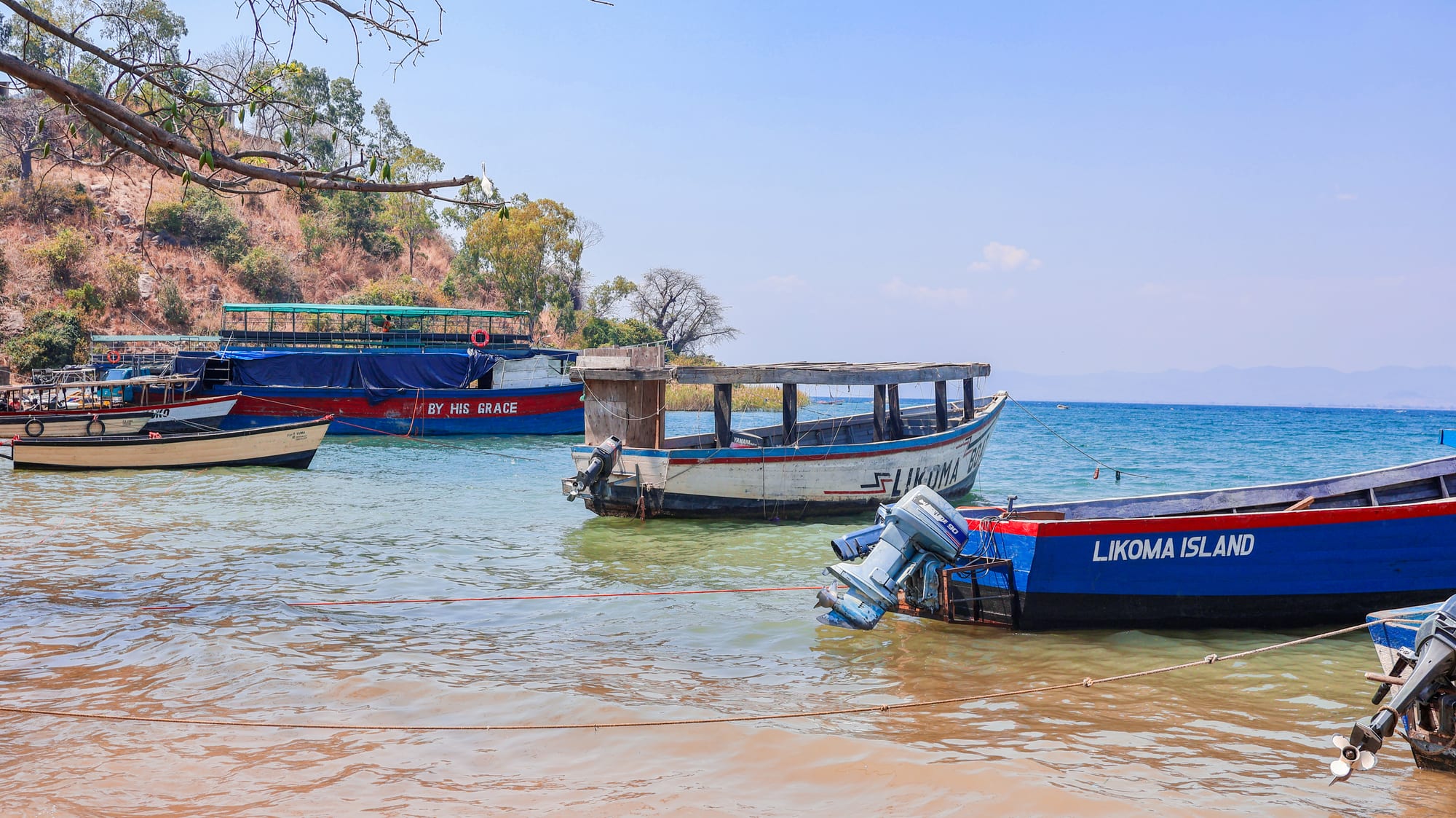
Wooden and painted boats moored in shallow turquoise water off a sandy shore with wooded slopes behind

Mzuzu & the Northern Region, Malawi

Likoma Island

Local boats moored off a beach on Likoma Island in Lake Malawi. (GJU_Malawi / Wikimedia Commons · CC BY 4.0)

A small Malawian island in Lake Malawi, lying close to the Mozambican shore and separated from the rest of Malawi by many kilometres of open water. Baobabs, rocky headlands and sandy coves surround a handful of villages, and at its centre stands an unexpectedly large Anglican cathedral built by missionaries in the early twentieth century.

Neighbourhoods

  • Likoma town and the cathedral
    • First-time visitors
    • Historic district
    • Markets

    The island's main settlement, on the western side, grew up around the mission. The cathedral, the market, the hospital, schools and the main landing are all here, and it is the busiest part of the island by a wide margin.

    Open in Maps
  • The eastern and northern shores
    • Beaches
    • Quiet
    • Swimming

    Sandy bays and rocky points face Mozambique across a narrow channel, with fishing hamlets, baobab trees and a few widely spaced lodges. Walking tracks rather than roads connect them, and the beaches here are quiet outside the fishing hours.

    Open in Maps
  • The island's interior
    • Walks
    • Local life
    • Viewpoints

    Grassland with cassava and rice plots, granite outcrops, mango trees and large baobabs covers the island's middle, crossed on foot in under an hour. Village paths run between compounds and churches, and the high ground gives views over the water on both sides.

    Open in Maps

Things to do

The mission

  • St Peter's Cathedrallandmark

    The stone Anglican cathedral of the Universities' Mission to Central Africa, begun in 1903 and completed in 1911, out of all proportion to the island and one of the largest churches in Africa, with a long nave and an apsidal choir.

    Open in Maps
  • The mission village at Likoma townneighborhood

    The settlement around the cathedral, with the hospital, schools and church buildings that grew from the mission headquarters set up on the island in 1885.

    Open in Maps

Beaches and the water

  • The island's beachesbeach

    Sandy coves between granite headlands on the eastern and northern shores, with clear water, cichlids among the rocks and fish eagles overhead.

    Open in Maps
  • Baobab walkstrail

    Footpaths across the island pass large baobab trees, maize gardens and villages, and reach high ground with views towards the Mozambican shore.

    Open in Maps
  • The landing and the lake ferrytransit hub

    The island's link with the mainland, where the MV Ilala steamer calls on its run round the lake and smaller boats and dhows carry people and goods to Chizumulu and to Cobue in Mozambique.

    Open in Maps

Short trips from the island

  • Chizumulu Islandattraction

    Likoma's smaller sister island across the strait to the west, also Malawian territory in Mozambican waters, with about 4,000 people, quiet beaches and a few villages.

    Open in Maps

Seasonal events

  • Church festivals at the cathedralChristmas and Easter

    The island's biggest gatherings, when choirs fill the cathedral and services draw people from every village and from the mainland.

  • Independence DayJuly

    Malawi's national day on 6 July, marked with school parades, football and music in the town.

Eat and drink

Long-standing places and food districts in Likoma Island. Hours, ratings and directions come from your maps app, always current.

Likoma classics

  • Grilled chambo and usiparestaurant

    Lake tilapia grilled over charcoal and the tiny usipa fried or dried, landed on the island's beaches and eaten with nsima or rice.

    Open in Maps
  • Nsima and ndiworestaurant

    The maize staple with a relish of beans, pumpkin leaves or greens in groundnut sauce, cooked at home and at the few simple eating places near the market.

    Open in Maps

The market and the lodges

  • Likoma town marketmarket

    A small market of dried fish, cassava, tomatoes, bananas and imported staples, restocked when the ferry or a supply boat arrives.

    Open in Maps
  • The lodge kitchensneighborhood

    The island's handful of lakeside lodges cook fish, salads and Malawian dishes with vegetables from their own gardens and whatever the boats bring.

    Open in Maps

Experience Likoma Island

History

Likoma's modern history begins with the Universities' Mission to Central Africa, the Anglican society inspired by David Livingstone's appeal for missionaries. In 1885 the mission set up its lake headquarters on the island, chosen because its island position was protected from raiders on the mainland and its harbour gave steamers easy access to villages on both shores; people had already fled to Likoma for refuge from the slave trade crossing the lake. The main village grew around the station, and the mission's school, printing and boat work made the island a centre of Anglican Christianity for the whole lake region.

The cathedral of St Peter followed, begun in 1903, dedicated while still unfinished in 1905 and completed in 1911, on a scale that still astonishes visitors: a European-style church big enough for a cathedral city, on an island a few kilometres across. Mission steamers carried clergy, teachers and supplies to congregations on both shores.

The island's oddest legacy is political. When Britain and Portugal agreed in 1954 that their boundary ran down the middle of the lake, Likoma and neighbouring Chizumulu stayed with Nyasaland because of the mission, even though they lie in what became Mozambican waters close to the Mozambican coast. They remained Malawian at independence in 1964, an enclave reached only by boat or light aircraft. Fishing, farming and remittances have sustained the island since, along with a small tourism trade that grew from the 1990s around its beaches and its cathedral.

Culture & Customs

Church and island are hard to separate here. Likoma is overwhelmingly Anglican in a country where Presbyterian and Catholic churches dominate, and the rhythm of bells, choir practice and Sunday services runs through village life. Choral singing is exceptionally strong, sung in Chichewa and Chitonga in harmony that fills the stone cathedral, and church festivals are the year's great gatherings.

The island's population is small and interrelated, and social life is conducted face to face: greetings on the path, conversations in the shade, news carried by the boats. Fishing and farming set the working day, and children walk to school across the island rather than by any vehicle. Long-standing links with the mainland and with Mozambique mean several languages are heard, and many families have relatives working in Lilongwe, Mzuzu or South Africa.

Visitors are received politely and with curiosity rather than pressure; there is little of the hustle found at busier lakeshore resorts. Modest dress in the villages, a greeting before a question and permission before a photograph are the manners that matter. Football on a dusty pitch, drumming at ceremonies and the arrival of the ferry — an event the whole shoreline turns out for — are the island's regular public occasions.

Daily Life

About 10,500 people live on Likoma, in a dozen settlements of which the largest is Likoma town on the western side. Fishing is the main livelihood: boats go out at night with lamps for usipa, and the catch is dried on racks and sold on the island or shipped to the mainland. Households also grow cassava and rice on thin, rocky soil, keep goats and chickens, and trade whatever the boats bring in.

Everything else arrives by water. Fuel, cement, flour and medicines come on the ferry or supply boats, which makes prices higher than on the mainland and shortages routine; a delayed boat is felt across the island within days. A generator and a solar bank supply the island's electricity, and the primary schools in every settlement and Likoma Secondary School serve the island, while hospital care is limited.

Work outside fishing and farming means the lodges, the hospital, the schools, church employment, boat crews and a few shops. Many young people leave for Mzuzu, Lilongwe or South Africa and send money home, and remittances are an important part of island income. Days start early and end early, and the loudest sound at night is usually the lake.

Food

Fish is the foundation of eating on Likoma. Usipa, the lake's small sardine-like fish, is fried fresh or sun-dried in the open and kept for the months when catches are thin; chambo, the lake's tilapia, is grilled whole over charcoal; and larger fish such as kampango catfish appear when the boats are lucky. Fish is eaten with nsima, the stiff maize porridge taken by hand, or with rice.

Relishes, or ndiwo, are made from beans, pumpkin leaves, cassava leaves, tomatoes and onions, often cooked in groundnut sauce. Cassava grows well on the island's poor soils and is boiled, roasted or pounded into flour, and in the wider northern lakeshore tradition it is also made into kondowole, a stretchy cassava-flour staple eaten with fish. Mangoes, bananas and papaya come from village gardens, and the enormous baobabs give a tart fruit whose powder is mixed into drinks.

Prepared food is simple and mostly domestic: mandasi, small fried dough buns, sold in the morning, roasted maize in season, chips and fried fish near the market, and strong sweet tea. The lodges cook for their guests with what the boats bring, adding curries, salads and baking. Thobwa, a lightly fermented maize or millet drink, is made at home, and bottled lager and chibuku sorghum beer are drunk at small bars in the town.

Planning tools

Budget

Costs on Likoma are split sharply. Village guesthouses, local food and the deck of the ferry are very cheap, while the island's small lakeside lodges are among the most expensive places to stay in Malawi, and a light aircraft seat costs many times the boat fare. Everything imported is dearer than on the mainland because it comes by water.

Daily Budget Midrange
USD 70–180 (a simple lodge or chalet, meals, boat trips and transfers)
Daily Budget Shoestring
USD 25–50 (village guesthouse or camping, local food, ferry deck passage)

Bring all the cash needed from Nkhata Bay or Mzuzu; the island has no reliable bank or ATM and lodges expect to be paid as arranged.

Best Time to Visit

May to October, when the lake is calmest, the water clearest and boat crossings most dependable. October and November are very hot. The rains from December to March green the island and are the season of storms on the lake, when crossings can be rough or delayed, though swimming is pleasant all year.

Suggested Number of Days

Two or three days are enough to see the island at a walking pace and spend time in the water. Allow four or five to include Chizumulu or to travel by ferry, whose timings often decide the length of a stay far more than the island itself does.

First Visit
2–3 days
With Surroundings
4–5 days

Transportation

There are no taxis or buses and very few vehicles; the island is crossed on foot in under an hour, or by bicycle. Boats do the rest of the work — lodge boats, fishermen's craft and the small craft that ferry passengers out to the lake steamer where it anchors offshore. Crossings to Chizumulu are made by local boat or by the ferry.

Confirm boat arrangements the day before and allow slack in onward plans, since weather and the ferry's running change timings at short notice.

Airport & Station Connections

Likoma lies well out in the lake, 7 km north-west of Cobue on the Mozambican coast and far from the Malawian shore. The lake ferry is the usual way in, calling at the island on its route between Nkhata Bay, Chizumulu and the southern lakeshore, a passage of several hours to a night. A tarred airstrip takes light aircraft, with flights from Lilongwe, and lodges arrange boat transfers.

Walkability

The island is small and entirely walkable: the town to the eastern beaches is a walk of half an hour or so on sandy tracks and village paths, with little traffic to avoid. The ground is rocky and there is little shade in the middle of the day, so walks are easier early and late. There is no street lighting, so a torch is needed after dark.

Safety

Likoma is a quiet, close-knit place with very little crime, and visitors are conspicuous enough that problems are rare. The practical risks are on the water and in health: sudden squalls and overloaded boats, strong sun, and a small hospital with limited facilities and no quick route to the mainland in an emergency. Malaria is widespread in Malawi, though it has not been reported on the island itself.

Use guides on remote walks, don't walk after dark, lock valuables away, take malaria prophylaxis, and treat bilharzia and sudden lake squalls as real risks. Check current official travel advice before travelling.

Climate

Warm all year, with one wet season and one dry season, moderated by the surrounding water and by breezes off the lake. Being in the southern hemisphere, the hottest months run from November to March, which is also when the rain falls.

Summer
hot and wet, November–March; days around or above 30°C, humid nights, heavy storms and rougher water
Winter
dry and warmer than the mainland highlands, May–August; days in the mid-20s °C, clear skies, light winds and the best visibility underwater

Local Customs

Likoma is strongly Anglican, and the cathedral shapes the island's week; Sunday is for church, and services are long and sung. Chichewa and Chitonga are spoken alongside English, and greetings before any request are expected. Dress is modest away from the beaches, and swimwear is not worn in the villages or near the church.

Ask before photographing people, services or the market, remove hats inside the cathedral, and greet elders first; small tips for boatmen and guides are welcome but not expected.

Common Payment Methods

The currency is the Malawian kwacha, and the island runs on cash. There is no dependable bank or cash machine, card payment is limited to the lodges and not guaranteed, and mobile money depends on a network signal that comes and goes. Visitors usually bring kwacha, and some US dollars in cash, from the mainland.